
One thing that never gets old is watching surprise bloom on the faces of the uninitiated when they play one of the smaller amps from Orange’s Terror and Baby series. Just about everybody thinks these amps look crazy-cool (the slightly more stylish Terrors, with their chrome handle, mostly get the nod on this count). But those who have never jammed or performed with one are usually impressed with how complex, rich, fat, full, and flat-out huge they can sound.
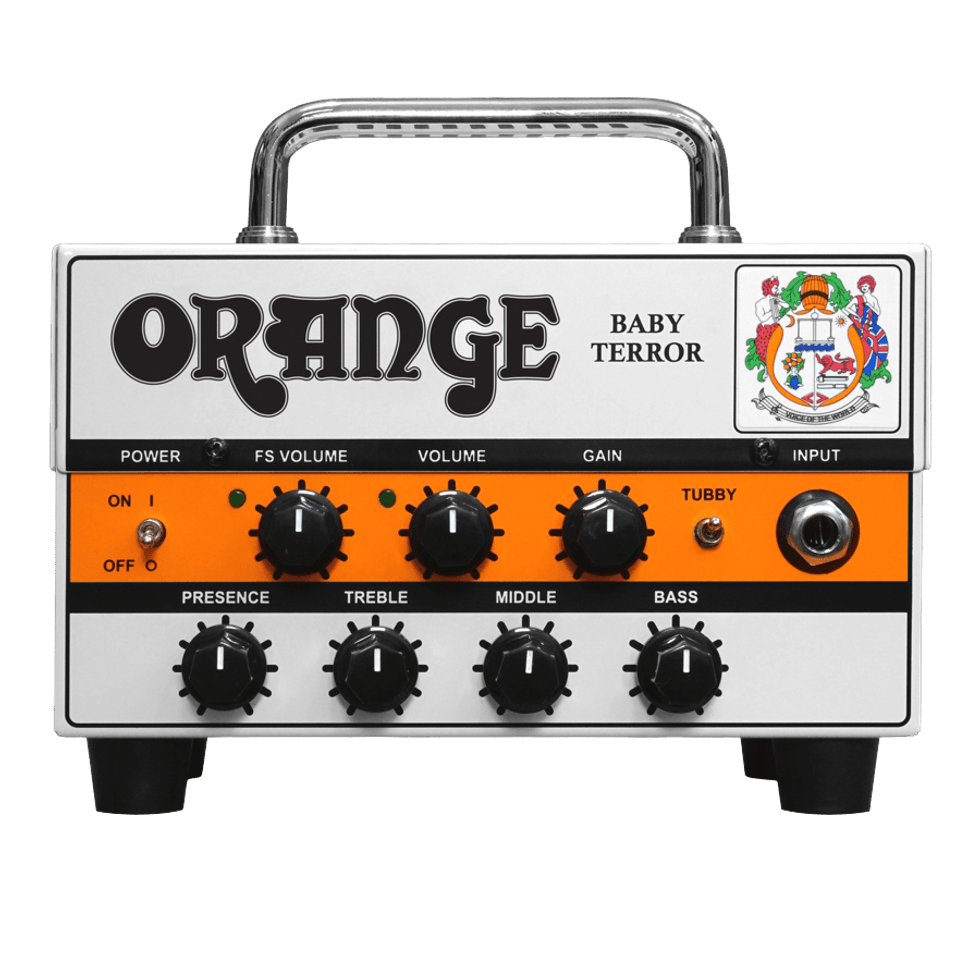
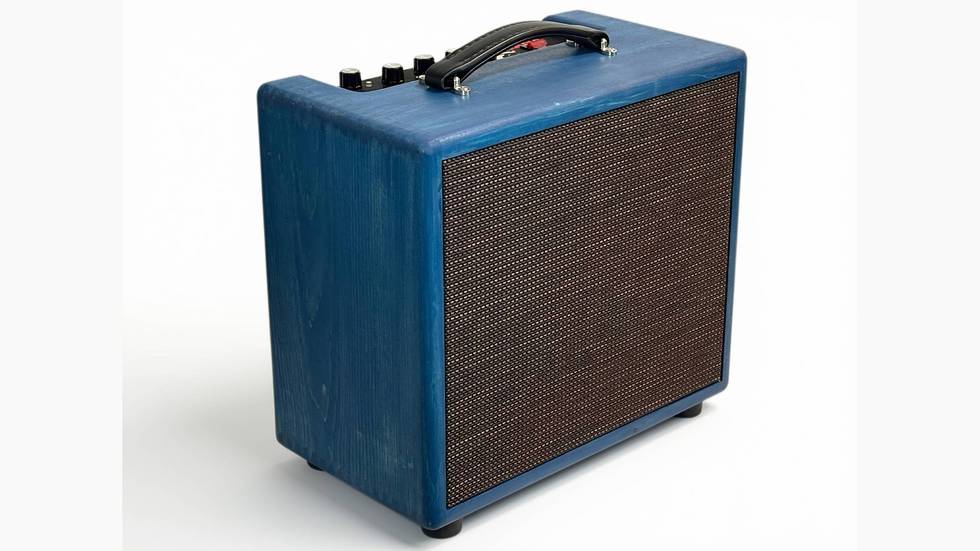
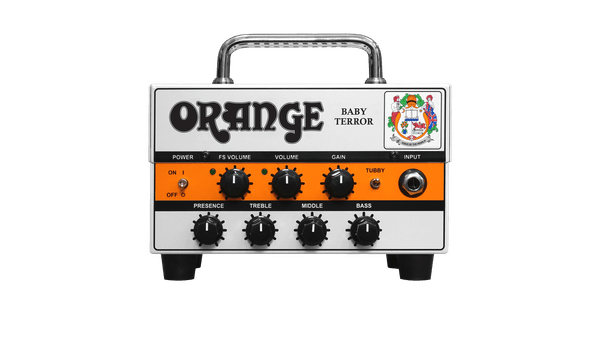
The new Baby Terror marks an interesting evolution of these two series primarily because it is a Terror in style and a Baby in function. Unlike amps that are strictly Terrors, and therefore all-tube or hybrid (with a tube preamp and solid-state power section) the Babys are all solid state. The Baby Terror shares these solid-state underpinnings, but adopts Terror aesthetics and dimensions—which, at 6.5" x 5.51" x 3.94" here, are extra small. It’s streamlined and lacks onboard effects. But at 20 watts, it sounds big, and more than a little tube-like at times—particularly when you linger in low- to mid-gain spheres.
Extroverted Economizing
Physically and aesthetically speaking, the Baby Terror probably has more presence precisely because of its small size. It’s impossible to resist looking at it and holding it in the same way you handle a favorite toy when you’re a kid. And in the Terror format—with the chrome handle and more compact geometry—it draws your eye like a Labrador puppy.
Circuit- and control-wise, it’s simple and streamlined—essentially comprising a single channel from the Dual Baby. That single channel effectively becomes its own footswitchable two-channel amp by setting up two separate master volumes that can be used in a boosted/lead-channel configuration. There’s a single gain control for both channels, and they also share the 3-band EQ and presence control, as well as the tubby switch, which adds low end in the early stages of the circuit. Interestingly, while the tubby setting is supposed to be well suited to single coils at lower gain, I preferred to add body to a Telecaster by adding bass and a touch of grit and compression from the amp gain. Both methods yield cool results, and you should feel free to get creative with the EQ controls and tubby switch as you move between guitars and guitar volume and tone settings. The Baby Terror will accommodate a lot of creative whims.
Gain, by the way, comes from a four-stage, cascading JFET array, which does a pretty admirable job replicating certain tube amp dynamics and sound. On the cleaner side of the gain knob, you activate stages one and two. Moving progressively clockwise from noon, you add the third and fourth gain stages. Though there are no onboard effects, there is an effects loop.
I asked Orange to send whatever cabinet they thought was the best fit for the Baby Terror, and they obliged with a beautiful England-made PPC212V 2x12 with Celestion G-12 Neos, which, yes, sounded and looked fantastic! I suspect that most customers for the $249 Baby Terror will not be purchasing a $1,099 2x12 to go with it (we’d venture the $109 1x8 PPC108 is the more likely part of a Baby Terror piggyback tandem). Thankfully, I had a much more modest 8-ohm 1x10 cabinet that I could use, too. But while the Baby Terror was definitely its burliest self with the 2x12, it sounded great, and plenty big, with the 1x10 too—just a little boxier, mid-heavy, and narrow, which could be a great fit for many clean and dirty tones.
“At cleaner settings, [the PAFs] conjured many ideal blends of hot, clean, jangly, and just a bit dirty.”
Slash And Burn
Though the Baby Terror’s small size makes it an easy-to-tote, affordable travel and backline solution (for both guitarists and club owners who like to keep an amp solution on hand), it’s the breadth of tones you can get from the thing that keeps your attention once you’ve grown accustomed to the convenience. I loved the sound of the amp with volume just clockwise of noon, the gain just left of the 12 o’clock spot, and a Telecaster driving the works, which yielded a cool part-Deluxe-part-AC15 combination of clarity and heat without getting too edgy. It was a great setup for upstream effects (though high-gain devices can sometimes upset the balance in these settings with less-than-flattering results.)
My favorite pairings for the amp, though, were PAFs in an ES-335 copy and an SG. At cleaner settings, these pickups conjured many ideal blends of hot, clean, jangly, and just a bit dirty. Dirtier amp setups responded to toppy output from the PAFs without getting brash, and woofy treble-attenuated sounds were super well-suited to the pair, too.
The Verdict
If you’re at risk of a compulsive shopping episode, the Orange Baby Terror is as deadly as candy on clearance. Its looks are irresistible, and so are the practical upsides of its hyper-cute size. On top of that, it’s an overperforming little thing that can sound muscular and sparkling and excels at sounds in the just-barely-dirty to low-mid-gain zone where failed attempts at tubey-ness tend to reveal themselves.
There are moments the Baby Terror might leave you pining for tubes. Certain high-mid, gritty profiles can get sizzly—particularly with single coils. But even if the tones you use to extract yourself from such a space aren’t perfect, the Baby Terror’s knack for making a usable-to-totally-appealing alternative available just a few little adjustments away is a real strength. For many players who like to travel light, it’s a formidable, flexible solution at a very appealing price.