

J Mascis has so many guitars that at least one of them has no obvious job. “It’s not good for songwriting, playing live, or recording. It’s not good for any of the real things we do. That leaves just playing it,” says the Dinosaur Jr. frontman, sporting a gray beard and red-framed glasses, via Zoom from a St. Louis hotel. “That’s kind of interesting: to play, knowing nothing will come out of it.”
The axe in question is a Gibson Les Paul Custom that had a broken headstock when Mascis bought it. “The guy at the shop said it was his bandmate’s,” Mascis recalls. “You could tell he just played it so much that it was somehow awesome. You could feel it was worn in just right.” Mascis had the headstock repaired, but he maintained everything else about it, including the “20th anniversary” letters stamped on the fretboard and its overall battered quality. “It’s beat up, and it’s been played at shows. It has a good feel you can only get from playing all the time. Somebody’s favorite guitar for years—it’s cool.”
The guitar has almost nothing to do with the reason Mascis is on this Zoom: to promote There Near, Dinosaur Jr.’s first album in five years. For this project, Mascis mostly employed a 1959 Fender Jazzmaster, after taking a multi-year break from the model. “I’m getting back to my roots because I never seem to,” he says, “and [playing] leads with it and stuff.” He retired the Fender from touring when he realized the guitar was worth tens of thousands of dollars, which freaked him out: “I’ll just play it when I’m recording,” he says.
Befitting Dinosaur Jr. since the Amherst, Mass., trio’s debut album, Dinosaur, in 1985, There Near is packed with Mascis’ solos and distinctively slacked-out voice meandering over the din. What’s slightly different about There Near, compared to the band’s previous album, 2021’s Sweep It Into Space, is a foundation of precise, Who-like power chords; the opening track “Several Got Away” has the feel of “I Can’t Explain” or “My Generation.” Mascis has zero theories about why that might be so: “Yeah, that’s just the songs I came up with,” he says. “At the time, I’m not sure where they came from.”
One physical piece of inspiration for There Near: a Mesa/Boogie Mark I amp, similar to the one Mascis used for the Dinosaur album 41 years earlier. Mascis purchased the more recent one secondhand, learning that the Rock & Roll Hall of Fame had once utilized it for bands onstage. It had hemp cone speakers, and he plugged it into a Marshall cabinet he miked for the recording. “It was an interesting, clean sound that I hadn’t gotten again—this thicker-than-a-Fender sound,” he says. In 1985, he “didn’t know anything about amps,” he adds. “I had a Yamaha solid-state amp, because I saw Bob Mould had one. I thought, ‘How bad could it be?’ But my friend, the good guitarist in town, told me how terrible it sounded. I just used the amp they had at the studio”—the Mesa/Boogie Mark I.
The band’s core—Mascis; bassist Lou Barlow, who would go on to front acclaimed indie-rock band Sebadoh; and drummer Emmett Murphy, known as Murph—has been together off and on since 1984, following the breakup of Mascis’ and Barlow’s hardcore band, Deep Wound. The new trio developed a distorted, sludgy sound that would resonate amid the ’90s alt-rock and grunge explosion.
The group put out Dinosaur on an indie label, Homestead, which employed a young Boston punk-zine publisher and show promoter named Gerard Cosloy. He had briefly managed Deep Wound and, after joining Homestead—also home to hardcore heroes Big Black and Naked Raygun—offered to release a record by Mascis’ new band. “Back then, the Minutemen were a band we liked, and they said, ‘You need an album. That’s like a flier for the gigs. It’s better to have an album than a tape if you want to get gigs,’” Mascis recalls. “It seemed more legitimate or something.”
After the first album gave Dinosaur Jr. a reputation as noise-rock innovators—their concerts reinforced this perception by cranking up the volume beyond healthy human-hearing capacity—the band shifted to a new label. Mascis had always admired SST Records, which had signed Black Flag, Hüsker Dü, Sonic Youth, and the Minutemen, so he left Homestead to go there. “That kind of ruined my relationship with Gerard,” Mascis recalls. “He kind of got pissed off and jumped ship. But I had to follow my dreams.”
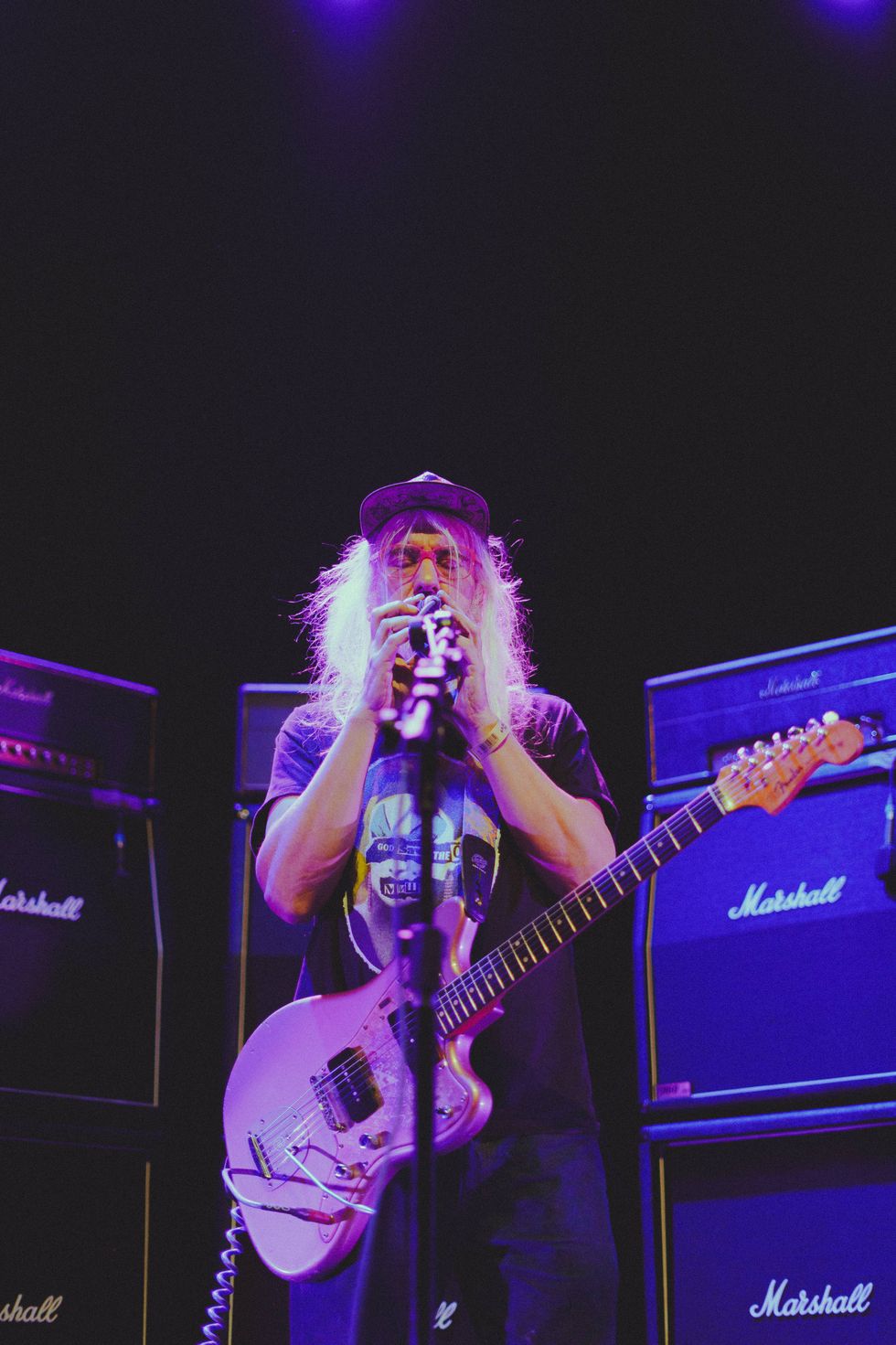 Photo by Rafael Novak
In 1990, Cosloy went on to join Matador Records, which released landmark indie-rock albums by artists like Pavement, Guided By Voices, and Liz Phair. Did Mascis ever reconcile with him? “Yes and no,” he says. “I mean, we’re not great. We never were as good of friends after that. But we definitely hung out a little bit.”
Mascis’ early professional bridge-burning had little impact on Dinosaur Jr.’s career. The band’s first SST album, 1987’s You’re Living All Over Me, was simultaneously more focused, song-wise, and more insanely packed with innovative guitar leads. The guitar-rock masterpiece was one of many crucial albums that soon revolutionized MTV and radio while helping the band become a touchstone for the Lollapalooza generation. (Dinosaur Jr. was on the storied festival’s 1993 bill with Alice In Chains, Rage Against the Machine, and others.)
“As I get older, my attention span gets less and less. I can’t play guitar for eight hours straight in the studio like the old days.”
The original Dinosaur Jr. lineup, though, was fraying. Mascis and Barlow were silently feuding. Mascis maintained tight control, writing almost every song, but Barlow was evolving into the band’s George Harrison, and he needed an outlet of his own. In 1987, Barlow released a four-track cassette of home recordings under the name Sentridoh, with his friend Eric Gaffney contributing percussion; that project helped lay the groundwork for Sebadoh and the lo-fi aesthetic at the core of the band’s music. Tensions within Dinosaur Jr. continued to grow: As the story goes, Mascis informed Barlow he was disbanding the lineup, but he put a new version together instead, initially with a rotating cast of bassists.
Both entities kept moving forward: Dinosaur Jr. signed with a major record label, Sire, and released their Mascis-produced 1991 album, Green Mind; Sebadoh was prolific, peaking with 1994's electrifying Bakesale, and Barlow formed several other projects and collaborations, including the Folk Implosion, best known for the 1995 Kids soundtrack hit, “Natural One.”
Mascis and Barlow continued on their separate trajectories until 2005: Indie label Merge Records reissued their early albums, and they reunited for a tour, which led to a 2007 record, Beyond, with the original lineup.
How has the Dinosaur Jr. dynamic between Mascis, Barlow, and Murphy changed over the years? Mascis pauses for a long time before responding: “Um. It’s hard to remember. At some point, it seemed like Murph and Lou flipped. When we first started, Murph wasn’t sure he wanted to do it all the time, sometimes. He’d quit for a week, but me and Lou were super-dedicated to the band.
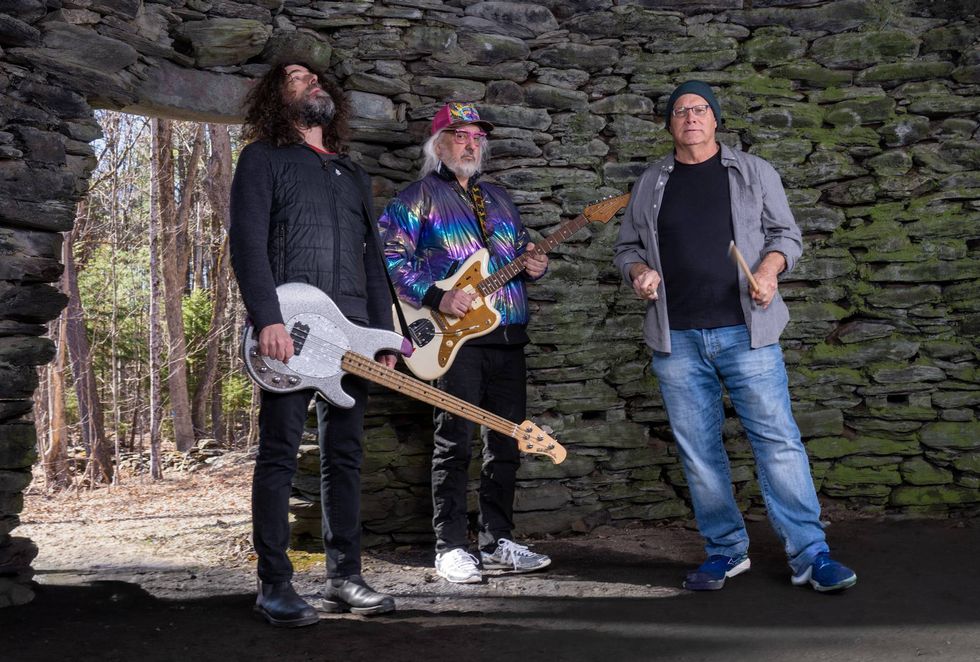
Dinosaur Jr. (l-r): Lou Barlow, Mascis, Murph
Photo by Jeff Fowler“When we got back to the band, it seemed like they had switched the roles. Murph was way more into it than Lou,” Mascis continues. “Other than that, it seems similar. I’d write the drum parts and Murph learns them. Or, for Lou songs, me and Murph would both drum—just try to write some drum parts, because Lou doesn’t think of drums.”
The band created There Near in bursts over the course of a year at Bisquiteen Studio, in Amherst. That’s a function of age, says the 60-year-old Mascis: “As I get older, my attention span gets less and less. I can’t play guitar for eight hours straight in the studio like the old days. Now we just figured—[don’t] push it at all. Record for an hour and a half, four days a week. At that schedule, it takes a while.”
The approach, Mascis says, tightened the album and made it easier to focus on a unifying sound. There Near follows Dinosaur Jr.’s nearly 40-year formula—moaned and mumbled Mascis lyrics set to a stomping rhythm, which is especially pronounced on the faster songs like “Several Got Away” and “Gone Off,” but slower tracks such as “Walk Me Back” open up to sharp torrents of shredding as well. “It’s good for quality control because you have time to weed out what you don’t like and see if you still like the thing four months later,” he says.
The two songs that deviate from this style are the Barlow-written “Blowin’ Up” and “No One’s Ready,” which have a softer, more melodic feel, with more space to accentuate the pointed lyrics: “You’re about as dumb as they come / and telling stupid stories every day,” he begins on “Blowin’ Up.” Mascis cedes control on Barlow’s compositions, playing guitar and bass as needed. “I just step back a bit and see what he wants me to do on the song,” he says.
“Back then, the Minutemen were a band we liked, and they said, ‘You need an album. That’s like a flier for the gigs.’”
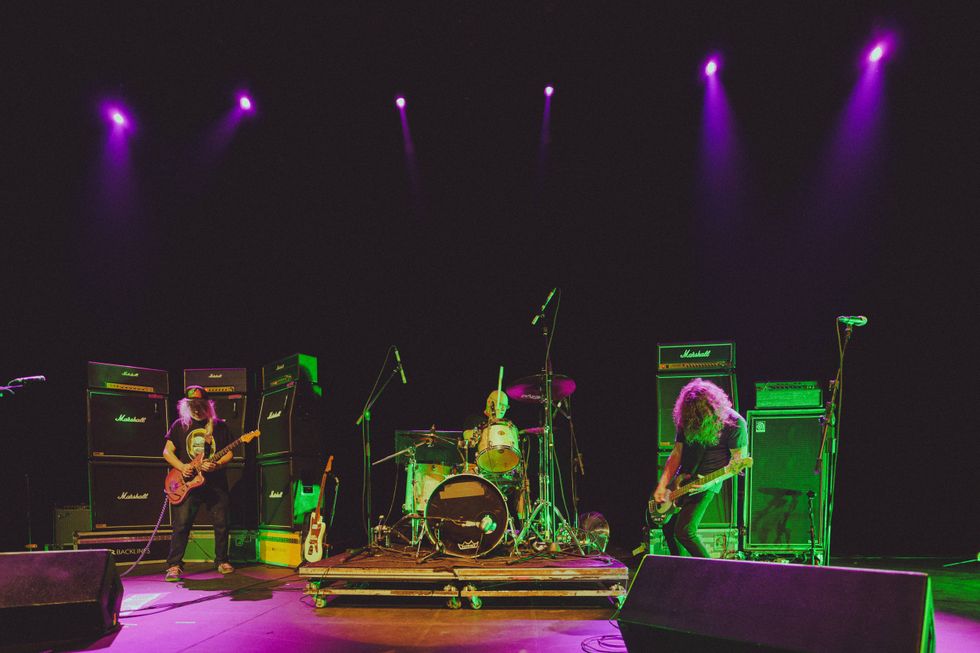
Mascis, Murph and Barlow take it to the stage
Photo by Jeff FowlerIn the early days, Dinosaur Jr. put out a new album every two or three years; more recently, in part due to the band members’ solo projects, the gap has expanded to four or five years. But there’s no strategy for the timing of There Near, according to Mascis: “We just kind of do ’em. There’s no rhyme or reason. It just feels like time to do a new album. You’ve played all these places already, so it feels like you need a new album so you can play all the same places again. I guess that’s the logic in our head. That’s how we grew up.”
During the mixing process, Mascis adds, he wrote a couple of other songs “that were on the back burner,” and recorded them in the studio living room. Eventually, Dinosaur Jr. will release a seven-inch single as an addendum—but Mascis refuses to divulge any information about these additions. “Like what? What do you say about a song?” he asks. “Songs that didn’t quite make it. The one song sounded a lot like all the other songs. There were three that were vying for the last slot on the album, and one was just slower. It seemed to be good to have a slower song.”
At one point during the half-hour interview, Mascis refers to a Fender Super Champ as his “favorite around-the-house amp,” which he uses to “just watch TV and play the guitar and hope for the best.” He adds: “It sounds really good at a low volume.”
It’s one of many public references Mascis has made over the years to his lifelong passion for watching television; in 1997, he informed this reporter, for a Billboard story, of his obsession with MTV’s The Real World. The streaming-and-bingeing era hasn’t changed his habits much—including one specific and unexpected technical characteristic of his TV time. “I still watch it on my computer. I like the computer because it’s 15 inches—and that’s the size of the TV I had when I was a kid in our kitchen,” he says. “It was an odd size back then, but somehow I’m always drawn to 15-inch screens.”
All this talk of TV leads Mascis to an even more passionate subject: guitars. He brings up his Gibson Les Paul Junior in TV Yellow, which, he says, “supposedly looks white on TV, because white guitars would get blown out. You wanted the look of a white guitar on TV, you get the TV model.”
Did Mascis ever play the “TV Model Junior,” as he calls it, on TV? Dumb question, as it turns out. “Well, it’s black-and-white TV,” he says with a small smile. “So I don’t know if that would work now.”
J Mascis’ Gear
Guitars
- 1959 Fender Jazzmaster (leads)
- Gibson Les Paul Junior, TV Yellow (rhythm)
- Rickenbacker 620-12 12-string
Amps
- Mesa/Boogie Mark I
- Marshall JCM800 Model 4104, 50-watt 2x12 vertical-input combo
- (All amps miked through a Marshall cabinet)
Pedals
- Tone Bender MkI-circuit fuzz (“I’ll use that as a base and then add other fuzzes to it.”)