
Patrick Hyland was studying at SUNY Purchase College’s Conservatory of Music when he met Mitski Miyawaki in 2012. Miyawaki was recording some sessions, and when the engineer she hired couldn’t make it, she asked Hyland to fill in. Miyawaki, a gifted songwriter, had more in common with Hyland, a guitarist and multi-instrumentalist, than she did with most of their classmates. At a time when their courses were packed with stomp-and-clap devotees emulating the pop-folk of Mumford & Sons and the Lumineers, Hyland and Miyawaki were interested in jazz, noise, and 12-tone music. When Miyawaki needed a collaborator, Hyland became her first call.

Nothing quite like lounging on the couch with a good friend.
Photo by Lexie AlleyNot much has changed in the 14 years since—the two college friends are still making records together. But Mitski, as she’s mononymously known, has risen to become one of the most celebrated artists in the alternative music world, with Hyland engineering, producing, mixing, and performing on all but one of her records, the 2012 debut, Lush. Earlier this year, Mitski released her eighth full-length, Nothing’s About to Happen to Me.
Conceptually, the record’s lyrics follow the life of a paranoid, reclusive woman. To build the world of Nothing’s About to Happen to Me, Hyland returned to one of his and Miyawaki’s cornerstone influences: the Ohio alt-rock band the Breeders, and their assured, scraped-elbows grit. With the exception of orchestral overdubs, the bulk of the record’s instrumentation was recorded at Hyland’s home. Drums were done in the dining room (this marks the first record on which Hyland didn’t man the kit), bass in the living room, and guitars in the kitchen. “We wanted to make something that had the spiritual quality of being a DIY home recording,” he says. “I own a lot of nice recording equipment, but it was still just my kitchen. It’s not an acoustically treated space.”
All the more impressive, then, that the record sprawls before the listener like an untouched walled garden, overgrown and throbbing with life and mystery. Opener “In a Lake” is a tender folk ode to loneliness and escape, paddled along by accordion, banjo, and Hyland’s acoustic. Next, a by-now Mitski trademark compositional flourish: a thrill of percussion, strings, horns, and city sounds burst in, like windows thrown open on a warm spring morning. Then there’s lead single “Where's My Phone?,” a perfectly deranged alt-rock radio stomp welded together from dueling fuzzed-out guitar parts and ridden out on a wailing, grimy solo. The record swings between gentle-to-nuclear ’90s rock like “If I Leave” and “That White Cat” and the bluegrass-and-Americana breeze of “Dead Women,” “Instead of Here,” and the jubilant “Rules,” ginned up with a grinning bass clarinet solo. Hyland never takes center stage when the song is better served by something other than his guitar.
Miyawaki is the principal songwriter, but Hyland’s arrangements and production details bring the compositions to life. Nothing’s About to Happen to Me continues a tradition of creating albums that feel spacious, physical, and just generally cared for. “I have a friend who says that the measure of a good song is, does it still have some kind of life in it every time you play it?” says Hyland. “And there’s no Mitski song that has ever diminished in that regard. Every time I play these songs, they feel alive and meaningful.”
From a young age, nothing interested Hyland quite like music. The Pixies—and, specifically, Joey Santiago’s playing—inspired Hyland to pick up a guitar in the first place. Bands like the Raincoats moved him, as well as jazz bassist and composer Charles Mingus. He played guitar in punk bands and picked up the saxophone in his teens, when he began writing jazz and “trying to be as much of a sponge as possible: really hearing and absorbing everything.”

Hyland and Mitski share a quiet moment onstage in Berlin in 2023.
Photo by Hella Wittenburg
Despite all of this, Hyland only ever took two guitar lessons in his life, both in 2020. John Cale and Sterling Morrison’s playing on the Velvet Underground’s 1967 debut gave him his approach to the instrument: expressive, free, no rules. “That set the baseline for what I think the guitar is,” says Hyland. “Eventually I tried to learn some chords and stuff, but from the beginning I was coming at it from a place of not being super interested in playing quote-unquote ‘the right way.’ I took music theory and arranging classes and had a structured education on that side, but listening to punk music opened me up to, like, ‘Oh, these things are just tools. Pedagogy is not that important. Technique is as important as you want it to be. These are just things for self-expression.’”
Hyland says he and his Mitski bandmates mused last year that there are two types of musicians: people for whom the instrument is a means to express oneself through music, and people for whom music is a means to express themselves on the instrument. “For the highly technical, shredder guitar players, the music seems almost incidental to their technique,” he says. “If I could play like those guys, I would be doing it, too, because it’s incredible. But I don’t have those technical abilities. So for me, the instrument is the path to music, rather than music being the path to the instrument.”
“Technique is as important as you want it to be. These are just things for self-expression.”
For the first couple of years he toured with Mitski, Hyland maintained a simple, punk-ish setup with few delineations. The first Mitski records were made with inexpensive gear routed in basic ways, but as people began paying attention to their work, Hyland felt a tug toward professionalism. “As I was starting to tour more, I was like, ‘I’m getting up in front of 200 people, and someone’s paying me to do this. I should probably understand more about the tools I’m using.’”

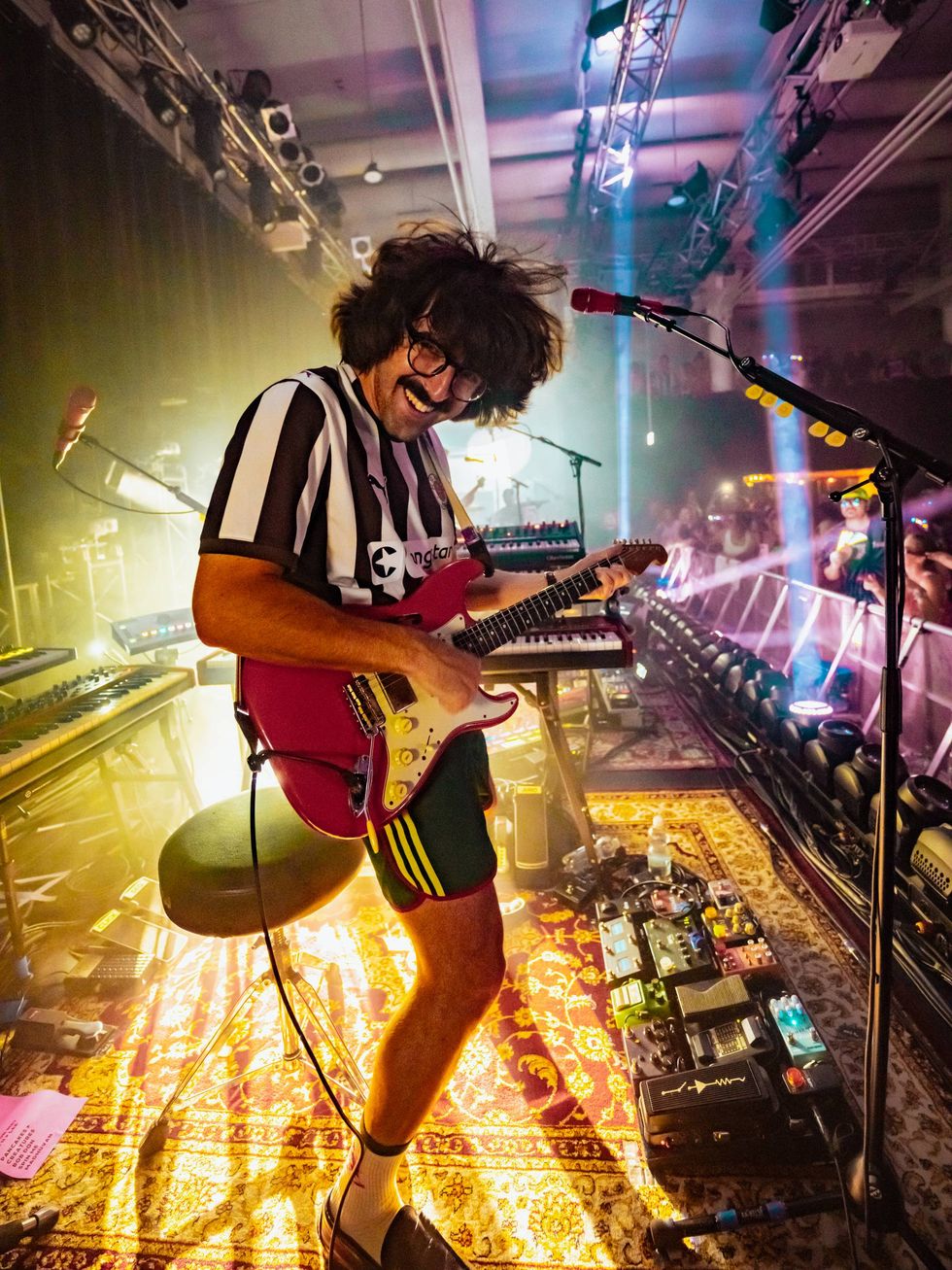
Rock climbing: Hyland balances atop his Black Tape Amplifiers Keifton and Fender Bassman.
Photo by Lexie Alley
Patrick Hyland’s Live Gear
Guitars
2011 Martin D-42 w/ LR Baggs Anthem pickup system
2018 Gibson ES-330 w/ Bigsby tailpiece and custom gold-foil pickups made by Lin Crowson in Nashville, Tennessee
2023 Electrical Guitar Company EGC-500
Amps, Cabs, Speakers, & Mics
Early ’70s Ampeg V-4 (clean) into a single Ted Weber Speakers Black Shuck, miked with AEA N22 microphones
Early ’70s Sunn Solarus (dirty), rebuilt to early ’70s Sunn Model T specifications by Black Tape Amplifiers in Nashville, into two Ted Weber Speakers Grey Wolfs, miked with AEA N22s (functionally a 90-watt Model T with transformers and many other components preserved from the original Solarus; affectionately referred to as the “Sunn Edsel”)
Roland JC-120 (wet) into stock Roland-branded speakers, miked with Josephson e22S microphones
Box of Doom isolation cabinets
Effects
Acoustic Guitar (via FX loop of Audio Sprockets ToneDexter II)
Boss TU-3S
Origin Effects Cali76 Stacked Compressor
Origin Effects DCX Bass Overdrive
Strymon Volante
Dry Signal (via GigRig G3)
Mission Engineering expression pedal
Boss TU-3S
Origin Effects Cali76 Stacked
Stromer Super Drive
Animal Factory Pit Viper
Color Audio Cassette Preamp
Circle Electric Harvester Fuzz
ZVEX Fuzz Factory Silicon
Faustone Valve Klipper Mk2
Electronic Audio Experiments Surveyor
JAM Pedals Harmonious Monk
Chase Bliss Billy Strings Wombtone
Moog MoogerFooger MF-104M delay
Wet (via second GigRig G3)
Electro-Harmonix Superego
Electro-Harmonix Polychorus
Beautiful Noise Effects When The Sun Explodes
Hologram Electronics Infinite Jets
Old Blood Noise Endeavors BL-37 Reverb
Empress Effects Zoia [stereo]
Strymon Volante [stereo]
Chase Bliss Generation Loss Mk2 [stereo]
Roland Stereo Chorus [in-amp]
Strings & Picks
D’Addario NYXL strings (.011–.056)
Wegen TF100 picks
Dunlop strap locks

Photo by Lexie Alley
Nowadays, Hyland describes himself as a “gear hoarder” who owns way too many guitars, amps, and pedals. He’s still not sure, though, where the line is between a healthy tone obsession and one that hinders the creative process. In preparation for hitting the road this summer behind Nothing’s About to Happen to Me, Hyland cycled through his collection of equipment, trying to find the right combination to take on tour. That experimenting led him back to the staples that he’s known and loved for years. “I’ve been trying a million different amps the last couple months, and the thing that made me happy when I plugged it in was my Ampeg V-4, which is the amp I’ve had the longest,” he says. “I actually know what I like. Knowing what you like and knowing what lets you feel free is wonderful. I can just let that part of my brain clock out, and think about the music.”
“The instrument is the path to music, rather than music being the path to the instrument.”
Fuzz has always been Hyland’s favorite type of effect. His first pedal was a Big Muff, though these days, he’s more interested in the Tone Bender circuit. “I’m not any kind of vintage purist, but admittedly, most of the stuff that really excites me to use is from the ’60s and ’70s, sometimes the ’50s,” he says. “I love guitars with P-90s, Fender Bassman amps, and germanium Tone Benders. Almost any amp that you can walk into a store and buy can trace its lineage pretty directly to a 1959 Bassman. The people who were designing those things were using the volume knob on the guitar, and assumed that the end user would be, too. It almost feels like this lost knowledge. All these old circuits that we still love and use all the time are not always being used in the way that the designer thought they would. I think sometimes we get into a habit of thinking older stuff is so primitive, like, ‘Oh, ’60s fuzz is just the velcro thing.’ Then you roll back the volume knob, and suddenly you’re like, ‘This isn’t primitive at all, this is actually really elegant and sophisticated.’”
Hyland collaborates frequently with Black Tape Amplifiers’ John Capito, who builds most of the amps that Mitski’s band takes on tour. (Years ago, Capito saw Tom Morello tape over the logo of his Marshall JCM800 with black tape. It gave him an idea: What if the tape itself were the logo?) Their partnership involves trying to work to create circuits that have never been made before, and Hyland thinks they’ve succeeded on a few occasions. “Whether or not people like it is a different thing,” he says with a laugh. “But the search for new sounds is a noble one.” Recently, Capito and Hyland assembled an amp with octal tubes in the preamp section and EL84s in the output section. The octal preamp tubes, he says, transmit sound through the speaker in a way that’s pleasingly three-dimensional and dark. Hyland’s Black Tape Keifton is loaded with these octal tubes, with a controlled, shaded high end that never feels piercing, even with the treble maxed.
At this point in their careers, Mitski and Hyland have an established working routine: Miyawaki brings fully-formed compositions to Hyland, complete with lyrics, melodies, and structure. This is still “a dream” for Hyland, who prefers to occupy himself with the production side of things. “I get to benefit from these brilliant, beautiful songs, and I get to run with them,” he says. The first part of his job is to listen, then find a way to present the songs to the world in a way that feels “truthful and impactful.”
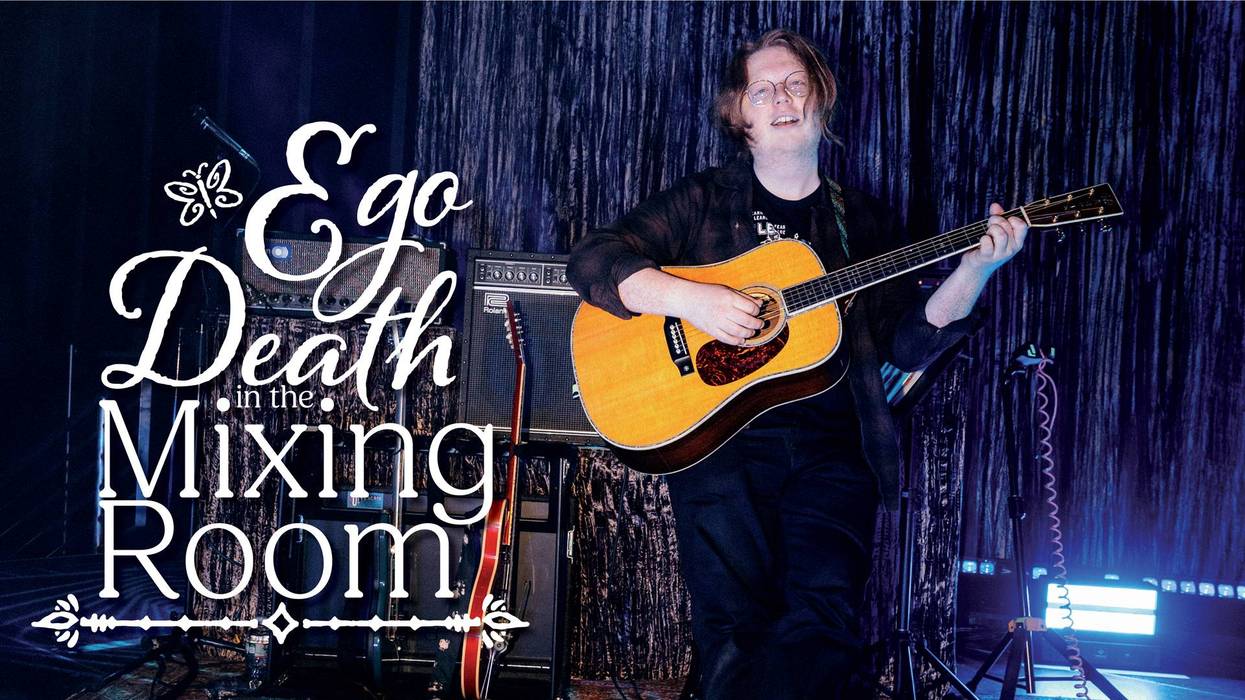
Hyland notes that this is distinct from what he might personally think is best. “That’s one of the biggest challenges for a producer: Try and experience an ego death on every track,” he says. “Maybe I try something as a rock song, and it feels bland and uninspired. It’s like, ‘Okay, well, we have to take all that out, start over, and find a new way to serve up this meal.’”