
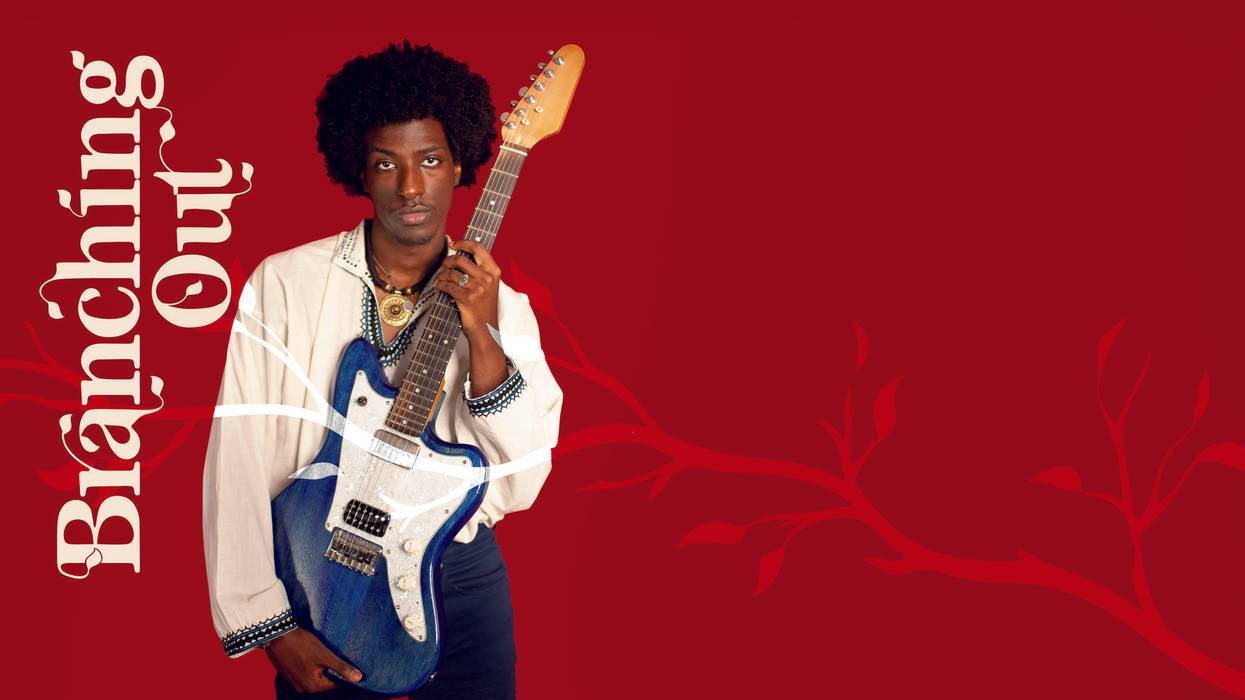
“By the end of senior year in high school, I was like, ‘I want to do guitar. I want to have a career in music.’ In order to do that nowadays, you have to do online posting with TikTok and Instagram,” Amani Burnham says. “So from September of 2023, I started posting, and the rest is history.”
From being an unknown bedroom guitarist to potentially becoming the next big thing in blues, Burnham’s journey has moved at a breakneck speed. His debut album, Roots & Wings, dropped the day before his 21st birthday. He also recently opened up for Ted Nugent at Heritage Hall in Ardmore, Oklahoma. For the evening closer, Nugent invited him, along with Phil X and Jared James Nichols, to jam on several songs. At last count, Burnham has amassed around a quarter of a million followers, with combined views of almost 30 million between his Instagram, TikTok, and Facebook accounts. It’s hard to believe that less than three years ago, Burnham wouldn’t even show his face in his videos.
“I was definitely shy at the time, because the only people who followed me were just friends and random people I had known from high school,” Burnham says. His very first clip, a take on Hendrix’s “Remember,” only showed a domed ceiling light fixture onscreen. Burnham was nowhere in sight and, as is to be expected, engagement was modest.
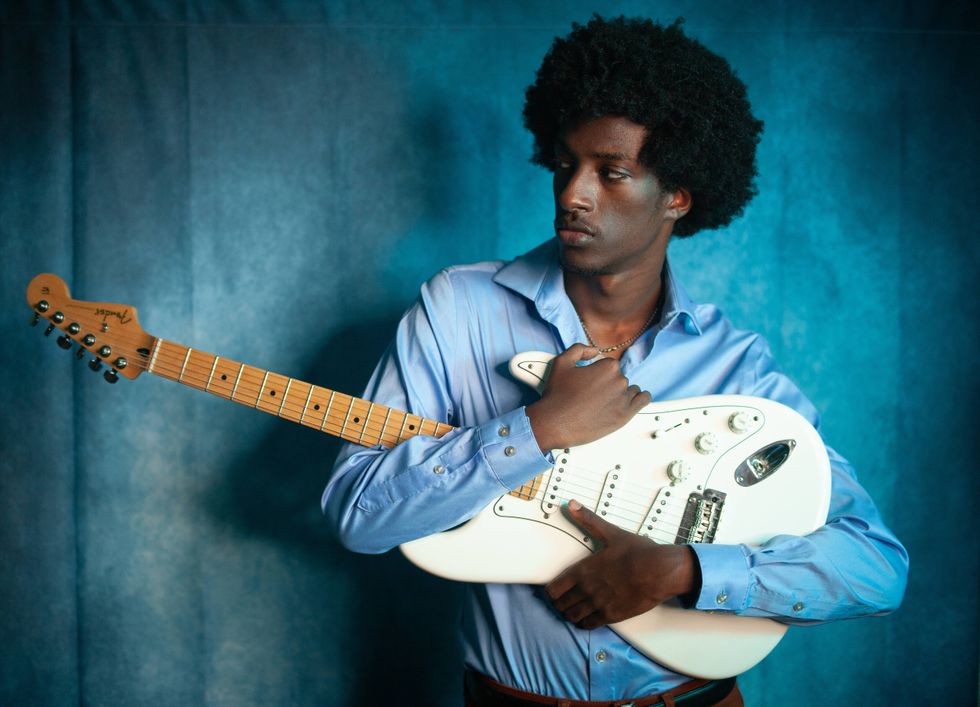
Photo by J.B. Lawrence
Amani Burnham’s Gear on Roots & Wings
Guitars
Amps
- 1964 Fender Vibroverb (borrowed from Jeff Schroedl)
- 1965 Fender Pro Reverb (borrowed from Jeff Schroedl)
Effects
- Dunlop Fuzz Face
- Vox Wah
- Dawner Prince Viberator (used on “Midnight Waterfall”)
- Ibanez TS808HW Hand-Wired Tube Screamer (borrowed from Jeff Schroedl)
Strings
- D’Addario (.010–.046)
After posting a handful of similar videos and getting similar results, Burnham had a revelation. “I realized pretty quickly that to make a career, people need a face to see in order to create an identity of who that artist is,” he explains. Burnham reinvented his online persona, and his videos started showing him shredding blues licks while explosively performing Hendrix-like movements, with the guitar played over his head, under his legs, and all points in between. People began taking notice.
“I realized pretty quickly that to make a career, people need a face to see in order to create an identity of who that artist is.”
Word spread like wildfire, and Blind Pig Records also identified the young talent as a person of interest. About a year after Burnham’s first post, while he was playing guitar in his dorm room at Central Connecticut State University, a life-changing email came in. Blind Pig Records president Jeff Schroedl had followed Burnham for a while, and was so impressed that he reached out to him directly. “It was a simple email where I said, ‘I’m really impressed with your talent. If you want to explore ways of working together, give me a call,’” Schroedl recalls.
“It was a little like, ‘Dude, this is too good to be true,’” Burnham says. “l was like, ‘Nah, that can’t be it.’ And it turned out to be real.” After establishing that it wasn’t a prank or a scam, Burnham got back to Schroedl. “I had to go to the study area in my dorm to call him. We were introducing ourselves and he was telling me about the label and stuff like that,” Burnham says. “He didn’t give me an official offer then because, at that time, I had just formed a band, and I really couldn’t sing that well. I was honestly still working on my voice and stuff like that. So we decided that we’d stay in touch, see what happens, and I’ll get some vocal lessons.”
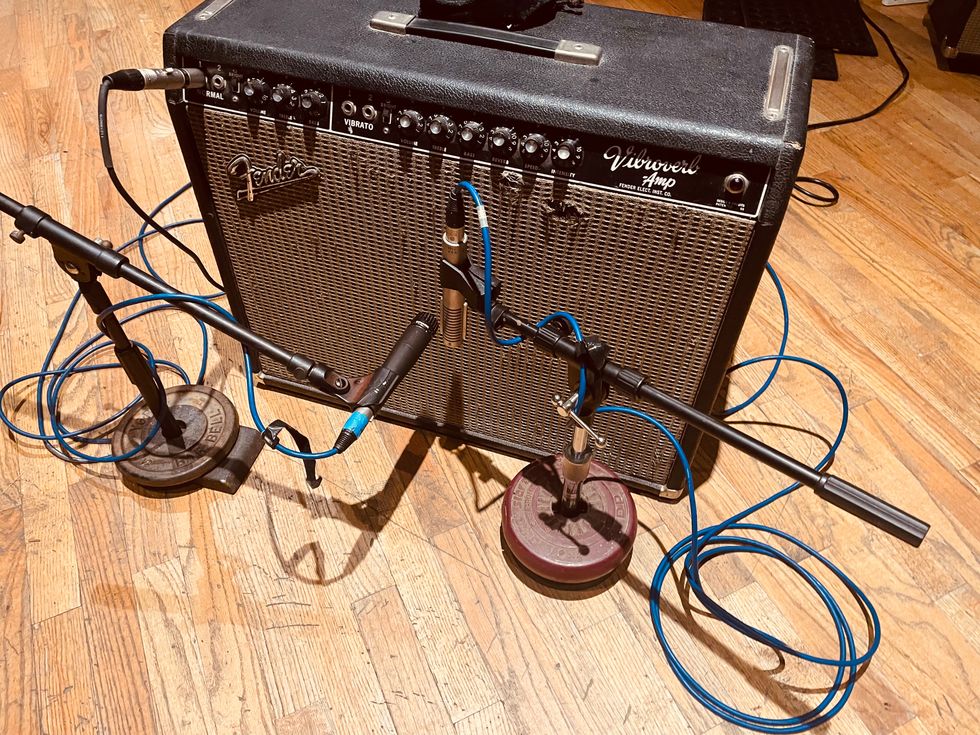
Schroedl’s 1964 Fender Vibroverb miked up at Carriage House Studios for the Roots & Wings sessions.
Photo by Jeff Schroedl
After a few more conversations, they eventually met in-person in Memphis, where they started to put together a deal. By April 2025, Burnham was ready for prime time, and Schroedl offered him a multi-album contract with Blind Pig.
Schroedl produced Roots & Wings, and together they spent three months writing 10 out of the album’s 12 songs, using a mix of existing riffs and new ones. “Some of those riffs I’ve had since I was, like, 15. I’m 20 now, so some of those I’ve been sitting on for a very long time. And then some of them less than others,” Burnham explains.
Joining Burnham on Roots & Wings are session players Ray Hangen on drums and Matt Raymond on bass. “I was really excited when we were making this album because it was like, ‘I’m going to be able to hear these songs fully realized with bass, drums, and maybe some tambourines for the first time ever,’” he says.
“Everybody starts off first learning guitar with the thumb, and I was just too lazy to graduate to a pick.”
The lyrical content of Roots & Wings runs a gamut of topics, from sleep paralysis to a reflection on Burnham’s African heritage. The guitarist was adopted from Ethiopia when he was only a few months old, and raised in Connecticut. The title track’s lyrics—“Father, mother, sister, brother, all my life I’ll always wonder”—allude to this. “I specifically came up with ‘roots and wings’ for the album,” he says. “That was one of the first few titles that we came up with when Jeff and I were calling over the summer. I knew we wanted to call it Roots & Wings because it ties into the adopted thing. I’m just curious about my heritage, and we kept that in mind when we were writing the song.”
Burnham cheekily borrowed Hendrix’s signature phrase “kiss the sky” for a line in “Roots & Wings.” Since the beginning, Burnham has posted numerous Hendrix covers on social media where he mimics Jimi’s attire and mannerisms. However, he’s not as much of a devotee as you might think. “I mean, I love Hendrix, but there are other artists that I love and have more to offer me,” he says, “Back when I was first starting out, Hendrix was a giant hero to me, so a lot of the songs just came out that way. I started getting really into the Beatles again because that was the first band I listened to when I was a kid. Nowadays, I’ve gotten way better at songwriting and [my songs are] a lot more structured. Some songs may not even have a solo, you know what I mean?”
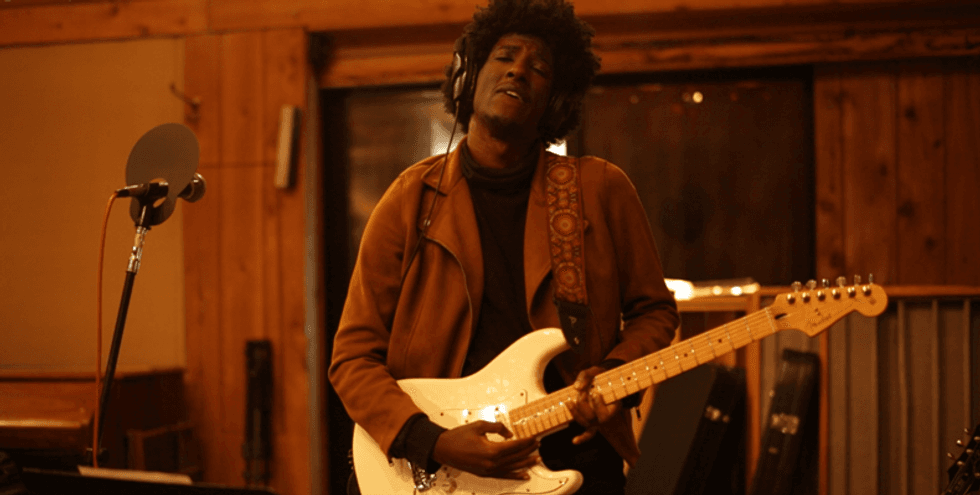
Burnham rips a solo at Carriage House Studios.
Photo by Jeff Schroedl
Case in point is “Midnight Waterfall,” which boasts an ethereal intro, some colorful chord moves, and a short, four-measure guitar interlude, but not an all-out solo. Burnham says, “That was one that Jeff showed me and I just came up with some of the stuff after, but I knew that—especially for the intro—since it was called ‘Midnight Waterfall,’ I had to make something that would sound like a waterfall. And I have a pedal called the Waterfall [the RFO Electronics Waterfall vibrato/chorus].” They didn’t use that pedal in the studio, but instead used a Dawner Prince Viberator to get the same effect.
There are two slow blues on Roots & Wings, each with notably different characteristics. The album closer, Elmore James’ “Bleeding Heart,” is the only cover song on the album. For that track, Burnham pulled out his first full-sized guitar, an Epiphone Les Paul. The half-step tuned-down “The Last Thing I Remember,” meanwhile, is a slow blues in G that hints at Stevie Ray Vaughan’s “Texas Flood,” which Burnham has covered several times in his short videos. His white Fender Stratocaster was employed for that one. “I always liked ‘Texas Flood,’ and since we wanted to have two slow blues on the album, I didn’t want them to be the same, where they’re both, like, chill, because ‘Bleeding Heart’ is a more traditional solo,” he says. “It’s not as in-your-face, and you can calmly listen to it. But I wanted to make ‘The Last Thing I Remember’ this big thing that’s right in your face. It might be in the same key as ‘Texas Flood,’ but that wasn’t necessarily intentional.”
“I know for a fact that there’s people that follow me that probably have never heard of Buddy Guy.”
If fate hadn’t intervened, Burnham might have made his mark on drums instead of guitar. He recalls, “My dad introduced me to a lot of older music; stuff like the Beatles, the Rolling Stones, and a lot of jazz stuff. From there, I wanted to learn to play drums, and started off with drum lessons at nine. When I was 10 or 11, I started guitar lessons. I had three different guitar teachers, and I stopped when I was 18.”
When it was time for college, Burnham enrolled at Central Connecticut State University as a percussion major, gaining acceptance by auditioning with the jazz standard “Take Five” and the Pointer Sisters’ “Cloudburst.” “If I knew how to read music on guitar, I definitely would have tried out for guitar there,” he admits. “But for some reason, being able to read drums was a lot easier, just because it’s more like beats and patterns. That was always easier than, ‘What note is that?’”
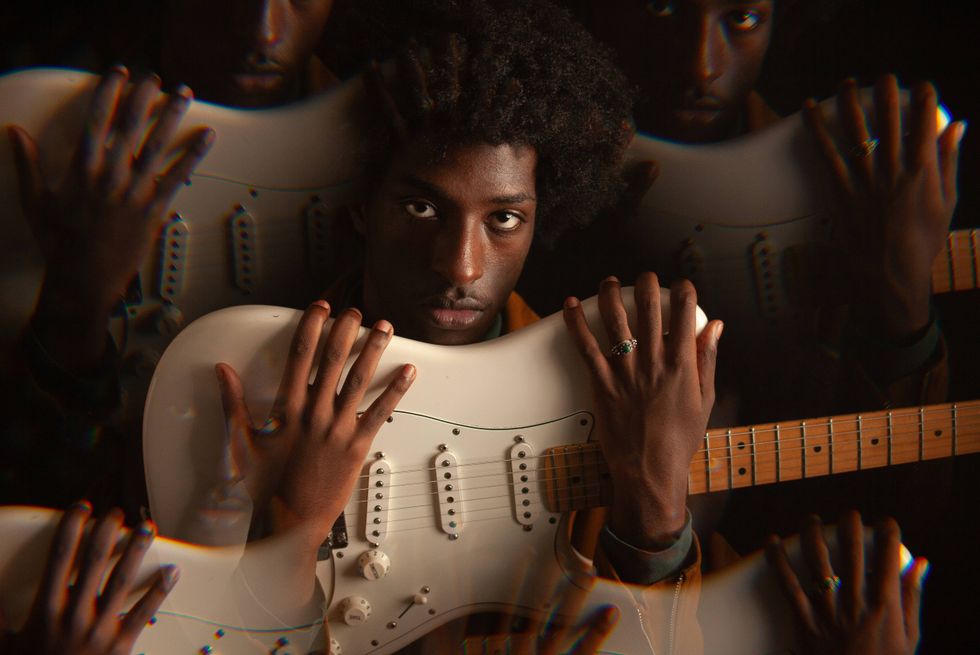
Photo by J.B. Lawrence
There’s a fresh rawness about Burnham’s approach. While he took lessons for almost half his life, he’s not tied to convention. He’ll tune down a half-step like Hendrix or Stevie Ray, but he’ll also tune down a whole step, or “way down,” when he’s on his acoustic. His most notable departure from the norm is that he doesn’t use a pick at all. Rather, he articulates everything only using his right-hand thumb (à la Wes Montgomery, who Burnham has recently started checking out), or a combination of thumb and fingers. “Everybody starts off first learning guitar with the thumb, and I was just too lazy to graduate to a pick,” he says. “It was always uncomfortable for me to use a pick. Flicking the thumb up and down just kind of happened. It wasn’t really anything that I planned. Usually, if I’m soloing, I just use my thumb. If I’m strumming, I pretend like I’m holding a pick and I use all my nails.”
Burnham is re-introducing the blues to a whole new generation, many of whom would have no connection to the genre otherwise. “I know for a fact that there’s people that follow me that probably have never heard of Buddy Guy and stuff like that,” he says. “But they still like me, which means they’re still technically liking the genre, because that’s the sort of genre that I’m in. I feel like the way to keep a genre alive is to change it, but also have the same sort of feeling. If you want to keep blues alive, you’re going to want to have the essence of it there in the album, but you’re also going to want to change it so that you can make it interesting for the new generation that are going to listen to it.”