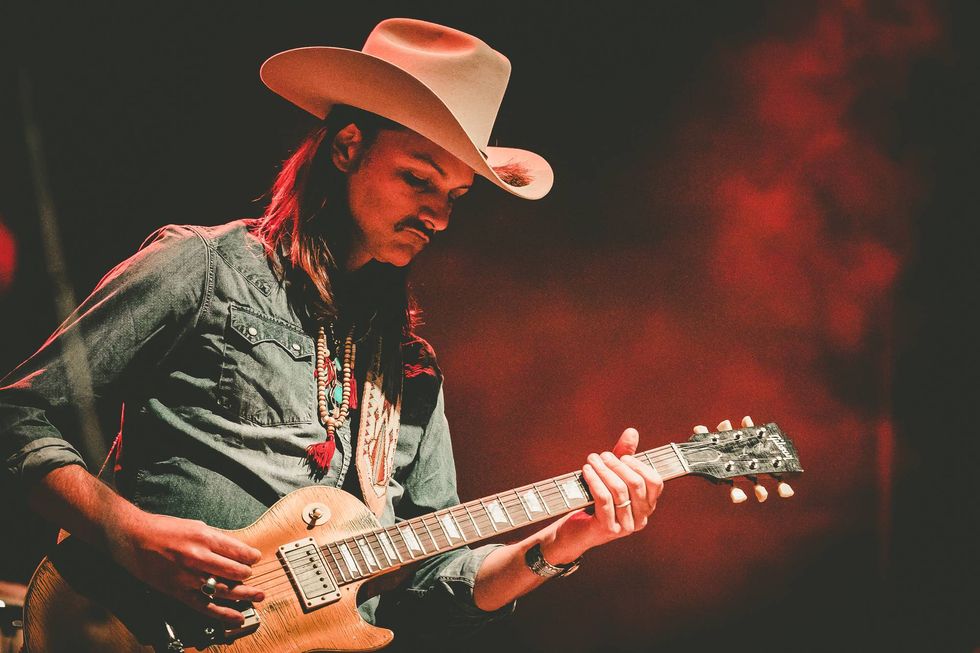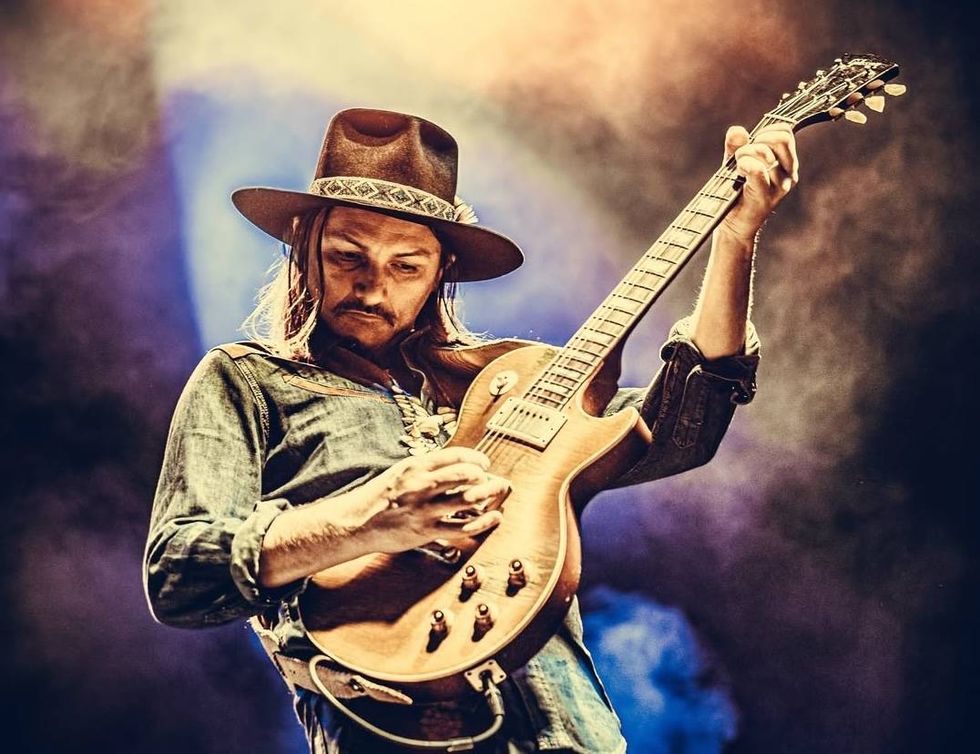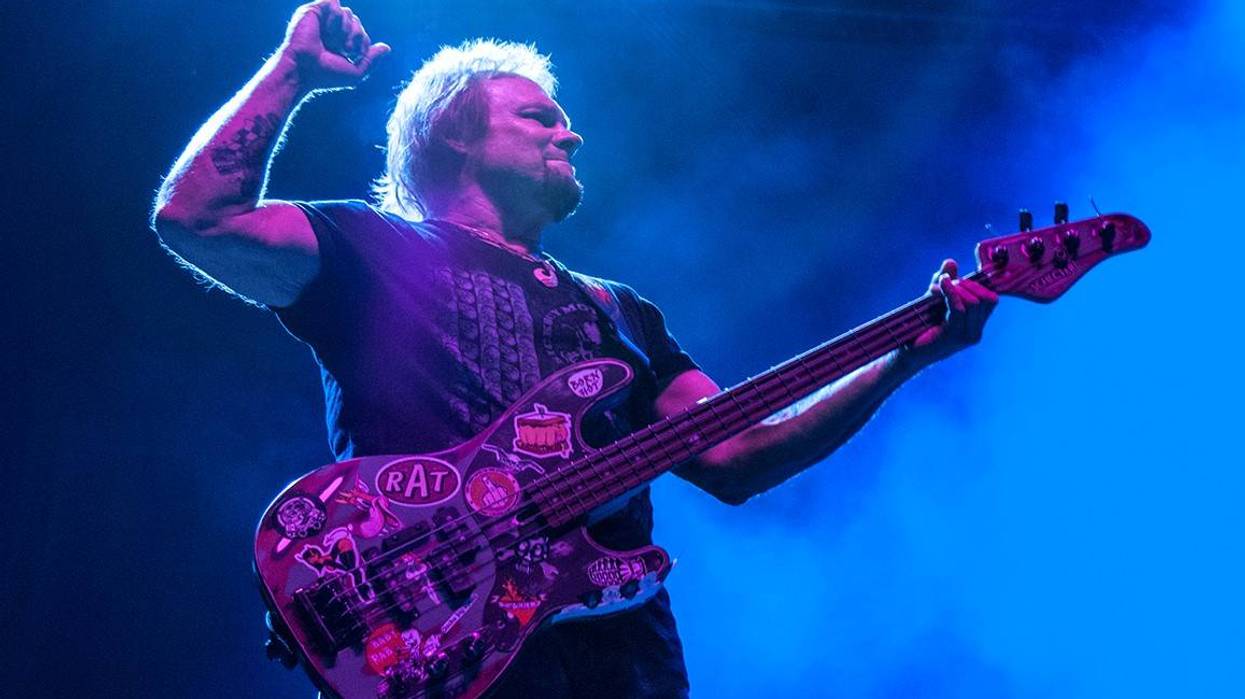

You know it within seconds: those priceless “song within a song” solos, that impeccable phrasing (never too much or too little, with lots of space between notes), a subtle Bigsby shimmer at just the right moment, the evocative 12-string jangle, and an overall style that blends the sweet melodicism of George Harrison with the blues-rock grit of Keith Richards. All it takes is but one of those elements and you know you’re hearing Mike Campbell, who has, since his time as lead guitarist of Tom Petty and the Heartbreakers, established himself as one of the most identifiable guitarists in modern history.
“Well, I certainly know me when I hear me,” Campbell says with a laugh. “Honestly, I’m aware people say I have a recognizable style, and while it’s nice to hear that, it’s also nothing I planned on. I play the way I play. I just look at the song in front of me and say, ‘How can I enhance this?’”
He breaks down his approach thusly: “I’ll listen closely to the melody of a song, and I’ll try to emulate it on the guitar. Because the singing fits with the chords, the notes that I play should fit with those chords, too. I’ll use the singing voice and the melody as a spin-off point, but I try to stay within a certain range. I do like to improvise during solos, but it’s never to distract from the song. It’s what I’ve always done, and the players I respect—George Harrison, Jimmy Page, Keith Richards—all do that. Those are people I learned from.”
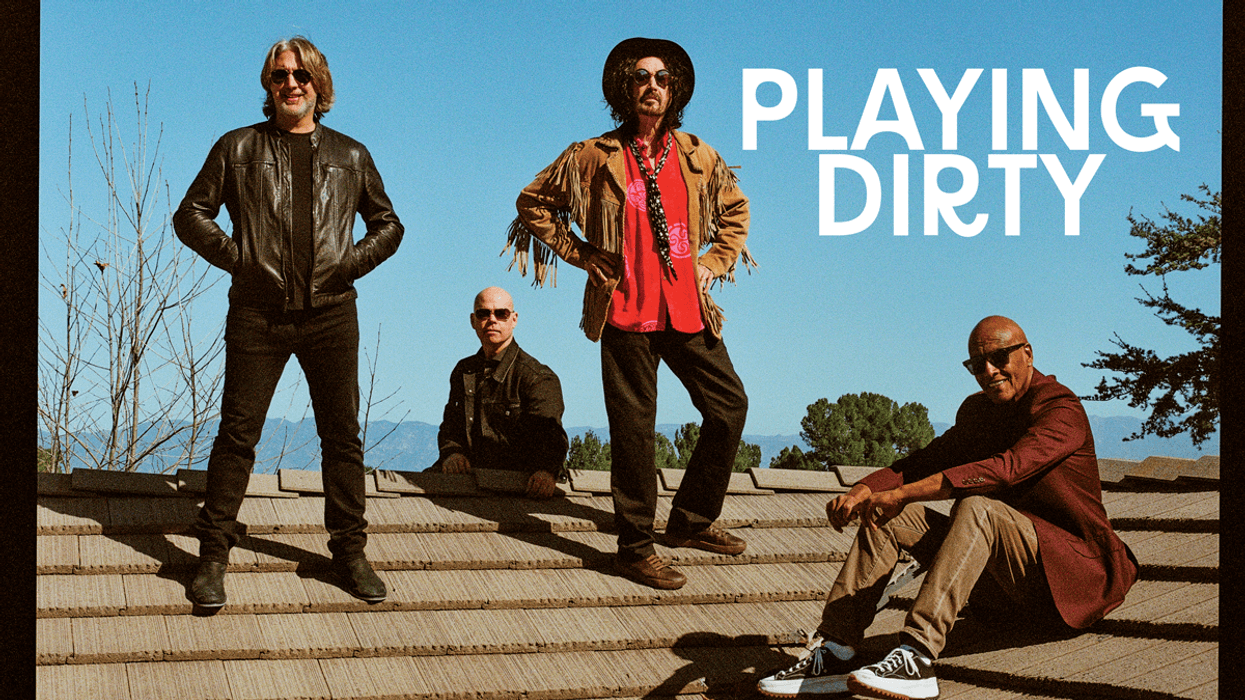
Campbell formed the Dirty Knobs as a side band back in 2000 with the idea that it would be simply that—a side band. One that offered him a relaxed, no-pressure space to work out songs away from the Heartbreakers, do a bit more singing, and let off some steam. Occasionally, he and the guys (guitarist Jason Sinay, bassist Lance Morrison, and fellow Heartbreaker drummer Steve Ferrone) would go play at a bar for fun. “I guess I thought, ‘If the Heartbreakers ever break up or if Tom quits, this is what I’ll do,’” he says.
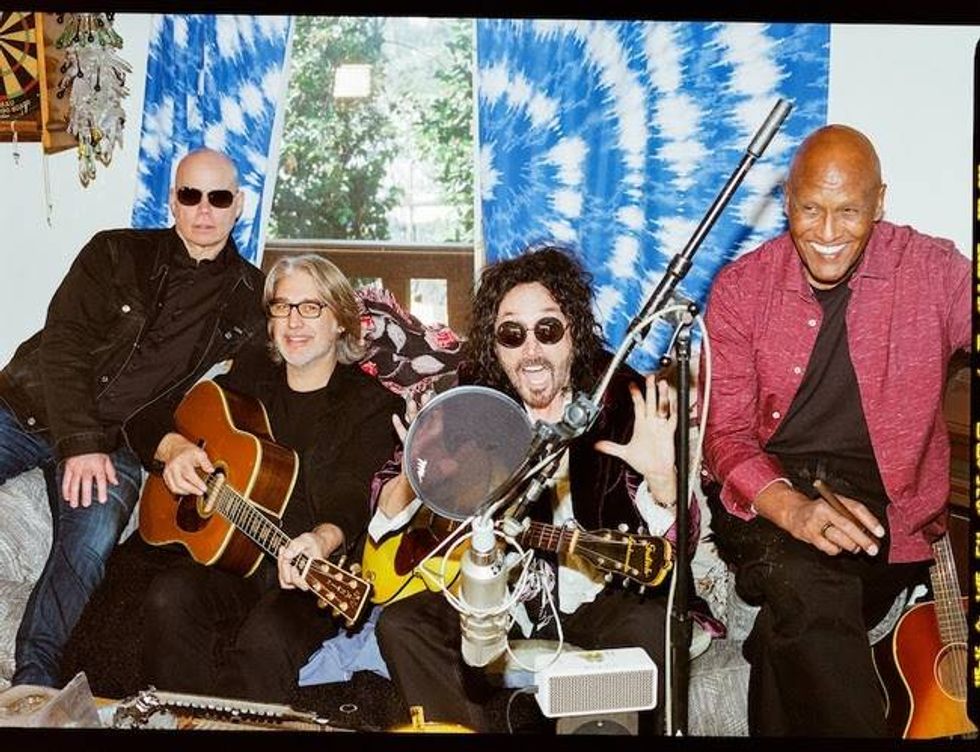
The Dirty Knobs (l-r) Lance Morrison, Chris Holt, Mike Campbell, Steve Ferrone
Photo credit: Sheva KafaiMike Campbell’s Gear
Guitars
- 1959 Gibson Les Paul Standard sunburst
- 1956 Fender Telecaster w/ B-Bender
- 1963 Rickenbacker 625/12 12-string
- Mid-’60s Fender Telecasters, Fender Stratocasters and Gibson Les Pauls
Amp
- Ampeg Rocket
Effects
- Way Huge Camel Toe Triple Overdrive MK II
- Vox wah
- Line 6 DL4
- Electro-Harmonix POG2 Polyphonic Octave Generator
Strings, Picks, & Cables
- D’Addario strings
- Dunlop picks
- custom Canare cables with Neutrik connectors
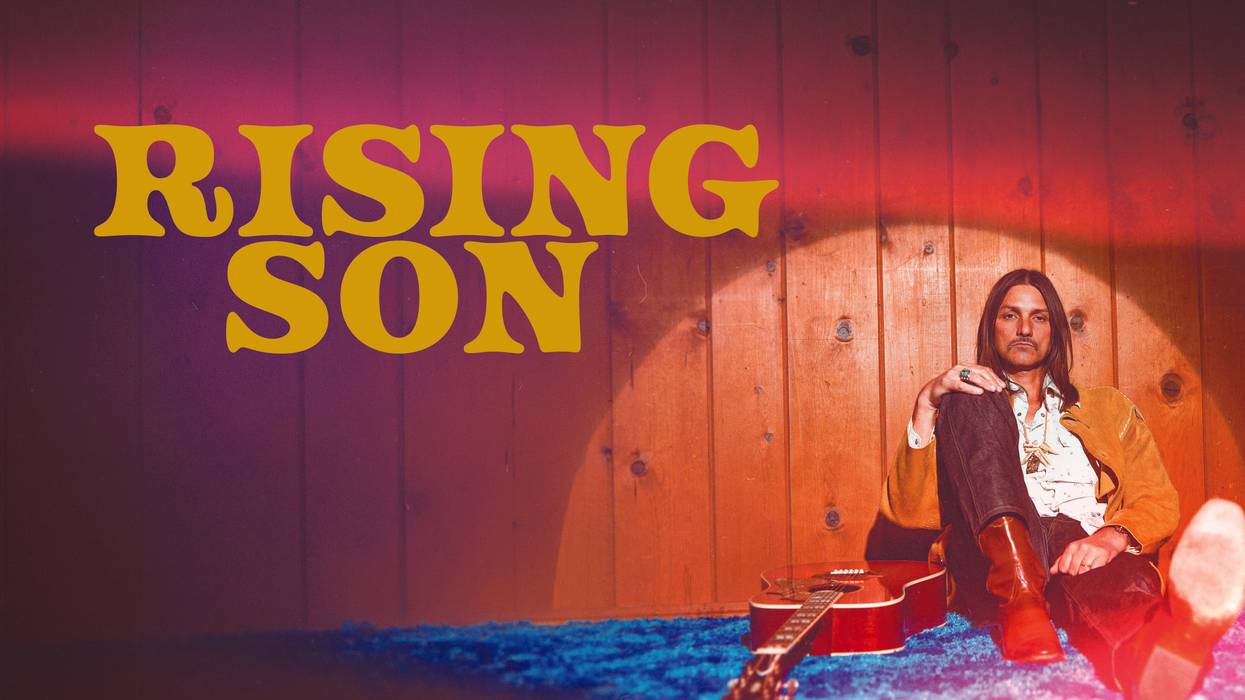
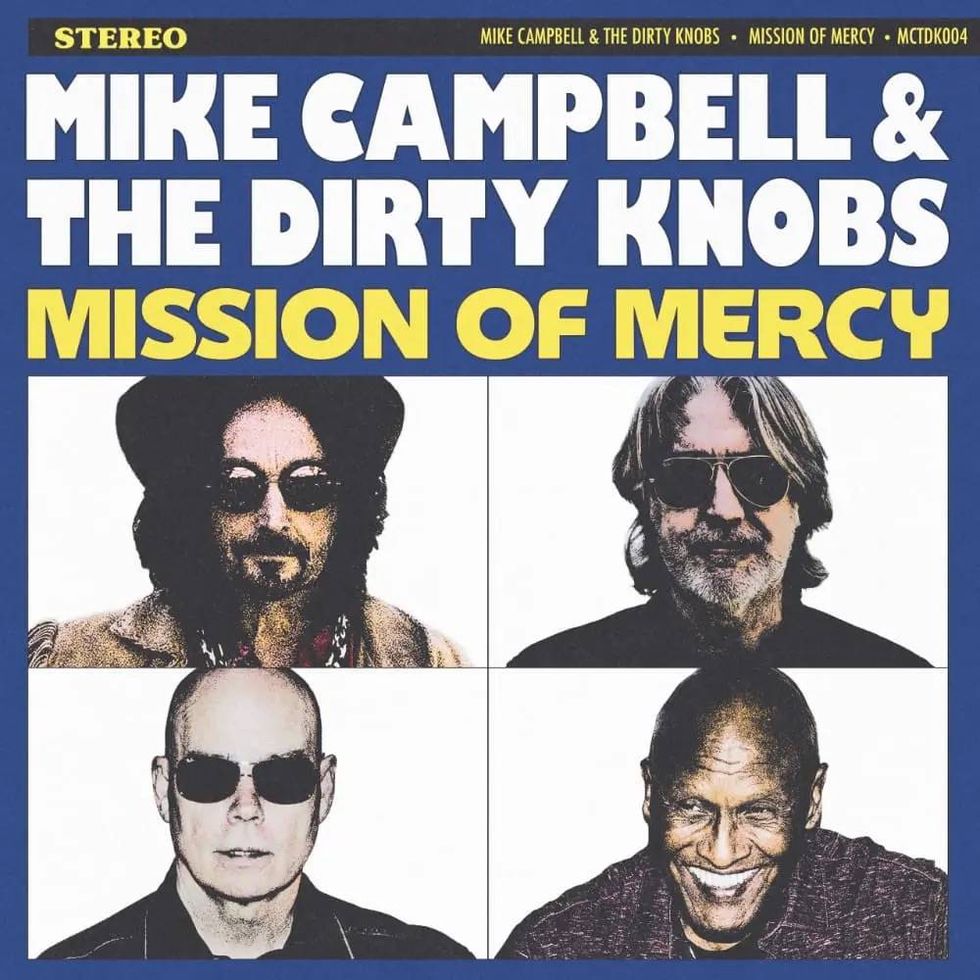
Following Petty’s tragic passing in 2017, Campbell joined Fleetwood Mac along with Neil Finn as replacements for Lindsey Buckingham, but after a 2018-19 world tour, he made the Dirty Knobs his main focus. In 2020, he finally wrangled the band into the studio to record an incredibly solid debut album, Wreckless Abandon, which he followed with two equally strong releases, 2022’s External Combustion and 2024’s Vagabonds, Virgins & Misfits. There have been several personnel changes over the years, but the current lineup—Morrison, Ferrone, and guitarist Chris Holt—recorded the band’s latest release, Mission of Mercy.
Much of the album is rooted in tough-minded rock—“Let Me Back in My Dreams,” “Vicious Hangover,” and “My Mama Told Me” are rude, untidy, and fun as hell, and the aptly named “Bongo Mania,” which, yes, features bongos a-plenty along with the luminous background vocals of the B-52s’ Kate Pierson, is a full-throttle knockout, brimming with Campbell’s sparky leads and solos. But there’s nostalgia and melancholy in the Americana ballad “More Than Gold” and the psychedelic title track, and the reflective opening cut, “No Regrets,” is a winning variation on the classic Heartbreakers sound. All told, it’s the strongest effort from the band—now billed as Mike Campbell & the Dirty Knobs—to date.
“I’m aware people say I have a recognizable style, and while it’s nice to hear that, it’s also nothing I planned on.”
A veteran of the album-rock era, Campbell co-wrote a number of Petty classics, including “Refugee,” “Here Comes My Girl” and “Runnin’ Down a Dream,” and he composed the music for Don Henley’s Grammy-winning hit, “The Boys of Summer” (a song Petty turned down, and later regretted). By his own account, it’s taken him a while to recalibrate his songwriting to suit the Dirty Knobs and his own vocal style, but with this album he’s starting to get the hang of it. Even so, he admits to some growing pains.
“It was daunting at first because Tom was so good, and I never had an ambition to sing or put my lyrics out front,” Campbell says. “I could just give him music and he would turn them into these great songs. I never worked at it. Also, Tom could be a little intimidating, because he was so good. But I started writing my own songs and recorded them in private, and slowly I got to singing. A lot of it was about building my confidence and feeling like I can do this. Being around Tom and watching how he would write words, I picked up a few tricks from him.”
Avoiding the obvious is one such skill, especially when it comes to wordplay. “Tom was kind of like Dylan in that way,” Campbell says. “He would set up a rhyme, and you’d think, ‘Oh, he’s going to use this word next,’ but he’d come up with something much cooler. I always thought that was something I’d like to emulate. Also, in the Heartbreakers, the songs’ characters were real and believable, and in most of our songs the characters may be lost or struggling or going through some kind of trauma, but there’s redemption at the end, like, ‘This is going to be okay.’ Tom had that element in his songs.”
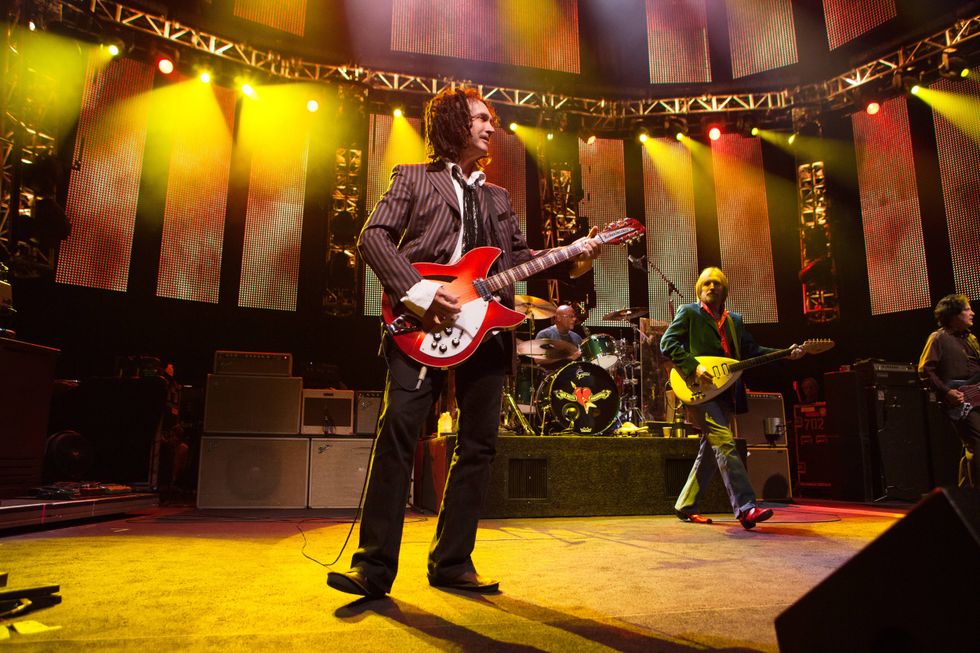
Campbell onstage in 2010 with Petty, the Heartbreakers, and trusty Rick 625/12
Photo by Tim Bugbee
It’s been nine years since Petty’s passing, but in some strange and beautiful ways, Campbell feels like he can summon his friend’s spirit whenever needed. “It’s all part of the grieving process,” he says. “Even though he’s gone, he’s still here and I feel like he’s sitting on my shoulder as I write. I’ll go, ‘Uh-huh, uh-huh, that’s not right. You can do better.’ So he’s around in my psyche.”
As musical partners, Campbell and Petty enjoyed an uncomplicated, intuitive musical bond. In most cases, Petty would come in and play a new song on acoustic guitar, and Campbell would immediately get to work on ways to enhance it. “I think that’s something I was pretty good at, or at least Tom always told me I was,” Campbell says. His manner of working with Chris Holt, who joined the Dirty Knobs in 2022, follows a similar pattern: “I’ll play a song and be like, ‘Here’s the rhythm and the chords,’ with no leads or guitar parts—those will be determined later.”
He laughs. “In a sense, I’ve become Tom and Chris has become me. He’ll interact with me, and if I like something, I’ll say, ‘Yeah, more of that.’ Or if I don’t like it, I’ll say, ‘You know that thing you did? Don’t do that anymore.’ But you know, he’s an incredible musician and I’m so fortunate to have him in the band. I can’t get over it—he sings great, he plays keyboards, and he’s so good on guitar.”
“I play the way I play. I just look at the song in front of me and say, ‘How can I enhance this?’”
So good, in fact, that Campbell now has to share Holt with the Eagles—the Dallas-born musician, who has toured with numerous big-name artists including Don Henley, was recruited by the veteran band to replace long-serving guitarist Steuart Smith in 2025. Campbell says the workaround hasn’t been too problematic.
“Chris came to me and said, ‘I’m going to play the Sphere [in Las Vegas], if that’s okay,’” he recalls. “I said, ‘As long as you don’t get in the way of our gigs, go for it.’ I think I moved our tour back a week or two to allow him to play a few Eagles gigs. The thing with Chris is, it’s great that he’s playing with the Eagles because he gets a lot of money. He gets to play those songs, but he doesn’t have much freedom—it’s pretty well-scripted music. With the Knobs, it’s like anything can happen. Chris loves the spontaneity and the unexpected. I’ll change the setlist in the middle of the show. I’ll just throw a song on—‘How about this one?’ Or ‘Chris, take a solo!’ He doesn’t get that in the Eagles.”
Campbell’s impetuous nature extends to the recording studio, as well. He points to the song “Vicious Hangover” as a one-take wonder that was written “totally live, in, like, two minutes,” and he raves about Holt’s wicked, off-the-cuff soloing. “How about this guy? He plays two solos, and they’re incredible. No matter what I ask of him, I feel like I can count on him to do something good.”
The sweeping, soaring solo on “No Regrets” is a full-glory blast of prime Campbell—set against a bed of chiming 12-string rhythms, it evokes the iconic splendor of his breathtaking lead break on “The Waiting.” To match the defiant tone of “Let Me Back in My Dreams”—it’s almost an extension of Petty’s “I Won’t Back Down”—he breaks out a hard-ass, thrill-laced solo, and doesn’t let up til he empties the tank. It sounds meticulously composed, but like so many of his leads, it’s a moment of unpremeditated wonder.
“I rarely work solos out,” Campbell says. “Even going back to ‘Breakdown,’ I didn’t work that one out. ‘Runnin’ Down a Dream,’ I didn’t work that out, either. It’s like, ‘Put the track up and let me play along.’ I just react to the music, and then I’ll try to emulate the melody so I know I’m in the game. Sometimes it’s a train wreck, but the next time it might be a beautiful thing that surprises me.”
A self-described “child of the ’60s,” Campbell drew inspiration from Brian Wilson for the dramatic title track, on which he consciously tried to mirror certain aspects of the late genius’ production approach. “It needed those sonics, with the background vocals and the odd chords in the middle,” he says. After recording basics with the band, he thought it was a little light on guitar, so he pulled out a wah pedal and added an end solo with a Fender Telecaster equipped with a B-Bender. “I just played it one time to give the song a little edge. It’s one of my favorite songs on the album. I hope people see it as a tribute to Brian Wilson. It wasn’t like I was trying to copy him or anything.”
“Even though [Petty]’s gone, he’s still here and I feel like he’s sitting on my shoulder as I write.”
Over the years, Campbell has amassed an enviable collection of guitars, but for Mission of Mercy, he relied on a small group of mid-’60s Teles, Strats, and Les Pauls, along with his treasured ’59 Les Paul ’burst. “I have guitars in the hallway, and occasionally we’ll go, ‘This might sound good with that one,’” he says. “Mostly we’re in a hurry, and I don’t want to waste time looking for guitars. It’s like, ‘Here, this one’s in tune. Play this one. Let’s get the track down.’”
Throughout the recording process, he found plenty of opportunities to strap on his 1963 Rickenbacker 625/12 12-string, the same guitar Petty borrowed for the cover of Damn the Torpedoes. “I just love the Rickenbacker 12-string,” Campbell says. “I can’t get away with putting some of it on an album.”
He briefly toyed with amp modeling, but he’s gone back to physical amplifiers, and in the studio he called upon a trusty Ampeg Rocket that he’s used since his Heartbreaker days. As for pedals, in addition to a Vox wah, he played through a Line 6 DL4 delay, an EHX POG2 Polyphonic Octave Generator, and a Way Huge Camel Toe Triple Overdrive MK II. “I don’t think they make the Camel Toes anymore,” he notes. “It’s got two overdrives—loud and louder.”
Campbell describes longtime confidante and co-producer George Drakoulias as “a big, lovable, and intelligent grizzly bear” who keeps things moving in the studio. “George knows how to put everybody in a good mood, and the main thing is, I trust him,” he says. “If I’m doing something that I’m not sure about, or maybe I am sure about it, he’ll say, ‘Maybe you should do that again,’ or ‘Maybe that bridge should come later in the song.’ He’s got great instincts and he knows me. He makes me feel comfortable with the microphone.”
One might assume that every item on the guitarist’s bucket list was checked off years ago, but who would imagine that the diehard rock and roller has secretly yearned to play with an orchestra? “It’s a dream I’ve had, and it’s finally come to the point in my life where it’s now or never,” he says. And so, following a summer tour with the Dirty Knobs, Campbell will join the Atlanta Symphony Orchestra for a performance of select Tom Petty and the Heartbreakers hits at Atlanta Symphony Hall this September.
“I have an orchestrator who’s writing out all the string parts for the high-point songs of my career with the Heartbreakers,” he says. “He’s writing parts for cellos and oboes and all that to present the songs in a more magnificent way as opposed to just a rock band. I love orchestra. I love Beethoven, Bach, Mozart—I’ve always listened to that stuff a lot. It’s exciting for me to finally realize an idea I had when I was younger. I’ll probably play a little guitar here and there in the show. I mean, I don’t know yet—we’re still formulating the idea. But some of the charts have been written, and they sound amazing.”
All of which raises the big question: What will he wear for his orchestral debut? Campbell laughs and says, “I don’t know if I should dress up or dress down. I might go against the grain and just go out in cut-offs and a ripped t-shirt.”
He pauses. “No, I’ll probably dress nice. I don’t want to let the people down.”