
If a Jeopardy answer read, “The only musician to work with both Miles Davis and Kiss,” the correct question would be, “Who is Robben Ford?”
Other mix-and-match credits across a 55-year career include Bob Dylan, John Scofield, Bill Frisell, John Mayall, Dizzy Gillespie, Bonnie Raitt, Burt Bacharach, Barbra Streisand, Barry Manilow, Duane Eddy, and more.
At barely 19, the now 74-year-old guitarist joined up with blues harpist Charlie Musselwhite, before forming the Charles Ford Band with brothers Patrick on drums and Mark on harmonica. The short-lived quartet could go from Chess Records blues to John Coltrane jazz as precious few have, then or since.
A pickup gig revived blues singer Jimmy Witherspoon’s career and got Ford spotted by the L.A. Express, leading to a Joni Mitchell tour that melded into George Harrison’s ’74 Dark Horse album and tour. Witherspoon keyboardist Russell Ferrante and Ford later formed the Yellow Jackets.
Session work, solo albums, the blues-rock trio Blue Line, the band Jing Chi, even a cameo with Ann-Margret found a place. A mutual admiration relationship developed with Larry Carlton, who recalled of the first time he saw Ford play live, “There was a fire and a looseness with Robben, an innocence. I responded immediately. I said, ‘I got to get some of that.’”
The effect was similar with Brit guitarist Matt Schofield. Born in 1977, he refers to himself as “a post-Robben Ford player.” “For anyone of my generation,” he stated of the “massive watershed” moment, “he had the biggest vocabulary of anyone up ’til that point.” (Schofield’s bandmate, Johnny Henderson, now plays organ in Robben’s band; “I remember them being 15, 16, 17 in front of the stage at Blue Line shows,” Ford recalls today with a smile.) In 2009, elder statesman George Benson summed up Robben succinctly: “Bad cat, man! Always has been.”
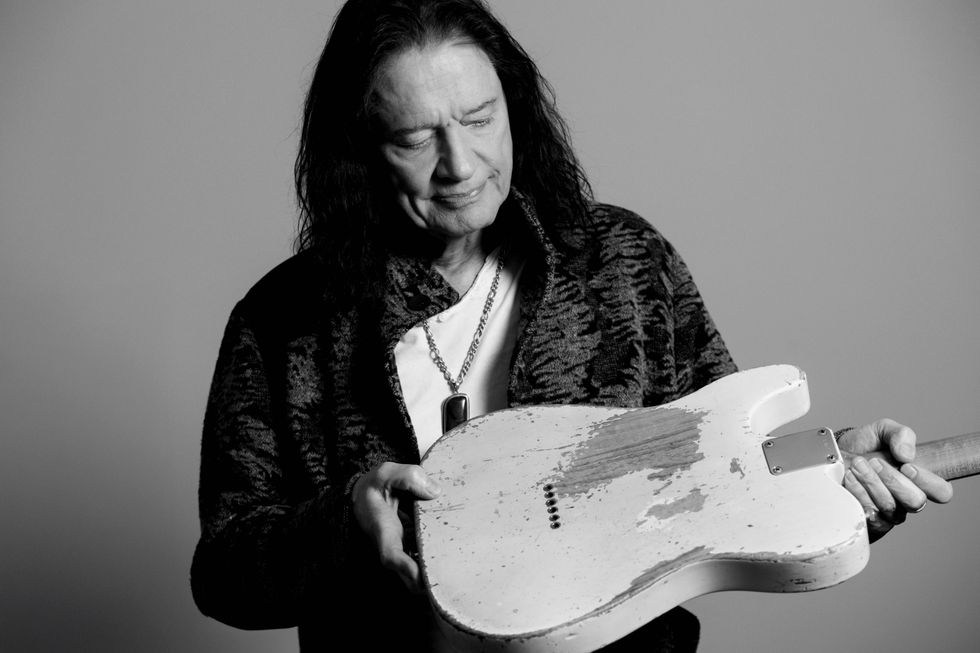
Ford inspects the heavily-worn back of his trusty ’60 Tele.
Photo by Rob Blackham
Robben Ford's Gear
For sessions at Eastcote Studios, London
(w/ Ian Thomas, drums; Johnny Henderson, organ):
Guitars
- 1960 Fender Telecaster
- 1952 Gibson Les Paul with Trapeze Wrap-Over Compensated Tailpiece by Joe Glaser’s Music City Bridge, refretted with 6105 fretwire
- 1959 Gibson J-45, played on “Perfect Illusion”
Amps
- Late-’60s Dumble-modded Fender Deluxe Reverb, provided by studio (used w/ Tele)
- Dumble Overdrive Special for riffs and solos on “Make My Own Weather,” “Black Night,” and melody on “Two Shades of Blue”
- All effects via studio console and gear
Sessions at Sweetwater Studio (for tracks “The Light Fandango,” “Fire Flute,” and “Feeling’s Mutual”)
(w/ Darryl Jones, bass; Larry Goldings, organ; Gary Husband, drums):
Guitar
- Fender Custom Shop 1966 Stratocaster
Amp
- Little Walter “59” with 2x12 “mismatched” speaker cabinet
Effects
- ThroBak Overdrive Boost
- Strymon TimeLine
- JAM Pedals Boomster
- Mad Professor Silver Spring Reverb
- Mad Professor Electric Blue II Chorus Vibrato
Xotic Wah
Strings
- D’Addario (.010–.046)
Whether 19 or 74, Ford can be outspoken, confident, even seem a little cocky. In 2007, he said, “If I’ve got my sound, I’m gonna be good. I’m going to be able to play; I’m going to feel comfortable; I’m going to be ready for anything and happy to be there. As long as I’ve got my sound, for me, it’s not a special space; it’s exactly the space where we should be.”
Now releasing his newest full-length as a leader, Two Shades of Blue, Ford sat down with PG to talk about the guitarists he couldn’t play like—and how long it took for them to finally show up in his playing. He traces the album’s origins as a tribute to Jeff Beck and amp builder Alexander Dumble, explains how a purely instrumental concept evolved into something more, and reflects on how influences absorbed decades ago have a way of arriving right on schedule.
You’ve stated that your new album is never like the one that preceded it. Was there a concept this time?
Robben Ford: This record began as a tribute to Jeff Beck and Alexander Dumble, who of course had passed away. Which is why it’s called Two Shades of Blue. The notion of actually attempting to play music and guitar inspired by Jeff Beck was an incredibly stimulating idea. I kind of felt I was the right guy to do it, because I didn’t grow up playing that way. I had come to believe he was absolutely the greatest of them all in contemporary electric guitar playing and thought, “I can really learn from this.” It was meant to be a totally instrumental album, inspired by him. But I only got three things out of those sessions, recording in the United States with the band I put together for that—Darryl Jones, Larry Goldings and Gary Husband—that I wanted to release. I went to London and got my guys and cut five more things, so it became a combination of Beck-inspired things and songs I was performing with my group at that time.
“I had a great drive to play like the people I admired—but I didn’t know what they were doing, so I just did what I could.”
Was there a specific Jeff Beck period or album that you gravitated to?
I kind of had in mind the [1989] Guitar Shop record, with Terry Bozzio on drums and a keyboard player [Tony Hymas]. The closest thing to what I wound up doing would have been that. On the tour we had a little trio of songs for a portion of the show: “Behind the Veil,” “Goodbye Pork Pie Hat,” and “Big Block.”
You’ve talked at length about Mike Bloomfield’s influence on your playing. Who might have qualified as a guitar inspiration prior to that?
Well, there wasn’t anyone before Bloomfield. I was 15 when I first heard that. [laughs]
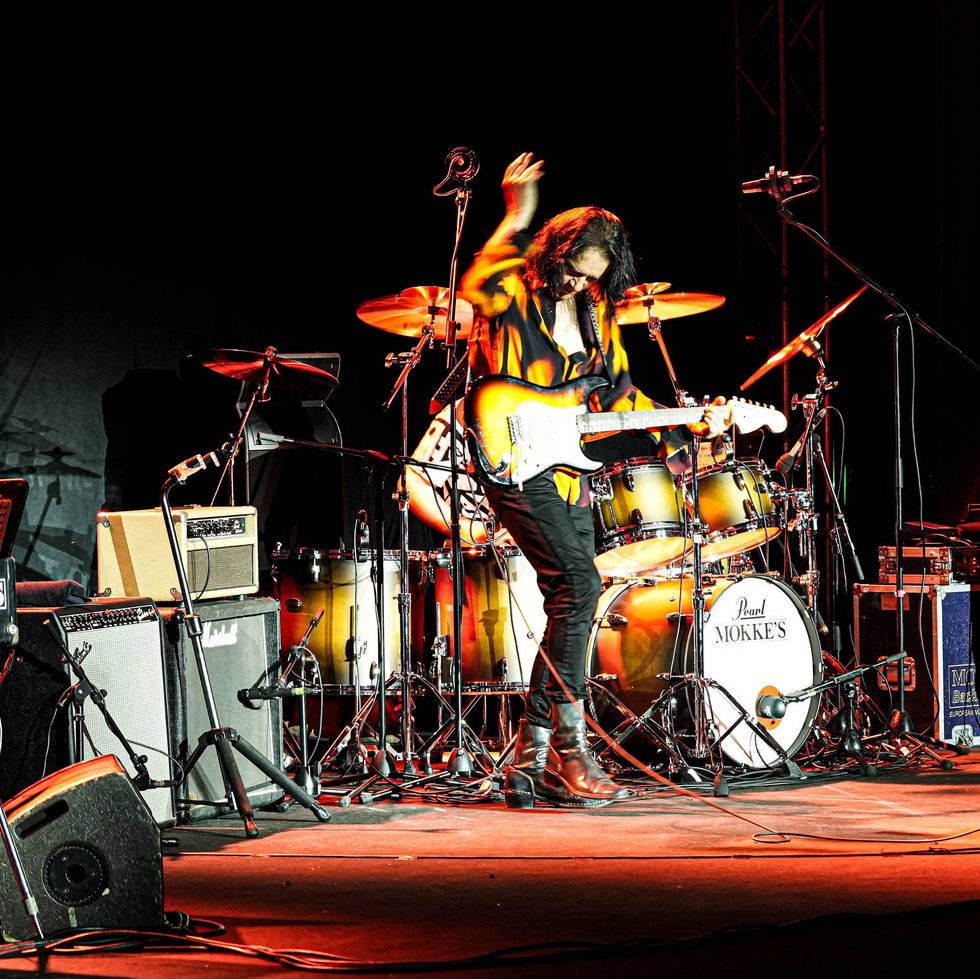
Ford and Strat, onstage in Italy in 2025
Photo by Kelly Roberts
Before you found the [1965] self-titled Paul Butterfield Blues Band album, had you heard anything that qualified as a blues act?
I was a big fan of the Animals. Eric Burdon in particular, because of his vocal delivery. I liked everybody in those days. Jeff Beck on “Over Under Sideways Down”; I liked Paul Revere & the Raiders; everybody sounded good to me. But that’s why the Bloomfield thing was such a revelation. That’s when guitar came alive for me. Of course I liked all the other stuff, but I was a baby. “This is great!” I was seeing bands on TV, and they looked cool and sounded cool. And then came Bloomfield. That’s why I became obsessed with him. Then Eric Clapton and B.B. King.
One of your calling cards is the way you incorporate jazz elements into blues. Besides horn players, were there jazz guitarists you listened to?
I was listening to Jim Hall and Kenny Burrell, but I had no idea what they were doing. The blues, I could hear it and I could find it quickly. It was just listening, listening, listening. In a pretty short period of time I was listening almost exclusively to Miles Davis, Coltrane, Wayne Shorter, and also Herbie Hancock and McCoy Tyner. That’s just where my ears went. That’s what excited me. A good part of that was, “I don’t know what they’re doing, and I sure wish I did.”
“I looked to my left, and there was that Telecaster. I walked straight over to it and started to play it, and I thought, ‘This is the best guitar I’ve played in my life.’”
When you were 19 and in Charlie Musselwhite's band, the influence of the blues guitarists you mentioned was evident, but later, you went through an Albert Collins period.
Oh, yeah. He became a real deal. There were people I listened to but couldn’t play like—B.B. King, I couldn’t play like him, or Albert Collins or Jimi Hendrix or Albert King. But later on, when I was in my 30s, Albert Collins started to surface in my playing. It was in my 40s that Jimi Hendrix started influencing my playing, and that was more the chordal aspect, like “The Wind Cries Mary,” “Castles Made of Sand”—that kind of R&B thing he had that was so cool. B.B. King was also later. I used to fake it, but later on I found my own way to do it. I had a little more of the aspect of channeling. Like Mike Bloomfield was kind of channeling it. But there wasn’t anybody else that I could play like. I couldn’t play like Eric Clapton or anybody. But I could play like Mike Bloomfield. [laughs] So eventually these things started coming into my playing, and I was like, “Wow! There it is, finally, after 20 or 30 or 40 years!”
But it didn’t take you very long to have a voice that was unique.
That’s the horn players—listening to them and trying to duplicate what they were doing. Not being able to do it, but doing something like it. I had a great drive to play like the people I admired—but I didn’t know what they were doing, so I just did what I could. Rather than trying to sound like somebody else, or trying to sound like people that I couldn’t sound like. And yeah, something happened there.
In the early ’80s, I was a big fan of the Talking Heads. I was like, “How do these guys sound like that?” What they were trying to do in the beginning was sound like James Brown. [laughs] They were trying to sound like people that they couldn’t possibly sound like; therefore, their own thing was created. Like that, I was trying to do something I couldn’t possibly do, but I created something of my own through that process.
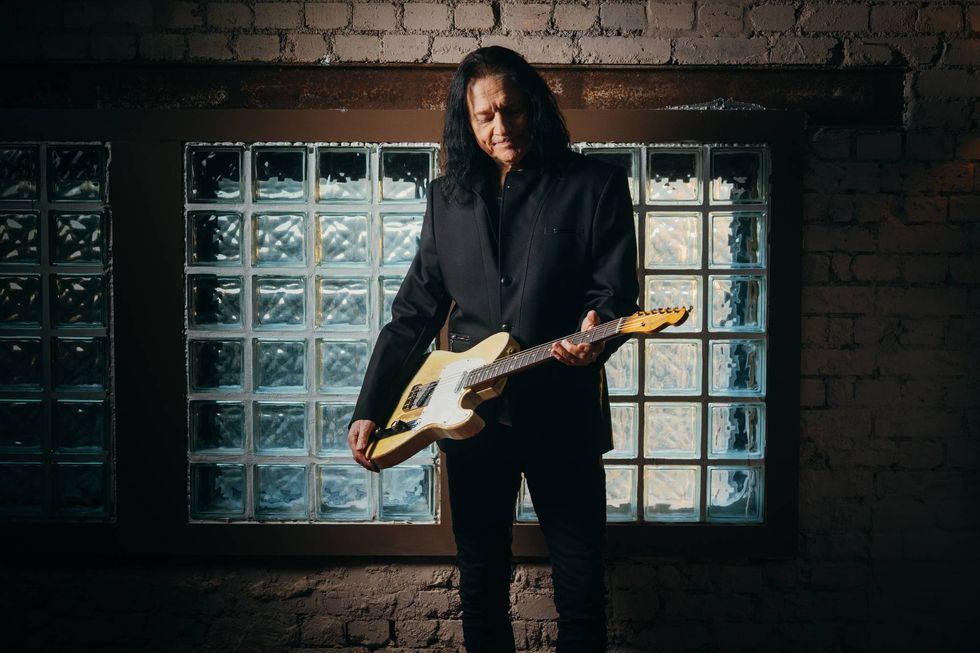
Ford with the “best guitar [he’s] ever played.”
Photo by Rob Blackham
You’re thought of primarily as working in the blues, jazz, and rock idioms, but in your rhythm playing especially there’s a lot of soul and funk.
The thing is, I never studied it. It just sort of started happening. In particular, on the Mystic Mile record, something happened there with Roscoe Beck’s song, “Say What’s on Your Mind.” I’d never played guitar like that, and it sounds like I’ve been playing it all my life. It’s sort of like, “Wow, I like this.” It’s more for me kind of Hendrix-y, but it’s also Steve Cropper. Somehow it just started coming through. Having never really done that, that kind of evolution was really great for me. I love when these influences are decades old, and now here they come.
There was blues guitar before you, and then you helped trigger a change—things like the half-step, whole-step scale you use. Other blues players weren't doing that.
It’s just the diminished scale, a series of half-step, whole-step, half-step, whole-step. That was the jazz influence. It was Larry Coryell who turned me on to that. Patrick and I were playing with Charlie at the Ash Grove opposite Larry Coryell for three nights. Backstage I asked him, “How do you play all that ‘out’ stuff?” Horrible question. I hate that question, and I asked it. [laughs] I was just as ignorant as others. Because there’s no such thing. It just sounds like it’s “out.” He said, “I just use the half-step, whole-step scale.” So I went home that night, picked up my guitar, and went, “Okay, G-Ab-Bb-B.” I worked it out, and I heard Miles Davis in it, like what he was doing on Bitches Brew, that period when he’d gone electric. I was like, “This is what I need.” I got way off into using that scale. And being in a blues band and not having a clue what jazz musicians were doing, I just applied it to blues.
“I was trying to do something I couldn’t possibly do, but I created something of my own through that process.”
You were well established as a player before the Telecaster became your main guitar. What finally brought you to it?
I bought that guitar in 1991. We were on tour with the Blue Line, and I was playing the Fender Esprit Ultra, and I went into a music shop in San Francisco called Black Market just to buy some strings. I looked to my left, and there was that Telecaster. I walked straight over to it and started to play it, and I thought, “This is the best guitar I’ve played in my life.” Not because it was a Tele; just because it was a great guitar. This is how I accept things. Telecaster, Stratocaster, Byrdland, whatever. I thought, “This is a great guitar. And I can’t leave it here in this store.” That happens very rarely. It’s been kind of a mainstay ever since.
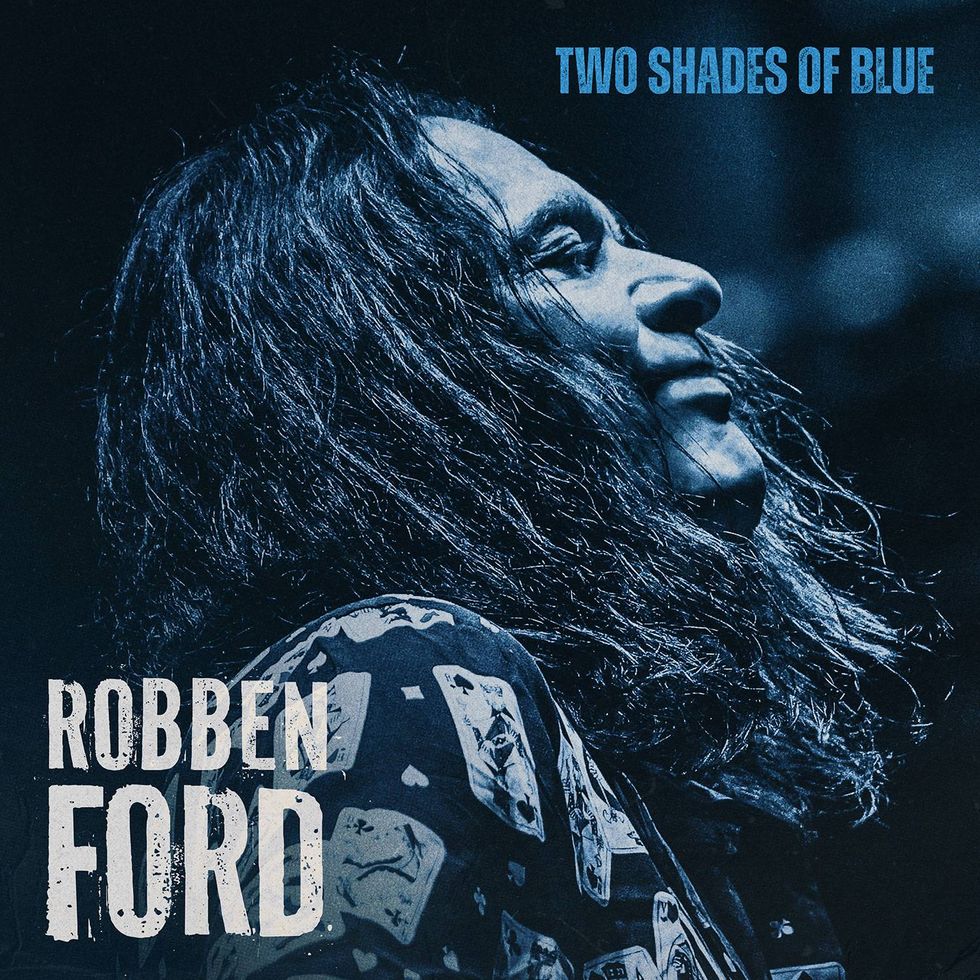
Ford’s new album pays tribute to Jeff Beck and legendary amp maker Alexander Dumble.
What’s the story behind your pristine ’52 goldtop?
Daniel Steinhardt, who co-hosts That Pedal Show, found the guitar for me at ATB Guitars, a two-hour drive west from London. It is the most mint guitar of that vintage that I’ve ever seen. It’s ridiculous. Daniel joked, “Somebody put it in a vault, and they took it out just to sell it to you.” I’m born at the very end of ’51, so this guitar and I are about five or six months apart. I like to say we were separated at birth.
Coming back to the new album, I wanted to ask you about your cover of John Lennon’s “Jealous Guy.” What led you to start covering that song?
I always liked the Donny Hathaway version, and I actually wasn’t familiar with John Lennon’s. I didn’t know who wrote it; I just dug it. It always kind of lingered with me. I thought, “I should try this”—just as a challenge. I had to change the key, but those are the things you learn with experience and time. You don’t have to sing it in the same key as John Lennon if it doesn’t fit your voice. It became a question of, what can I do with this song? And people just flip out every time we do it.
It took me years to evolve into what I think of as a good singer. But at the shows, I feel more connected with an audience if I’m singing to them. And that’s what you want. You want to feel connected to those people out there.