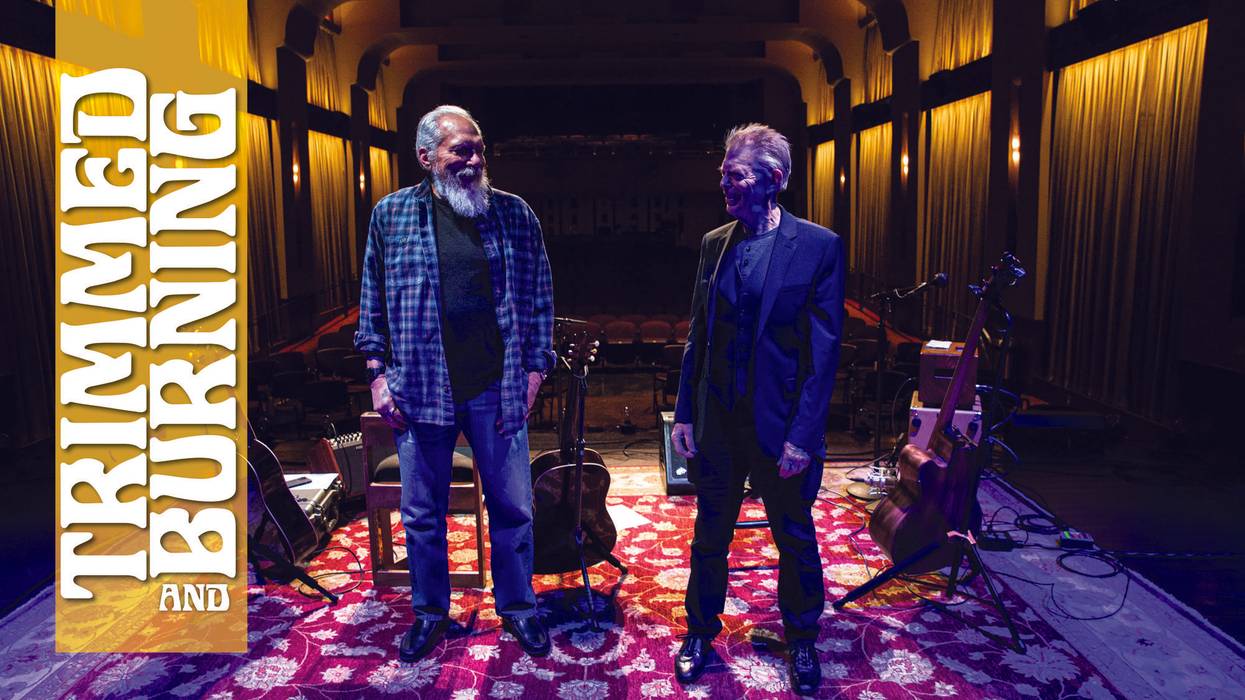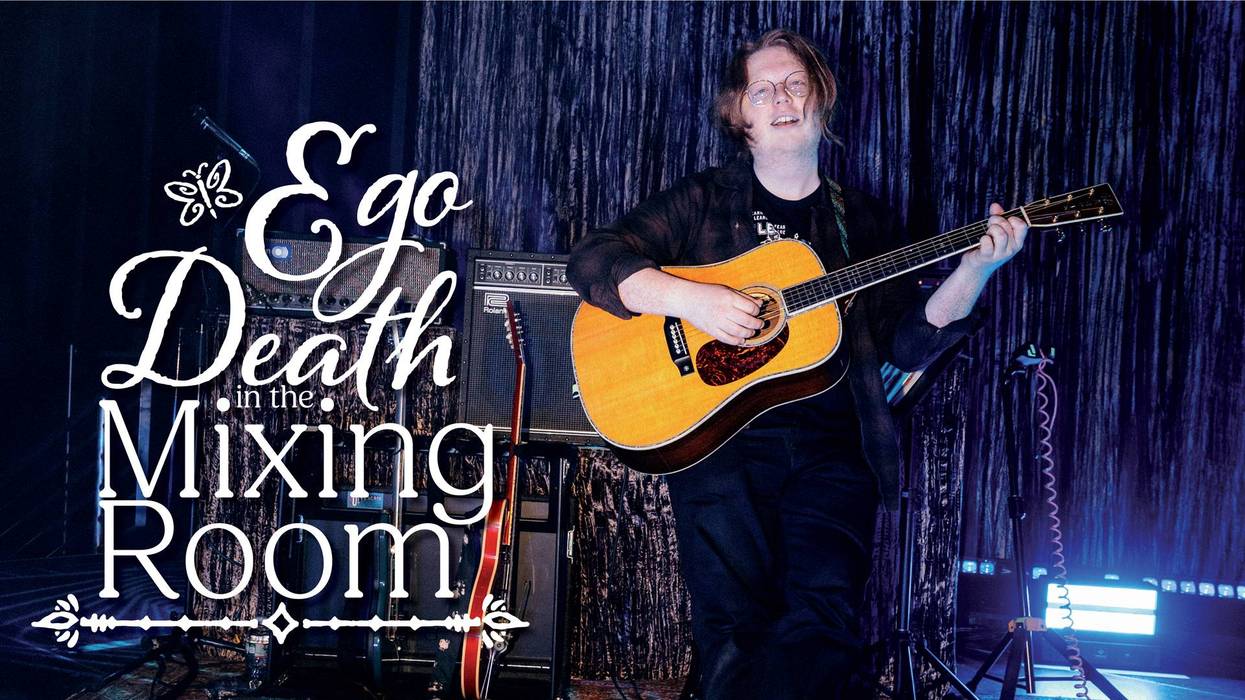
Bill Frisell lives in a perpetual cycle of activity. For decades, he’s jumped from project to project, a new album with a new configuration of collaborators always on the horizon, dates constantly being added with a growing swath of different projects. In a given month, he could be playing gigs on any continent with one group and heading to another, then back again. It’s a way of life that keeps his musical universe expanding in every sonic direction all at once. And through it all, no matter how diverse the musical setting, he’s always so undeniably himself. As Neil Young famously said, “It’s all one song.”
It’s exciting to be a Frisell devotee, and it always has been. And when we caught up over video recently, I, of course, wanted to ask about his new album, In My Dreams, which features four of his long-time collaborators—a rhythm section of bassist Thomas Morgan and drummer Rudy Royston, and a string section of violinists Jenny Scheinman and Eyvind Kang, with cellist Hank Roberts. To hear Frisell in any situation is always a gift, but long-time relationships like these are so rare, this is one to cherish.
Given the forward-facing nature of Frisell’s work, though, it’s easy to talk about what’s happening now and what’s next. The downside of that approach is that we don’t get to check back in on things. With a series of concerts celebrating his 75th birthday coming up when we spoke, it struck me that I hadn't really heard—or read—him discuss the Telecaster much since it became his de facto guitar of choice in the 2000s, effectively revolutionizing the instrument’s possibilities for adventurous jazz players everywhere. (That’s not to imply that Frisell is the first guy to play jazz on a Tele—arguably, that distinction belongs to Jimmy Bryant. But when Frisell plugged in a Tele and his pedals, something shifted across the entire jazz and jazz-adjacent guitar universe.) Sure, he’s talked about this a ton and it’s all out there on the internet. But have his feelings evolved? I’ve seen Frisell play quite the assortment of different guitars, but the Tele remains his mainstay. What is it that keeps him coming back to it, as well as acquiring new variations from builders like JW Black and Creston Lea, all these years later?
“A Telecaster, it can withstand the most ridiculous dropping and throwing it around. And if it breaks, you can just screw it back together.”
As we caught up, I casually dropped a reference to Ornette Coleman’s Prime Time band and we veered off into a story that, although it’s not tied to the guitar or the album, demanded to be included here. If there’s a loose theme to this conversation, it’s the idea of dreams. And not only did this story have me cracking up, I think it’s the kind of anecdote that pulls together a worldview, both personally and musically, about the surreality of life and long-term thinking. If nothing else, it brightened my day.
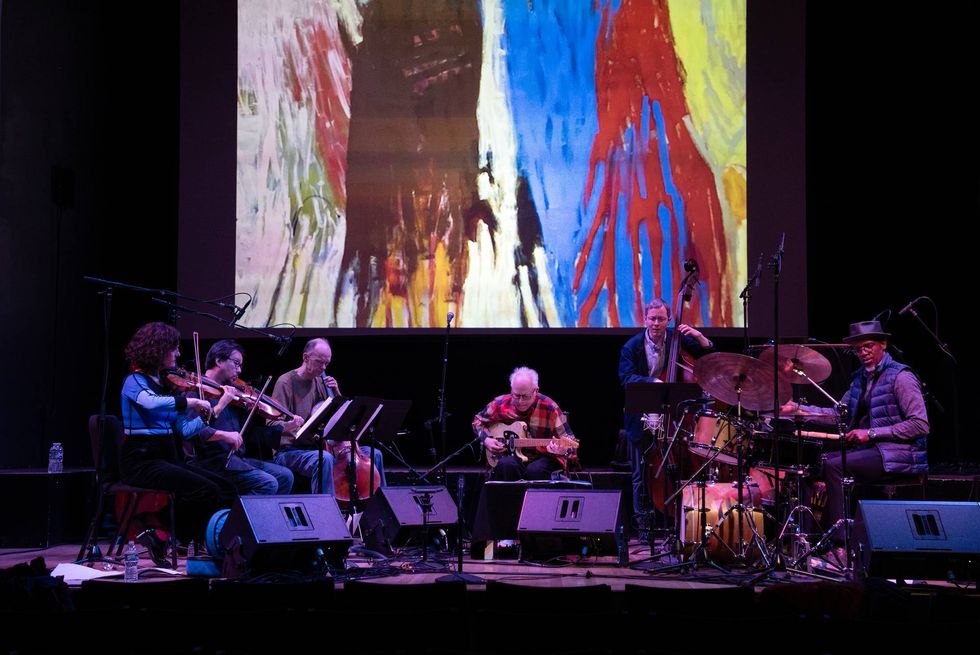
From left: Jenny Scheinman, Eyvind Kang, Hank Roberts, Frisell, Thomas Morgan, and Rudy Royston.
Photo by Kyra Kverno
You’ve been playing Telecasters for a while now, but you keep developing your relationship with the model, and also acquiring new ones. What keeps you excited about the Tele?
Bill Frisell: Pretty much everything is there that you need. There’s the thing about the familiarity with where everything is. If you have a Telecaster, you know the volume control’s here, and the switch is here, so all the instinctual things are there. But having said that, it also becomes this open platform. I have a couple just stock or normal Teles, and even there, there’s so much variety—if there’s a rosewood fingerboard or a maple fingerboard, they sound different. The exact same model guitar even from the same year … it seduces you. You play one and there’s some overtones that come out that don’t come out in another. Even from the most straight ahead one, there’s enough variation that can lure you into trying another one.
I have some that have a humbucker, and some that are straight, and some that have a P-90, then at the same time I can switch around and everything is where I know it will be.
The weight and placement of everything is going to be different if you pick up a Jaguar or something else.
And I have a Jaguar and I love a Jaguar! When I was a kid, the first guitar I got was a Fender Mustang, when I was 14, I guess. And then not long after that, I went to a pawn shop—and I’m talking about the mid, late ’60s, when Fender guitars that had maple necks were just, like, “that old junk, nobody wants that.” You’d go to a pawn shop and there’d be all these ’50s Strats and Teles hanging there for nothing, 50 bucks or whatever it was. I went to this pawn shop and I got an Esquire. If I remember, it was a top-loader. I bought it for $75, just to have a bigger guitar. So, that shape and weight and size is in my blood from when I was 15 years old.
“I’m just so lucky with the folks I’m playing with. They’re my best friends, and we’re all doing it together.”
Having said all that, I also love playing archtop guitars. I love my Collings—I have an I-30 and an I-35 that are awesome, they’re incredible. But I’m a little more nervous about them. There’s a thing about a Telecaster. I travel so much and I don’t have roadies, I’ve gotta carry all my stuff, and I gave up on trying to carry it onto the plane, so I just check it. A Telecaster, it can withstand the most ridiculous dropping and throwing it around. And if it breaks, you can just screw it back together. So, there’s also that aspect, that it’s just super practical.
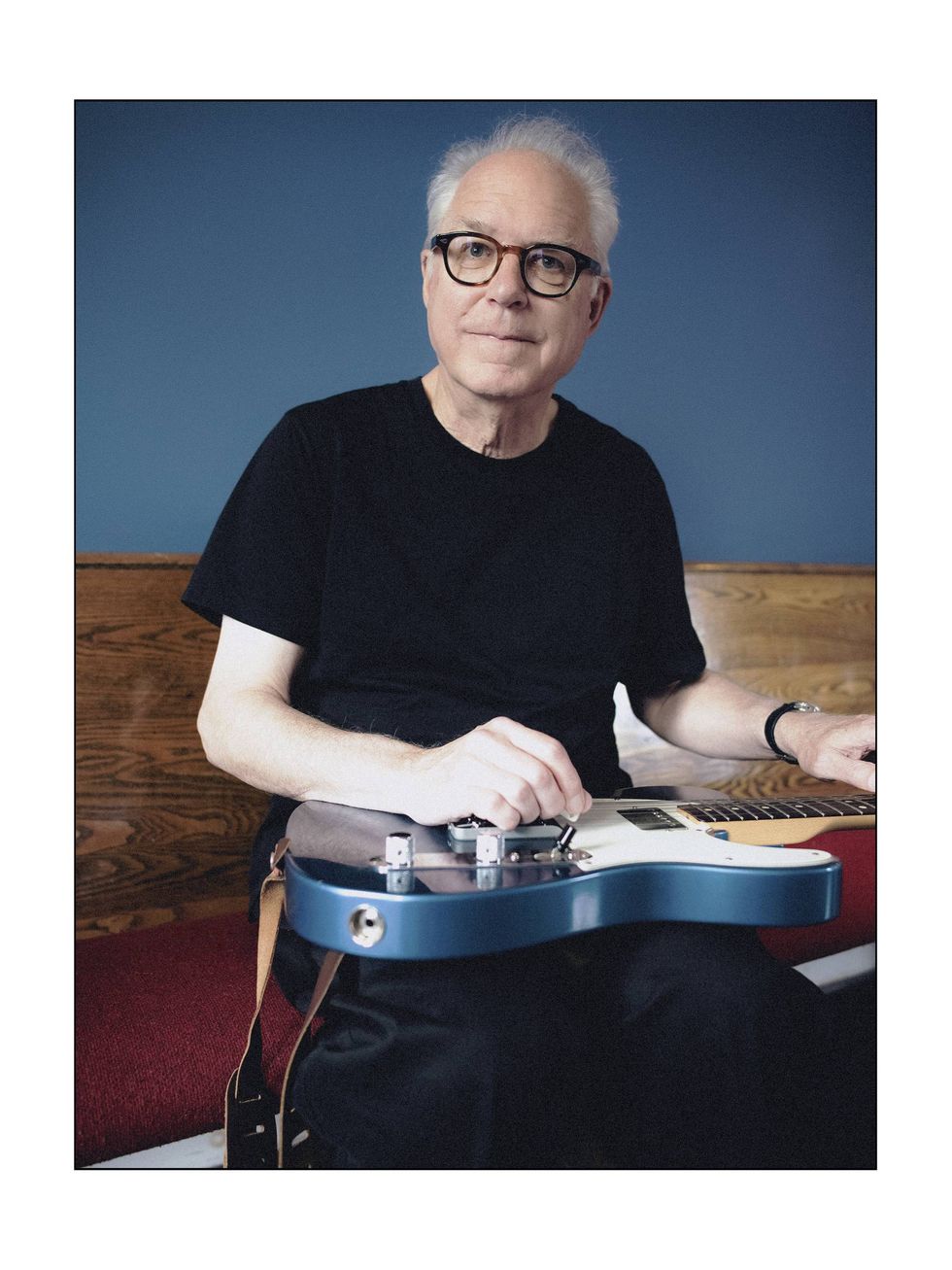
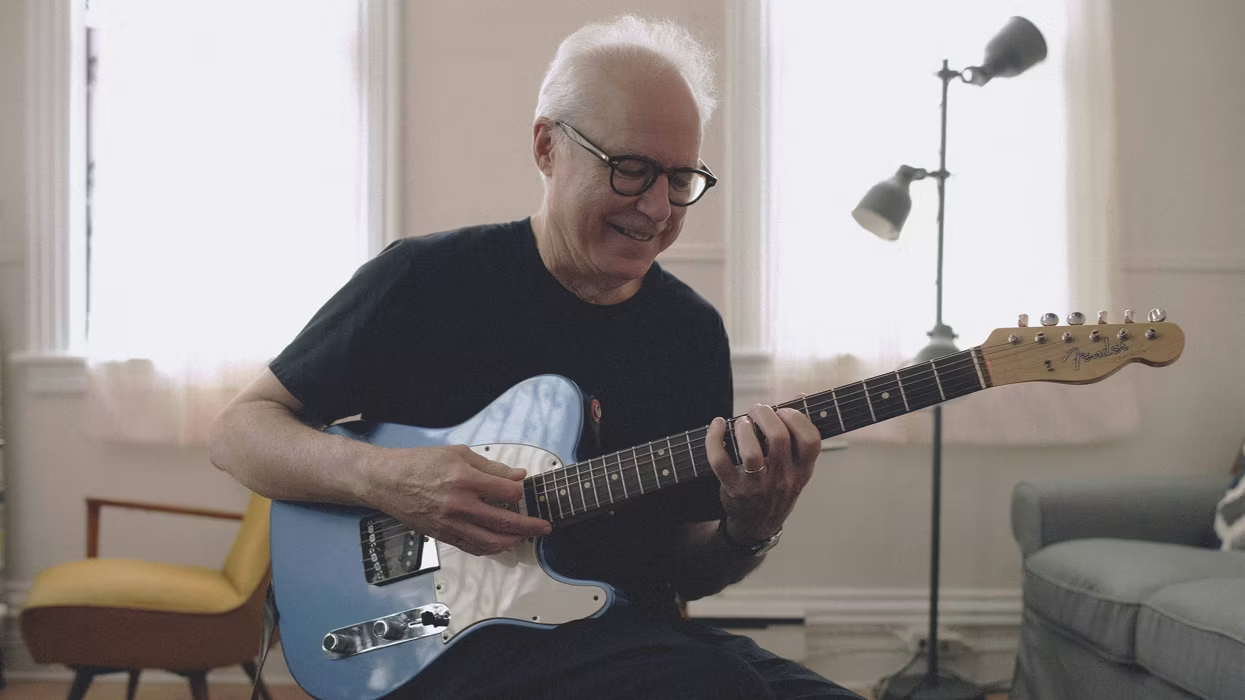
Frisell, seen here with a blue neck-humbucker-loaded model, remains inspired by the Telecaster.
Photo by Marko Mijailovic
What kind of case do you use these days?
The case probably costs more than the guitar. It’s a Hoffee, it’s carbon fiber, and it’s really light. You can’t carry stuff on [airplanes] any more. So far it’s gotten lost a couple times, but I got it back. They haven’t broken it yet.
And then I have a Calton case for the Collings. But just because it’s a much more fragile instrument—it’s solid—I don’t feel comfortable throwing that thing around as I do a Tele. And the case is much heavier, too.
You've been traveling all over the world for a long time now, and as you said, it's only gotten harder. You're constantly moving from one group to another, one location to the next. I find that variety inspiring—why is it so important to you?
With travel, it just seems like a miracle the way music can lift you up. Sometimes it’s just absurd when you think of how many hours we’ll spend to get somewhere. You don’t sleep, you travel for 12 hours, and then you get to some place where you’re gonna play for like an hour. The ratio is way out of whack.
So, I get there and I’m feeling like, “I can’t hardly stand up, how am I gonna do this?” But as soon as the music starts, it’s bam! It’s not just adrenaline, it’s the power of the music, and it blows my mind how it just keeps happening like that. I can’t imagine stopping doing it.
It’s like they keep throwing these roadblocks up in front of you, but it’s like, “Fuck you, I’m gonna do this. I wanna play.” And I’m just so lucky with the folks I’m playing with. They’re my best friends and we’re all doing it together. It’s this ever-expanding family of folks I get to play with. It’s so exciting. It’s not just one group, and even if it’s the same group, the music is changing from night to night.
Everybody’s doing their own thing as well. Folks go off somewhere and then we come back, and then they have news from somewhere else. Everyone’s learning and traveling around, and we stay together for periods of time, and when they come back, they have some other thing they learned from someone else, and they bring that. It’s this snowball effect of inspiring each other all the time.
Do you have a secret to staying healthy when you’re traveling?
No … just hoping for the best.
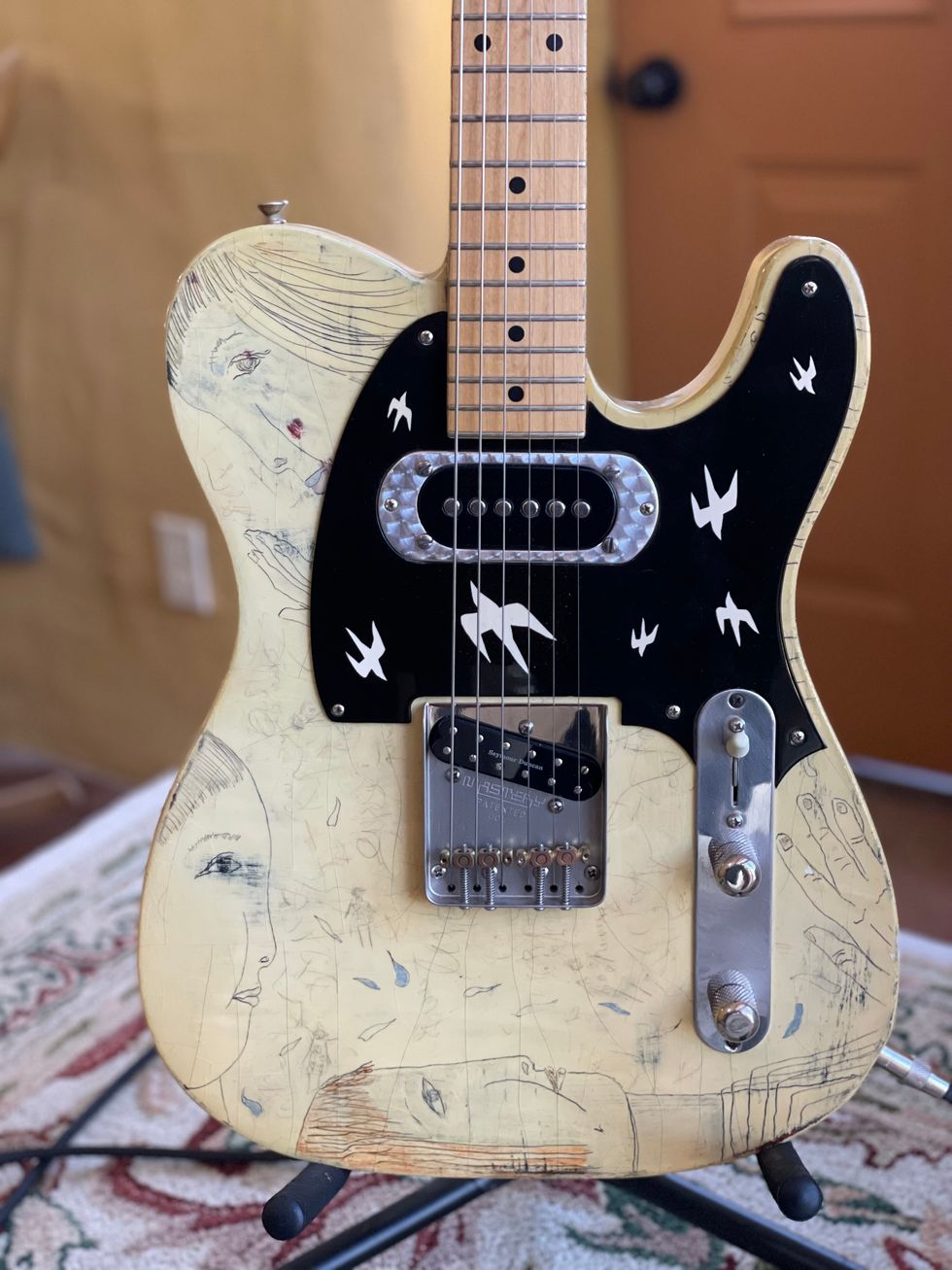
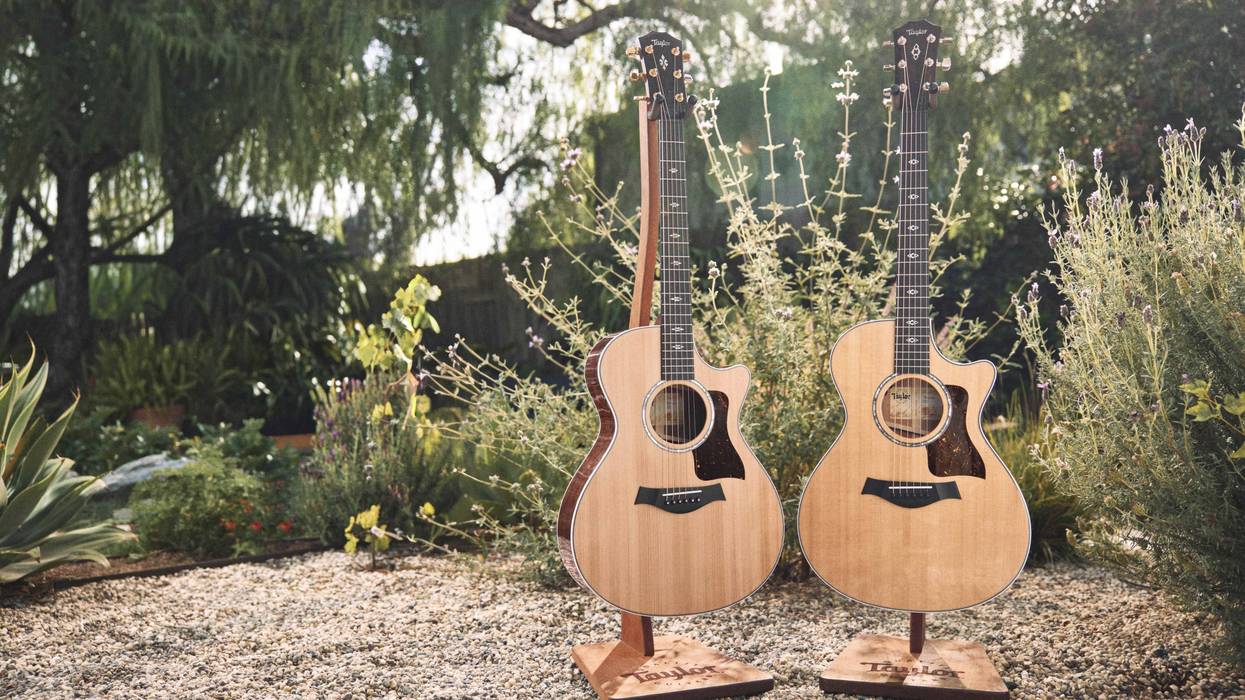
This JW Black T-Style was used on Frisell’s In My Dreams and features artwork from Seattle artist Terry Turrell.
Bill Frisell’s Gear List
Guitars
JW Black T-Style custom painted by Terry Turrell (24 3/4” scale with Mastery bridge, TK Smith neck pickup, Seymour Duncan Little ’59 bridge pickup, neck plate by Eric Daw)
Early 1960s Gibson J-45 (belongs to producer Lee Townsend)
Amps
Carr Sportsman
Fender Deluxe Reverb
Pedals
TC Electronic Polytune 3 Mini
Jam Pedals Rattler
Line 6 DL4 MkII
MXR Carbon Copy Mini
Strymon Flint Reverb & Tremolo
Strymon Ojai power supply
Strings, Picks, and Cables
D’Addario Chromes (.011–.050 with unwound G)
Apollo picks
Divine Noise cables
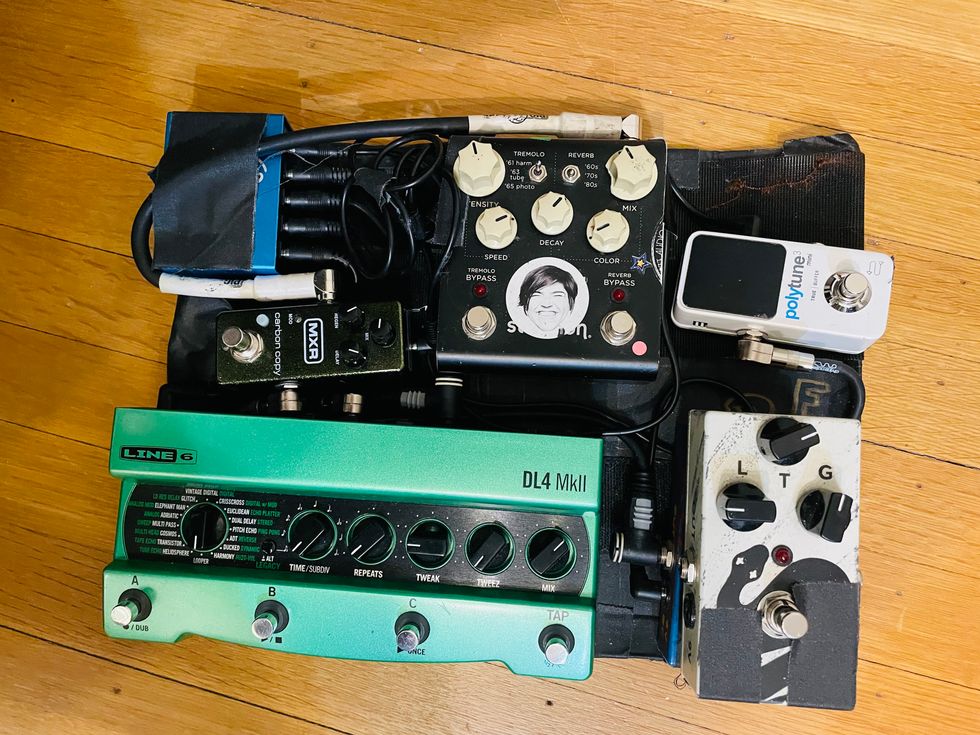
A constant traveller, Frisell keeps his board simple.
With your albums, I always love hearing a favorite song turn up in a new setting. On In My Dreams, you revisit “When We Go” and “Again”—songs you’ve surely played many times with the musicians on this album over the years.
“When We Go,” maybe I played that with Hank 40 years ago or something. That one, I can’t remember how it came into my mind to play. And “Again,” I don’t think I’d played with Rudy or Thomas, but I might have played it with Hank.
I met Hank more than 50 years ago! We met when I went back to Berklee in 1975. Pretty soon after that, we started playing. He was around before I ever even wrote a tune. He was in my first band that I ever tried to put together. There’s an album called Lookout for Hope with Kermit Driscoll and Joey Baron, and Hank’s on that.
My daughter was born at the end of 1985, and that was right around the time I got those guys together. I’d made two albums before that, but this was like, now I’m going to have my own band.
Before my wife and I had our daughter, I received some great life advice about how having a family would help me focus my creativity from friend, sometime collaborator, and all-around inspiration Jamaaladeen Tacuma [of Ornette Coleman’s Prime Time band].
The first time I saw Ornette Coleman was in 1979. This is a crazy story. Do you want to veer off for a moment?
Yeah—this sounds interesting.
I was in Boston in the mid ’70s, and I moved to Belgium and lived there for a year. That’s where I met my wife. We were living in a jazz club in a tiny little town called Spa. This Belgian saxophone player Steve Houben, invited us all—guys from Boston—to move to Belgium and start a band. It was this incredible year of living above this jazz club. We’re in this tiny town and all these people would come—Art Blakey, Art Ensemble of Chicago, Dexter Gordon, Woody Shaw, Betty Carter, on and on. They’d feed us spaghetti and we’d play for a bit, and that’s how we lived for a while. I met my wife, she worked in the bar.
I’d never seen Ornette Coleman, and I was just like, “Man, I’ve got to see Ornette Coleman.” And we found out he was coming to the North Sea Jazz Festival. We drove all night, it was in Den Haag. It was an early version of Prime Time. It was “Blood” Ulmer and Bern Nix and Jamaaladeen, and I’m pretty sure it was Shannon Jackson.
I wasn’t doing drugs or anything. I swear. Nothing. Maybe I had a beer or something. But we go into this big auditorium, and it was like, “What is this?” It was so drastically different from what I was expecting to hear from Ornette. And he was wearing this fluorescent suit. It was so far out.
So, I saw the gig, and it was in the afternoon, and I was so happy that I saw Ornette. It was in this festival situation and it’s really crowded. I’d gone there especially to see Ornette, but then I’d gone and seen Oscar Peterson, I saw Stefan Grappelli, Anthony Braxton. I’m walking around and walking through this mass of people, and I had a Coke, and I’m holding it in my hand and Ornette comes up to me and he goes, “Where’d ya get that Coke?” And I’m like: What the fuck? Ornette just talked to me! I came all the way here to see him, and he just talked to me. So I said just over there’s this concession stand.
Now, I swear this is true, I’m not dreaming. The day goes on, and I go see some other stuff. And I’m tired and I’m getting kind of burned out. It was in this convention center, and there’s this door and a stairway. So I open the door and I’m sitting on the stairs, just resting next to the door. There’s a knock on the door, and it’s Ornette, again. And he says, “What’s back here?” And I go, “I don’t know … nothing.” And the door closes and he goes away. And I couldn’t believe it.
Some years later, I got to play with him a little bit. The last time I was at Ornette’s place, he kept going to the refrigerator and getting Cokes out of the refrigerator and he’d say “Do you want a Coke?” Like … what is going on with this?
You have a story about how the true sound of music was once revealed to you in a dream, and this record is called In My Dreams. How important are dreams to your music? And how important is the goal of recreating that sound that was revealed?
I’ll never get that. I wish I could bring that dream back. It was one of those things where I know forever that you can’t get there, but I keep reaching for this beauty. You know, you get closer and it gets farther away and you get closer. But that’s just the deal. You just keep striving for that. It’s something I know, anyway. You have to love being in whatever the struggle is you’re going through, the hope that you’re going to find something.
The whole idea of having a goal, it doesn’t quite work. You set up these little goals, you want to learn more, but then the goalpost keeps moving, or you do achieve something, then you realize by doing that, you just messed up this other thing. Then you struggle with that. So there’s that with dreaming.
I’m fascinated with that thing, like the way a dream, when you’re sleeping and you wake up, it’s just like a vapor—“Wait, what was that?” It’s so hard to grasp that. There’s a place you go, and you’re there, and you want to bring something back into this realm, but it’s so elusive.
That’s kind of like when you’re playing music, and you’re really in it, and the moment you realize something good is happening, it’s gone again. To try to stay in that state where you’re really not sure what’s going on, and you’re just in it and you’re playing, that’s the most amazing feeling.
But then there’s also the dream of Martin Luther King, especially these days. Somehow, we have to keep dreaming. We have to get through this, whatever this mess is that’s going on right now, and not get beaten down. Music is the place, again, where I feel things come together in a beautiful way. You know, all the things you do in music, you listen to each other, and you share things, and you watch out for each other, it’s all in music. There’s all kinds of dream stuff you can go off on.