
Guitar virtuoso/singer-songwriter Paul Gilbert’s latest release, WROC, a homophone of “rock,” is based on George Washington’s Rules of Civility and Decent Behaviour In Company and Conversation. Yes, the George Washington you learned about in middle school—Gilbert’s one of the few people on the planet that can make a history lesson fun!
While Gilbert’s peers in his early metal days were more inclined to doodle pentagrams and flip through the Satanic Bible, Gilbert had vastly different interests. “I read a bunch of Founding Father writings decades ago,” he explains to PG. “I was curious, so I bought the full, thick compendium of everything written by Ben Franklin, Thomas Jefferson, and George Washington. There are no stories there; instead it’s almost like finding somebody’s emails from hundreds of years ago. That was the first time I came across Washington’s Rules of Civility, and the idea of being more civil, of having better manners, somehow that was appealing to me.”
In February of last year, Gilbert had just wrapped up the final concert of Mr. Big’s “The Big Finale” tour at Tokyo’s storied Budokan, and on the flight home, both inspiration and Rules of Civility struck. “I was thinking, ‘Okay, it’s a new start for me,’ and I was excited about what to do next. I had an internet connection on the plane, and that excitement turned into this conversation with AI,” he recalls. “I couldn’t remember what they were called, I just sort of remembered there were these rules that Washington tried to follow when he was a kid. So I Googled around and asked AI, and refreshed my memory.”
Gilbert and his chatbot then worked in tandem to dissect lyrics out of Washington’s rules. “I said, ‘Take a random Washington rule and turn it into a blues lyric.’ And in three seconds, I got this Washington rule turned into a blues lyric,” he says. Gilbert then proceeded to ask AI to do additional things: Make the chorus repeat more. Find a different Washington rule for the bridge. “I was sort of telling AI what to do. That was my initial process,” he says. “As I went on, I realized it was better if I did it myself, because I know what I want. So then my conversation with AI changed. Instead of having AI do it, I said, ‘AI, give me the list of rules.’ There’s 110 of them, so I said, ‘Put them in order according to length—the short ones first and the longest last.’ That way, when I’m searching around, if I just need a short line, I don’t have to hunt through the whole book.”
Washington’s rules were the perfect springboard for Gilbert. “I love writing from a lyric—it’s so much easier than any other way of songwriting,” he says. “It was maybe the most fun I’ve ever had writing songs in my life. It’s almost escapism—I can get out of myself and enter some other world. I would take [Washington’s] lines and try to make it into a melody. Then once I had that, all the jobs that follow are my favorite jobs. I love finding chords for a melody, I love the balance of repetition—but not too much. You get to that point where it’s like, ‘Okay, that’s too many repeats, I’ve got to pull it back and find, like, a weird note that I haven’t used yet.’ And that will inspire a chord I didn’t think of. That whole craft is something I really have fun with.”

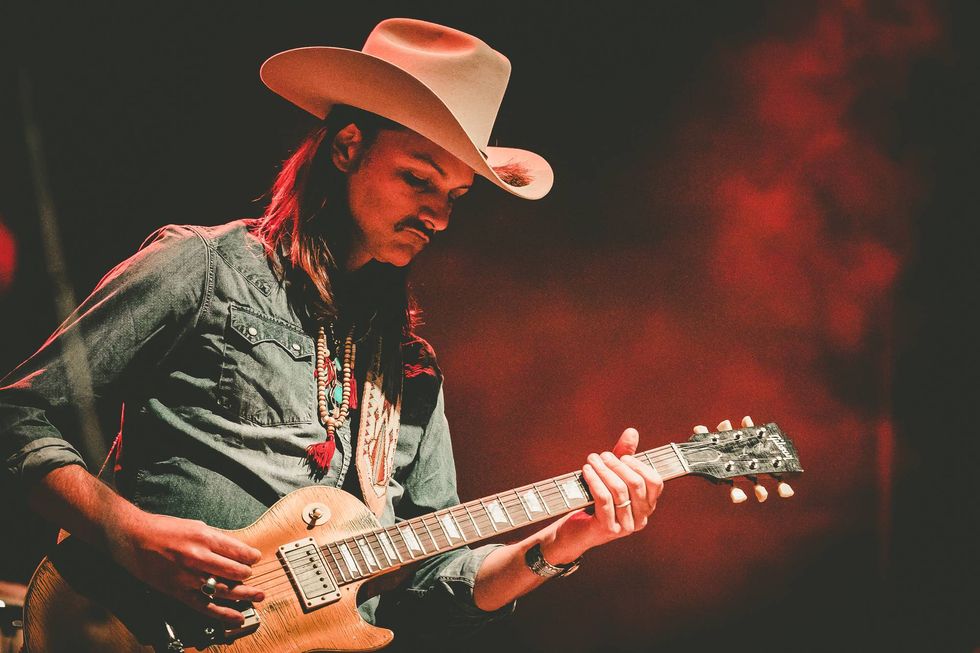
Gilbert wails on his Ibanez during a recent gig.
Simone Cecchetti
Paul Gilbert’s Gear
Guitars (live)
*Paul uses DiMarzio pickups in all his guitars
Ibanez FRM350 Paul Gilbert signature
Ibanez PGM50 Paul Gilbert Signature
1970s Ibanez IC200
Ibanez RS530
Ibanez Custom Shop PGM Paul Gilbert Signature (pink)
1970s Ibanez double neck (set neck version)
Guitars (studio)
Ibanez AS7312
1970s Ibanez 751 acoustic
Amps
1990s Fender Custom Vibrolux Reverb into a Randall isolation cabinet
1960s Fender Vibrolux Reverb as a wedge monitor
Victoria Club Deluxe (turned on for solos as a volume boost)
Effects
Distortion pedals for main amp:
Xotic AC Booster (always on)
JHS Overdrive Preamp
Mojo Hand Colossus
Distortion pedals for solo boost amp:
MXR Distortion+
Xotic AC Booster
Voodoo Labs Pedal Power 2 Plus
Boss LS-2 Line Selector (Gilbert has two: one to switch between distortion and clean, the other to switch on solo boost amp)
“Clean” pedals:
Boss CS-3 Compression Sustainer
Catalinbread Callisto
“Modulation” pedals:
JAM Pedals RetroVibe
MXR Stereo Chorus
Home Brew Electronics THC Three Hound Chorus
Sabbadius Tiny-Vibe
Strings, Picks, Slides & Cables
Ernie Ball Mighty Slinky (.0085–.040; Gilbert replaces the .040 with a .046)
Dunlop Tortex III .73 mm picks
Dunlop 318 Chromed Steel slide
Divine Noise coiled cable
DiMarzio straight cables, patch cables, and speaker cables
In a perfect world, Gilbert would have loved to use Washington’s rules exactly as they were written, but each song went a different way. To turn the rules into songs and make them singable, Gilbert had to resort to some basic rules of songwriting. “The first trick is just to repeat things. Or repeat an ending,” he explains. “Like, ‘If you soak bread in the sauce, let it be no more, let it be no more.’ You sing the last line twice, it becomes more like a song. So a lot of that is, you sing a line and then take the end of it and repeat it. And then once I had the verse, I might grab the book and flip through to find the bridge. Some of the songs are really simple in that I just sort of repeat the same part, but the second verse will have a harmony to it, so that’ll take it to a different direction.”
The chord progressions on some WROC songs like “Orderly and Distinctly” reveal a harmonic palette that stands out among today’s songwriters. When I covered Gilbert’s Great Guitar Escape camp in 2013, the nightly jams featured harmonically rich songs like the Bee Gees’ “How Deep is Your Love,” and ABBA’s “Dancing Queen.” These types of compositions inform Gilbert’s writing style, and their influences can be heard on many of the chord progressions on WROC.
“The idea of being more civil, of having better manners, somehow that was appealing to me.”
“That comes from growing up in the ’60s and ’70s and hearing a lot of piano-composed songs,” he says. “I was listening to Elton John, the Carpenters, Todd Rundgren, Queen, the Beatles, the Beach Boys. And you know, there’s some chords in there. That was the hard thing for me as a kid—and it was really helpful for me to go to school [in 1984 Gilbert enrolled at GIT, now called Musician’s Institute] to learn that stuff, because I was essentially an ear player. I’ve learned by ear mostly. I never had a deep knowledge of harmony until I went to school, and then I started filling in the missing puzzle pieces.”
Gilbert continues, “I remember learning ‘God Only Knows.’ I’m ruminating about the half-diminished chord in that song because it was so important to me. Or another one is, ‘When I Grow Up to Be a Man.’ The opening vocal harmony, I don’t even know what it’s called—I know what it looks like. It’s like a sharp 11 or something. It’s really a crazy chord and it starts the song off. And I don’t necessarily have to know what it’s called—whenever I hear one of those things I know it’s the ‘When I Grow up to Be a Man’ chord. My wife [Emi Gilbert] is amazing at jazz piano, but she began as a classical piano player. So some of the jazz chords are new to her and she’ll be like, ‘What is that?’ Well, there’s that Beach Boys chord. I can spot it. And I think the Beatles were like that. They weren’t trained in the vocabulary of the terminology. But they were really well trained with songs.”
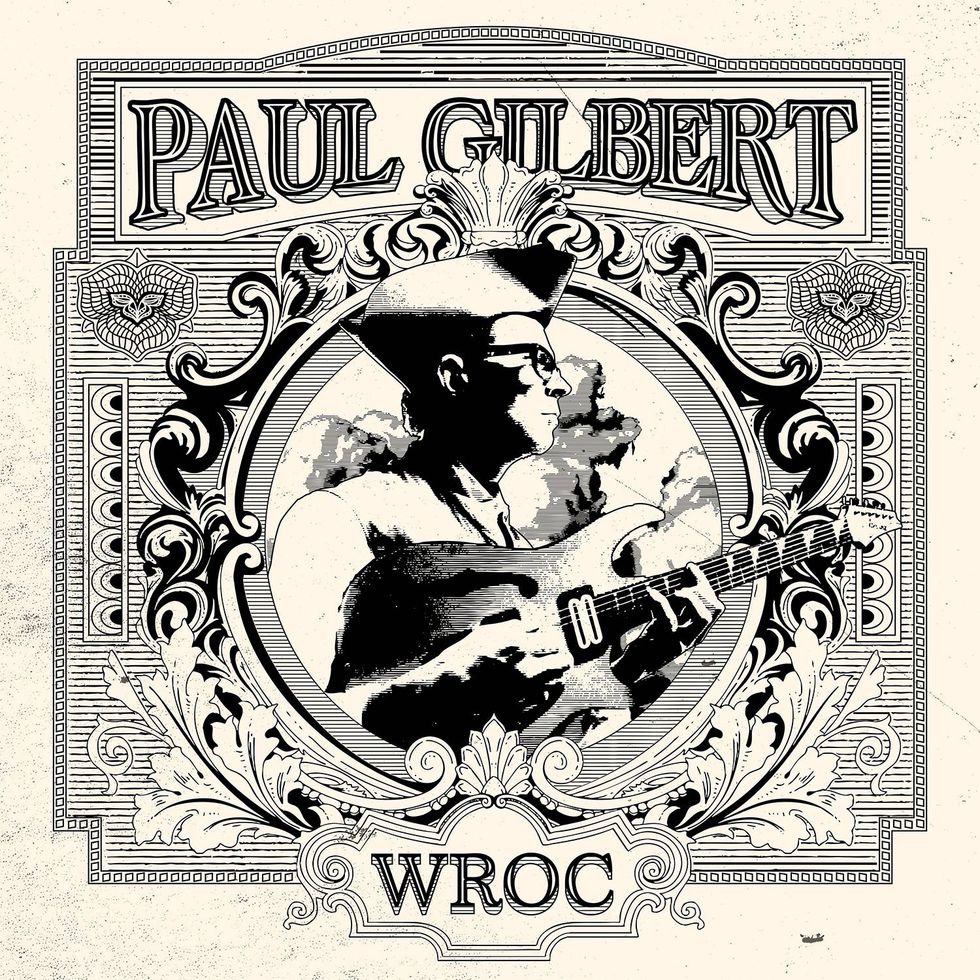
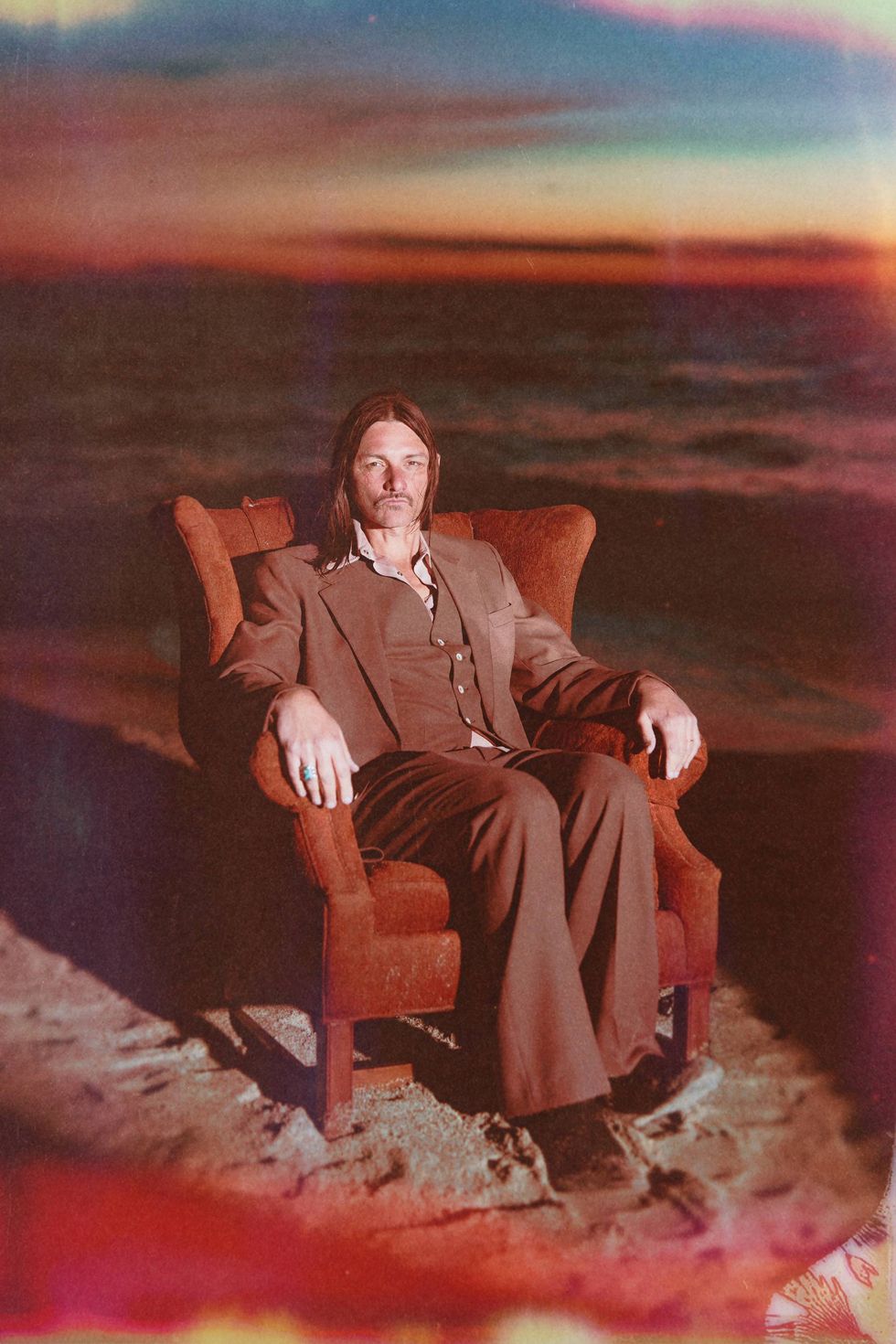
Paul Gilbert’s latest, WROC, is a treatise on good manners. Sort of.
As the songs for WROC started coming together, Gilbert made an interesting, and unfortunate, discovery about AI, his writing partner. “I learned that AI doesn’t always tell you the exact truth. It’ll make stuff up,” he says. He found this out when he did a Google search for a rule he used for a song title—and nothing came up. Gilbert recalls, “I then asked AI, ‘Which Washington rule is this?’ And AI was like, ‘That’s not any Washington rule.’ I said, ‘Well, you gave it to me. You were the one that told me.’ And the response was, ‘Oh, I’m sorry, I must have hallucinated.’ So I was searching through this list, and now I know it was about 80 percent correct and 20 percent hallucinated. And that was a good learning experience.”
The lesson? “Always double check your AI, because it’ll just make stuff up,” he says. Nevertheless, one song on the album, “Conscience is the Most Certain Judge” features some of these AI hallucinations—Gilbert kept them because he felt they were still in the correct spirit. He also took poetic license and composed variations with his own words on “Show Yourself Not Glad at the Misfortune of Another.”
WROC, of course, is more than a mere (AI-assisted) history lesson. Since his Racer X days, Gilbert’s fanbase has been heavily populated by guitar geeks that salivate at every 16th-note run he unleashes. As is to be expected, WROC showcases Gilbert’s fiery six-string work. The opener, “Keep Your Feet Firm and Even,” kicks off with characteristic neoclassical licks and harmonized melodic lines. “Maintain a Sweet and Cheerful Countenance,” meanwhile, is built on an incendiary harmonized jazz/fusion and prog-influenced riff in the intro, which leads to a solo that sees Gilbert tearing it up on the slide—a texture he’s been exploring over the past decade.
“I learned that AI doesn’t always tell you the exact truth.”
Gilbert’s slightly unusual guitar setup accommodates both his newfound slide inclinations and his legacy speed-demon licks. While Gilbert’s strings are very light—he uses .0085 for his high-E string (at this year’s NAMM convention, while performing with Steve Morse at the Ernie Ball booth, he even admitted to using .007s on that day)—the guitar’s action is set fairly high. “It’s funny, I did a guitar clinic in Italy where I didn’t bring my own guitar,” he says. “All the students let me use their guitars, so there were, like, ten guitars on a stand. They said, ‘Use any guitar you want,’ and I picked this one up and I hurt myself. Everybody had .010s and low action and, man, I can’t play .010s with low action. I can’t get a grip on the string, and I bend all the time.”
Even though he’s been most often identified throughout his career as a guitar hero, Gilbert’s focus hasn’t been strictly on the guitar. Since King of Clubs, his 1997 debut solo album, his abilities as a lead vocalist have come to the forefront. Gilbert is a charismatic frontman who can belt out songs in a multitude of styles. He readily admits, however, that guitar is still more natural for him. “As a lead singer—which, really, if you want to be a pop musician, singing is very important—my voice always had limitations that my hands didn’t have,” he says. “If I sat down and practiced, you know, I could play this Van Halen thing. Whereas if I practice singing, I still couldn’t sing ‘Oh! Darling’ by the Beatles, no matter how much I practiced.”
Currently, Gilbert’s guitar practice goals are less about mechanics and more about melody. The days of endlessly repeating outside picking exercises with an ever-increasing-in-tempo metronome have taken a backseat to his new obsession with mastering the ability to instantaneously play the melodies he hears in his head on the guitar. Being able to produce a melody on the guitar with the proper inflections is an art that isn’t nearly as easy as it might sound (especially doing it on the spot in real time), even if you can shred scales and arpeggios at supersonic speeds. “It’s funny, right before this interview I was practicing improvising over Gary Moore’s ‘Still Got the Blues,’” he says. “Which has challenging changes, almost like ‘Autumn Leaves.’ To me, that’s a rough, rolling rapid of rocky river to navigate, but I’m getting better at it. Step one is I found all the shapes—the shape for the B half-diminished and for the E7. But then I’m using my eyes to navigate, like, ‘This shape goes into this shape.’ That’s useful to some extent, but it’s not coming from my singer’s voice. So now I sit down and go, ‘Don’t play it if you can’t sing it.’ And I force myself to sing and solo at the same time.
“I’m not great at it yet,” Gilbert continues, “so it’s risky to do it because it does slow everything down. But the more I do it, the better it gets, and there’s a real payoff at the end. But it feels like I’m telling the truth when I really play what was in there. Suddenly everything’s connected and it tells a story.”