
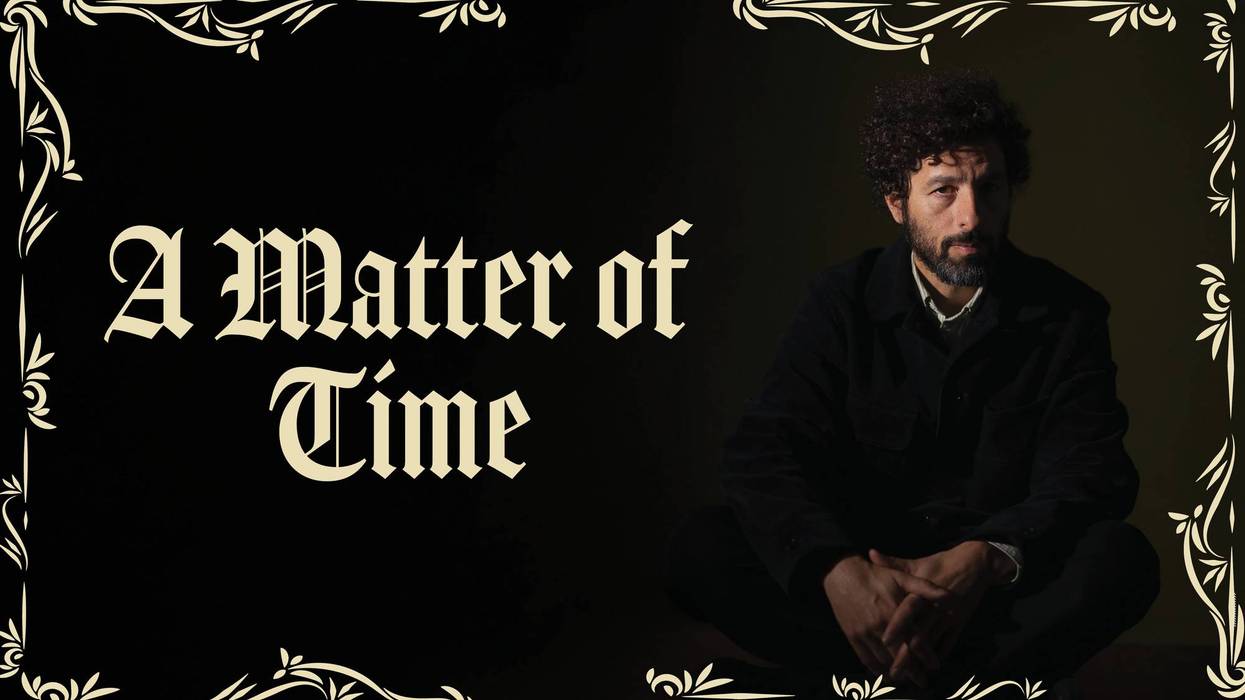

Don’t be fooled. Yes, José González’s mellifluous folk-pop, powered almost exclusively by Spanish acoustic guitars, sounds like it must have been a breeze to make. But if it were, a lot more of it would exist. As things stand, the acclaimed Swedish singer, songwriter, and guitarist (a child of Argentinian parents who emigrated to Scandinavia in the 1970s) has managed to put out just five solo albums in the past 23 years. Because his work is truly a solo production—González plays, sings, and records all the parts either at his home in Gothenburg or in a private studio space nearby—he has nobody to blame for this but himself. And as he explains during a recent Zoom interview with Premier Guitar, a key issue is that he starts the creative process for each of his albums intending to attain a noble ideal, of which he inevitably and invariably falls short.
“The first ambition always is to do everything, the whole album, with one guitar and one voice,” González says. “But then I’ll have a song that I feel will still be good enough for the album [that way] but I’ll just try adding one more guitar, or some vocals, or some clapping, or some looping. It’s cheating,” he acknowledges, “but you know, I’m old enough to not care that much about it. So that becomes part of the new ambition, which is to make it all sound like it was done with just one guitar and one vocal.”
A bemused grin flashes from behind the 47-year-old González’s dark, scraggly beard. “But then I run into another problem,” he continues, “which is that if the album sounds like it was done with just one guitar and one vocal, it’s a bit too homogeneous and boring for many people. So that’s when I start pushing each song in different directions, adding echoes and reverbs, changing the style of guitar playing. When I put my producer’s hat on, then it’s a different ambition: to make the album more interesting.”
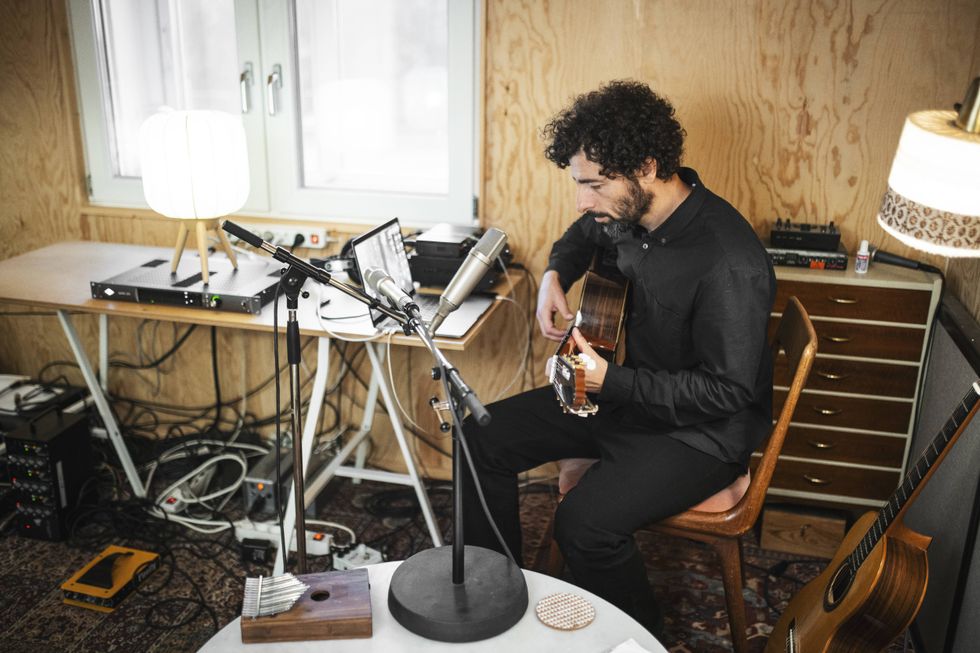
González in recording mode.
Photo by Ellika Henriksson
José González’s Gear
Guitars
- Estevé Adalid 11 classical acoustic
- Estevé 9CB classical acoustic (one with spruce top and one with cedar top)
- Loriente Clarita classical acoustic
- Córdoba Rodriguez classical acoustic
- Alhambra classical acoustic
Effects
- Boss OC-3 Super Octave
- Boss GE-7 Equalizer
- Roland RE-201 Space Echo
- Ableton Live software (for live looping)
Strings & Capo
- D’Addario Pro Arté EJ46 Silverplated Wound/Nylon Core
- Shubb C2 capo
Pickups, Mics, & DI
- Fishman Prefix Pro Blend pickups
- Neumann U 67 and SM 69 microphones
- Radial Engineering Firefly tube preamp/DI
Recording Software
- Logic Pro
- Universal Audio plugins, including A-Type Multiband Dynamic Enhancer, EP-34 Tape Echo and Precision De-Esser
Does González foresee a time when he might actually achieve his first ambition of making a literal solo album? “That could happen,” he says. “I don’t know, there’s many things I want to do with life. If I look into my future, when the kids [an eight-year-old daughter and a four-year-old son] are older and they move from home, I might play every day and all of a sudden have 10 songs that are amazing and just put them out on an album like that. But then again, I might just be happy on my porch by the water. And I might not have an audience that wants to see this old dude.”
One has a hard time imagining the latter situation ever coming to pass if González keeps making music that matches the consistent quality of his latest release, Against the Dying of the Light. Like its four predecessors, the new album sounds simple at first, quiet alt-folk spotlighting González’s gentle, reedy voice and mellow nylon-string plucking. But it reveals greater complexity the more closely you listen: in the tricky rhythms that course through each song, derived from West African, Caribbean, and Brazilian sources; in the harmonic richness of the chord progressions; and in the advanced philosophical concepts referenced in the lyrics.
“The first ambition always is to do everything, the whole album, with one guitar and one voice.”
Indeed, Against the Dying… could legitimately be called a concept album—not in the rock-opera sense, but in the more basic definition of a linked group of songs that explore kindred ideas. The album opens with “A Perfect Storm,” which presents a problem: Human consciousness and well-being are threatened by artificial intelligence, algorithms, memes, and other human creations. The implications of that problem are examined more deeply as the album progresses, until 13 songs later, we arrive not at a solution but at an awareness with which a solution might be found—an awareness of our own humanity. The closing song, “Joy,” concludes with these words: “As we cognify everything/We’re still conscious souls/Who can’t help but sing.”
Each song on Against the Dying… flows into the next one naturally, like the evolution of an argument or the telling of a tale. Some of this is the product of post-facto track sequencing, but sometimes González wrote the songs with their order in mind from the start. For example, the lightly skipping “For Every Dusk” is followed by the more introspective “Sheet” because the songs were originally written as two sections of the same composition. The former track, with three subtly interlocking guitar parts, is also the one that strays farthest from its author’s opening play-it-all-on-a-single-instrument mission.

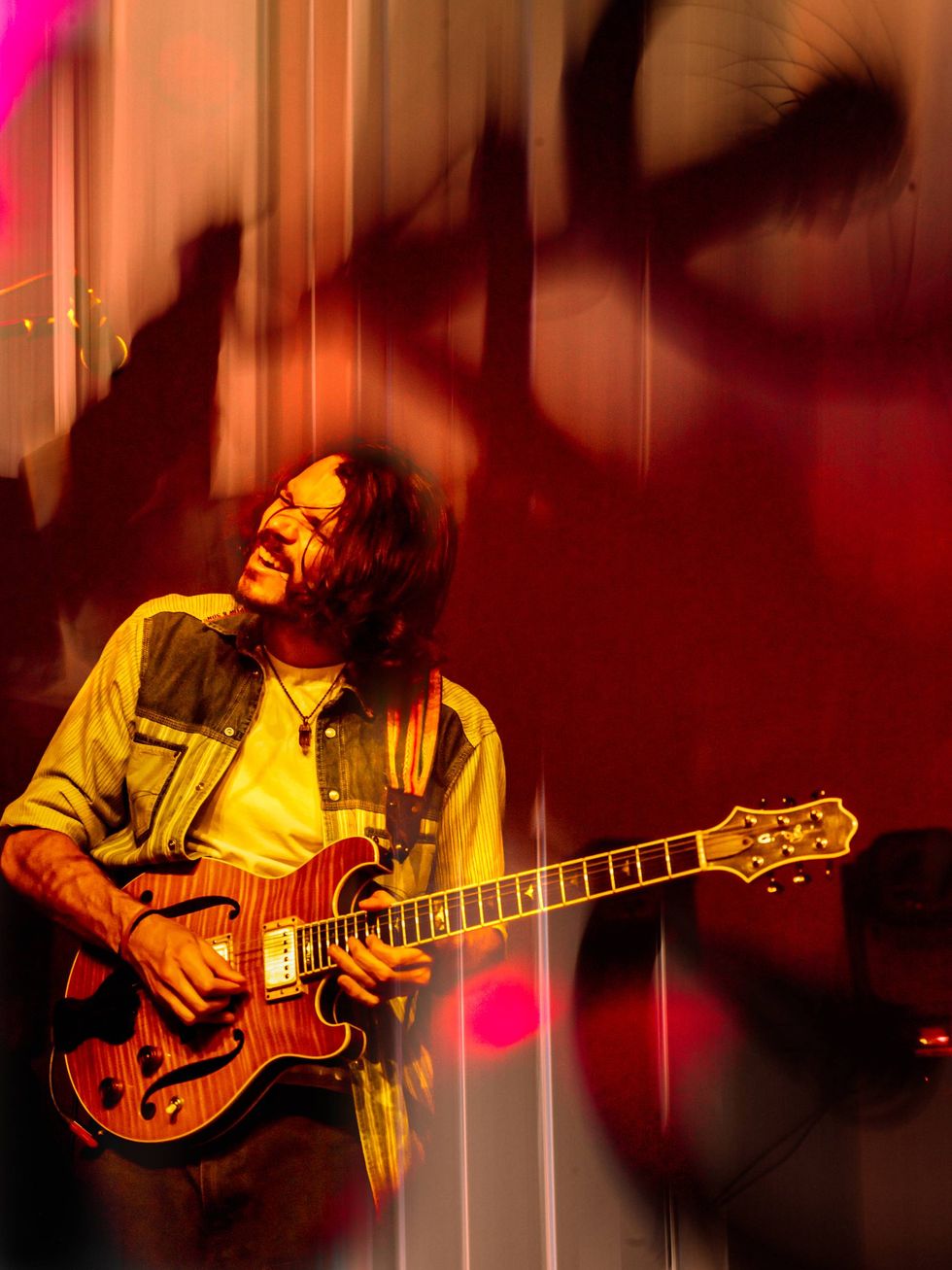
Onstage in Cleveland
Photo by Robert McCune
According to González, “For Every Dusk” was composed in a manner similar to the way he writes most of his songs, but ended up sounding different due to certain performance realities. “I always start with guitar,” he says, “and then I start humming. And then I start writing, and when I start writing I do the words and the melodies, partly on their own and partly by sitting with the guitar. That’s the part where I give up sometimes, because I raise the bar a bit too high for myself. With some songs, I’m not able to play that well and sing at the same time. I could sort of lower the bar for the guitar part, but usually I record the guitar separate. ‘For Every Dusk’ was one of those songs. I basically did full takes and felt like they had some highlights, but none of them were good enough, even if I tried to edit them. It sounded way better if I just put two of the takes together [running simultaneously]. Then it sounds like two guitarists hanging out. The guitars are almost playing the same thing, but you get these variations that are nice, and they also sound similar to the music from Mali, where usually a couple of people with guitars are playing.”
“It became obvious that people were liking my acoustic guitar and vocals. That was what I was doing best.”
González has been a fan of Malian music for the past two decades; guitarist Ali Farka Touré and kora player Ballaké Sissoko were his gateway drugs. “Later, I got to hang out with [fellow guitarist] Sidi Touré and Bombino [Omara Moctar] from Niger. It was a pleasure to see how they play, and it’s just fun to jam with that sort of music. And I recently sang on a track for [Saharan “desert blues” band] Tinariwen’s new album—I’m really happy with how that turned out.”
Another highlight of Against the Dying…, “Ay Querida,” features an ear-grabbing alternate tuning. With a nod to legends Joni Mitchell and Nick Drake, the guitarist cranks the low E string of his Estevé Adalid 11 down, way down, to B. That, however, is the song’s only deviation from standard. González employs several similar tunings, all of which share a minimum of retuned strings. “I never retune the A, D, B or high E,” he points out. “It’s only the low E and the G that go down, or up—there are many songs that are E-A-D-A, for example. But it’s fun to have those downtuned songs. The first one that became popular was ‘Far Away,’ that was used in a video game [Red Dead Redemption]. And since then, I have a couple of songs that are in that tuning. They’re really fun to play live, because you have a P.A. with subwoofers, and when you tune down, all of a sudden you’re not playing guitar, you’re playing bass.”

Photo and Makeup Credit: Laura and Mateo, ages 8 and 4
Besides the transglobal rhythms and the altered tunings, the most distinctive elements of González’s guitar style are what he plays (nylon-string acoustics) and how (always with a combination of the flesh and nails on his right-hand fingers, never a pick). That’s the way he played when he first took up the instrument at age 13; he even studied classical guitar for a while in his youth. “I went to a private teacher here in Gothenburg,” he remembers, “and I asked him, ‘Could you teach me jazz guitar?’ He told me, ‘No, I can’t, but I can teach you classical guitar.’ So I started learning all these Spanish classical tunes, like [Francisco Tárrega’s] ‘Recuerdos de la Alhambra,’ [Isaac Albéniz’s] ‘Asturias,’ some Bach even. I went to see my teacher once a month for a couple of years, but it took too much time to learn. So I let that go, but I learned a lot during those years.”
It wasn’t long before González had made a significant stylistic break from his early classical studies. By age 15, he was playing bass in the first of three hardcore punk bands that occupied his spare time for most of the ’90s, eventually switching over to electric guitar. “The hardcore songs weren’t bad,” he says now, “but they weren’t that good, either. And we didn’t have much success with them.” His next band, formed in 1998, was Junip, a trio that reunited him with the classical acoustic in a new indie-rock context: “It became obvious during those years that people were liking my acoustic guitar and vocals. That was what I was doing best.”
“I always start with guitar, and then I start humming. And then I start writing.”
Five years into Junip’s career, González released a solo seven-inch single, which unexpectedly hit No. 4 on the Swedish pop chart. The band proceeded to go on the backburner (though it reconvened for albums in 2010 and 2013), and González dropped his university studies—he’d been working toward a PhD in biochemistry—to focus on music full-time. “All of a sudden, I was famous in Sweden,” he recalls.
And the nylon-string guitar had played a major role in making this happen. “At that point it became a thing for me to not switch to steel-string, even though that would have meant louder sound when we were playing live,” González says. “My sound engineers were trying to get me to play steel-string, but to me that sounded like what everyone else was doing. I wanted to do what I liked, and in a way that wasn’t new either, because in the ’60s and ’70s there were Spanish guitars everywhere, in the folk traditions and the protest singers and the music that I listened to when I was young.”
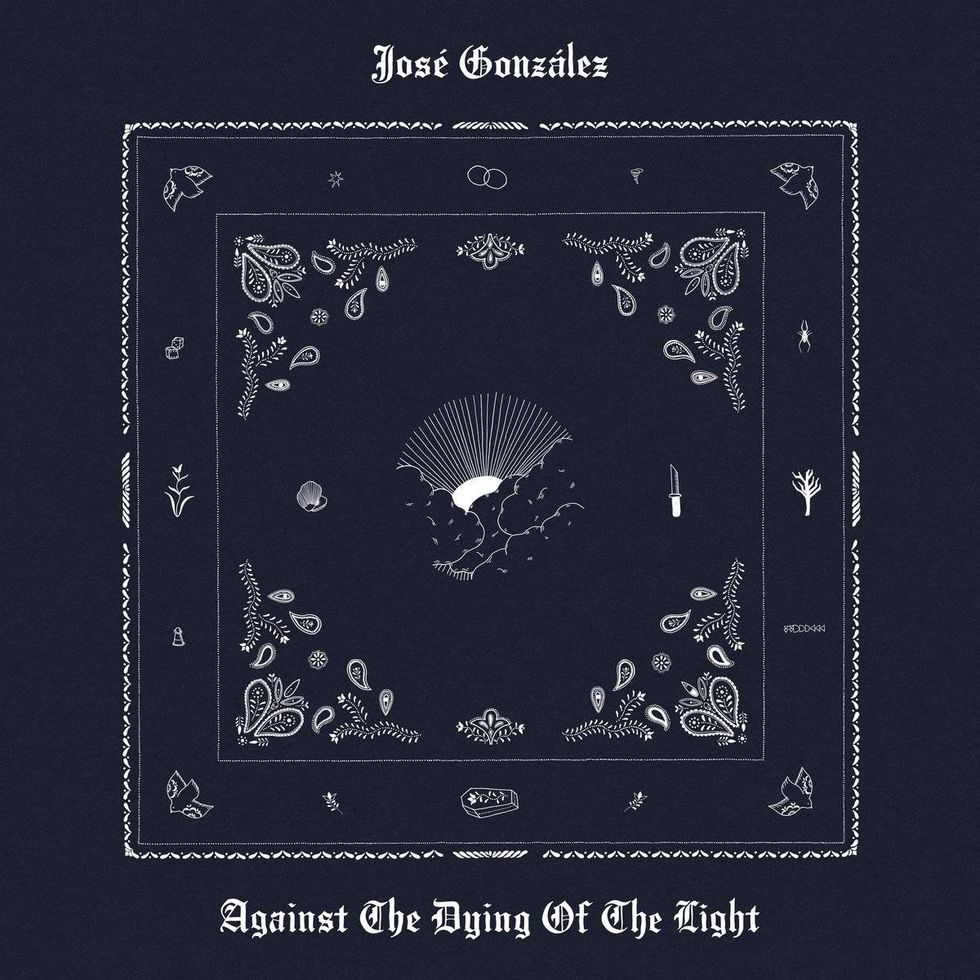
Against the Dying of the Light is González’s fifth studio album, and first in five years.
That vintage sound has informed not only González’s writing and playing but also his approach to recording. Although he works strictly in the digital domain with Logic Pro, he’ll add analog-style ambience to his tracks whenever he deems it necessary—which is most of the time. “I’ll record through a tube amplifier, so I get that distortion that you can’t really take away later,” he says. “After that, I’ll add some saturation in different steps, depending on the type of song, and some tape emulator. And then, one of my favorite things to do is to add noise. The Universal Audio A-Type plugin has a noise generator that’s pretty round in its sound. I’ve got some nice mics—on the new album, I used Neumann’s SM 69 stereo mic a lot—but I don’t want things to be too bright or hi-fi, so I try to make it sound more old-school.”
Add every hour spent looking for just the right kind and amount of tape-style distortion to every hour spent struggling with the relative complexity of guitar arrangements, and you begin to understand why it generally takes five-plus years for a José González album to be completed. And of course, those aren’t the only things that can eat up a lot of time. “I’ll tell my label, ‘The album’s almost done, I have all the demos so I’m gonna start recording soon,’” González says. “So they start booking tours and setting up interviews. But then, you know, life catches on. Someone in the family gets sick, and I’m not rehearsing guitar as much, and then I need another month, or two more months. But eventually,” he concludes with a shrug, “I get to a point where I feel like this is good enough.”
He’s being humble here. For most listeners, José González’s “good enough” is way more than that.