
Michael Hampton’s whole career started with a single song.
As a teen growing up in Cleveland, Ohio, he taught himself to play along with records on just one string. The Temptations’ “Get Ready,” Led Zeppelin’s “Dazed and Confused”—those worked. Then he expanded, adding strings and songs like Kool & the Gang’s “Jungle Boogie” and Edgar Winter Group’s “Frankenstein” to his repertoire. Somewhere in there, he started jamming along with Funkadelic’s 1971 psychedelic guitar opus, “Maggot Brain.”
On the opening track to the band’s album of the same name, guitarist Eddie Hazel defined new boundaries of post-Hendrix fuzz-and-wah-soaked psychedelia. George Clinton’s Echoplex manipulations cranked the mind-melt factor further afield. It moved the young guitarist, and he kept coming back to that song.
By 1974, the band rolled through Cleveland and the 17-year-old had a chance to witness the live P-Funk extravaganza. Around that time, he had been playing music with his cousin, Lige Curry, and “a guy on the east side called Ed Sparks, he was an older guy playing bass,” according to Hampton. Together, they went to catch the show at Public Hall. Afterward, they all ended up with some of the band back at Sparks’ house.
“Ed’s like, ‘Go play “Maggot Brain,”’” Hampton recalls in his soft-spoken voice, “and I just played it til I couldn’t play it no more.”
About two weeks or so later, P-Funk drummer Tiki Fullwood called and invited the teenager to join the band. Driven to the airport by his cousin—who would also go on to join the band in 1978—he recalls, “I took my first plane ride to a sold-out show at the Capital Center in Landover, Maryland. I put my head down and played ‘Maggot Brain.’ Bernie [Worell, the band’s keyboardist] was accompanying me, which helped a lot. They wanted just Bernie and myself to do it. He was good at putting that backdrop behind me so I could solo freely.”
At first, Hampton’s only role in the Parliament-Funkadelic stage show was to play “Maggot Brain.” He eventually learned the whole set, somewhere along the way earning the nickname Kidd Funkadelic. (A recording of Hampton’s “Maggot Brain” from 1978 is included on the CD edition of Funkadelic’s One Nation Under a Groove, showing his soaring, liquid phrasing and searing tone.)
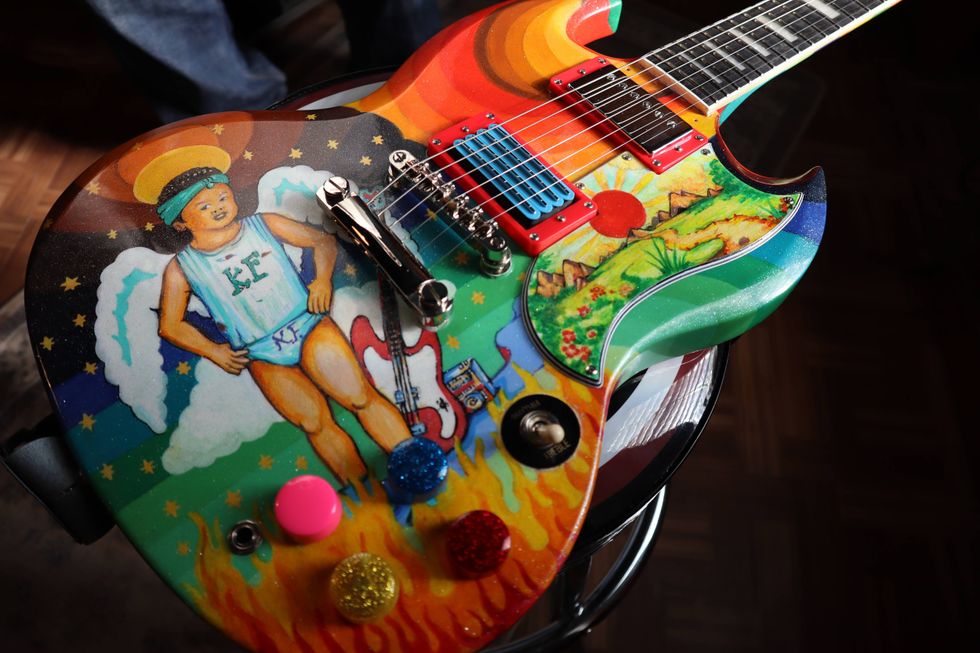
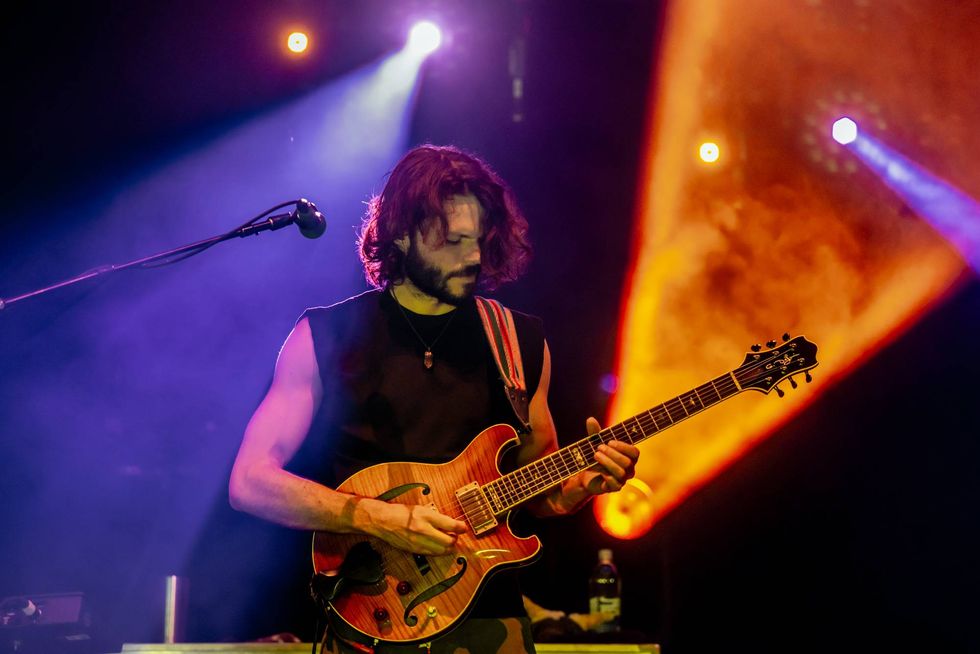
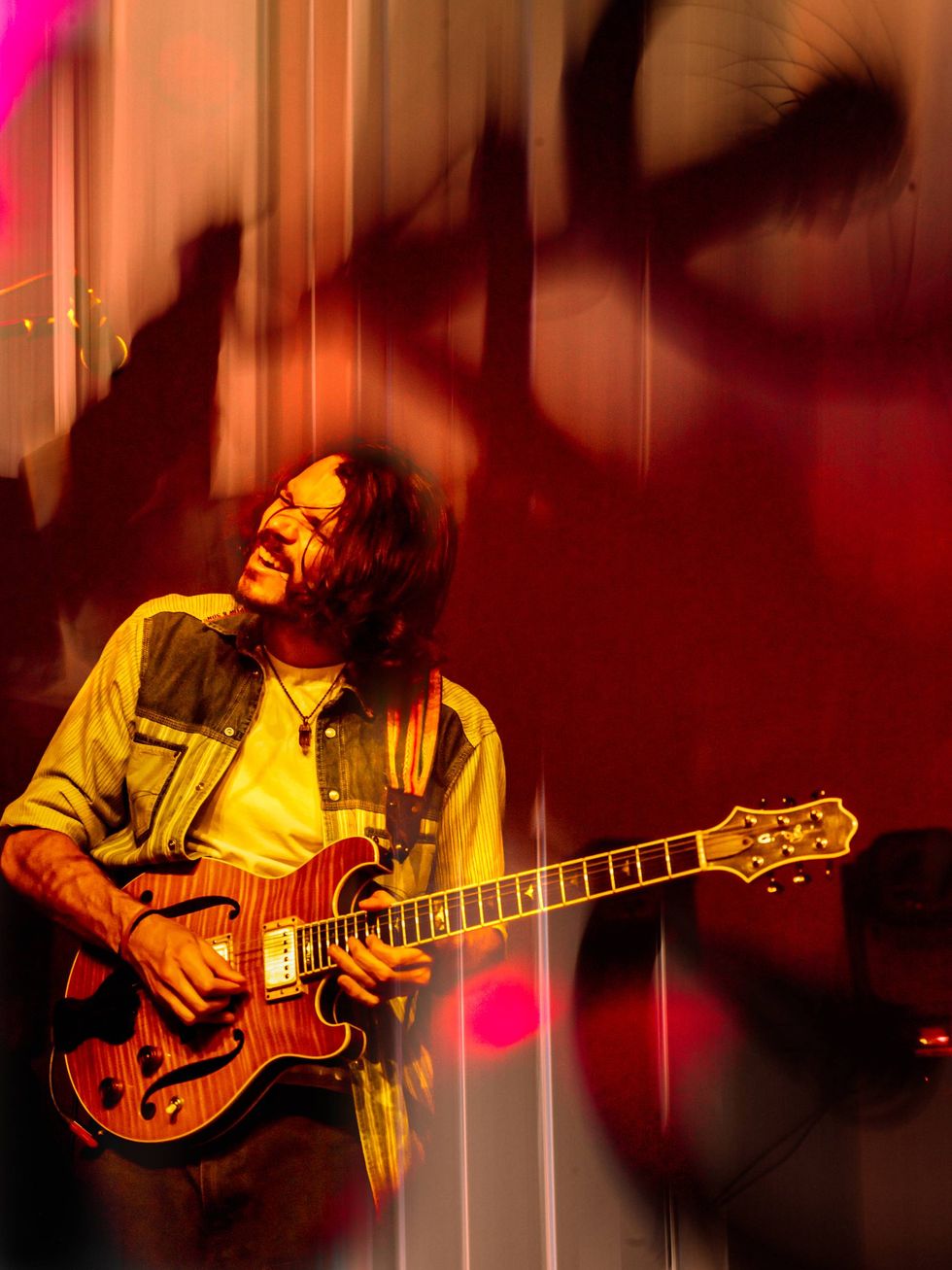
Hampton doesn’t keep track of which guitars he uses on which tracks, but this guitar, a gift from PhilipTheArtist, hit the road on a recent Hampton solo tour.
Photo by Nick Millevoi
Ever since that first night, Hampton has been a fixture in the P-Funk universe, and the band and its music have been the centerpiece of his musical life. Though he’s done some collaborating beyond P-Funk, his own solo work has maintained an orbit, as can be heard on his 1995 release, P-Funk Guitar Riffs for DJ’s, or on the more solo-minded but still related Heavy Metal Funkason from 1998, which features Curry as co-producer and Clinton on guest vocals. More recently, with drummer Chuck Treece and guitarist PhilipTheArtist (Philip Smith), he’s released music as Punkadelic, which includes original material, but remains reverential in name.
Now, he seems ready to set himself apart. But that might not be a conscious effort. In fact, sitting and talking to Hampton on one of the couches at SoundPlex Studios in South Jersey, just outside of Philadelphia, I get the distinct sense that Hampton makes his way through life by going with the proverbial flow. He takes it as it comes, and for a guy who’s been playing a lot of the same music for decades, he seems surprisingly in the moment, not lingering on the past.
“Since Parliament-Funkadelic is one of the most sampled groups of all time, it’s probably safe to say you’re among the most sampled guitarists around,” I point out. “Do you ever reflect on that?”
“Nah,” he tosses off. “I don’t reflect on it. I’m honored.” He pauses, adding, “It’d be cool if I could get some more sessions or be a fly on the wall at some of these sessions that they do.”
What does get him excited is a lifetime of listening. Hampton cites his musical inspirations off the cuff: Pink Floyd, Herbie Hancock’s solo on “Chameleon,” Kiss—he stops to show me a recent gift from guitarist PhilipTheArtist, the owner of retro-minded Goldfinch Guitars, an LP-style guitar with an Ace Frehley tribute finish. “This was a gift after Ace passed,” he explains. “That’s what’s gonna get me inspired to do more—‘I wanna do something Kiss-like with that guitar’ or whatever.”
“Everything I hear, I want to play.”
He jumps to a host of more recent references—cosmic jazz saxophonist Kamasi Washington, bass futurist MonoNeon, blues phenom Christone “Kingfish” Ingram, and electric blues rocker Joe Bonamassa—then goes more big-picture. “The grooves to a lot of things—it could be commercials—whatever catches my ear, it could be electronica, it could be classical, everything I hear, I want to play.”
Hampton gets stoked thinking about all the music he loves. He mentions Les Paul, then catches himself—“Django … his ass! Man, come on!” It’s a wide musical world, full of inspiration.
It’s not just music itself that gets him going, it’s the instruments as well. Hampton loves to collect guitars, and figures he currently owns around 50 or so. In addition to the Ace Frehley tribute, he’s also brought another recent gift, also from PhilipTheArtist, this one an SG-style guitar with a finish in the style of The Fool—the Gibson once owned by both Eric Clapton and Todd Rundgren. On this one, the iconic angel has been replaced by the Kidd Funkadelic logo from Funkadelic’s 1976 Tales of Kidd Funkadelic.
That guitar made it out with Hampton for some solo band dates to celebrate the release of Into the Public Domain, the first of two EPs plus an LP that he’s releasing. The name is literal: He’ll also be releasing the multitrack files, which can be used royalty free.
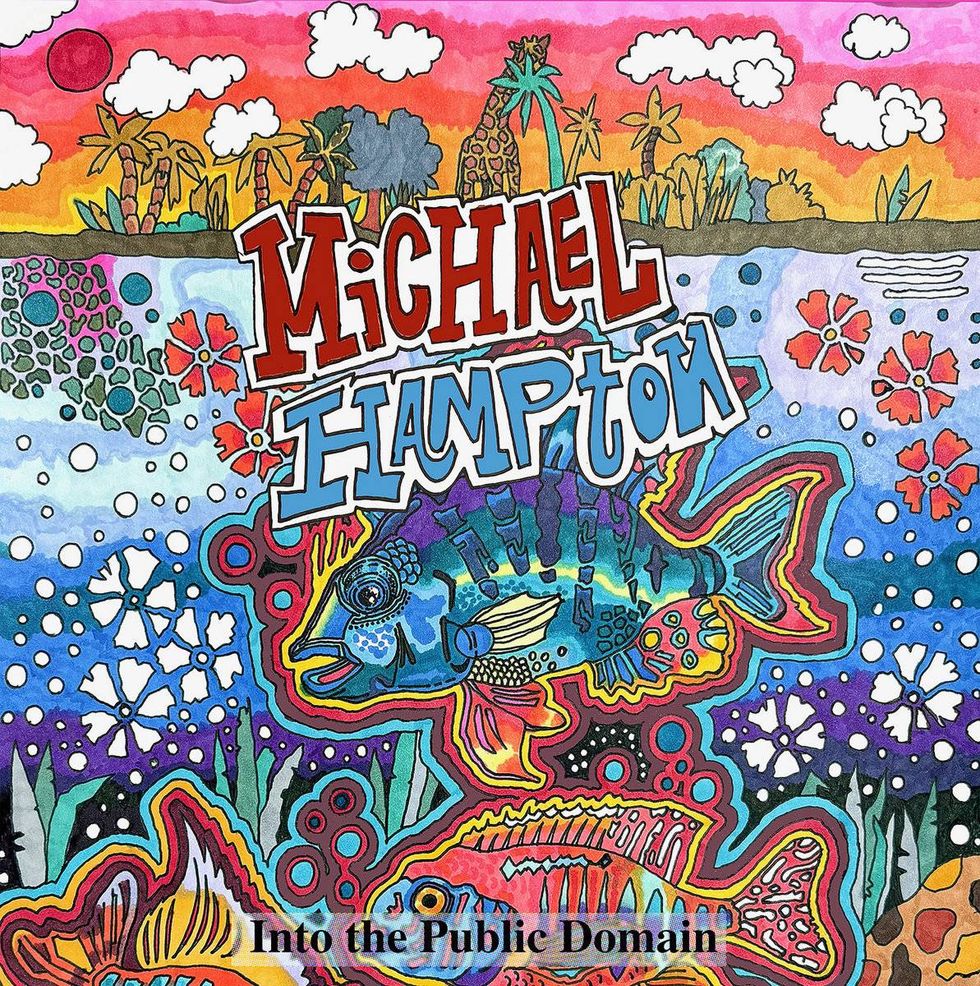
Hampton’s latest, Into the Public Domain, is the first of three records that he’ll be releasing, alongside King Kong and The Kidd.
It’s a large project with a lot of moving parts and a long cast of collaborators, but it came together at the behest of PhilipTheArtist, who co-produced the record along with Hampton, Joe “the Butcher” Nicolo, and John Schreffler. Recorded at Fort Wolf Studios in Canyon Country, California, and Los Angeles’ Sunset Sound, much of the music was initiated by PhilipTheArtist and Schreffler in order to create something, according to the former, “like if National Geographic or Nova wanted something in the background—not just rock ’n’ roll.”
A song like the off-kilter funky rocker “Steve’s Kadillac” strikes an experimental funny bone that could certainly work in that direction, with warped riffs floating in and out across the groove-centric soundscape. But there is plenty of rockin’ to be found, as on the opening “Fight or Flight” and the title track, where Hampton’s distortion-drenched leads crack the stratosphere wide open and launch into space.
PhilipTheArtist explains that “Technicolor Mobile Home” has roots that reach beyond the studio. “When me and Michael play ‘Hit It and Quit It’ [from Funkadelic’s Maggot Brain] live,” he explains, “there’s a certain way he plays the chorus that is different than the record. That way he plays it evolved into ‘Technicolor Mobile Home,’ then I recorded what I remembered he came up with.”
Hampton remembers the sessions as a laid back affair, where the vibe, from his perspective, was “just do what ya feel.” He recalls, “Phil would call me up from California and say, ‘You got time, Mike?’” If he was available, he’d fly out from his Philly area home. “If I didn’t jump on and do it then, I wasn’t gonna do it,” he says.
“Today, there are some serious issues and it’s like, what am I gonna write to that? Am I gonna write about it? Or not gonna write about it? Or just play?”
Nicolo, a nine-time Grammy winner and co-founder of legendary hip-hop label Ruffhouse Records, assembled the jammy tracks into songs. “I had so many colors of the rainbow to paint with,” he says.
Hampton will follow Into the Public Domain with King Kong, a musical telling of the classic story, and The Kidd. With a preview of rough tracks from the latter, it seems as though the trilogy will showcase just how singular and varied Hampton’s guitar playing is. The early tracks indicate a world that’s all over the sonic map, his still-distinctive guitar fitting right into ’90s ZZ Top-style heavy blues, warped disco funk, soul jazz, and beyond.
Nicolo will release the albums through his SMN Records imprint—a part of his Sound Mind Network, a nonprofit whose “mission is to change the way the world looks at trauma suicide and drug abuse with the arts.” He says the records display Hampton’s “splintered genius” and calls him a “chameleon" who is “so unlike traditional guitar players.”
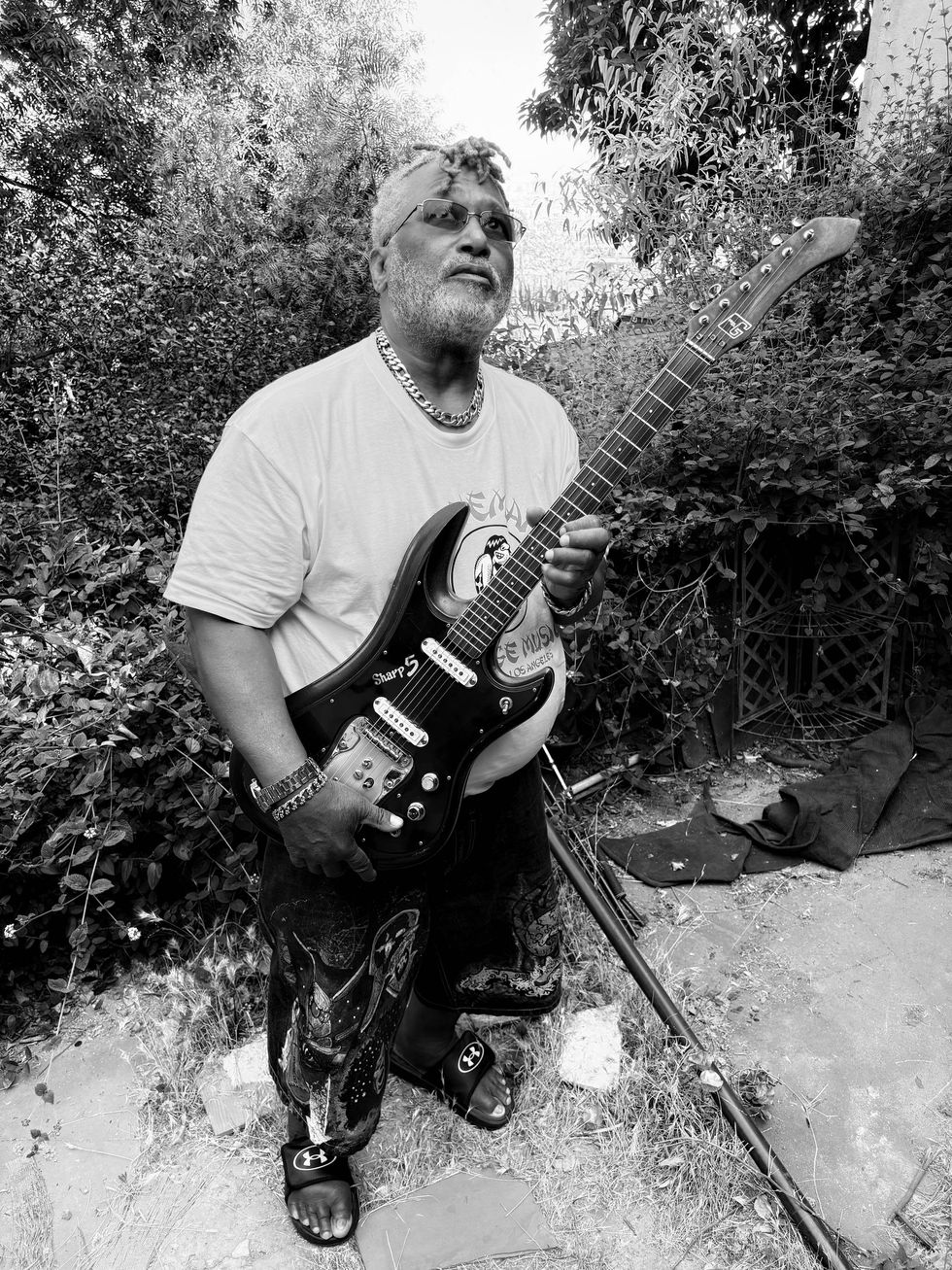
Joe “the Barber” Nicolo, of production team the Butcher Bros., whose credits span pop stardom, calls Hampton a “chameleon” and a “splintered genius.”
Photo by Philip Samuel Smith
Hampton is all about the vibe, and that seems to be what makes him such an adaptable player. He gets the vibe, and dives in. It’s an approach that any improvisor knows requires staying in the moment and keeping overthinking at bay, and that’s where Hampton is most natural.
“I like to remain ‘not-knowing,’” he muses. “I like to practice a lot, but at the same time, I want it to be new.” (It’s also the answer he gives when I ask if he likes messing around with pedals, which he doesn’t really get into extensively: “Every time I hook something up, I want it to be brand new.”)
“Staying inspired,” he continues, “it’s just life itself. Today, there are some serious issues and it’s like, what am I gonna write to that? Am I gonna write about it? Or not gonna write about it? Or just play?”
This recent burst of activity is intentional, though; Hampton tells me he’s trying to be more available to new musical things. In this case, it’s been working out. Jams that started some years ago in Philadelphia turned into sessions—he mentions some early jams related to the project at Bam Margera’s house—that led to more sessions and eventually to the L.A. recordings. Throughout, he’s just been trying to be open to saying yes. Where that will lead next is anybody’s guess.
“I like to remain ‘not-knowing.’ I like to practice a lot, but at the same time, I want it to be new.”
If all that sounds like he’s always on to the next thing, that’s only partially true. P-Funk continues to take it to the stage, and when we talk, Hampton is getting ready to head out for a few dates. The group’s large ever-changing lineup has sounded powerful on recent tours. And at the recent Hampton-band live shows in California, the pickup band assembled by PhilipTheArtist opted to stick to versions of P-Funk classics, namely “Butt-to-Butt Resuscitation,” “Red Hot Mama,” “Hit It and Quit it,” and, of course, “Maggot Brain.”
While the classics remain in all parts of his life, Hampton says he hopes to get a live band playing the new material. He adds that when the time comes to play those songs, “I don’t want to know them too well.”
The driving force in Hampton’s camp, it seems—the one making sure this all goes down—is PhilipTheArtist, and he’s passionate about the music. He wants people to hear the breadth of what’s possible. The world knows his work with P-Funk, but he wants Hampton to be heard as an individual. “It’s time for Michael to get out there,” he says. “Every legendary guitar player has a set of solo records and has a sound people can put their finger on. Michael was under-celebrated in that way. It was time.”
What is it about Hampton that has driven this project? “Michael has the ability to give you goosebumps with his playing,” PhilipTheArtist says. “He’s one of those guys who can make you cry or make you smile with his playing.” Or to put it simply, “He just knows how to make you feel something.”
![Rig Rundown: The Black Crowes’ Rich Robinson [2026]](https://www.premierguitar.com/media-library/youtube.jpg?id=66952027&width=1245&height=700&quality=70&coordinates=0%2C0%2C0%2C0)