
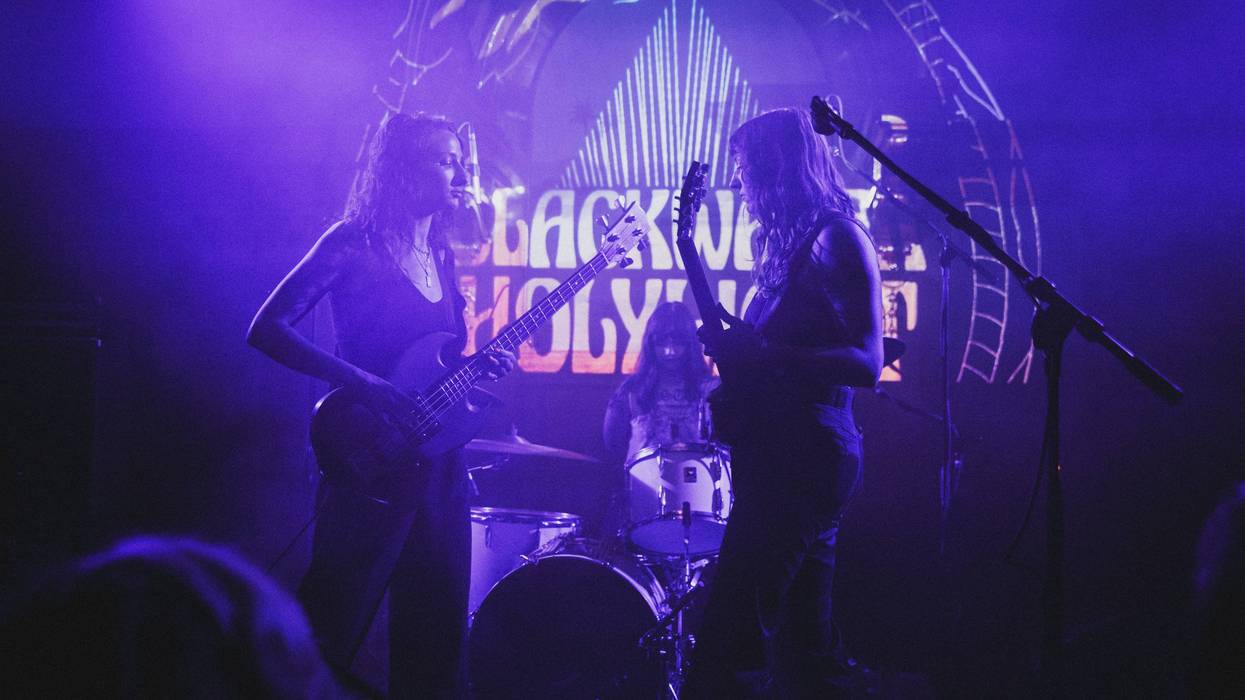

Several years ago, after releasing a trio of well-received stoner-doom albums, the core members of Blackwater Holylight—vocalist/guitarist/bassist Allison “Sunny” Faris, guitarist/bassist Mikayla Mayhew, and drummer Eliese Dorsay—left their hometown of Portland, Oregon, and took off for Los Angeles. News of the move filled some of the band’s fans with dread: Would the blissed-out, carefree Cali lifestyle result in a lighter and friendlier Blackwater Holylight? Would the band start writing—yikes!—happy music?
“Not a chance,” Faris scoffs. “I think our music is more depressing than ever.”
“We needed to get out of the physical gloom of Portland, but I guess we took a little bit of that with us,” Mayhew says. “It’s not like we came to L.A. and everybody went, ‘Yay, you’re here!’ We had to start all over in a lot of ways—meet a bunch of new people, find different opportunities. It was hard. It would have been easy to stay where we were, but I think we needed to grow to keep the band sounding fresh.”
“Fresh” might be a relative term when discussing Blackwater Holylight’s songs—there’s no frothy singalong choruses and nary a trending dance beat to be found—but there’s a looseness and a recklessness to their new album, Not Here Not Gone, that feels like something of a breakthrough. It’s there in the woozy, fuzzed-out guitar rhythms on bulldozers like “Bodies” and “Spades,” which come at you gritty and grimy, yet with a disarming playfulness to the dissonance. Another track, “Heavy, Why?” is rooted in thick layers of distorted sludge, but boasts plenty of kinetic sass and swagger—and when Faris swoops in with her ethereal, almost angelic vocals, complemented by former bandmate Sarah McKenna’s feather-light synth lines, the effect is transcendent. The capper to it all is the mini epic “How Will You Feel,” in which Mayhew’s scarifying, Iommi-esque guitar tones seem to take flight when the band locks in for a wicked, post-grunge jam.
“Our last album [2021’s Silence/Motion] was pretty much written and recorded during the Covid pandemic,” Mayhew says. “We couldn’t tour or go out that much, and we didn’t have a lot of time to work on material. With this album, we took a lot of time to write. Some of the songs were written years ago, so we had time to demo and play around with them.”
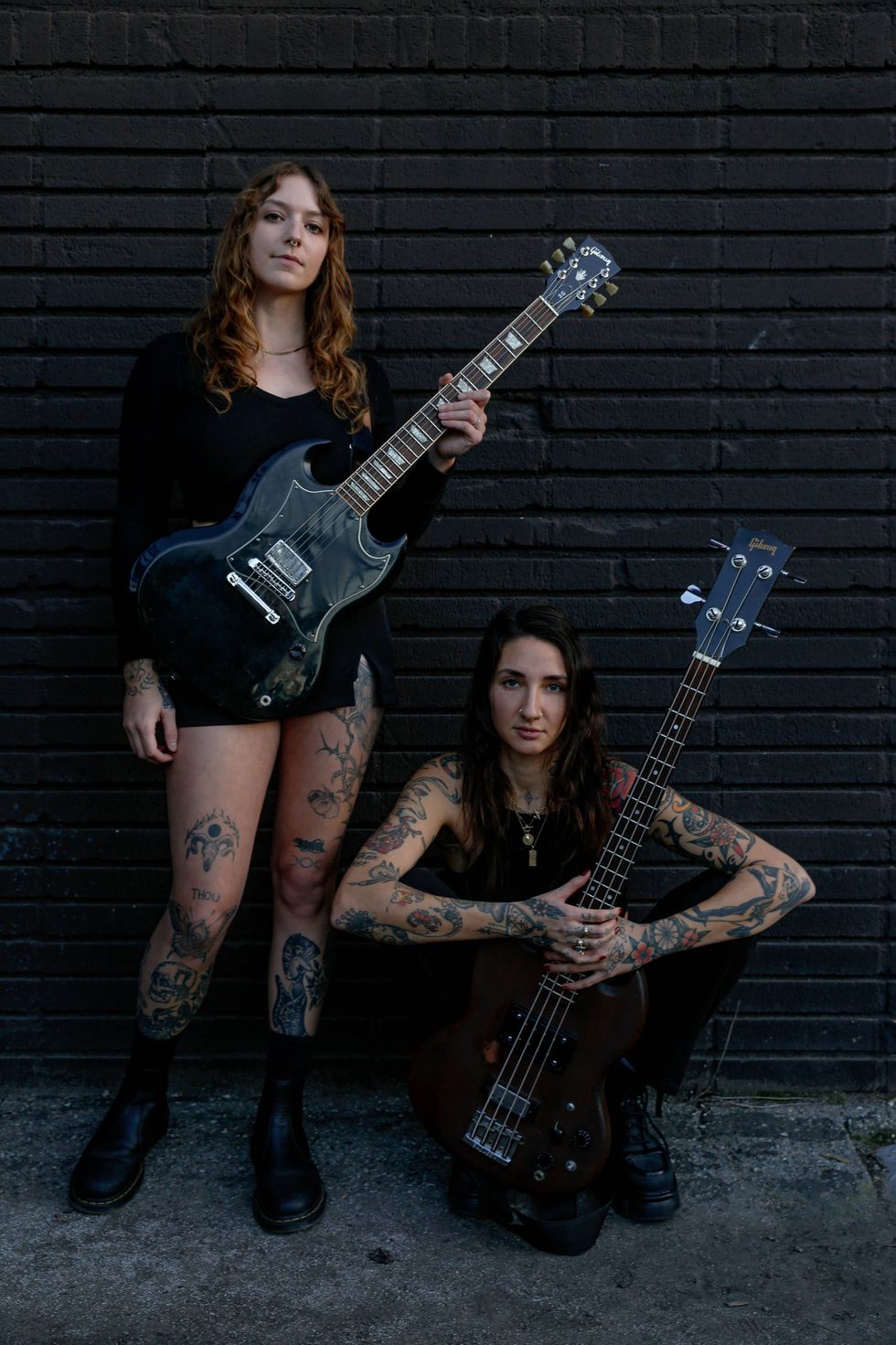
Faris and Mayhew switch guitar and bass roles depending on a song’s musical needs.
Photo by Candice Lawler
Kicking up Blackwater Holylight’s kind of apocalyptic racket (Mayhew calls it “sensually murderous”) means that neither Faris nor Mayhew is epoxied to a guitar or bass—live and in the studio, the two alternate instruments. “There’s no set formula,” Faris says. “I might write a guitar part and have a melody, and I’ll bring it to practice and Mikayla will play bass to it. And sometimes she’ll have a guitar part, and I’ll play bass and start singing to it. We’re flexible.”
Occasionally, a different scenario unfolds. “I might bring in a guitar part, and we’ll start playing and I’ll go, ‘You know, maybe I should play bass on this,’” Mayhew says. “I think our skills are pretty equal on bass and guitar, and nobody has a big ego about who plays what.”
The two share a love of “heavy music,” though their distinct influences differ wildly. Faris sings the praises of My Bloody Valentine and the Brian Jonestown Massacre, while Mayhew cites Nirvana, the Beatles, and Black Sabbath as her essential references. Asked to assess her bandmate’s playing style, Faris says, “Mikayla is a lot more forward in terms of lead lines. She’s better at being kind of noodly. I think that helps to balance us out, because she can do more of a shreddy, cruising-around-the-fretboard thing, and I can play more rhythm stuff.”
Describing Faris’ strengths, Mayhew says, “Sunny has more of a folky background, so she’s really good at fingerpicking, which I think is cool. She’s got the rhythm down, and her bass playing is great. Sometimes she plays guitar like a bass.”
On Not Here Not Gone, Mayhew says, “We took a lot of time to write. Some of the songs were written years ago.”
Their amp preferences—and, significantly, how they crank up the walloping distortion—present more examples of sonic divergence. Mayhew relies on the vintage clean tones of a Music Man HD-130 through a 4x12 cabinet, with all dirt conjured via pedals. “My main one is a Fuzz War by Death By Audio,” she says. “I absolutely love that pedal. I also like to use a [EarthQuaker Devices] Terminal fuzz and a Big Muff. And, of course, I gotta use a Tube Screamer.”
For her part, Faris stands by her Sovtek MIG100H, a Russian-made amp favored by metal and stoner rockers for its Marshall-like high-gain firepower. “I borrowed one from a friend a few years ago, and I just fell in love with the sound,” she says. “They’re not too easy to find, but I did locate a guy selling one in Eugene, Oregon, and I was like, ‘I’m buying this!’”
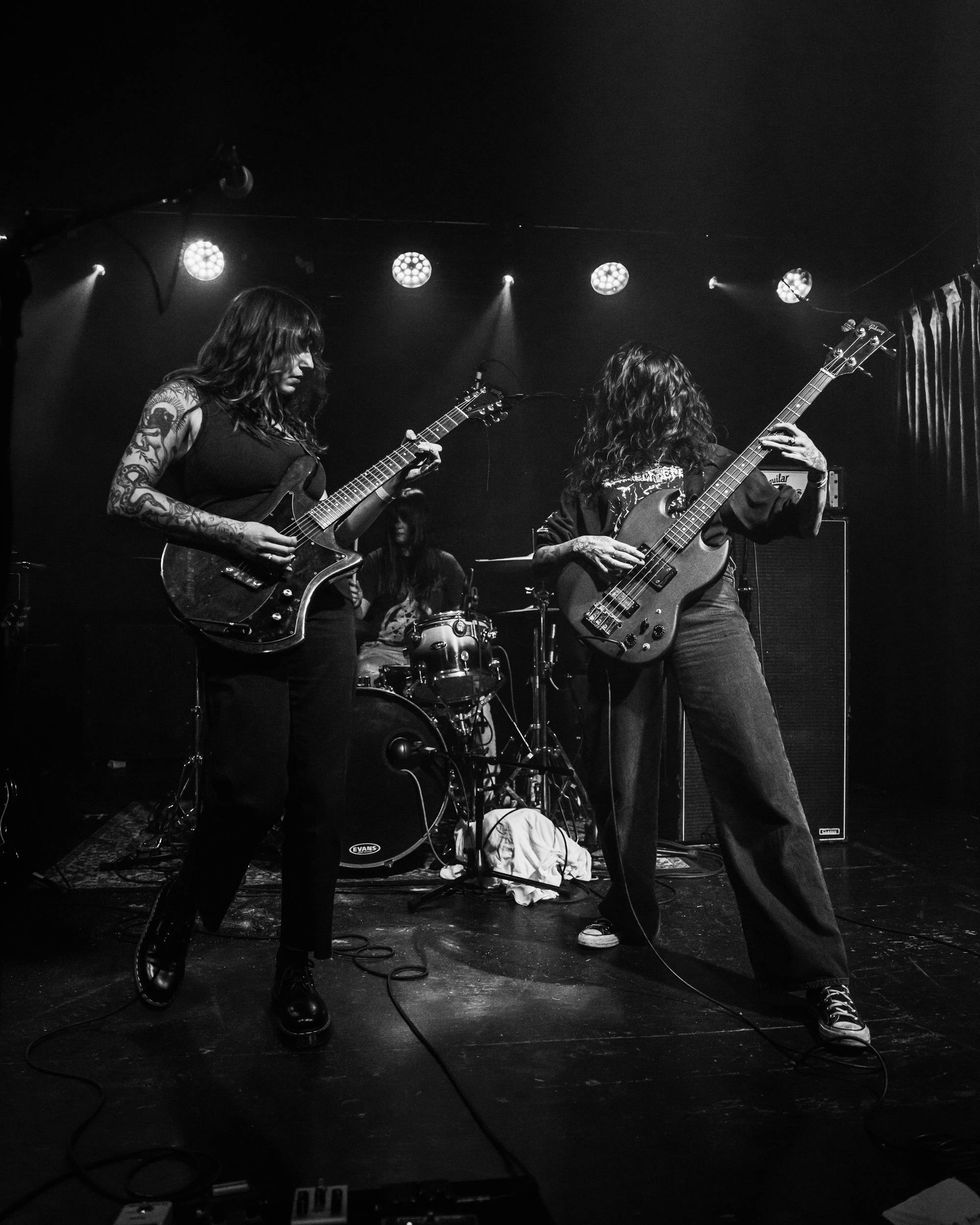
Though some of the band’s songs are down-tuned to D or use DADGAD, most of their tunes lie in C minor: C–G–C–G–C–Eb.
Photo by Candice Lawler
She adds, “The Sovtek is a killer guitar amp, but we also use it for the bass. Normally, we run our basses through an Ampeg SVT, but the Sovtek really comes through. We like to flip-flop what we use.”
They do agree on one key aspect of their approach to ultimate heaviness: Standard tunings are out, alternate tunings are in. “I don’t remember how we got there. I think we started using alternate tunings by accident and they just sort of stuck,” Mayhew says. “We have a couple of tunes where we tune down to D, and we have a few that are in DADGAD. Most of the tunes on this record are in open C minor—that’s C–G–C–G–C–Eb—and we even go down to open B minor.”
Before recording Not Here Not Gone, the band had only performed “Heavy, Why?” live, but they promise that their upcoming spring tour will feature a healthy dose of new tunes. “We’ve got a lot to learn, but it’ll be fun,” Faris says. “I’m really proud of what we accomplished on the new album, especially the way we’re experimenting with dynamics and how things can be crushing and heavy, but also soft and beautiful. When you think about it, that’s what life is.”Sunny Faris’ Gear
Guitar and Bass
Gibson SG Custom
Gibson SG Standard bass
Amp
Sovtek MIG100H
Ampeg SVT
Ampeg 8x12 cabinet
Effects
Death By Audio Fuzz War
EarthQuaker Devices Terminal
Tech 21 Boost RVB
Tark Audio Morty’s Fuzz Drive
Boss GEB-7 bass equalizer
Strings, Picks, & Cables
“I’m not sure what strings I use. They’re thick, though.”
Dunlop Tortex .73mm
“Cheap cables”
Mikayla Mayhew’s Gear
Guitars and Bass
Gibson SG Custom
Guild S-60
Gibson SG Standard bass
Amp
Music Man HD-130
Music Man 412 GS cabinet
Ampeg SVT
Ampeg 8x12 cabinet
Effects
Death By Audio Fuzz War
EarthQuaker Devices Terminal
Ibanez Tube Screamer
Electro-Harmonix Big Muff
Hologram Electronics Microcosm
Strymon Cloudburst
Tech 21 Boost RVB
Tark Audio Morty’s Fuzz Drive
Strings, Picks, & Cables
Ernie Ball Power Slinkys
“I can’t remember the bass strings. It’s been so long.”
Dunlop Tortex .73mm
Ernie Ball cables—“If I want to splurge.”





![Rig Rundown: The Black Crowes’ Rich Robinson [2026]](https://www.premierguitar.com/media-library/youtube.jpg?id=66952027&width=1245&height=700&quality=70&coordinates=0%2C0%2C0%2C0)