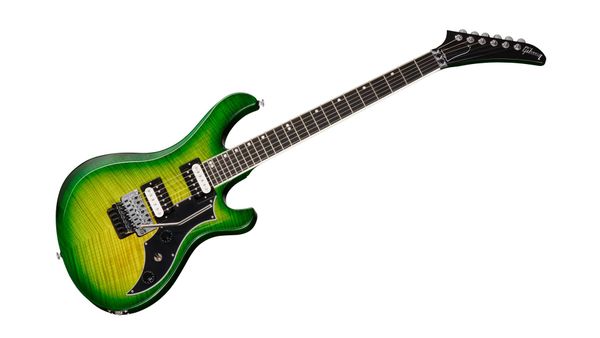
Gibson’s lost ’80s classic returns with a locking trem and a neck that favors bar-hand nuance over speed.
There’s a certain vindication when an ostensibly failed experiment gets a second life some 40 years later. That’s the story of the Victory, Gibson’s response to the superstrat land-grab of the early ’80s—an era when Charvel, Kramer, and a rising tide of dive-bombing Van Halen disciples remade the solidbody marketplace. The Victory was built to be a serious player in that category, but it didn’t work out quite that way.
The Victory’s adventure began in Gibson’s Kalamazoo R&D shop, when it was still owned by Norlin. And under the guidance of designers Chuck Burge and Tim Shaw, it became a truly distinctive instrument. It arrived in two variants: the MV II, which was aimed, per Gibson’s copy at the time, at “the discerning country player,” with dual Tim Shaw humbuckers and a rosewood fretboard; and the more ambitious, hot-rodded MVX, which came in an HSH-style 3-pickup design with a coil-tap switch and a 5-position blade selector, as well as an ebony fretboard
Interestingly, the necks and bodies for both guitars were carved from solid Eastern hard rock maple, which explains their reputation as boat anchors. Though it was a unique instrument, it never attached itself to a bonafide guitar hero. By 1984, it was quietly discontinued, and in time it migrated to pawn shops. Victory? What victory? But maybe it came up short for what it was missing: a great modern vibrato.
Never Say Die
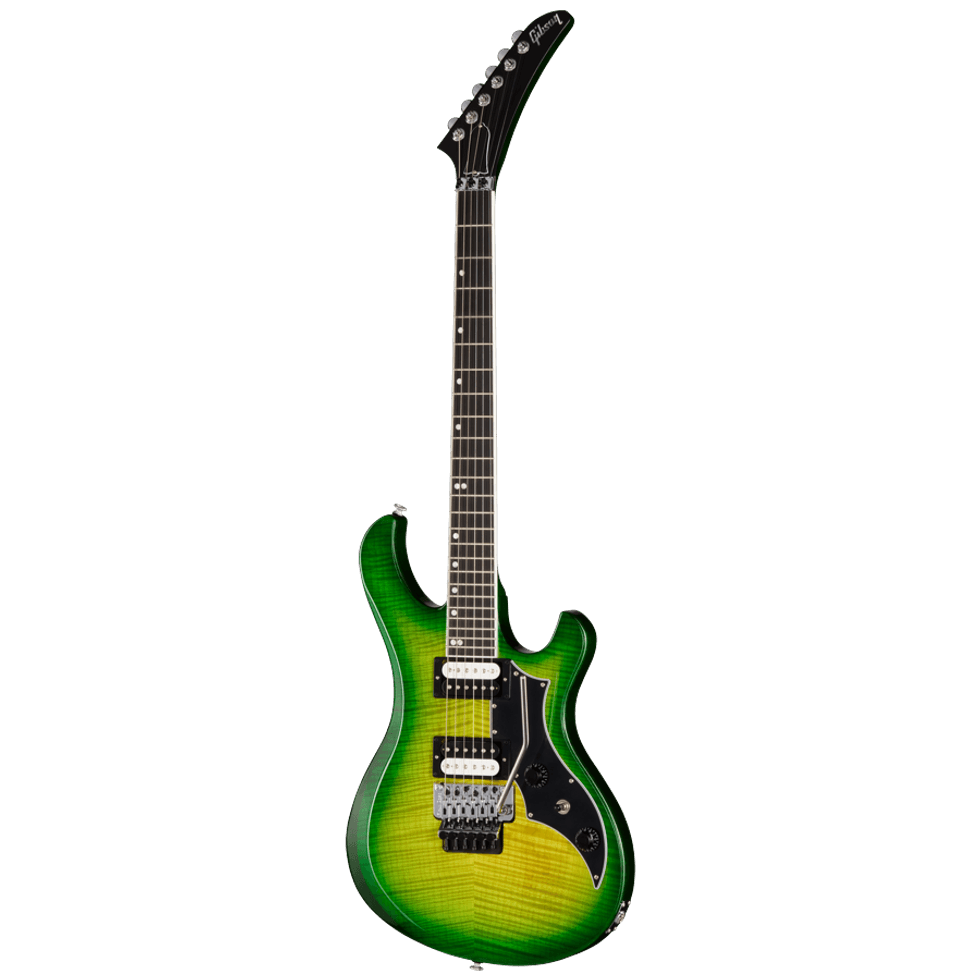
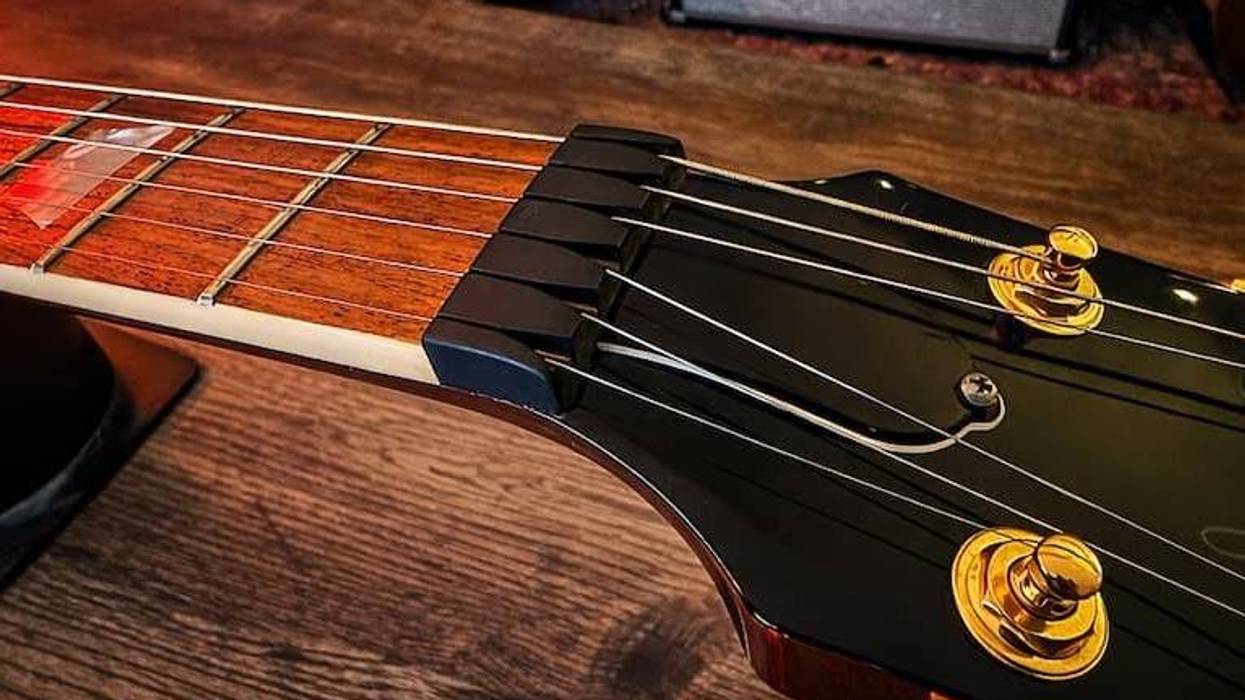
How times change. Gibson now owns Kramer and its superstrat legacy. Maybe that’s why the company felt compelled to give Victory another shot in 2024. And this year they gave players that thing they’d really been asking for—a way to cut loose on a vibrato. In this Floyd Rose-equipped version of the Victory, Gibson made some changes to the original’s bones. For instance, the maple body is now a mahogany body with an AA figured maple cap, while the neck is mahogany. Elsewhere, the scale is 25 1/2", and there’s a 24-fret, compound-radius ebony fretboard. A pair of ’80s Tribute humbuckers are wired for push/pull coil-splitting and switching between inner or outer coils in split setups.
The ’80s Tribute pickups are uncovered, zebra-bobbin humbuckers loaded with Alnico 5 magnets and voiced hotter than a vintage PAF, but nowhere near modern-metal output. There’s enough push for most hard rock and heavy leads, and clarity in reserve when you back off the volume knob, which offers real balance. The push/pull wiring adds more tricks: Pull up on the volume pot and you split each humbucker. Pull up on the tone pot and you switch between the inner or outer coil pairings. Combined with the three-way toggle, the Victory gives you plenty of tone foundations to work within.
Full humbucker mode, however, is where the Victory is in its element. It’s thick and midrange-forward, with plenty of sustain for the legato and bar-driven phrasing this guitar seems built for. Dial up the split-coil mode and the character changes entirely, becoming glassier and airier, with top-end chime that flirts with Strat territory. It’s good for funk comping, spanky clean arpeggios, or just resting your ears between heavy passages. It’s not a perfect single-coil emulation—no coil-split humbucker ever is—but it’s a useful clean voice, and it means the Victory covers a wider stylistic range than the narrow shred-machine classification this guitar suggests.
Wiggle Room
The Victory Floyd Rose’s extra hardware adds extra weight. Compared to its vibrato-less Figured Top cousin, which typically weighs around 6.5 to 7 pounds, a Floyd Rose-equipped version like ours weighs north of 8 pounds. Beyond weight, there’s another real performance difference between the Victory Floyd Rose and the vibrato-less version a player should consider. The Figured Top’s fixed Tune-o-matic bridge delivers very immediate, present-tense responsiveness. The Floyd Rose’s locking vibrato trades some of that directness for elasticity, a very slight give under aggressive bends that some players read as feel but some read as slop. That goes for any vibrato system, of course. And if vibrato is at the core of your playing, you’re already more than willing to make that sacrifice. If you’re less sold on the vibrato path, it’s interesting to play both versions of this guitar and see how you relate.
The beautiful thing about the Floyd Rose is the fluidity it invites to your approach. Once that bar becomes an extension of your picking hand—and it really has a way of ending up tucked into the palm at all times—the guitar stops being a fixed pitch-generator and starts behaving more like a fretted violin. You can shade a note sharp or flat with the tiniest palm pressure, stack fretting-hand vibrato on top of bar-hand vibrato for extra-vocal pitch wobble, or wander into all the microtonal territory between the frets where a fixed bridge simply does not go.
“Dial up the split-coil mode and the character changes entirely, becoming glassier and airier, with top-end chime that flirts with Strat territory.”
Shapes of Things
The Victory neck is a relatively full-feeling SlimTaper profile that seems closer to a substantial C, and that brushes near to a D-shape in the lower positions. It’s certainly a little unusual for such a shred-leaning guitar. Shred-design orthodoxy dating to the Charvel/Jackson era has been about thin necks and ultra-flat radii—built to minimize palm contact and maximize left-hand velocity. The Victory doesn’t play that game in the same way, and on first contact, if you come at it with those expectations, it can feel like too much neck for a dive-bomb.
But if you have that natural reaction, keep pushing through and play to the neck’s strengths. Keep that vibrato bar tucked into your palm and the ergonomics will click into place. A thin, flat neck may be great for raw fretting-hand velocity, but doesn’t necessarily reward constant Floyd Rose pitch bending. This set-up encourages the stuff Jeff Beck did so well: bar-hand and fretting-hand vibrato working in tandem to generate continuous pitch shading rather than discrete fretted notes. And the Victory’s fuller neck gives your fretting hand more expressive leverage.
The Verdict
For a player chasing Jeff Beck’s palm-anchored expressions—where the vibrato bar becomes a root part of your vocabulary rather than the source of an occasional flourish, the Victory is worth the premium price. It’s a singular instrument some players will have to play to understand, but many who do will discover a strong, distinctive voice and vehicle for exploring alternative techniques.


![Rig Rundown: The Black Crowes’ Rich Robinson [2026]](https://www.premierguitar.com/media-library/youtube.jpg?id=66952027&width=1245&height=700&quality=70&coordinates=0%2C0%2C0%2C0)