Though they never made major inroads into the North American guitar market, Swedish maker Hagstrom’s guitars have always had cool cred to spare. Hagstroms in the hands of ABBA’s Bjorn Ulvaeus and Rutger Gunnarsson might not surprise anyone. But they were also used by a range of icons spanning from Jimi Hendrix, David Bowie, Frank Zappa, and Elvis Presley, to Nels Cline, Mark Arm of Mudhoney, and Pat Smear of the Germs, Nirvana, and Foo Fighters. Hagstroms are often unique in sound and feel. The thin necks on many 1960s models, for example, make them favorites among players who like to riff at speed.
The new China-made Megin isn’t quite as quirky as, say, a 1960s Hagstrom III. It’s closer to a traditional rock machine and priced for what you could call the quality-entry-level range of the market, selling for a sum just south of a grand, including the tweed-style hardshell case.
Arctic Charm
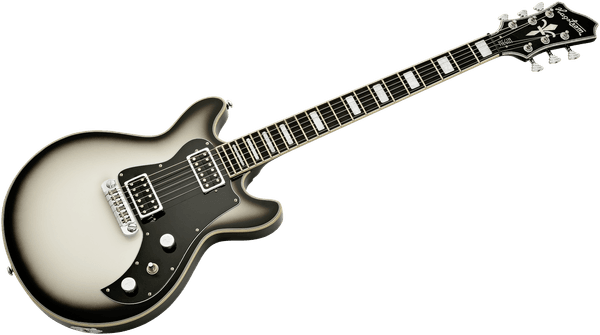
At a glance, the Megin evokes thoughts of Gibson’s Les Paul DC, as well as Hagstrom’s own very Les Paul-like Swede, though there are plenty of departures from those formulas that give the Megin a unique identity and personality. What’s familiar here? Well, there’s a set neck, two humbuckers, and a mahogany body and neck. Unlike a Les Paul, though, there’s no maple cap. And the extra space and stretch you feel is the Megin’s 25.5" scale length, which translates to tighter bass tones on the wound strings and a little more shimmer on the higher strings.
The neck is carved to a slim-C profile that tapers only slightly as you climb it, and although the bound fingerboard looks like a slice of ebony, it’s actually a composite material Hagstrom calls “resonator wood.” Hagstrom’s unique H-Expander truss rod encloses the adjustable round rod within an H-shaped sleeve of lightweight alloy that increases stability—and, Hagstrom claims, the guitar’s resonance. The 22 medium-jumbo frets are smoothly dressed, and the guitar plays easily from nut to joint.
“The Megin cuts straight to the beefy humbucker rock tones that its looks suggest.”
The Megin has a lot going on in the style department, and deluxe details abound, including 5-ply body binding and rounded block inlays. The headstock is classically Hagstrom—ornate and bristling with Art Deco touches, including the Empire-style tuners. Our test guitar came in a grey burst finish that’s happily reminiscent of Gibson’s circa 1979 silverburst, which is one of four options including black gloss, crème, and sky blue. Taken as a whole, it’s fancy without being over the top.
Northern Lights
Hagstrom loads the Megin with a pair of the company’s own Custom 62 humbuckers, including a medium-output unit at the neck measuring 8.2k-ohms resistance and a high-output bridge pickup rated at 13.8k ohms. They’re routed through a simple 2-knob volume and tone setup, which includes a treble-bleed network on the volume control. A 3-way selector switch is positioned between the knobs.
Played through a 1964 Fender Bassman head and 2x12" cab, a recent Vox AC15, and a Fractal FM9 modeler, the Megin projects beefy humbucker rock tones, just as its looks—and those pickups’ resistance ratings—suggest. Guitars like this one have a way of sparking big leads and riffs, and the Megin excels in these rowdy musical settings. There’s lots of sizzle, tons of girth, and sustain enough for any situation I can imagine. Generally speaking, this might sound like a very same-old-humbucker-meets-mahogany-solidbody formula, but the Megin’s 25.5" scale adds articulation that cuts more effectively though distortion and lends the guitar a distinct personality.
Rock modes may be this guitar’s primary mission. Even so, I wonder about the need for such a high-output bridge humbucker. It ramps up dirt and saturation—often in a welcome way— but also makes it tougher to dial in pristine clean tones. A lot of the appeal in less potent humbuckers is that they make it easier to remove distortion and retain a big, clear signal. On the Megin, reducing the guitar’s volume control doesn’t always add up to crystal clear notes.
The Verdict
At $949, you start to expect a lot from a guitar in terms of quality. On that front, the Megin delivers. It’s extremely well put together and exhibits impressive care from just about every design and assembly perspective. That translates to easy playability and a lively resonance.
Guitarists familiar with Gibson-like 24.75" standard scale length might have to adjust to the slightly stiffer feel that comes with the longer scale, but the tone payoff from the extra chime and tight low end can be worth the sacrifice, depending on your style and preferences. The other factor to consider is the pickups. The high output may not be for players who work outside hot-rocking realms, and it can offset the charms of that extra chime and tight bass. But if that’s your lane, the Megin can be magical.




![Rig Rundown: The Black Crowes’ Rich Robinson [2026]](https://www.premierguitar.com/media-library/youtube.jpg?id=66952027&width=1245&height=700&quality=70&coordinates=0%2C0%2C0%2C0)