


Part of me wonders whether
anyone could possibly
think I’ve got wisdom to proffer
after last month’s embarrassing
confessional [“What Was I Thinking?” April 2011], but
enough PG fans have responded
with similar stories that I felt
it wouldn’t hurt to share a
few lightbulb-over-the-head
moments this month. Consider
it the faith-renewing sequel to
last month’s tragicomedy.
Unlocking.
I’m all for gear that makes life easier and less painful, but I used to think every guitar had to have locking tuners to stay in tune reliably, as well as an aftermarket strapsecuring system to escape certain destruction. But applying pencil graphite or something like Big Bends Nut Sauce to the nut slots keeps every one of my guitars in tune quite well (although if you play hard like I do, you’ll probably still have to tune between songs). Similarly, although not having strap locks requires keeping a closer watch on things, I’ve never had an axe fall off going the old-school route.
I’m all for gear that makes life easier and less painful, but I used to think every guitar had to have locking tuners to stay in tune reliably, as well as an aftermarket strapsecuring system to escape certain destruction. But applying pencil graphite or something like Big Bends Nut Sauce to the nut slots keeps every one of my guitars in tune quite well (although if you play hard like I do, you’ll probably still have to tune between songs). Similarly, although not having strap locks requires keeping a closer watch on things, I’ve never had an axe fall off going the old-school route.
Power-Tube Revelations.
I’ve owned amps with myriad power-tube types—and I love what other players have done with all types—but I eventually realized I usually sound better through amps powered by 6V6s, 6L6s, or something else with a rounder, fatter tone—something that doesn’t sound spiky and harsh with my heavy attack and heavy strings (.011s). That said, tube type alone doesn’t determine tone—and I’ll still give any amp a fair shake—but this epiphany has helped my ears search for the type of tone that works best for my style.
Volume-Knob No-Can-Dos.
Another big breakthrough
came when I realized any guitar
with a Volume knob placed
forward of the bridge saddles is
bad news—my energetic way
of banging out chords always
ends up gradually lowering the
volume till the tone is neutered.
Now, anytime I consider buying
a guitar, I look at it horizontally
and draw an imaginary line
straight down from the saddles.
If the Volume knob crosses that
line toward the neck, the axe is
out of the question.
Flesh Tones.
When you’re new to guitar, it’s tempting to view fingerpicking as something only classical or country players do. Gods like Jeff Beck and Brian Setzer (the latter is featured on p. 116 of this issue) taught me that exclusive plectrum use stunts your potential. An infinite number of overtones and inflections are yours for the taking with the fleshy parts of your picking hand’s thumb and fingers.
When you’re new to guitar, it’s tempting to view fingerpicking as something only classical or country players do. Gods like Jeff Beck and Brian Setzer (the latter is featured on p. 116 of this issue) taught me that exclusive plectrum use stunts your potential. An infinite number of overtones and inflections are yours for the taking with the fleshy parts of your picking hand’s thumb and fingers.
No Bad Genres.
That pretty much says it. If you think [insert your most loathed genre name here] just blows—across the board, no questions asked— you’re sort of being a bigot. You’re also preventing yourself from hearing a lot of music that could literally change your life. There’s great stuff and crap in every genre, but everything deserves at least one listen. Everything.
Pared-Down Pedalboard.
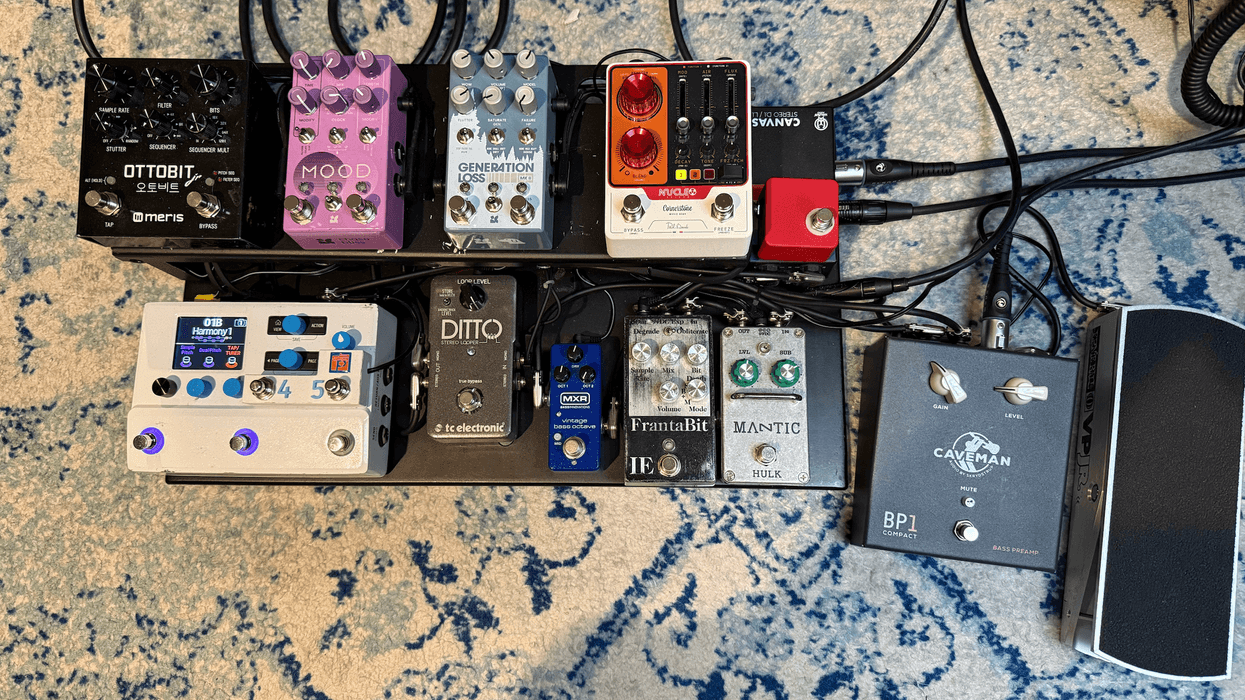
I’ve never had a massive pedalboard,
but at one point I had
seven or eight effects at my feet. I
was so preoccupied with making
my parts “more interesting” by
stepping on another box (or finding
some magic combination)
that I neglected to make them
more interesting in the ways that
no box on earth can—by using
my imagination and my fingers.
Though all the stomps were
quality, interesting effects, they
were becoming crutches—not
to mention, all that tap-dancing
threw off my timing and groove.
These days, I’m perfectly happy
with reverb, a tremolo pedal,
and a boost. I’m not saying it’ll
always be that way, but there is
something liberating about cutting
loose—and it does wonders
for signal fidelity, too.
Taming the Inner Gear
Snob.
If you’ve ever made the mistake of thinking gear that’s not “boutique,” made in the USA, or exclusive in some way can’t be worth playing, you probably also realized after shelling out thousands of dollars for top-drawer gear that your same basic sound was there. The takeaway: You do not need a custom-shop axe, a point-topoint- wired amp, and thousands of dollars’ worth of pedals to kick ass! The blues masters who paved the way for rock ’n’ roll and inspired everyone from Keith Richards to Clapton, Beck, Hendrix, and more played department-store guitars that we’d balk at today—and they changed the world. What matters most is putting time into getting the sound you want out of your fingers. My point isn’t that boutique gear is a waste or a sham—far from it—but for everyone except millionaires, moderation is key. (Personally, I think pickups and amplification are where you should splurge a little.)
If you’ve ever made the mistake of thinking gear that’s not “boutique,” made in the USA, or exclusive in some way can’t be worth playing, you probably also realized after shelling out thousands of dollars for top-drawer gear that your same basic sound was there. The takeaway: You do not need a custom-shop axe, a point-topoint- wired amp, and thousands of dollars’ worth of pedals to kick ass! The blues masters who paved the way for rock ’n’ roll and inspired everyone from Keith Richards to Clapton, Beck, Hendrix, and more played department-store guitars that we’d balk at today—and they changed the world. What matters most is putting time into getting the sound you want out of your fingers. My point isn’t that boutique gear is a waste or a sham—far from it—but for everyone except millionaires, moderation is key. (Personally, I think pickups and amplification are where you should splurge a little.)
Low-Capacitance Cables.
Many of us have marveled at things Eric Johnson says he can hear, but I’ve got to thank him for enlightening me years ago (via magazine interviews) on the importance of low-capacitance instrument cables. If you want bristling, clear, hi-fi tone, this is perhaps your single most important investment—especially if you use a lot of pedals. Spending tons on guitars and amps but being blasé about cables is like putting budget tires on a Mercedes.
Learning by Osmosis.
If
you’re like me and are more
interested in creating your own
(hopefully) unique art than
playing covers, you may find
that you come closer to that
goal when you refrain from putting
your heroes’ licks under a
microscope and instead let their
vibes seep into your playing—
however they filter through your
brain’s synapses to your fingers.
I’m not saying never check out
the tablature to your idol’s most
amazing songs, but I believe
minimizing that and instead
reading about his or her philosophies
on technique, phrasing,
theory, and inspiration will help
you capture some of their mojo
without sounding like you’re
copying them. It’ll take longer
that way, but it’ll be worth it.
The items above aren’t necessarily
truisms for everyone in
the same sense that everything I
admitted to last month is a glaring
example of what to avoid.
Many of them are more like
epiphanies about what works for
me and my playing, but hopefully
they’ll help you find your own
epiphanies or remind you of ones
you’ve already had. Either way,
we hope you’ll share your “Aha!”
moments with us via email
(shawn@premierguitar.com) or
in the comments section of the
online version of this article.
Later!
Shawn Hammond
shawn@premierguitar.com
shawn@premierguitar.com