

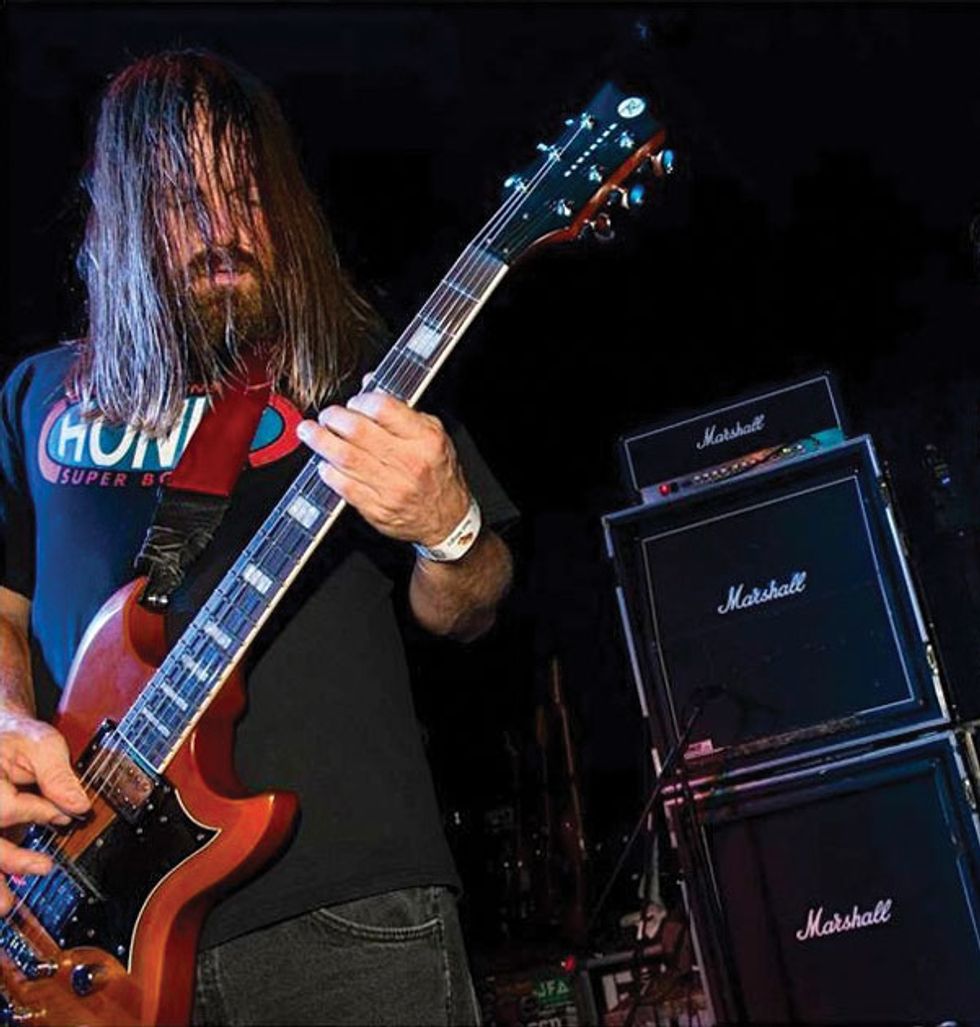
Bob Balch’s signature Reverend guitar is based on the company’s Sensei model and has beveled edges, satin finish, a tone chamber under the pickguard, and Railhammer Bob Balch Signature pickups. Photo by Jerry Miller.
Borne out of the same sunbaked SoCal soil that spawned stoner rock and doom metal mainstays like Kyuss and Goatsnake, Fu Manchu has been fighting the good fight for crushing riffs and Sabbath-esque grooves since before it was hip. On Gigantoid, the band’s first studio effort since 2009’s Signs of Infinite Power, singer/guitarist Scott Hill, guitarist Bob Balch, bassist Brad Davis, and drummer Scott Reeder prove that the fire burns as bright as it ever did in the band’s proto-grunge adolescence. Balch’s cascading fuzz effects form the perfect foil for Hill and Davis’ “plug in, turn up, rock out” ethos. On a short break between North American and European tour dates, they took time to talk to us about how they craft their larger-than-life tones.
How did the songs come together for Gigantoid?
Scott Hill: Kinda like how we’ve been doing it for the last 25 years: show up to practice, play a riff, show our drummer. Usually we record everything we do on a 4-track cassette machine. We’ll put one microphone in the middle of all of us—pointing down. That seems to capture everything really well. We’ve been doing that for 20 years on the same recorder.
Bob Balch: We’ll work on arrangements and add little twists and breaks. We won’t really hear the lyrics until we go in to record. We might each have some ideas, but usually Scott has it down. He’s been doing it for so long, and we all trust each other.
the same recorder.” —Scott Hill
This is the first new album in a number of years, but you guys stayed busy on the road.
Hill: After we did Signs of Infinite Power, our manager said, “Hey, next year is the 15th anniversary of In Search Of…. The record label will reissue it on vinyl if you want to do that.” We did a tour where we played the whole record live—we’d never done that before. The next year was the 15th anniversary of The Action Is Go, so we toured and played that one, as well. Last year we finally decided to write a new record.
When you revisited those two albums for the tours, did you rediscover any deep cuts that shed light on what you did in your earlier years?
Hill: On In Search Of… there’s a song called “The Bargain” that we’d never played live. It wasn’t one of my favorite songs on that record, so I was like, “Oh crap, I better learn how it goes!” It was like a new song to me, and I came to like it. There were maybe two songs from The Action Is Go that we’d never played live. And they were fun to play—I don’t know why we’d never played them in the past 15 years.
How do you two work together to find complementary guitar tones?
Hill: I’ve pretty much had the same guitar tone since ’93 or ’94. I use a Univox Super Fuzz and Crown W-Fuzz pedals, and those are basically the same tone. Usually our fuzz tones are so over-the-top and noisy that they just fit together. Mine has a little more high end, and his is more full-bodied.
Bob Balch's Gear
Guitars
Reverend Bob Balch Signature
Amps
’69 and ’71 Marshall Super Bass heads
Marshall DSL100H
Effects
Creepy Fingers Creepy Face
Creepy Fingers Pink Elephant
Voodoo Lab Pedal Power 2
Boss TU-2 Tuner
ZVEX Sonar
MXR Phase 100
Dunlop Cry Baby Wah
Electro-Harmonix Memory Man with Hazarai
BBE Soul Vibe
Colorsound Bass Fuzz
Strings and Picks
Ernie Ball Power Slinkys (.011–.048)
Jim Dunlop 1 mm Tortex picks
What’s the biggest challenge for you guys in the studio?
Balch: For me, it’s tripping out on guitar tones, trying to get sounds that we dig. We made an effort on this record to make it as fuzzy as possible. Usually I go into the studio, plug in, and go, “Sure, that sounds good.” But it’s been since 2009 since we had a new record out, so this time, I really wanted to dig in. I wanted people to go, “Whoa, that’s insanely fuzzy,” because that’s what our fans dig. I used two fuzz pedals at once. One has an external bias control, so I would crank that one, and use the second fuzz pedal as a noise gate.
How does that work?
Balch: Brad has a pedal company, Creepy Fingers, and he makes a pedal called the Creepy Face, which is loosely based on a ’60s Fuzz Face. That one has an internal bias control you can access through the back panel, but on the one he made me, that control is on the top. When you crank it all the way, it completely squashes the signal and it sounds kind of farty. But if you turn it the other way, it opens up and lets the sound through. If you have a lot of fuzz going, you can use the bias control to quiet it down. The first pedal in my signal chain is a Creepy Fingers Pink Elephant, which acts like an old Tone Bender. I crank the shit out of that, but then there’s a lot of noise. I crank the fuzz on the Creepy Face, but then can quiet it down with the bias control. If you run two fuzz pedals at once, you get a ton of hiss, even when you’re not playing. I was just messing around at home and found those two pedals to be a really cool combination. But it only works with a few particular Marshalls—some heads are like, “No, this is ridiculous,” while others are like, “Sounds good—let’s do this!” I can’t really explain why or how—it was trial-and-error. I definitely have the fuzziest tone I’ve ever gotten on this record.
Despite all the fuzz, there’s a lot of low-end body in your sound.
Balch: Since the Creepy Fingers were designed as bass pedals, they retain a lot of the low end. Also, Reverend made a signature guitar for me recently that uses Railhammer pickups, which use pole pieces for the high strings and rail magnets for the lower strings. I really dig the pickups, but their low end was battling with the low end from the pedals. So when we worked on the signature model, I wanted the pickups to emphasize more midrange so it could cut through the fuzz.
Were there any other special things you wanted out of your signature guitar?
Balch: I run a website called playthisriff.com, where I interview musicians teaching their own songs. When I interviewed Frank Agnew from the Adolescents, I took notice of his Les Paul. It originally had three pickups, but the middle one was gone, leaving an empty chamber. The guitar sound was unique—it sounded like a Les Paul, but with a different harmonic structure up top. It definitely didn’t sound like any other Les Paul I had heard. Scott’s old Fender Jaguar has the same deal—he yanked the middle pickup and left the chamber empty. So when the guys at Reverend suggested having a routed-out chamber in the body underneath the pickguard, I was like, “hell yeah!” I don’t know exactly why—I don’t build guitars—but it just adds a lot more sustain.
The first guitar they gave me was a Reverend Daredevil. They showed up at a show in Detroit and offered it to me. At first I said “no, that’s okay”—I’d been playing Gibson SGs for years. But my SG at the time had just been given a terrible re-fret job, so I tried the Daredevil. When I plugged it in, I loved how the notes sustained and bloomed. We started talking about a signature model, and I told them I’d want the midrange to poke through, and I asked for it to look more like their Sensei model.
Had you ever tried playing hollow or semi-hollow guitars with Fu Manchu before that?
Balch: Before I joined the band I was deep into jazz, so I had hollowbody guitars, but no, not really. In the studio it might be cool, just to add some texture for some leads or clean guitar up top. But live, it might be a little strange. For the most part, Fu Manchu needs to be as fuzzy as possible and have as much low end as possible.
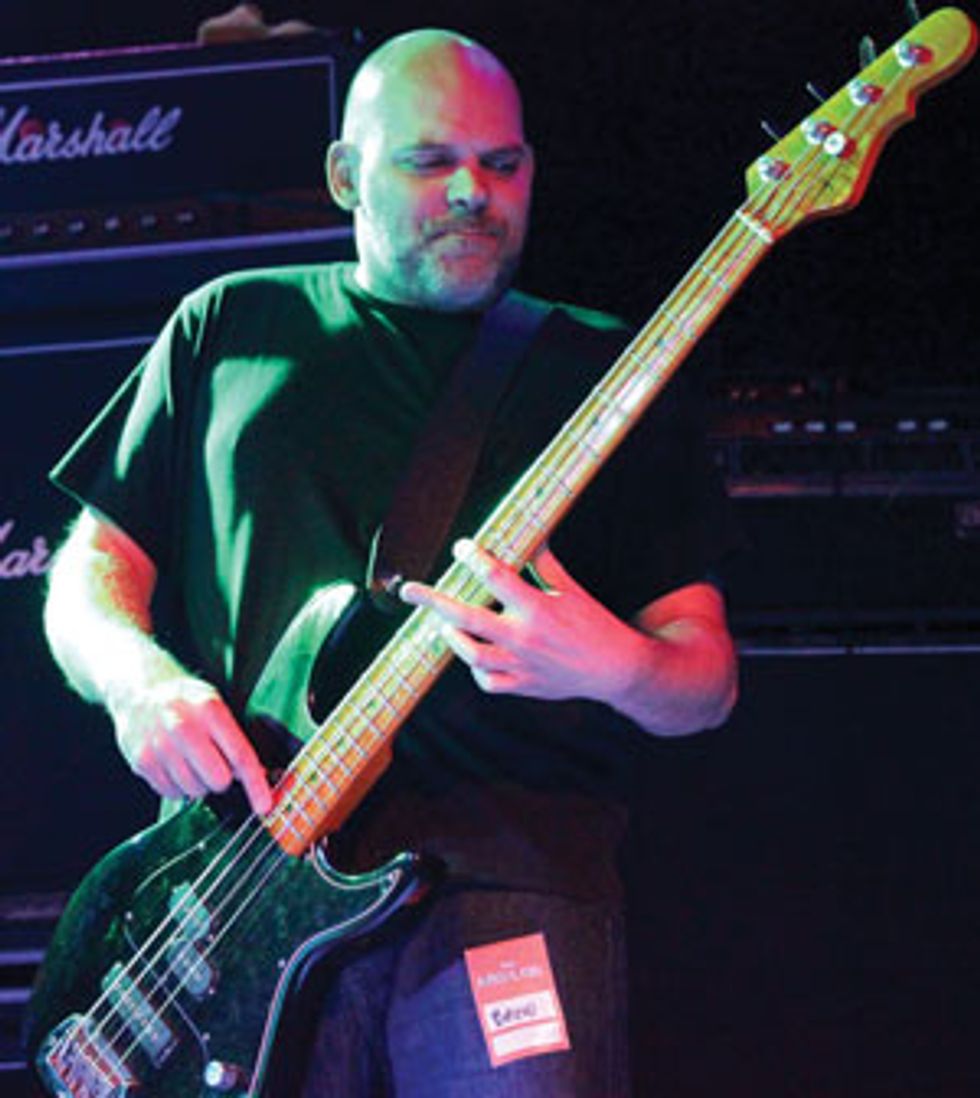
Bassist Brad Davis is known for the pedals he makes under the Creepy Fingers moniker, but with Fu Manchu he sticks to a basic rig of G&L SB-1 and SB-2 basses driving a 1969 Ampeg SVT. Photo by JJ Koczan.
Bass-man Brad Davis on His Fuzzy Bottom
Since joining Fu Manchu in 1995—replacing original bassist Mark Abshire—Brad Davis has made subtle tweaks in the tone department, preferring the sound of his trusty P-style G&L basses cranked through an Ampeg SVT. Davis’ bass tone is fuzzier than a laundered woolen poncho, but despite his considerable skills as the principal pedal builder at Creepy Fingers, Davis ditches stompboxes in favor of the natural overdrive that can only come from vintage glass. What goes into your bass tone?
For all the Fu Manchu records, it’s been fairly consistent. On this record, I used two basses: my 1992 G&L SB-1—the first bass that I purchased to play with the band—and my custom 2007 G&L SB-2, which was built to feel more like the original SB-1 but with a wider neck. Between those two basses, I could get all the basic tones I wanted. For amplifiers, I used the same 1969 Ampeg SVT that I’ve used on all the records. For tracking, I like using an 8x10 cabinet with speakers that aren’t completely worn down, so I can have clarity when I need it.
Do you have particular go-to settings for the head?
It’s pretty middle-of-the-road. I don’t use any of the “deep” or “bright” switches, and everything is usually set to around 7. I’ll set the midrange according to the room—if I need to cut through, I’ll set [the frequency center] a bit higher, but it’s generally in the middle setting.
With two fuzzy, down-tuned guitars, does the Fu Manchu sonic environment pose any challenges?
I don’t need to use a graphic EQ to notch particular frequencies out. My tone is fairly dirty, but it’s all natural amp distortion. On bass, pedals automatically knock out some of the low end, so I prefer the natural overdrive I get from an amp. The G&L pickups are pretty high-output, but they’re passive, so they don’t sound muddy. I prefer high-output passive pickups, because they help to drive the amp.
The bass sound for the whole album is just the amp and whichever bass I was playing. With that amp, once you set the volume around 6, that overdriven tone is the sound that naturally comes out of it.
Like Bob and Scott, you tune down a full step. Which strings do you prefer for that?
DR Strings Lo-Riders, .050–.110. When tuning down, I want to retain tension—but if the string is too heavy it gives too pure a tone for me. With medium-light tension, I feel I can get a richer tone.
Do you prefer playing with a pick or your fingers?
It depends. On [1999’s] Eatin’ Dust and [2000’s] King of the Road, for example, it was almost all fingerstyle. The Action Is Go [1997] was almost all played with a pick. On the new record, I let the song decide—it usually comes down to tempo. I want to be able to accent certain parts on faster tunes, and if I’m playing a slow song, I want to use fingers to get that extra low end. Sometimes I’ll record a song playing with a pick, but find it’s more fun to play live with my fingers.
Brad Davis’ Gear
Basses
1992 G&L SB-1
2007 G&L SB-2
Amps
Ampeg SVT
Ampeg 8x10 cab
Effects
None
Strings and Picks
DR Strings Lo-Rider sets (.050–.110)
Tell us about things at Creepy Fingers.
Things are good. I generally split my time between production pedals—like the Creepy Face, the Fuzzbud, and the Pink Elephant—and custom work, which is the more creative side of pedal building.
How did you get into building pedals?
I was always obsessed with pedals, even before I was in Fu Manchu. I started by buying a lot of pedals—especially when eBay was first around—but it was getting to be a bit much. Like a lot of people, I got into BYOC [buildyourownclone.com].
I’d built a theramin from a kit for a few of our albums, and I thought, “Well, that went pretty well.” So I thought I’d try a few pedals. It quickly went from not being able to stop buying pedals to not being able to stop making them. It was fun to pursue the sounds I wanted instead of just buying equipment to find out if it fits my sound. I started making some pedals for friends, and then word got around.
What’s most important when it comes to building and tweaking pedals?
You have to have a decent ear. My understanding of the circuits themselves is limited, but I learn more every day. But without knowing what you want, it’s far more difficult. Personally, I like using vintage components, although I don’t think that’s a make-or-break kind of thing.
Which pedal builders do you admire in particular?
There are a lot of builders out there that have a common bond, in terms of trying to build vintage-style circuits, taking an old-school approach. David Main of Differential Audio Manifestationz is one. John Lyons from Basic Audio is another. Jerms—Jim Roth from Built to Spill—also makes a lot of nice handmade pedals.
Aside from Fu Manchu and Creepy Fingers, what else do you have coming up?
I’m headed into the studio with [Clutch frontman] Neil Fallon and [former Sabbath drummer] Vinny Appice. It’s an old-school metal kind of thing.
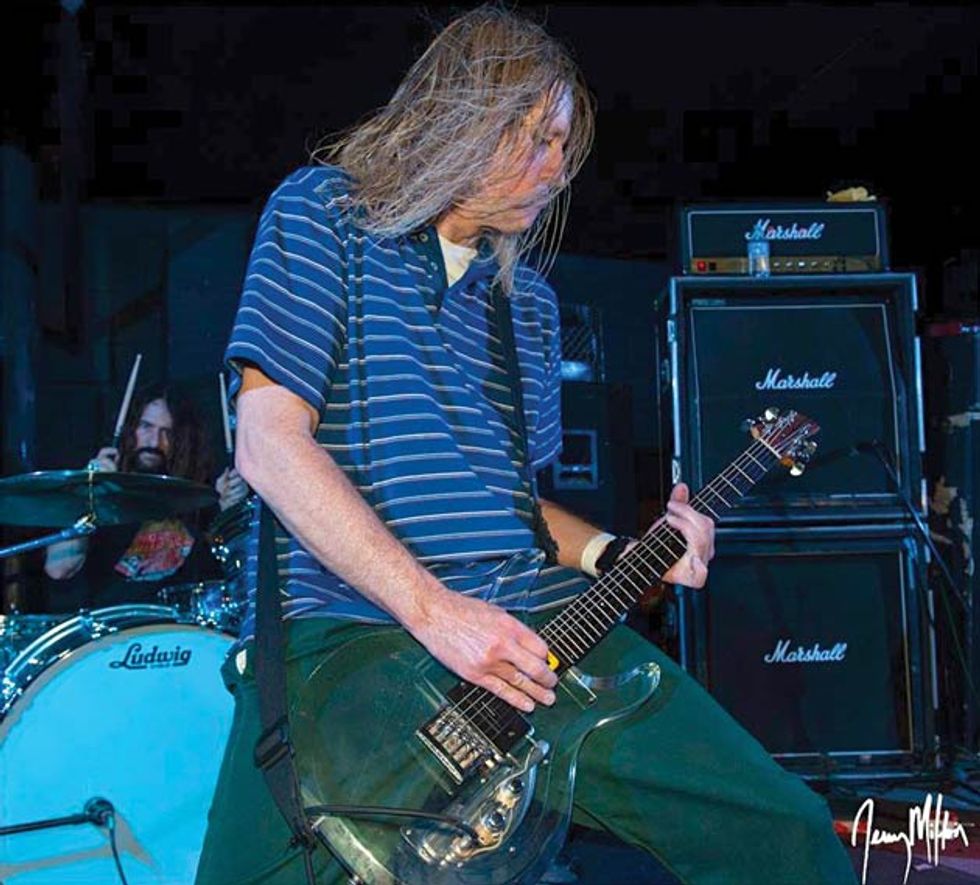
Shown here with his No. 1 axe, an Ampeg Dan Armstrong Plexi guitar, Fu Manchu frontman Scott Hill says his tone has been the same since the early ’90s. He uses a Univox Super Fuzz and Crown W-Fuzz pedals through a Marshall JCM800.
Photo by Jerry Miller.
Scott, what are your go-to guitars?
Hill: I mainly play an Ampeg Dan Armstrong guitar. I’ve been using Seymour Duncan Hot Rail pickups since ’94. I replace them every couple of years because they get so sweaty. Those are a major part of my sound. I then go to the fuzz pedal, and then into a Marshall JCM800 head. I set the head as numb and dead as I can, and let the fuzz pedal get all the tone. I played a Fender Jaguar on this record, as well.
Bob, what are your other key pieces of gear?
Balch: For the recording, I used a ’69 or ’71 Marshall Super Bass. For live shows, I just got a Marshall DSL100H, because my other heads were having some trouble with arcing. I dig it—especially because I get so much of my tone from the guitar and the pedals. I basically just need an amp for the crunchy, AC/DC-type clean tone.On my pedalboard, I use a Voodoo Lab Pedal Power 2 for power. The Pink Elephant comes first, then the Creepy Face. That goes into a Boss TU-2 tuner, and then on to a ZVEX Sonar, which basically chops your signal in and out. I use that one at the end of “Dimension Shifter,” and in the intro and outro of “Evolution Machine,” coupled with an old MXR Phase 100. The Sonar goes into a regular Dunlop Cry Baby wah and then an Electro-Harmonix Memory Man with Hazarai delay. I use the delay a lot for leads, especially with the tap tempo on it. The Super Bass heads didn’t have an effects loop, but live with the DSL100H, I run a ’70s MXR Phase 100 and a BBE Soul Vibe through the effects loop.
On “Anxiety Reducer,” we really wanted to rip off the tone of the guitar solo in the Isley Brothers’ “Who’s That Lady.” So we plugged into the phaser and then straight into the board—that was apparently their trick to that sound. I wasn’t sure how to duplicate that sound live, but it turns out if you run the phaser and the Soul Vibe at the same time—even if they are running at different rates—it comes pretty close to what’s on the record. In the studio for “Anxiety Reducer,” we used a Colorsound Bass Fuzz and an MXR Phase 100 direct. Brad and I are big Isley Brothers fans, and we had been talking about trying that technique for years.
Also, I never really used to care about picks, but for the past five years or so I’ve found I prefer 1 mm Dunlop Tortex picks. I used to play the same pick and the same guitar as Scott, because I was obsessed with playing in tune with him. But that was just my OCD—that obsession kind of vanished. And for Fu Manchu, it’s actually cool that you can hear there are two different guitars playing together. When I switched to thicker picks, I found I could play the leads I actually wanted to. Before, I was playing with thin picks, and I found I didn’t have the control I wanted for faster runs.
Scott Hill's Gear
Guitars
Ampeg Dan Armstrong Plexi
Fender Jaguar
Amps
Marshall JCM800
Effects
Univox Super Fuzz
Crown W-Fuzz
Strings and Picks
Ernie Ball Power Slinkys (.011–.048)
How do you tune your guitars?
Hill: We tune to D all the way down [D–G–C–F–A–D], and sometimes—like on “Evolution Machine”—we’ll drop down to C.
Name a band or a player who’s caught your attention in the past few years.
Balch: Mike Scheidt from [doom-metal band] YOB—his guitar playing is insane. I teach guitar on Skype, and I get a lot of requests, like, “Teach me this ZZ Top lick,” or whatever. When one guy asked me to figure out a YOB guitar part, I was stumped. And when I get stumped, I get intrigued.When I’m at home, I actually don’t listen to much rock. Fu Manchu fans would be pretty disappointed if they knew what was going on when I’m at home—it’s a lot of ’70s soft rock.
Hill: I like Moab—their guitar player and singer [Andrew Giacumakis] produced our last record, and they have a new one out that I really, really like. I’ve been listening to Clutch’s latest record a lot. That’s pretty much it. On tour I don’t listen to much music.
Bob, how did playthisriff.com come about?
Balch: I’ve been doing that since 2009. I was initially going to put up a website with just Fu Manchu lessons, so I filmed myself playing every Fu Manchu song that I played on and posted TAB in PDFs on the site. It was a subscription-based site, and I figured if I got 20 or so subscribers, that would be cool—a little bit of extra cash. But I realized I could drive more people to the site if I could interview other players, as well. Exodus was the first band to agree to do it, and now there are around 70 bands—including Megadeth, Queens of the Stone Age, Death Angel. It’s a lot of thrash metal, stoner rock, and punk. We’re constantly adding videos and tabbing stuff out.
When you go to shoot the videos, what gear do you bring with you?
Balch: Aside from the camera and lights, I bring an old BK Butler Tube Works TD-752 combo amp. I bring all that stuff backstage to various venues. I feel weird doing it—because I’ll take over the backstage of a band I don’t really know! A lot of players—Tim Bogert from Cactus, John 5, Tracii Guns, Gary Hirstius from the Circle Jerks—have invited me up to film at their houses. It’s amazing to meet the people that I grew up idolizing. When I go home and edit the stuff, I end up learning a ton, too. In the past five years, I’ve gained a lot of knowledge. I parlayed a lot of that into Sun & Sail Club, the side project I did with Scott Reeder, the former bassist in Kyuss. I’d interview dudes and come home and be fully inspired.
YouTube It
Heavy riffs, hot rods, rad rides: In this May 2014 video from New York City, Fu Manchu performs “Mongoose” from their 1999 album, Eatin’ Dust.
You get some insane tones on Sun & Sail Club’s Mannequin. What’s going on there?
Balch: That’s my guitar going into a vocoder and a Chandler mic preamp. For that, the guitar parts are a little bit faster than Fu Manchu. When you play fast with a fuzz, it can just get buried. So I used a Marshall JTM45 with the Creepy Face and blended it with a Marshall JCM800 with a Tube Driver. When we mixed it, I wanted to have the guitar as fuzzy as possible, with the Tube Driver channel in there to give it crunch and attack.
What’s your pedagogy or approach to teaching lessons?
Balch: I just cater to each student. Some are absolute beginners, and we’ll just learn songs. Others will come and say, “I’ve been improvising for years and I’ve just hit a wall.” That’s usually a pretty easy fix, because people tend to stay in a pentatonic box. So I’ll say, “Try playing pentatonic on only two strings,” or other ideas. Since I’ve started, I’ve gotten some bizarre requests that make me wonder how people found me. Somebody might ask me to teach them Chet Atkins licks. I’m like, “I’m in Fu Manchu, how did you find out about me?” [Laughs.] But it’s cool—I’m stoked to do it.
Hill: I’ve always wanted to just stand by my amp and play. I just plug into a fuzz pedal and a Marshall and turn it up as loud as I can.
![Rig Rundown: The Black Crowes’ Rich Robinson [2026]](https://www.premierguitar.com/media-library/youtube.jpg?id=66952027&width=1245&height=700&quality=70&coordinates=0%2C0%2C0%2C0)