

When you get into the history of the development of the electric guitar, you encounter a lot of famous names: Les Paul creating his “Log” from a 4x4 block and a Gibson neck, Paul Bigsby fashioning his ultra-modern solidbody for country legend Merle Travis.
Go deeper and you’ll read about pioneering brands like Rickenbacker, Epiphone, Vega, Volu-Tone, and Vivi-Tone, all of which helped bring the dream of the electric guitar to life. But one name you seldom see? Slingerland.
Yes, Slingerland.
Although best known these days as a drum brand (thanks to the success of its 1930s Radio King set), back in the 1920s Slingerland was actually the king of cheap banjos. It was only after the success of the banjos that it moved into drums, then acoustic guitars, and soon thereafter, a giant leap forward for electric guitars.
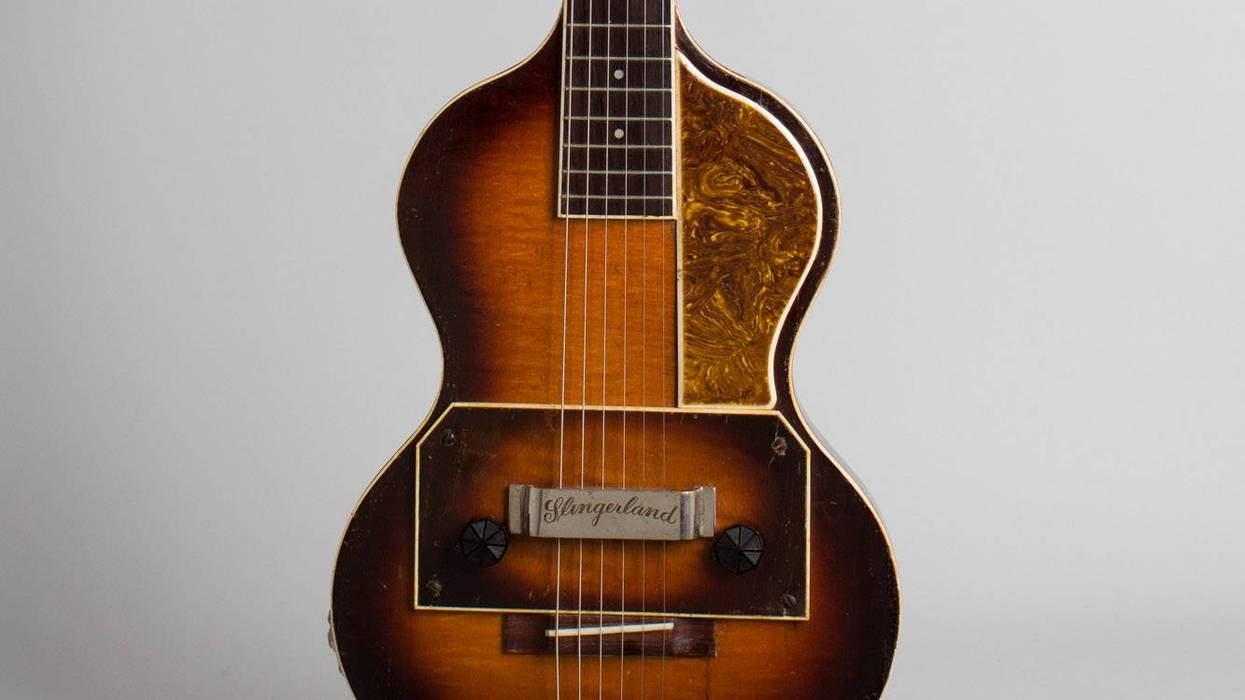
The Slingerland Songster Model 401, created in 1936, was in many ways the first solidbody electric guitar that most of us would recognize as a modern instrument. Serial #132, up for sale now on Reverb via Retrofret Vintage Guitars, is our featured pick for this edition of Vintage Vault.
That’s not to say this model was the first. By ’36, there were many companies affixing pickups to otherwise acoustic archtops and flattops. Rickenbacker had made its frying pan lap steel way back in ’31, and had issued a solid, plastic-bodied Bakelite Electro Spanish guitar in 1935.
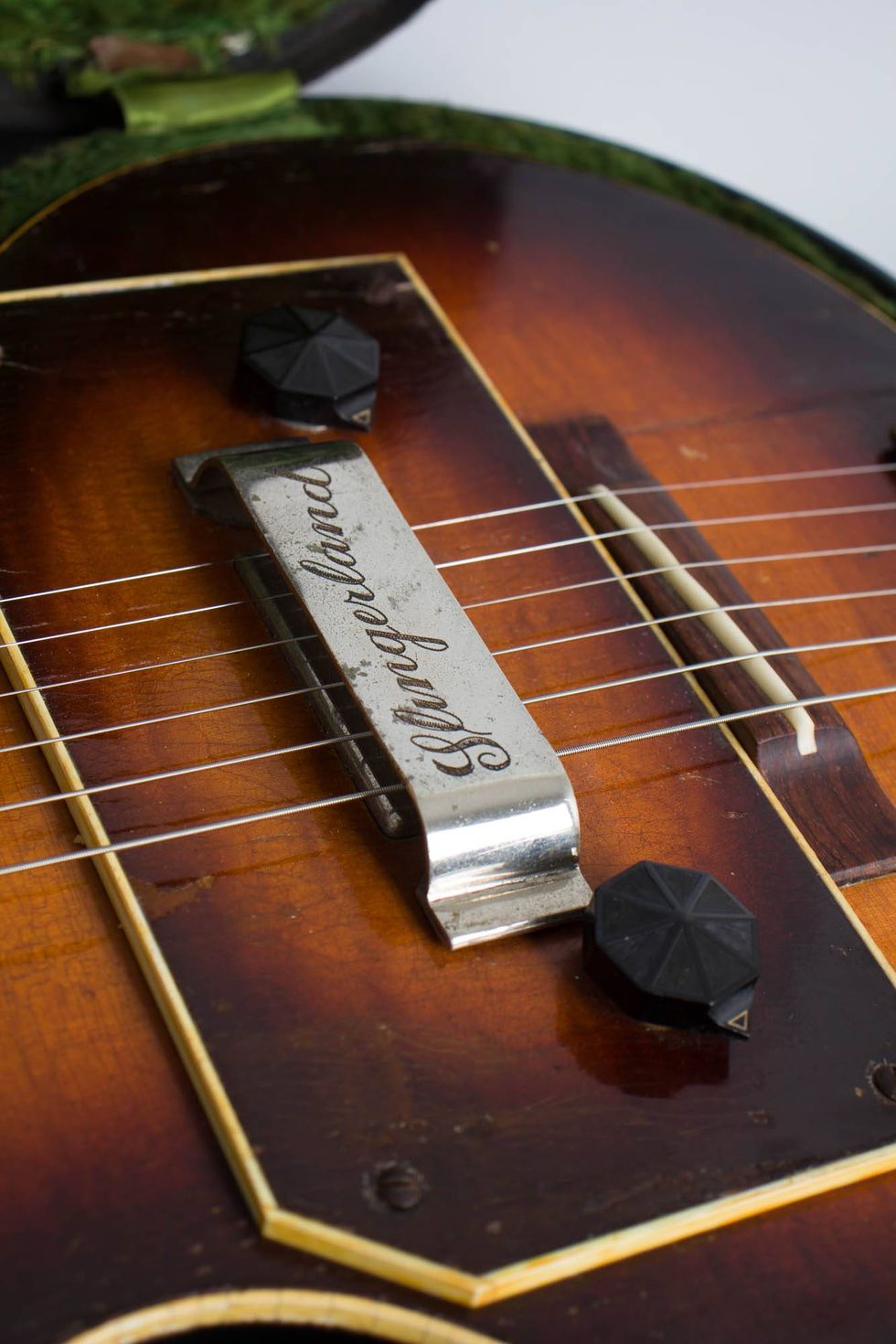
Despite its unique construction, the Songster’s pickup, powered by a horseshoe magnet, operated similarly to a modern humbucker.
Photo courtesy of Retrofret Vintage Guitars
But the Songster Model 401 was the first solidbody electric guitar to be made out of solid wood, which is a fairly important distinction. In an era of electrified archtops, aluminum Hawaiian steels, or Rickenbacker’s plastic Electro Spanish, the Model 401 was a beautiful, slightly hefty instrument, one that would look right at home on a wall hook next to a Les Paul.
Built via neck-through construction, the round, D-shaped neck and the body itself were both made out of poplar, with a gorgeous flamed maple veneer on top with a sunburst finish. The rosewood fretboard has a comfortably fast 12" radius, and a 25" scale length.
Its body—15.25" long, and 11.5" wide at the lower bout—was revolutionarily small compared to the large archtops that dominated the guitar market, and is even svelte compared to a Les Paul. But at over 7 pounds and 6 ounces of solid wood in weight, it would’ve felt closer to a light Tele than any of its mid-’30s peers … if the Tele had been invented in time to compare.
“…the Model 401 was a beautiful, slightly hefty instrument, one that would look right at home on a wall hook next to a Les Paul.”
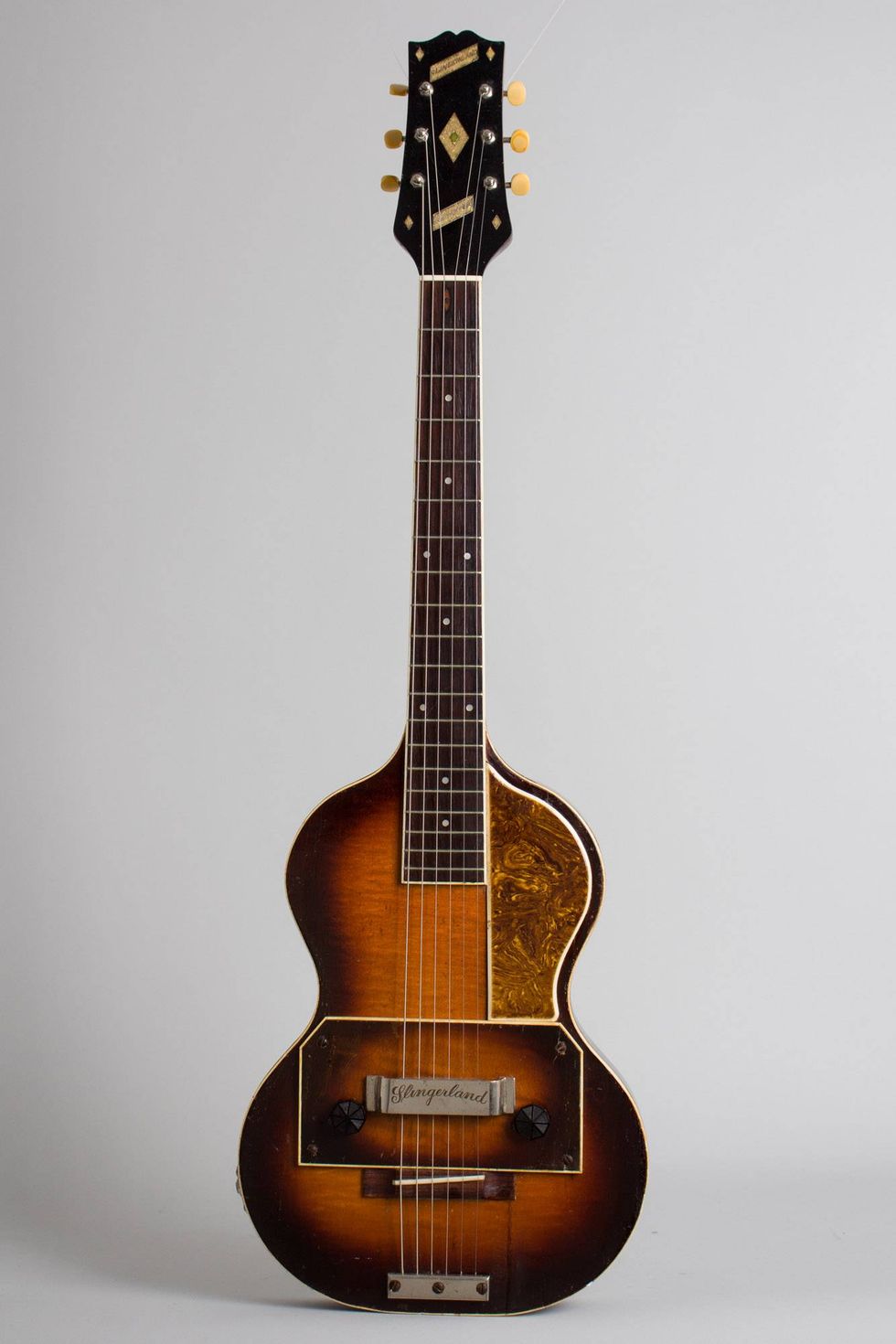
The Model 401’s pickup situation looks quite unique, but what you’re looking at is something akin to the Stratocaster’s pickguard: the Songster’s pickup, volume, and tone control all mounted onto one plate that is then secured to the body.
In The Pinecaster Collection, Lynn Wheelwright explains what’s happening under the hood: “The original Songster pickup had a unique design; it used six individual pole pieces—one for each string. Each elongated coil was divided into two sections of three coils with the coils connected in series.” These were energized by a horseshoe magnet. While not constructed the same, the effect was similar to a modern humbucker.
The 401, with its matching amplifier, was $135 at the time of its release, in line with other electrics of the era and a little more than $3,000 today if adjusting for inflation. Its solid wood construction, flamed maple top, and small body made it thoroughly modern, and it was, perhaps, too advanced for its time. By 1940, it had ceased production in its original form, only ever numbering in the dozens of units.
Today, you might expect them to be priceless. But you can actually find them for anywhere between its original inflation-adjusted price of about $3,000 to $9,000. Our Vintage Vault pick, listed at $5,950 at the time of writing, is not even the only one currently for sale on Reverb.
So if you want a piece of true guitar history, why not start with an early electric solidbody that won’t even feel that early in your hands?
Sources: The Pinecaster Volume 1: The Pioneers by Lynn Wheelwright, jayrosen.com, Reverb listings