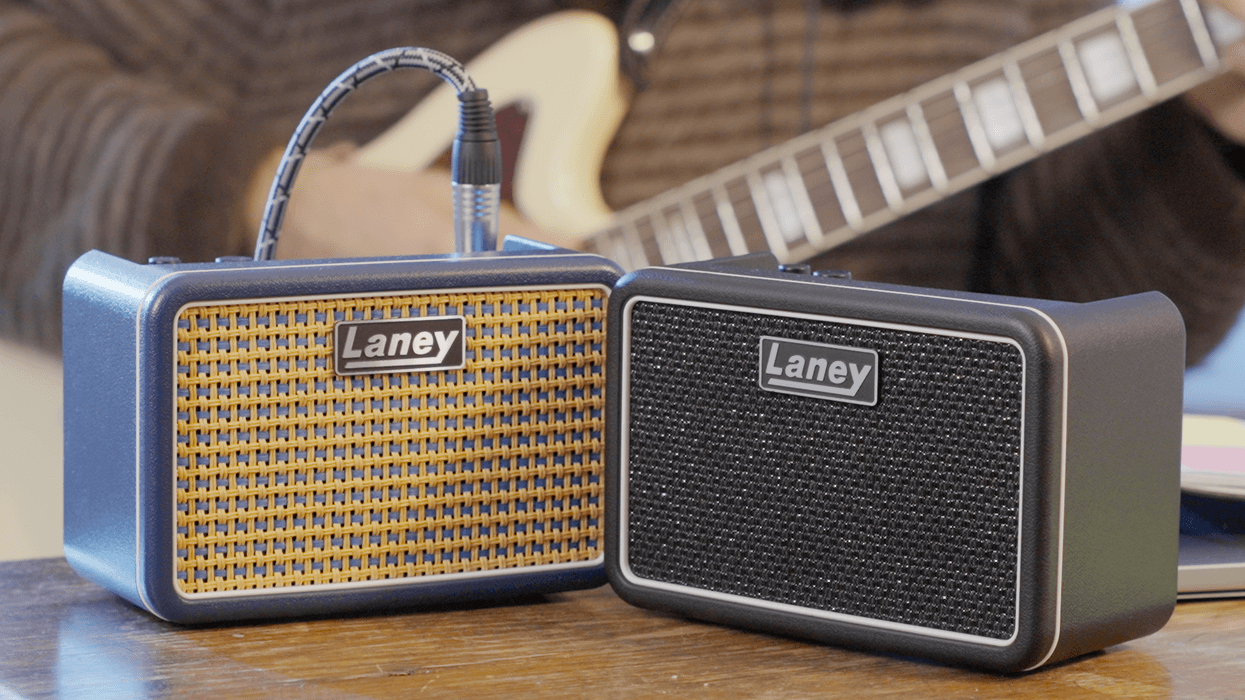
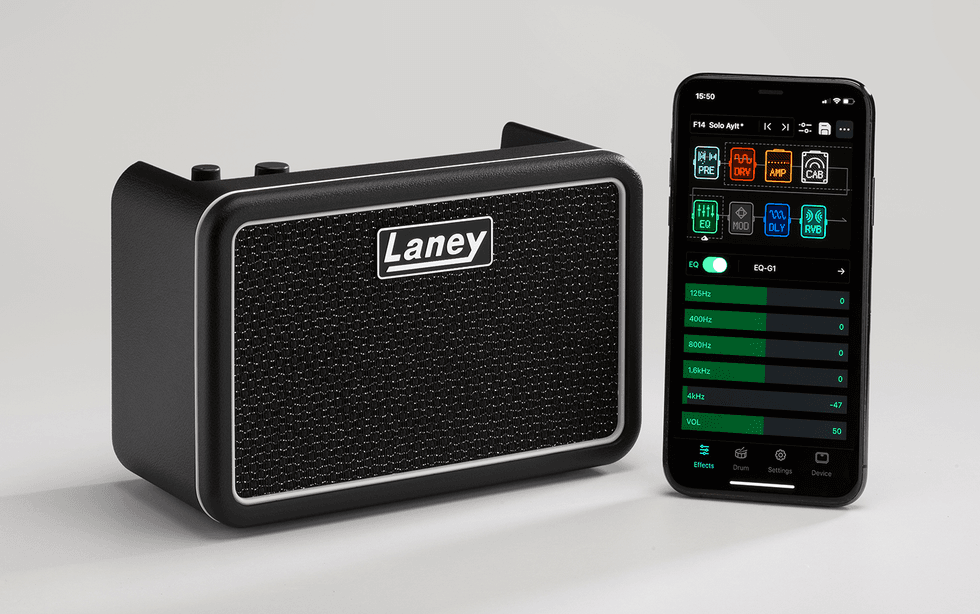
Adding a new dimension to the company’s product line, Laney has introduced the Prism-Mini portable stereo multieffects guitar amp and Bluetooth speaker. The compact amp delivers a full spectrum of sound with 100 presets, Bluetooth® control, and stereo depth.
The Laney Prism-Mini packs a full-featured digital effects engine, Bluetooth® connectivity, and rich sound in a portable desktop amp that you can take anywhere. With 100 presets (50 factory / 50 user) and six simultaneous effects, it’s ideal for practicing and recording, and includes a bright 1.77" full-colour screen and intuitive volume and parameter controls to make it easy to quickly dial in preferred sound.
You can jam along to your favorite tracks via Bluetooth® 5.3, practice in tune and on time with the built-in tuner and drum machine. The Prism-Mini’s rechargeable battery provides up to 14 hours of continuous operation. Available in Black or Blue - it’s the modern mini amp that feels unmistakably Laney.
With USB Type C power, true stereo 3-watts per channel output, and dual 1.5” woofers, the Prism-Mini delivers detailed tone from a remarkably compact body. The Prism-Mini is partnered with the new Laney Tone Wizard mobile app, which makes it easy to edit patches, manage presets, and control your amp directly from your phone or tablet. The Tone Wizard app supports Android and iOS Platforms.
You can import and export preset files, store your Prism-Mini patches and even load third party IR’s. It also has a built-in drum machine.
Key Prism-Mini features include:
100 presets, 17 amps
6 effects at once
Bluetooth capable
Built-in tuner and drum machine
Free Tone Wizard app (to control the amp)
Rechargeable battery offers 14 hours continuous playtime per charge
Laney’s Prism-Mini carries a street price of $149 USD. For more information visit www.laney.co.uk.
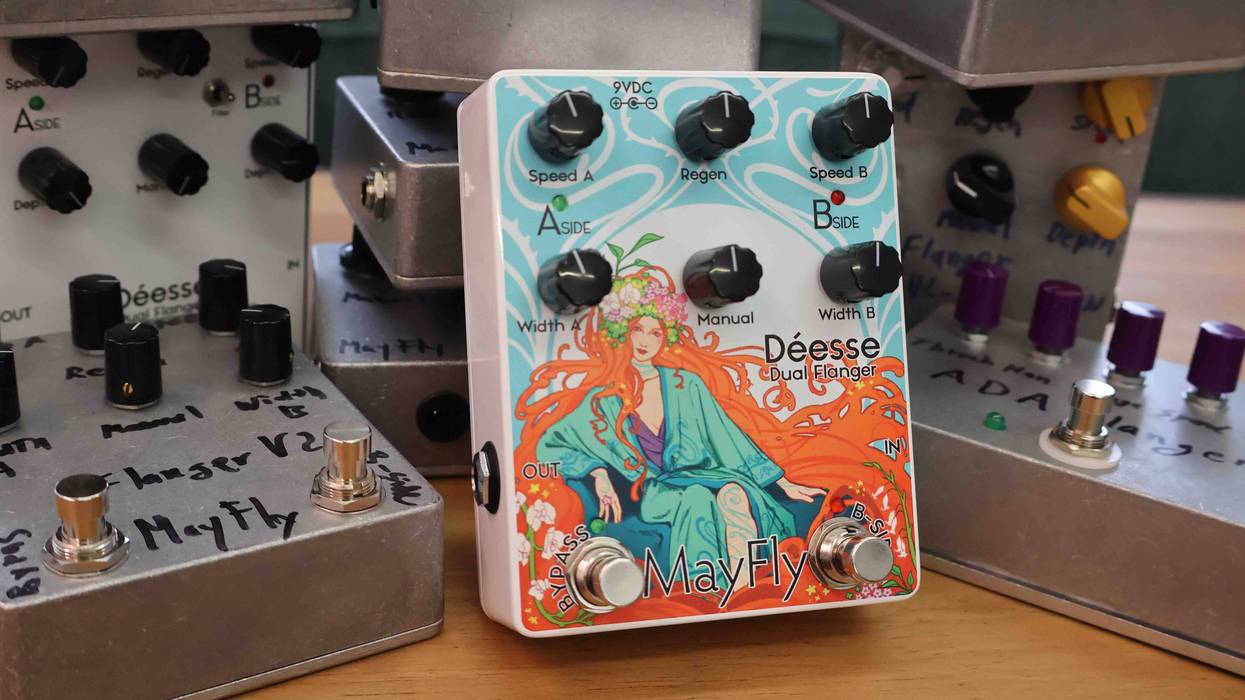
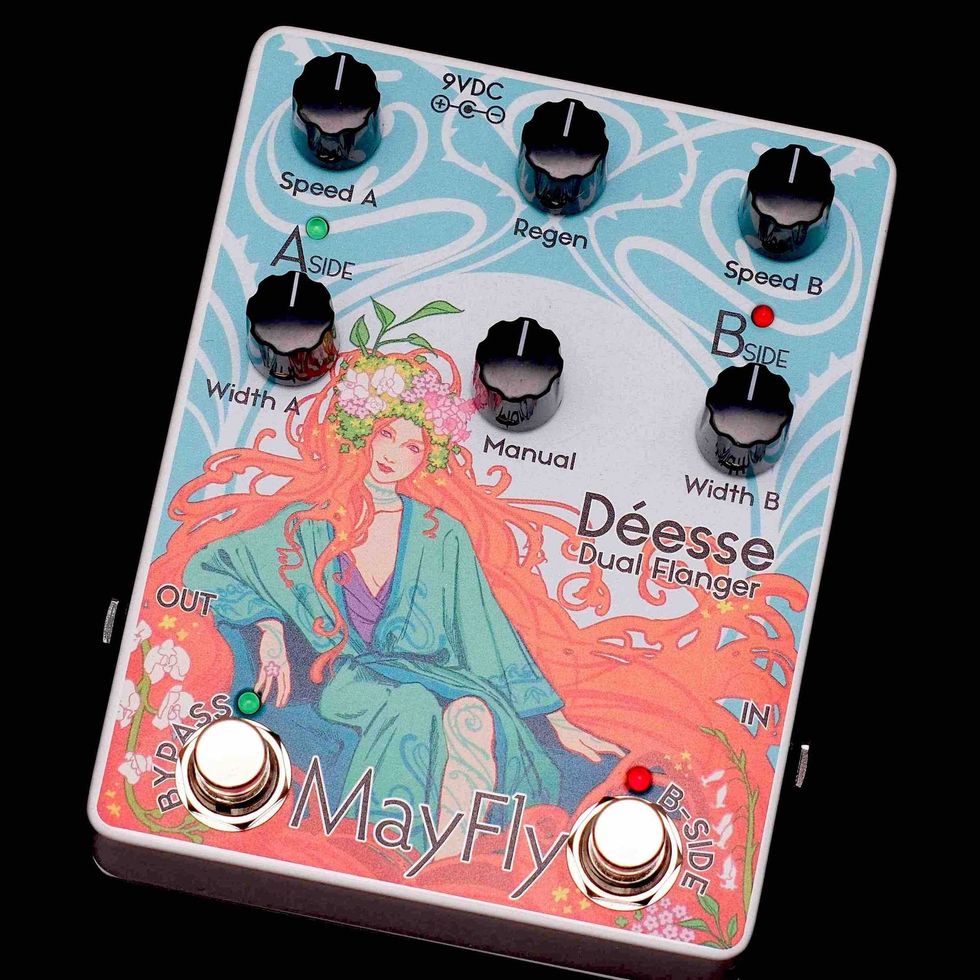
Canadian boutique builder MayFly Audio Systems has introduced the Déesse dual flanger.
The Déesse has two foot-switch selectable sides with independent Speed and Width controls. Set side A to be a classic slow flange, sent side B to a ring modulator sound (or anything in-between), and switch between them on the fly, live. It includes two knobs for controlling Manual and Regen function for both channels.
Like the popular Mayfly Goddess dual chorus, the highly versatile Déesse uses bucket brigade delay chips for its organic, immersive sound. These chips are expensive and a pain to work with, but MayFly Audio feels that this old-school tech still sounds the best.
Key features include:
Dual flanger with footswitch selectable sides
Separate Speed and Width controls for each side
Global Manual knob adjusts the midpoint of the LFO (Low-Frequency Oscillator) sweep, effectively controlling the range where the flanger is operating
Global Regen knob (Regeneration or Feedback) for controlling the intensity of the flanger’s the comb-filter effect
Old-school bucket brigade chips for unrivalled flanging sound
True-bypass switching
9-volt DC power operation via standard externals supply, 55mA – no battery compartment
Evocative artwork by Sabine Elliott
About the pedal’s name: Déesse is French for Goddess. According to MayFly “this flanger sounds like it has divine feminine connections, but we could not call it ‘Goddess’ as we already had a pedal with that name. So instead we named it after a mythical Québécois character who ranks right up there in the powerful, mystical, and la Femme category. Kind of like the pedal itself.”
The Déesse carries a street price of $215 USD / $295 CAD. For more information visit mayflyaudio.com.
Kemper GmbH, the creators of the acclaimed Kemper Profiler, have launched their next-generation profiling technology 2.0 — designed to deliver breathtakingly dynamic and lifelike amp captures.
The new technology is available in public Beta Profiler OS 14.0, a free software update for the Profiler MK 2 Series and all Profiler Player owners. With OS 14.0 also the Profiler Player will be able to create Profiles in the same quality as its big brothers.
For creating a new Profile of a treasured amplifier, over 100,000 individual frequency points are meticulously analyzed. The result is the most organic and authentic amp tone possible, preserving every nuance of your amp’s sonic character.
This new system delivers a truly analog-inspired measurement rooted in pure physics — not a simple approximation. Each Profile captures the amplifier’s unique behavior with exceptional precision, moving far beyond traditional “amp snapshot” territory, and the entire profiling process is much faster than you might expect.
The new profiling engine profiles the true dynamic behavior of any amplifier and cabinet using the longest and most intricate impulse responses ever implemented in a guitar amp profiler. It even captures the true cabinet bass resonance of a rig, widening the sound scape, and makes it user-adjustable for later tweaks.
When satisfied with this ultra-high-resolution snapshot, congratulations — the Profile is ready to go.
However, for those who are not satisfied with just a snapshot of their precious amp, the Profiler offers a rich palette of new, exclusive features that redefine and truly revolutionize what guitar and bass tone sculpting can be.
The technology includes these precision features and deep control:
Authentic Gain Detection: The Profiler determines the true amp gain during profiling, applying it directly to the Gain control for further tuning.
Faithful guitar-level response: Thanks to Kemper’s level-calibrated Profiler hardware, every Profile is guaranteed to respond exactly like the original analog guitar amplifier. On any Profiler model, with any guitar, at any time.
Cabinet Resonance: Real speaker and cabinet resonance are captured and can be adjusted later via the new Resonance Frequency and Resonance Intensity parameters.
Automatic Definition Matching: The popular Definition parameter is set precisely for each new Profile and remains fully adjustable.
Smart DI Profiling: Profiles created without a cabinet (via DI box or load box) are automatically labeled as DI Profiles. Simply add an imported impulse response or merge a cabinet from another Profile to create a complete Profile.
Ground lift on board: No need for an additional isolator box during profiling to prevent ground hum. Thus no coloration of the signal chain.
Flexible Routing: Send cabinet simulation to the PA while bypassing it on the monitor output and run a real speaker cabinet — or enjoy authentic stage sound through the Kemper Kabinet using its Speaker Imprint technology.
Intuitive Tube Stage Controls: Allows for modifying the tube distortion characteristics easily and musically.
Pure Cabinet Technology: Smooths out harsh or phasey high frequencies for a more natural, cab-in-the-room experience.
Cabinet Morphing: Transform cabinet size and character to explore new and unconventional tones.
Kemper’s patented Liquid Profile technology is the icing on the cake to make the Profile complete, transforming an amp snapshot into a moving picture. Liquid Profile adds the exact authentic gain stage behavior and the authentic tone stack controls seamlessly to the Profile when the target amp model is pre-selected from the menu. This turns any static capture into a fully interactive, living amplifier. Adjusting gain and tone controls exactly feels and sounds like with the real amp — the unmistakable behavior and feel of the original treasured amplifier.
As before, there is no need to own real tube amps to profile them at home. Professional Profile creators have their amps running hot right now. Coming up with the most amazing collection of authentic amp tones for the Kemper Profiler Platform.
The new Kemper Profiling Technology 2.0 is available for all Profiler MK2 models. comes as part of the free Kemper OS Update 14.0 for all Profiler models. Non MK2 models will handle the 2.0 Profiles at a lower resolution. For more information, visit www.kemper-amps.com.
When it comes to reverb, very few pedal manufacturers have done as much to reinvent the category as EarthQuaker Devices has over the past couple of decades.
The independent, family-owned company has a long history of opening new doors of experimentation for ambient adventurers with landmark pedals—like Afterneath, Dispatch Master and Astral Destiny—that have found their way to stages of every size the world wide.
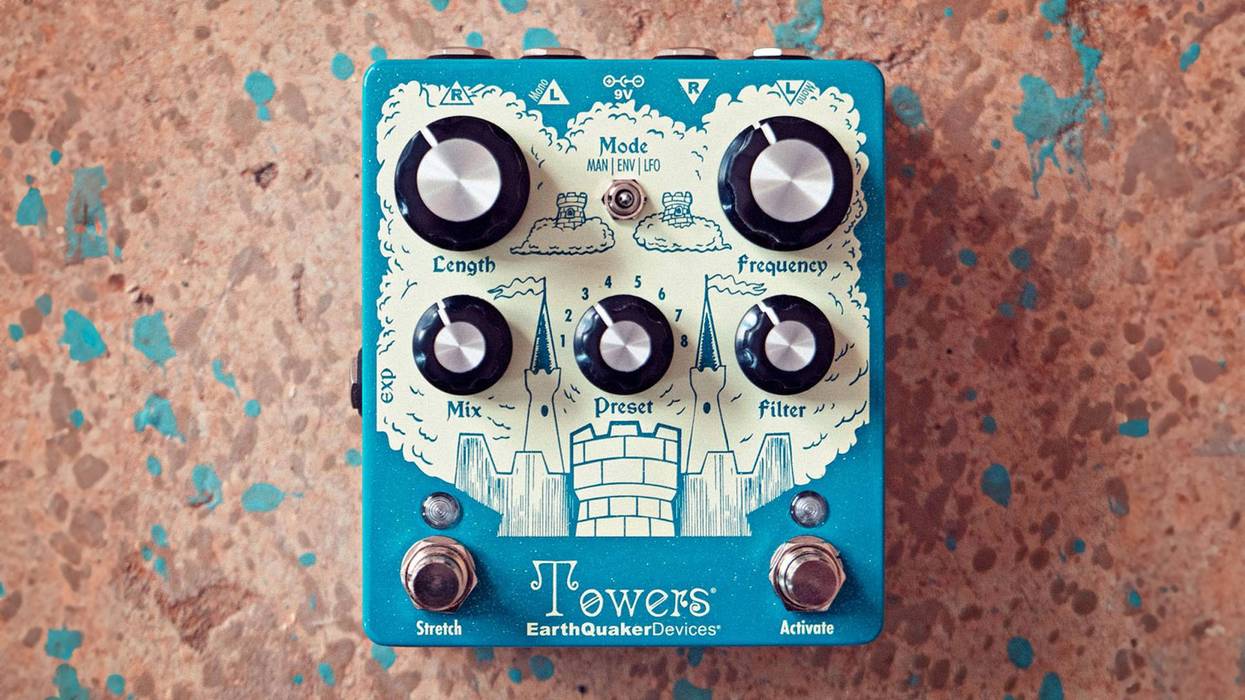
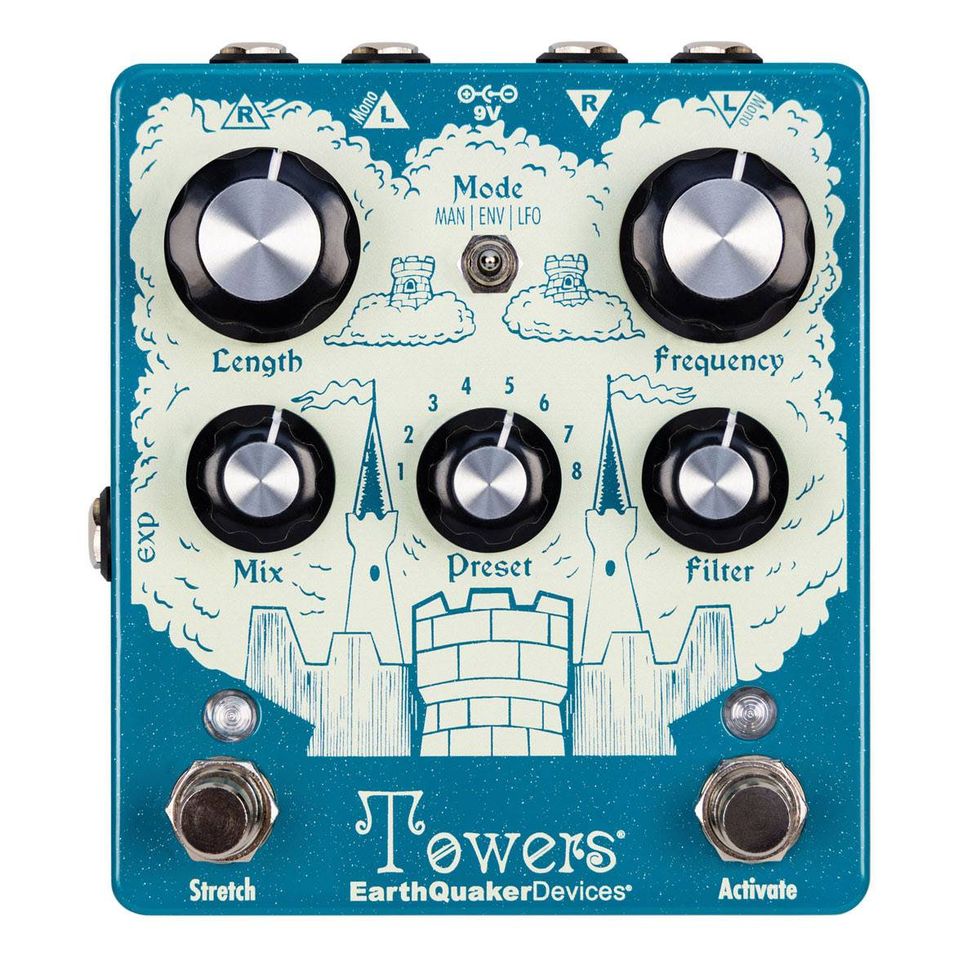
Today, the sonic wizards at EarthQuaker Devices are expanding our aural universe once again with the release of the Towers Stereo Reverberant Filter—an entirely new entry into the pedal brand’s reverb product portfolio.
Perhaps best described as a “soundscape generator,” Towers sends your input signal into a unique set of resonant filtered feedback networks to create a massive stereophonic expanse that’s rich in movement and atmosphere.
Towers is the type of reverb pedal that will sound incomprehensibly huge and haunting with all the settings maxed out, but it’s also the type of pedal that offers virtually endless possibilities for the users who take the time to explore its wide range of sounds. There’s something really special about the textures the pedal generates when its subtler settings are explored.
The sheer amount of possibilities is thanks in part to the pedal’s three distinct modes of operation. There’s a Manual Mode, whichputs the player in charge of the filter frequencies and stereophonic movement. Then there’s Envelope Mode,where playing dynamics breathe and morph into everchanging filter movements. Finally, in LFO Mode, the playersurrenders control to a slow-moving oscillator that sweeps the filter frequencies andacross the stereo field.
And while anyone familiar with the brand’s history knows that Towers isn’t EarthQuaker Devices’ first or only reverb pedal, company President and Founder Jamie Stillman wants to ensure the market understands that Towers is a new type of reverb for the company and is by no means simply an evolution or fresh take on an existing pedal.
"I don't want people to think that we've redone the Afterneath, or that we've redone the Transmisser, or that we've redone the Astral Destiny,” Stillman explained, “Towers represents a linear progression of reverbs. It’s not an evolution of or update on any current or legacy device.”
Stillman is tight lipped when it comes to divulging too much information related to the secret sauce that gives Towers its unique voice, but did explain that the colorful, resonate movement that occurs in the reflections is created internally and isn’t the type of effect you could recreate with external hardware.
When it comes to the big questions most prospective purchasers ask themselves when trying to decide if they should buy a new pedal like “who is this pedal for?” and “would I benefit from adding this to my rig?” The answer is it’s really a pedal for any and every reverb-loving musician who is ready for something new.
In the case of Stillman—the architect of Towers—it was something he wanted because he really loves having resonant filter movements in the tails of a reverb.
Ultimately, guitarists, synthesists, drummers, vocalists, and all other types of musicians in search of an expressive reverberant voice are encouraged to make a journey into the Towers, because all who do will be rewarded with massive resonate experimental reverbs, subtle expressive reflections, and a lifetime of ambient adventures.
Towers is built by the skilled tone technicians of EarthQuaker Devices on the banks of the prestigious Ohio and Erie Canal located in the heart of the heart of it all, Akron, Ohio, USA.
Features:
Mode: This is a 3-position toggle switch that changes the mode of operation. Towers has three modes to operate in:
Manual - The filter frequency is manually changed by adjusting the Frequency control. This works across the stereo field, with the left channel opposite the right.
Envelope - This adjusts the filter frequency with an envelope that is controlled by picking dynamics. In this mode, the Frequency control adjusts the sensitivity of the envelope.
LFO - The filter frequency is controlled by a slow moving LFO, and the Frequency adjusts the rate. This mode also sweeps across the stereo field creating a slow panning filter effect.
Preset: Selects which user preset to use in preset mode, allowing you to recall your favorite mystical configurations.
Activate Footswitch: This turns the effect on and off.
Stretch Footswitch: Stretch slows down the entire digital system of Towers. As a result, the reverb length is doubled, the spectrum of frequencies is altered and a pitch bending effect can be heard throughout the morphing process.
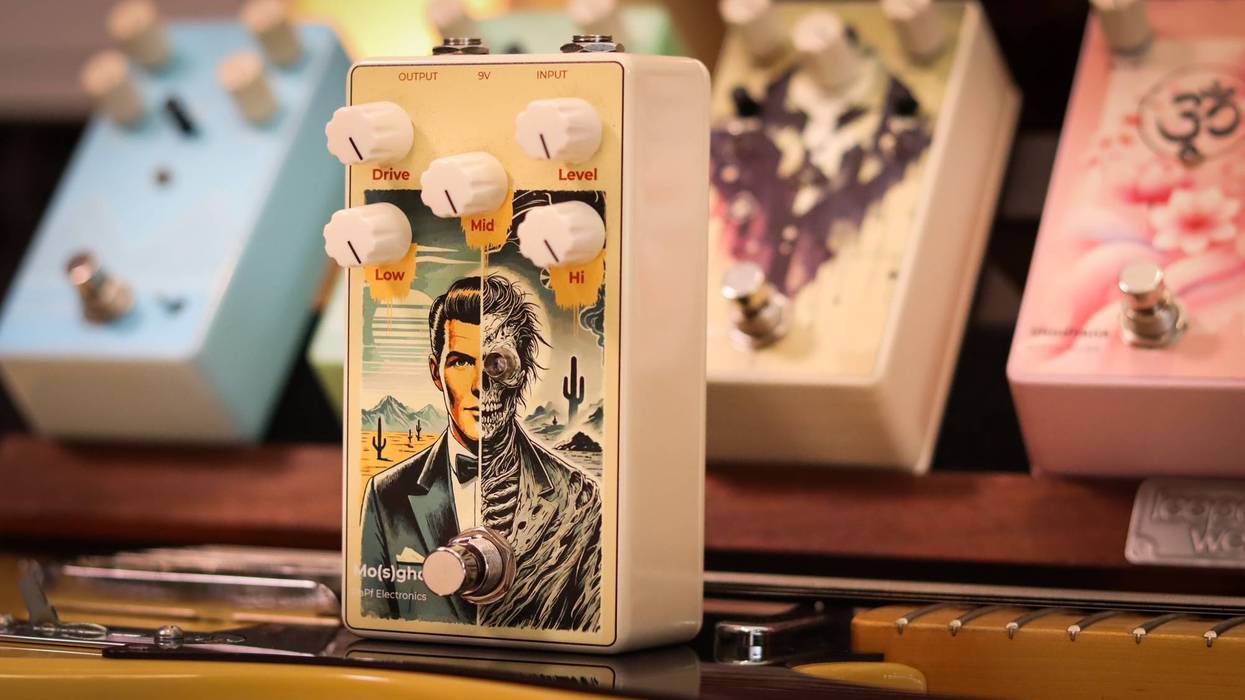
RhPf Electronics has introduced the Mo(s)Ghoul, a reactive high-gain MOSFET distortion designed for guitarists who want saturation that feels alive. Built around stacked MOSFET stages for organic clipping, the Mo(s)Ghoul delivers dense, layered distortion that retains clarity, articulation, and dynamic control.
The circuit builds distortion progressively through four cascading MOSFET stages. Saturation develops naturally, adding warmth and harmonic bloom before expanding into powerful, fully saturated sustain for a thick, immersive drive that feels responsive under the fingers. The gain stages progressively build stacked distortion that cleans up smoothly with your guitar’s volume knob.
Key features:
Layered, 90s-scale high-gain voice: Thick, harmonically rich saturation with focused upper mids, controlled low end, long musical sustain, and the depth of stacked guitar textures.
Three-band EQ: Moves the voice from scooped, cutting attack to dense, mid-forward authority, and from smooth warmth to sharp, defined edge.
Top-mounted input/output jacks, true bypass switching, and standard 9V center-negative operation.
What defines the Mo(s)Ghoul is its reactive behavior. Light picking produces articulate, open tones. Digging in increases compression and sustain in real time.
The three-band EQ interacts directly with the gain structure, shaping the distortion’s density and focus as it evolves. The Mid control acts as the center of gravity for the distortion, allowing players to move from scooped, aggressive rhythm tones to focused, mid-forward lead voices with a single adjustment. The EQ remains controlled and musical even at higher gain settings.
Whether used for tight rhythm crunch, sustained leads, or stacked drive textures, the Mo(s)Ghoul delivers long, musical sustain with controlled low end and smooth highs. It is designed for players who want high gain that breathes and responds.
The Mo(s)Ghoul carries a street price of $179 USD. For more information visit rhpfelectronics.com.