Rebecca Dirks graduated from the University of Iowa with degrees in journalism and art, and joined Premier Guitar as an intern in 2007. She lives in the Iowa City area with her husband, two giant dogs, and more cats than are appropriate to mention. When not petsitting, she enjoys challenging herself in the kitchen, watching the Packers dominate, and discovering new music or rediscovering old favorites.
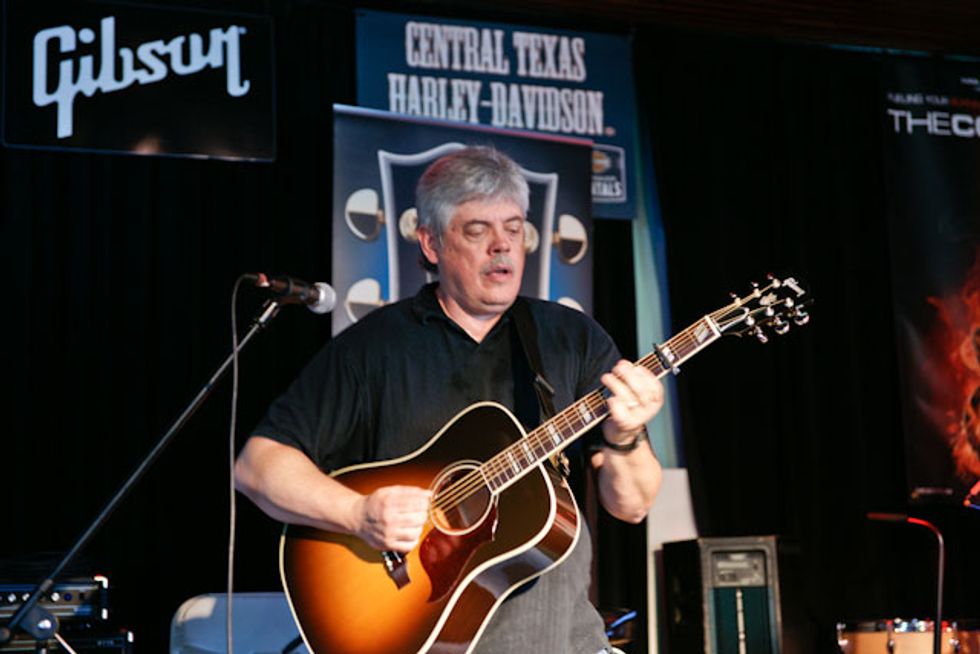
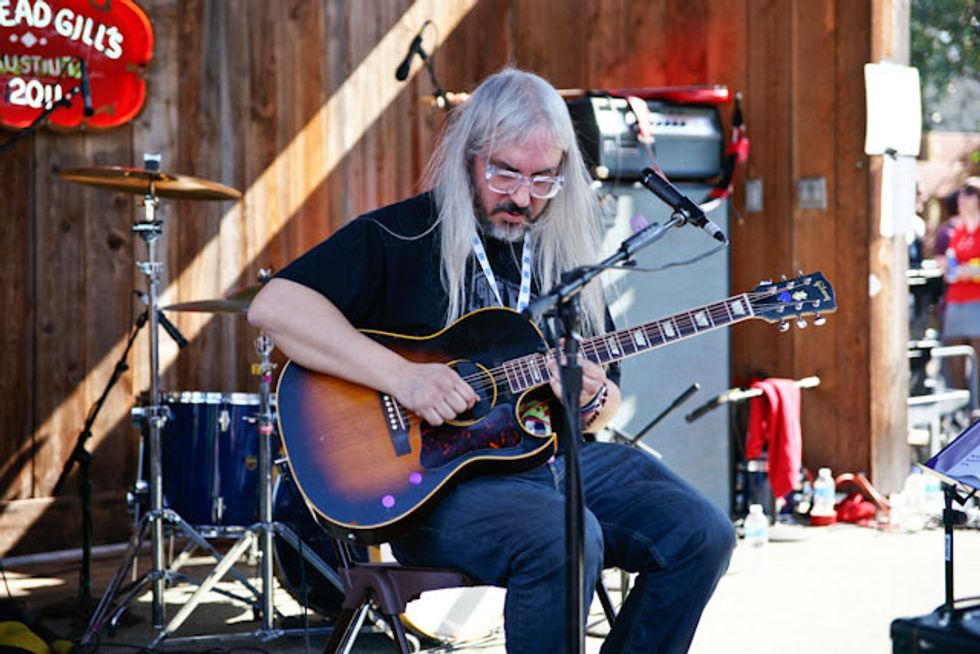
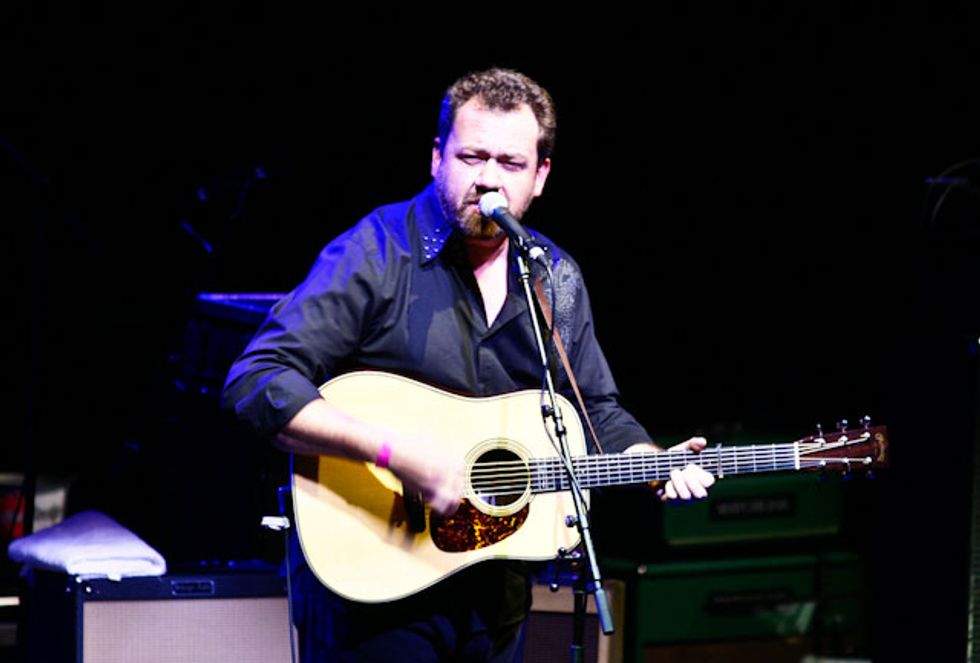
"Maines, a Grammy Award-winning country producer and multi-instrumentalist, opts for a classic Gibson J-45 acoustic capoуd at the third fret for his set at Maggie Maeуs Gibson Room."
Not to bore you with my day gig, but I do product reviews. I’m a bit surprised to find myself here, as I’m not great at techy things. I hate reading manuals, and having spent most of my life in the pre-digital age, I’ve developed a low rage threshold when it comes to dealing with technical issues. Get an error message twice in a row, and I want to throw my phone or computer across the room. I’m the kind of musician whose comfort zone is a traditional guitar plugged into a few pedals (tuner, compressor or boost, overdrive, delay, maybe a phaser for something weird), running into a tube amp with controls limited to volume, treble, mid, and bass—and maybe verb and trem. If I haven’t changed by this point, it’s unlikely I will.
Yet, the PG reviews seem pretty popular. Perhaps the appeal is that the average guitar player can hear what the gear is capable of, even with a knuckle-dragging guitarist twisting the knobs—sort of like having a monkey test-driving a new car.
Part of the draw may also stem from my being a furiously positive person who genuinely looks hard for the good in everything. My default mode is up, probably because I don’t handle the downs very well. That being said, when I review anything, I look at it as somebody’s baby. People don’t dedicate themselves to building guitar stuff to get rich (although a few do make a ton of dough-re-mi)—they build out of passion. I am not one to yuck somebody’s yum, so I search for the best a piece of gear has to offer and lean into that—rather than looking for the bad, like a bitter restaurant blogger. Even when it’s a sound I don’t find appealing (an extreme clipping fuzz, for instance), I understand that, for some of my 6-string family, this may be just what they’ve been searching for.
The truth is, it’s good to be forced out of one’s comfort zone. When you have to make music with a sound or tone that’s completely foreign to you, it can take you to some very cool places you wouldn’t normally go. I usually build a track for my demos, and it often seems like the tones I’m least comfortable with lead to the most interesting backing tracks or playing, because I’m not able to rely on my comfortable old bag of tricks.
“Analog won’t vanish, but in time, it’ll be a premium, ‘vinyl-like’ niche.”
Last week, PG’s editors lined up a review of the Boss PlugOut Pedal for me. I admit, I experienced some initial frustration—and emitted some vile cursing—when I first plugged in the PX-1. But once I got past my tech fear, pilot error, and some Bluetooth issues with my phone, I found a lot of sounds I really liked. It felt like a practical way to bring a Swiss Army knife of a pedal to a session—something packed with just-in-case sounds if you need them. It also occurred to me that in five years, this pedal will be as normal to my kid as my 50-year-old Ross Compressor is to me.
To me, doing a gig without an amp feels wholly unnatural. But I know young players whose comfort zone is a Kemper/Fractal/Line 6/etc. into headphones. And in time, AI-driven tech improvements, combined with the rising cost of analog gear, will result in digital rigs becoming the standard. Stats back this up. In a blind test conducted by Sound On Sound in 2024, 90 percent of listeners found digital indistinguishable from analog.* In a 2024 Sweetwater survey, 55 percent of new buyers opted for digital gear over analog (up from 35 percent in 2020).
Digital amps tend to be more affordable, and offer preset tones that usually sound good-to-great without any tweaking (or the addition of pedals). They’re also more stable. If your rig consists of a tube amp driven by five pedals and a bunch of cables and AC power lines, there’s a lot that can go wrong compared to plugging into a Boss Katana loaded with onboard effects.
For casual and home players, who make up roughly 70 percent of the market, the low cost and simplicity of all-in-one amps and effects makes digital an easy choice. And as many Rig Rundowns have shown, the stability of digital amps, combined with their portability, has led many classic bands to leave their Marshalls at home in favor of modeling gear.
Analog won’t vanish, but in time, it’ll be a premium, “vinyl-like” niche. The combination of technology and economics makes digital inevitable for most players. Obviously, we’ll play whatever we can afford and acquire. So if analog is your thing, hold onto those amps and stock up on tubes.
With less than six weeks until the arrival of their eighth studio album on January 9, 2026, Alter Bridge return with their brand-new single, “Playing Aces.” The track bursts open with the band’s trademark dual-guitar firepower as Myles Kennedy (vocals/guitars), Mark Tremonti (guitars/vocals), Brian Marshall (bass), and Scott Phillips (drums) lock into the muscular groove that has defined their sound for more than two decades. The propulsive verses build into a soaring, unforgettable chorus, highlighted by Kennedy’s declaration: “If I risked it all, I hope you’ll understand that I had to play my hand…”
“Playing Aces” is available now across all digital service providers. The accompanying music video—directed by J.T. Ibanez—is also out today and can be seen here.
“The term ‘Playing Aces’ ties in with the gambling analogy of risking everything regardless of how many times you’ve failed in life. It’s a last-ditch effort to come out on top,” explains Myles Kennedy.
With over twenty years as one of rock’s most consistently acclaimed bands, Alter Bridge continue to push forward. Renowned for their towering riffs, infectious melodies, and masterful guitar interplay, the quartet will release their self-titled eighth studio album on January 9, 2026, via Napalm Records. Physical formats are available for preorder now at https://www.lnk.to/AB-AlterBridge.
The forthcoming album features 12 brand-new tracks that capture some of the band’s most compelling work to date. Songs like “Rue The Day,” “Disregarded,” and “Scales Are Falling” stand tall alongside staples from the Alter Bridge catalog. “Trust In Me” showcases the powerful vocal chemistry between Kennedy and Tremonti, with Myles taking lead on the verses and Mark commanding the chorus—an approach they flip on “Tested and Able,” one of the band’s heaviest introductions to date. “Hang By a Thread” is primed for the live stage, echoing the energy of fan-favorite anthems, while album closer “Slave to Master” delivers an epic finale and marks the longest track the band has ever recorded.
The first single, “Silent Divide,” continues its ascent at Active Rock and has already surpassed 4 million views on YouTube. Longtime producer Michael “Elvis” Baskette once again joins the band for the project, recorded over two months this spring at both the legendary 5150 Studios in California and at Elvis’ studio in Florida.
-1-CD Jewel Case (Ticket Bundle for Townsend exclusive) + Guitar Pick (Band exclusive)
To coincide with the new album, Alter Bridge will hit the road in support of the release on the What Lies Within Tour. The 31-date European run kicks off January 15 in Germany and wraps March 5 in Nottingham, UK, with Daughtry and Sevendust joining as special guests. The band has also announced a headlining U.S. tour featuring Filter or Sevendust and Tim Montana on select dates. The trek begins April 25 in Orlando, FL and concludes May 24 in Tampa, FL. Full ticketing information and VIP package details can be found at www.alterbridge.com.

Bonnaroo Music & Arts Festival is thrilled to announce the return of the internationally acclaimed camping festival, taking place June 11-14, 2026, on the 700-acre Bonnaroo Farm, located just 60 miles southeast of Nashville in Manchester, TN. Bonnaroo 2026 will once again present a fantastic lineup of top artists performing around the clock across more than 10 unique stages over the four-day festival, with live music and much more through the night and into early morning with special sunrise sets. This year’s highlights include headline performances from Skrillex, The Strokes, RÜFÜS DU SOL, and Noah Kahan, along with top-billed live sets from GRiZ, Turnstile, Teddy Swims, The Neighbourhood, Role Model, Kesha, and many more. In addition, Kesha will lead the 2026 Superjam, titled “KESHA PRESENTS: SUPERJÂM ESOTERÍCA: THE ALCHEMY OF POP,” and “Weird Al” Yankovic will be performing a special late-night Saturday set called “Bigger & Weirder Saturday Late Night Roovue.” The complete Bonnaroo 2026 lineup is below.
Bonnaroo tickets go on sale Friday, December 5th at 10:00 am (CT), exclusively via bonnaroo.com. 2026 ticket options include 4-Day General Admission, 4-Day GA+, 4-Day VIP, 4-Day Platinum, and 4-Day Roo Insider, along with a variety of camping and parking options.

Bonnaroo also offers upgraded ticket types for those who prefer an elevated experience. GA+ tickets include unlimited access to the Centeroo GA+ Lounge, with relaxed seating, dedicated food for purchase, air-conditioned restrooms, and hospitality staff to assist with all festival needs; a private bar with drinks for purchase plus complimentary soft drinks; a dedicated premium entrance lane at both gates into Centeroo, and more. VIP and Platinum guests will enjoy the same perks plus dedicated close-in and on-field viewing areas; unlimited access to VIP and Platinum air-conditioned Lounges; an express lane at the main festival store and artist merch store, commemorative festival gifts, and so much more. To learn more about all Premium experiences, please see http://www.bonnaroo.com/tickets.
A wide range of Camping & Parking options will be available in Outeroo, including Primitive Car Camping, Glamping, RVs, Backstage Camping, Accessible Camping, Groop Camping, Community Camping, and more. Premium Outeroo Camping Accommodations include pre-pitched Souvenir Tents, cool and comfortable Darkroom Tents, Luxury Bell Tents, and spacious 2-person Wood Frame Safari Tents for the ultimate Bonnaroo camping experience. Cosmic Nomads On-Site Daily Parking passes will be available for ticketholders who are not camping. For details on all accommodation options, please visit www.bonnaroo.com/accommodations.
Bonnaroo 2026 will also see an array of new experiences along with significant upgrades to the Farm, including improved drainage, miles of new roadways, and 135 acres of new turf. In addition, the much-beloved Bonnaroo bandanas will be back this year. 2026 will also see the long-awaited return of Bonnaroo Radio, providing exclusive programming like throwback Bonnaroo performances, interviews, traffic and weather updates, and more as fans arrive at the Farm and throughout the weekend.
Bonnaroo Music & Arts Festival is generously supported by PayPal, Venmo, and Verizon.
THE COMPLETE BONNAROO 2026 LINEUP IS BELOW:
THURSDAY
Skrillex
Four Tet
Vince Staples
Spiritual Cramp
FRIDAY
The Strokes
Griz
Turnstile
Mt. Joy
Major Lazer
Jessie Murph
Yungblud
Geese
Cloonee
Lil Jon
Blood Orange
Wet Leg
Hot Mulligan
bbno$
Zack Fox
Smino
Sidepiece
Rachel Chinouriri
The Dare
Adventure Club
NOTION
Mother Mother
Łaszewo
Blues Traveler
Wolfmother
Wednesday
The Chats
Lambrini Girls
Amble
Daniel Allan
Goldie Boutilier
Dora Jar
Villanelle
Jackie Hollander
PawPaw Rod
SATURDAY
RÜFÜS DU SOL
Teddy Swims
The Neighbourhood
Alabama Shakes
Chase & Status
Sara Landry
Rainbow Kitten Surprise
Freddie Gibbs & The Alchemist
Amyl & The Sniffers
Sub Focus
Gorgon City
flipturn
Passion Pit
Snow Strippers
Tash Sultana
Wyatt Flores
Boys Noize
Holly Humberstone
Deathpact
SG Lewis
Osees
Waylon Wyatt
The Runarounds
DJ Trixie Mattel
Buffalo Traffic Jam
Confidence Man
Arcy Drive
Mountain Grass Unit
Juelz
The Stews
Congress The Band
Midnight Generation
Sunami
Nikita, The Wicked
"Weird Al" Yankovic Bigger & Weirder Roovue
KESHA PRESENTS: SUPERJÂM ESOTERÍCA: THE ALCHEMY OF POP
The Alex Skolnick Trio (l-r): Nathan Peck, Skolnick, Matt Zebroski
Photo by D. Randall Blythe
“The title definitely makes a statement,” says Alex Skolnick, referring to Prove You’re Not a Robot, the latest release by his jazz-rock ensemble, the Alex Skolnick Trio. “On the one hand, it’s a phrase we’ve all encountered online, and I think, ‘Why should I have to prove I’m not a robot, especially when a robot is posing the question?’
“On the other hand, there’s a musical statement,” he continues. “There’s been a decline in many types of music, most of it in the pop world where a lot of it has become more robotic. They’ve conducted tests and have found that people can’t tell the difference between actual artists and AI-generated music, but that doesn’t happen with jazz. When you get a quality group of dedicated musicians, their work can’t be replicated.”
You’d need one exceptionally crafty robot to replicate Alex Skolnick. On one side, there’s his blistering thrash-metal persona, honed over nearly four decades with Bay Area legends Testament. On the other, there’s his sharp, high-energy jazz improvisation with the Alex Skolnick Trio. Sometimes it’s hard to believe that all of it actually comes from the same person.
Skolnick, with Gibson ES-347, onstage with the AST at the Cutting Room in New York City.
“I’ve heard it compared to how an actor changes roles, and I get that,” he says. “When I warm up for a show with the trio, I work on my Grant Green and my Wes Montgomery. But when I’m getting ready to play with Testament, I click on the distortion and go for some Van Halen or [Allan] Holdsworth. The actor is the same, but the script is different.”
Continuing with the analogy, he says, “Instead of changing costumes, I’m changing gear. I wouldn’t play screaming metal on a ’76 Gibson L-5 archtop, just as I wouldn’t try to play jazz through an Orange Rockerverb cranked on the overdrive channel. So the person’s the same, but the tools are different. The bottom line is, it all feels very natural to me.”
From the start, the AST specialized in wildly inventive, improv-heavy covers of hard rock and metal tunes. Over the years, the band has had their way with “Detroit Rock City,” “Dream On,” “War Pigs,” “No One Like You,” Goodbye to Romance,” “Highway Star” and “Tom Sawyer,” among others. Not every tune lends itself to interpretation, however. As Skolnick points out, “Whenever you’re playing a song that’s essentially a vehicle for improvisation, it has to have a strong, identifiable melody—that’s key. Even when we take things really outside, the foundation of the song is the melody. The Kiss songs we’ve done—great melodies. Same with ‘Dream On.’ I would put the Scorpions at the top of the list. Every song of theirs has a melody you could play on a saxophone.”
“When I warm up for a show with the trio, I work on my Grant Green and my Wes Montgomery. But when I’m getting ready to play with Testament, I click on the distortion and go for some Van Halen.”
Thus far, all efforts to transpose AC/DC to free-form jazz have proved elusive. “They’ve got great riffs and grooves, but they’re not big on strong vocal melodies,” he says. “Trying to do one of our arrangements with AC/DC would be like covering James Brown. Incredible music and awesome grooves, but it’s not about the melody.”
Lately, Skolnick and company (drummer Matt Zebroski and bassist Nathan Peck) have placed more emphasis on original material, but they haven’t bagged the covers entirely: Prove You’re Not aRobot includes “Armondo’s Mood,” a cheeky mashup of Chick Corea’s “Armando’s Rhumba” and Steve Howe’s “Mood for a Day” that beautifully showcases Skolnick’s breezy, delicate touch and dulcet tones. There’s also a hypnotic take on Tom Petty’s classic “Breakdown” that sees the guitarist skipping and pirouetting across the fretboard over multiple time signatures. “That one came about the day Tom Petty died,” Skolnick explains. “I went on stage and said, ‘We just lost Tom Petty,’ and we started playing the vamp. When we decided to record it, I knew that I didn’t want to just copy the original, so we made it slower and did odd-time sections. In a lot of ways, it’s inspired by Dave Brubeck and Paul Desmond.”
Skolnick with his signature ESP electric
Photo credit by Evelyn Steinweg
Among the album’s original tunes, “Polish Goodbye” is a snarky and sassy modern-age lounge affair that offers sticksman Zebroski considerable room to stretch out and flex his chops, while “Asking for a Friend” is a shimmering (and at times, aching) ballad built on Skolnick’s spare, contemplative melodies. The effervescent “Guiding Ethos” ranks as one of the guitarist’s most memorable compositions, and his playing—in particular, an extended steel-string acoustic solo—rises to meet the quality of his writing.
“I actually wrote that song on the piano,” he reveals. “That was my first instrument, but I had a teacher who wasn’t very inspiring, and so I got into the guitar. Lately, I’ve revisited playing the piano a bit—I’ve gotten into some good jams—and I came up with the parts that became ‘Guiding Ethos.’ I transferred it to guitar and thought it sounded nice, particularly this section that’s so bright and shiny. It offered me a lot of spots to go places and have cool key changes.”
“Instead of changing costumes, I’m changing gear.”
The song, he continues, “was meant for steel-string acoustic, particularly the solo. I knew I wanted the sound to really pop, and as it turned out, right before we did the album, I had needed a tax write-off, so I allowed myself to buy a guitar that I might normally have considered an extravagance.”
The guitar in question is a 1935 Gibson L-00 acoustic that Skolnick found while poking around at RetroFret Vintage Guitars in Brooklyn. “They had over a dozen guitars from the ’30s and ’40s, and I went around and played them all,” he says. “Some were easy to play, some were hard to play. They all sounded good, but some sounded great. The L-00 sounded great and was easy to play. It’s a parlor guitar, but it blows a lot of my other guitars out of the water. The people at the studio where we recorded were like, ‘That is one of the best guitars we’ve ever heard. It sounds like it has a microphone on it.’”
Perhaps more importantly, the guitarist’s accountant also weighed in with his assessment. “He said, ‘Well done,’” Skolnick says with a laugh. “All in all, it was worth the money.”
Founding Partners: Tosin Abasi (left) with an Abasi Concepts Larada 8 Master Series Black Beauty and Ivan Chopik with an ēmi 8 Master Series Black Beauty
Photo by Ekaterina Gorbacheva
In the modern guitar lexicon, few names scream “new frontier” like Tosin Abasi. As the creative engine of Animals as Leaders, he’s helped reframe the electric guitar’s vocabulary. But unlike Jimi Hendrix, Eddie Van Halen, or Steve Vai before him, he’s done it not on six strings—or even seven—but on eight. So maybe it’s only fitting that he’s now CEO of Abasi Concepts, the only “guitar solutions” company that can deliver the instruments he needs for his otherworldly technique.
Abasi’s not doing it alone. Abasi Concepts co-founder and COO Ivan Chopik has deep roots in the guitar industry. Along with his background in manufacturing and supply-chain development, he is the founder and editor-in-chief of Guitar Messenger. This experience brings a rare duality to the brand: a guitarist with deep genre fluency combined with a business-operations mind focused on precision.
Through our conversation, it became clear that their partnership runs on an unspoken principle: innovation born from problem solving. Rather than chasing trends, Abasi Concepts begins with questions like, “What keeps extended-range guitars from feeling effortless? How should ergonomics evolve as the register expands? Where does resonance get lost between wood, hardware, and finish?”
Their answers don’t arrive as marketing slogans—they take shape in the lines, contours, and design choices that put a guitarist’s hands first, while giving their eyes something just as striking.
Far from the typical hype of “the future of guitars,” these two talented players treat design like composition: eliminate noise, enhance articulation, and let ideas breathe. If there’s a better way to do something, find it, refine it, or create it.
PG sat down with Abasi and Chopik to explore how they translate that ethos into instruments, and why their brand of innovation stands apart as the genuine article.
Abasi with a Larada 7 Nylon Custom Prototype and Chopik with an ēmi 7 Master Series Jade. Also pictured (l-r): Larada 8 Master Series Black Beauty; ēmi 8 Master Series Mint; ēmi 8 Master Series Lavender
Photo by Ekaterina Gorbacheva
Tosin, your partnership with Ibanez led the charge for 8-string guitars. And then, as everybody was expecting the next Ibanez Abasi signature model, you launched Abasi Concepts. What inspired you to go into the guitar business?
Tosin Abasi: I had a close to a 10-year relationship with Ibanez, but there were a lot of realities of dealing with such a large company that started to make the process feel less than ideal for us. It got to the point where I felt I could take it and bring it to life on my own.
And I did negotiate ownership of that original body design, so the Larada [model] started life as an Ibanez.
So to avoid the red tape at Ibanez, you thought, “I know what will be easier. I’ll start a company.”
Abasi: [laughs] A part of what informed that was my experience of making custom 8-string guitars. I liked the whole luthier experience of having a bespoke handmade instrument. It was attractive to make a made-in-the-USA, smaller-scale instrument; something closer to a Suhr or something of that caliber.
It was also a perfect storm of living in Southern California. There are a lot of guitar builders here, so what seems like a pie in the sky idea, if you’re in Southern California, all of that infrastructure is there.
Ivan, how did you connect with Tosin to create Abasi Concepts?
Ivan Chopik: Our first meeting was actually through my interview with Tosin for Guitar Messenger in 2010. Later, myself and one other guy started the metal ensemble at Berklee [College of Music]. We had a small budget to bring in visiting artists, and I was like, “Man, we have to bring Tosin in here.” He came to Berklee, did a performance there, and we stayed in touch.
Abasi: I knew Ivan could wear many hats. Ivan has this capacity in the business sense, but he’s also a great guitar player. So when it comes to making decisions, we’re not a business that doesn’t understand the culture of guitar playing. We both play, and we’re both very passionate.
“I think a lot of 8-string guitars attempt to scale up a 6-string into an 8-string. I wanted to treat the 8-string as its own consideration.”—Tosin Abasi
You launched Abasi Concepts with the Larada, a guitar design that definitely makes a statement. What informs your designs, and why do you think players are so willing to embrace them?
Abasi: I think the search began as more of trying to answer a problem. I think a lot of 8-string guitars attempt to scale up a 6-string into an 8-string. But I felt that a ground-up approach made more sense. I wanted to treat the 8-string as its own consideration. So there was a solution-oriented approach.
Chopik: It was exciting to rethink a lot of those things as its own instrument, rather than an extended version of something that already exists.
Still, both the Larada and your ēmi model are more than exercises in function over form. What made you lean into such a bold design instead of something more traditional?
Abasi: We wanted to offer an aspirational instrument. I feel like every player has a poster on their wall of a guitar they’d pull the trigger on if they ever made enough money. But, as a metal guitarist playing an extended-range guitar, there wasn’t the same prestige to many of the options.
We also wanted to communicate, aesthetically, that we are forward-thinking. The music I make, I’m very concerned with new musical horizons. So we wanted an instrument that encapsulated all of these concepts.
Chopik: I think it’s also important to notice that all the ergonomics and design choices, while modern, are all from the player’s perspective. All the different curves, all the cutouts; there’s an aesthetic choice, but there’s also a functional one. That’s where there’s a connection between the design and the player’s perspective.
A Larada 8 Master Series ready for sanding in preparation for paint.
Photo by Ivan Chopik
Two guitar players can come at the same thing from very different perspectives. How do you two balance that?
Chopik: I toured with progressive metal bands for some years. And I was hugely inspired and influenced by Animals As Leaders and Periphery when they came out. So there’s definitely a lot of overlap in the things that we like. But, over the years, I came full circle to one of my first loves, which is blues.
So we do come at it from different angles, and there are different iterations of gear that serve what we’re doing. But [the guitars are] a good example of something that extends beyond the realm of what one set of musicians might expect.
Abasi: I think it’s great. As idiosyncratic and distinct as my playing style is, we are trying to offer a guitar that works for other styles as well.
Like, Ivan’s an interesting player. He can do the progressive metal thing, but he can also … I call it “Dad Hands,” where he’s like, “Does the guitar have fight in it?” [laughs]
That’s how we achieve this balance where the guitar does excel at very modern and distinct styles of music, but also doesn’t fail to deliver classic and established tones.
“All the ergonomics and design choices, while modern, are all from the player’s perspective.”—Ivan Chopik
Currently, you offer versions of two body styles. And customers have to be signed up for your newsletter to be notified of availability. Why follow such a limited-release model?
Chopik: We base a lot of releases around streamlining the manufacturing process. Having greater consistency for our team helps them stay very connected and gives us better visibility into [quality control].
The customer is more informed than ever, and they have more choices than ever. They’re looking for every last detail, and they’re informed about specs. We have to answer to that, and we’re very specific with it. So, ultimately, the consistency comes from our standards, the design itself, and how we want to see it executed.
Abasi: It’s relatively boutique and lean. We want to consider every product we release. We want it to be meaningful, and the Larada was the starting point.
We know what we think the guitar needs to be, and there are so many variables that come together to make a guitar that feels that special. It could be as minute as the number of coats sprayed on the body at a facility, which affects the guitar’s resonance. This is the level of granularity we’re getting down to.
A pair of ēmi 6 Master Series Lunabursts in the paint booth.
Photo by Ivan Chopik
You’ve also released the Pathos Distortion and Micro Aggressor compressor pedals. Why branch out from guitars?
Abasi: Abasi Concepts was always meant to be an umbrella encompassing more than just guitar design. We’re interested in solutions across the board. And part of the fun of having the company is that we get to manifest the things we wish existed.
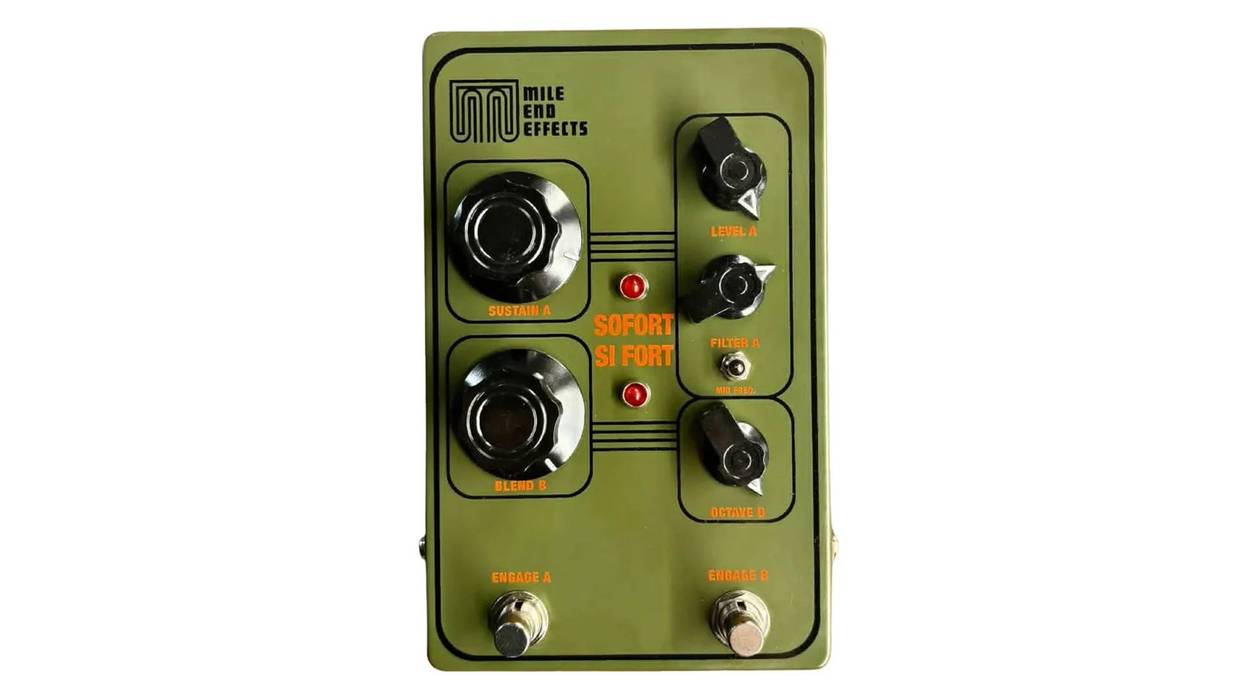
With the Pathos pedal, Brian [Wampler] had existing circuitry, and we got together and tweaked it to taste. Ivan and I both personally use this pedal, and it does a really good job of achieving an amp-like feel in pedal form.
Compression isn’t even on the radar for a lot of guitar players, and then the ones that exist don’t always feel great on the guitar. So the Micro Aggressor has an almost amp-type bloom and response, similar to cranking a tube amp and having the power section start to work a bit. It’s another thing where I think we’re solving something.
“Part of the fun of having the company is that we get to manifest the things we wish existed.”—Tosin Abasi
Tosin, you’re playing tube amps these days, but you guys also collaborated with Neural DSP on the Abasi: Archetype plugin suite. Are there plans to broaden the line into amplifiers and additional plugins?
Abasi: We’d love to have an offering in each of those spaces. Software is a territory that we have not really stepped into yet, but it is clearly of such utility that it would make sense. But Ivan and I are both big fans of tube amplifiers. There’s no substitute for playing an amp in a room. So the amp thing has been a conversation.
What about the instruments themselves? What kinds of designs can Abasi Concepts fans look forward to?
Abasi: We’ve been dabbling in nylon-string instruments, since I have some tracks that use that sound. We also want to offer instruments at a lower price point. It’s hard to make these things in the United States to the caliber we’re trying to make them, but we’re sensitive to the fact that there are players who don’t have enough to buy the Masterbuilt stuff.
Chopik: That’s where our Legion Series comes in. The idea was to give players the chance to experience the same design language and feel that defines what we do, but at a more approachable price point. Both lines come from the same DNA, but the Legion models are bolt-on, with a thin U-profile neck that’s flatter and faster. The materials also play a big role. For instance, wenge necks are unique to the Legion line.
We’re also looking at a semihollow take on the Larada. In the same spirit, it’s looking to solve issues with traditional design.
Larada 8 Master Series guitars lined up for QC before they enter paint prep.
Photo by Tosin Abasi
You’ve definitely carved out your own lane, but there’s been a noticeable rise in artists and influencers starting their own gear companies. Why do you think that’s happening?
Abasi: It’s an extension of the fact that artists have direct relationships with their fans and manufacturers. Before, that connection was filtered through record labels and publications. We’re in a paradigm now where you have direct access to turning those ideas into reality.
Also, artists are reclaiming their brand value. They can hold the keys and deliver instruments that represent their vision directly. I actually think we will see more of it.
Chopik: It’s interesting to see this formula growing and expanding, and the gap between artist and product narrowing. It’s a lot of work. And had we known the journey that we would be on, a lot of it would have seemed unreasonable. But we held it together because we had such a strong belief that it was going to work.
“Unreasonable” is an interesting word choice. From Animals as Leaders’ first album to the Larada’s body style, you guys have practically cornered the market on unreasonable.
Chopik: [laughs] Yeah, for sure. I mean, look, we built this thing from the ground up, and funded it ourselves. And you know, we learned lessons along the way. It’s definitely been a journey.