

Get exotic with these spicy two-handed patterns.
There are many rhythms from the Middle East and Asia Minor (Anatolia) that are based on local folk dances, sometimes from specific villages. If you’re not accustomed to them, they can sound complicated, but they’re meant to be organic; the average person is able to dance, sing, and naturally feel the rhythms they grew up around. In this lesson, we are going to focus on some of these odd time signatures while utilizing the tapping techniques I discussed a few lessons back. I will start off with some basic 2/4, 4/4, and 6/8 rhythms before expanding to 7/8, 9/8, and my favorite, 10/8.
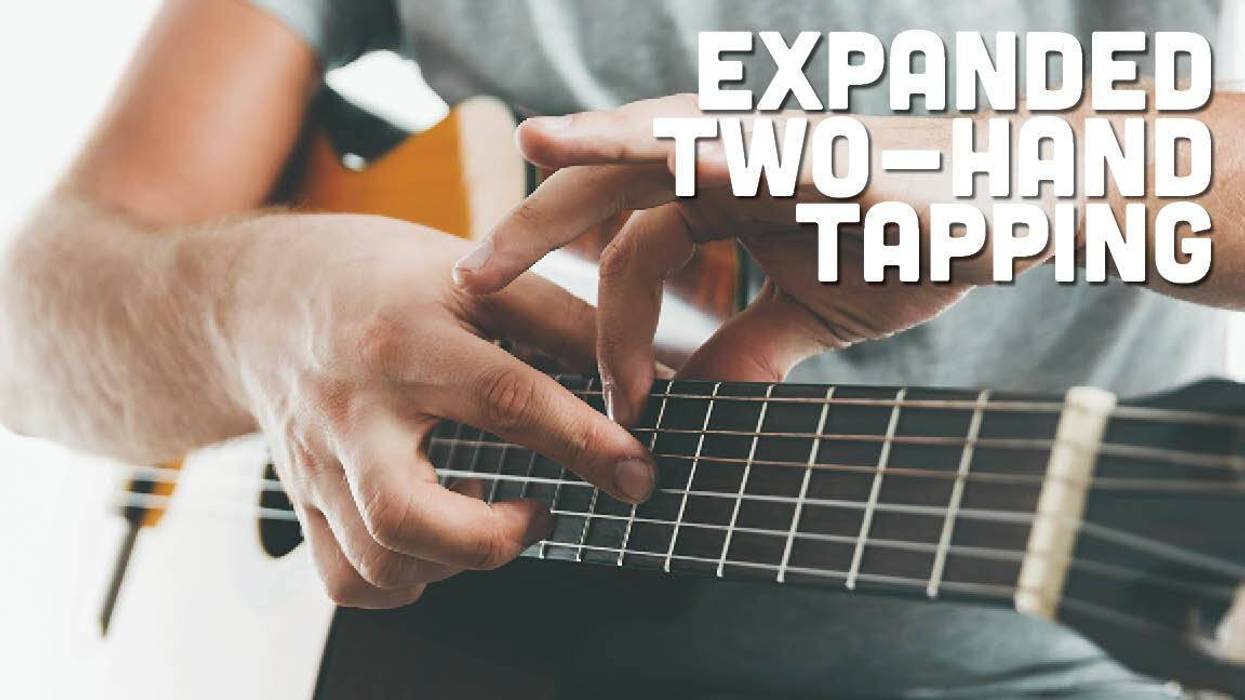
As mentioned in my previous lesson, when I practice this technique, I think of my left hand and right hand playing together, and then playing separately. For example, I can have multiple fingers on one hand playing at the same time as a single finger on the other hand, multiple fingers on one hand playing at the same time as multiple fingers on the other hand, a single finger on one hand playing at the same time as a single finger on the other hand, or consecutive individual notes on one hand followed by consecutive individual notes on the other hand.
Explanation of tabs: Below each column of the noted tab I use the letter R to symbolize right hand and L to symbolize left hand. They are stacked in a way that reflects the tabs. For example, if you see the letter L all the way at the bottom and the letter R on top of that, that would mean your left hand is tapping the lower note while your right hand is tapping the higher note.
These examples can be heard on my album Curcuna.
Ex.1
This is a very basic 2/4 pattern known as the Malfuf rhythm. This sounds similar to a reggaeton rhythm.
Ex.2
This is an extension of the 2/4 rhythm and is from one of my tracks titled “Sirel Em Yes Kez.” It includes some slides and movement with the right hand.
Ex. 3
Known as a Saidi rhythm, this is common to Arabic music. The difference between a 2/4 and a 4/4 is the length of the phrasing before it repeats again. This example demonstrates a chord progression within the Hijaz mode, otherwise known as Phrygian Dominant or the fifth mode of harmonic minor.
Ex. 4
This is a 6/8 rhythm where I use the same extensions in the right hand from the first chord to the second chord. I often do this sort of thing because I love how one cluster of notes can have a particular color against one root note, then have a completely different color against a different root.
Ex. 5
The 7/8 rhythm is known to be from the Laz region of the Black Sea. When musicians play a tune that’s a Laz, they are referring to any tune that uses this particular rhythm. Sort of like when western musicians play a blues, they are referring to a particular understood chord progression, though the melody/lyrics might vary based on the song.
Ex. 6
This is a 9/8 rhythm known as a Tamzara. The same concept of the 7/8 example applies to this 9/8 rhythm in terms of a tune being classified by the rhythm. Think of this as two groups of 2/4 followed by an additional eighth-note.
Ex. 7
This is one of my favorites. The 10/8 rhythm is common to many people from the historically Anatolian region, present day Asia Minor. A lot of western musicians feel this as five but the reason why it would be officially classified as ten is because the subdivisions are inverted in the latter half. Think of it as 3+2+2+3 (as opposed to 3+2+3+2). By virtue of the inverted subdivisions in the second half, the phrase has been extended to ten.
Ex. 8
Another 10/8 example, but within a progression.
I hope you enjoyed this article and are able to use some of these fun rhythms and two-handed tapping techniques to your playing. Note that these examples are my interpretations of these rhythms with some of the ornamentation that I like to add.