

Advanced
Advanced
- Get hip to neighbor tones.
- Learn the art of the octave, a Montgomery trademark.
- Kick your solos into high gear with chords.
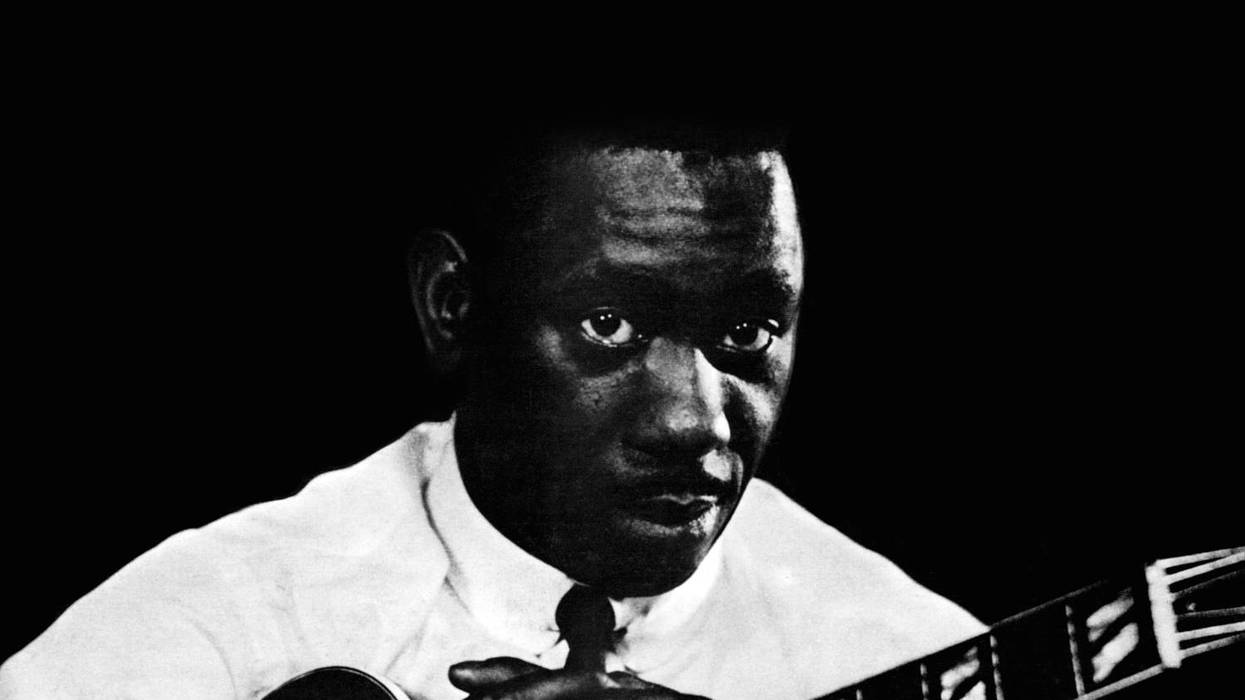
In August 1960, hot on the heels of releasing his breakthrough record as a bandleader, Wes Montgomery won the New Star guitarist award in DownBeat magazine’s International Jazz Critics Poll. The album, The Incredible Jazz Guitar of Wes Montgomery, set the jazz world on fire, and featured one of the guitarist’s most electrifying approaches to soloing—moving from stunningly swinging single-note lines to breathtaking cascades of his trademark octaves, and culminating in wickedly masterful chordal soloing.
Playing with his thumb instead of a pick—initially, so as not to wake his family and neighbors during his late-night practice sessions—Montgomery’s tone was strikingly smooth and warm, while simultaneously being the epitome of cool.
The album has more than a few standout tracks, but, as DownBeat writer Ira Gitler raved in his 1960 review, “‘West Coast Blues’ will knock you out.” Composed by Montgomery, it is a decidedly non-traditional 12-bar blues, evoking a smoke-filled, late-night jam session. Also unique is its use of 6/4 time. But, fear not, you can think of a bar of 6/4 as simply being two bars of 3/4, with an invisible bar line in between.
Here’s the tune in its entirety. Note how Montgomery keeps his solo (0:58) compelling throughout, all the while building to a dazzling chordal crescendo. You can follow along using the accompanying chord chart.
- YouTube
Enjoy the videos and music you love, upload original content, and share it all with friends, family, and the world on YouTube.Note: You can play all of the examples in this lesson either with a pick, or Wes-style with your thumb, but you’ll notice a snazzy change in tone trying the latter.
Half-Steps Are Hip
For the first four choruses of his solo, Montgomery focuses exclusively on single-note lines. Along the way, he injects new life by conjuring unique twists and turns. Every chorus is vibrant, always keeping us on the edge of our seats.
Let’s begin with Ex. 1 (1:09), in which Montgomery spices things up with some subtle rhythmic detours.
Ex. 1
Coming off of a series of eighth-notes in the solo’s previous bars, notice how adding just a slight hitch, like the tie in the middle of bar 1, can throw us rhythmically off balance for a moment (in a good way). The triplet figure in measure 2 is also pretty cool.
Now, you may have noticed that even though the initial chord is Ebm7 (Eb–Gb–Bb–Db), Montgomery chooses to treat it as if it’s Eb7 (Eb–G–Bb–Db), playing the major third right on beat 1. In jazz (or blues or rock), if you play with confidence, and phrase musically, you can often get away with breaking the rules.
Ex. 2 (1:28) demonstrates Montgomery’s skillful use of über-memorable motifs.
Ex. 2
Here, he establishes a unique rhythmic motif that he repeats, altering his note choices along the way to fit the underlying harmony. This creates a unique moment that immediately distinguishes the second chorus from the first and, again, keeps things moving along nicely.
Also, notice his use of neighbor tones—the note a half-step below any target note, regardless of whether it’s in the key (it often isn’t). This is an extremely hip jazz concept that can make your phrases come alive, as Montgomery’s does here.
He also employs another nifty melodic device, one that is often useful over a dominant chord: playing a min7 arpeggio starting on the chord’s 5. Over the Ab7 (Ab–C–Eb–Gb) in measure 1, Montgomery outlines an Ebm7 arpeggio (Eb–Gb–Bb–Db), the 5 of Ab7. Notice how its first two notes are the 5 and b7 of Ab7. Next comes some magic, as you begin to add the chord’s extensions—color tones that go beyond the b7—here, the 9 (Bb) and 11 (Db). Repeating the idea, he then plays an Fm7 arpeggio (F–Ab-C-Eb) over the Bb7 (Bb–D–F–Ab).
Ex. 3 (1:44) is another example of Montgomery employing an ear-catching motif, this time whipping up a bouncy descending phrase that also happens to include some neighbor tones.
Ex. 3
It’s so musical, yet Montgomery is simply playing the key of Bb’s diatonic arpeggios—those found naturally in the key—each introduced with a quick nod to a neighbor tone. But why does he target an Ebmaj7 arpeggio (Eb–G–Bb–D) to start? Another basic jazz melodic device, used over a minor 7 chord, is to play a major 7 arpeggio starting from its 3. Here, the chord is Cm7 (C-Eb-G-Bb) and its 3 is Eb, so your major 7 arpeggio starts from there; note that it adds D, the chord’s 9, to the conversation. (Conversely, over a major 7 chord, playing a minor 7 arpeggio from its 3 can also be very hip.) Montgomery ends the phrase in style, on a C, the 9 of Bbmaj7.
Octaves, Octaves (and More Octaves)
There are more great moments in the opening choruses, but we must move on to Montgomery’s trademark—his unearthly ability to play complex melodies entirely in octaves. This interval is most often played on two non-adjacent strings, with the unused string in between muted with the inside of your picking-hand index finger.
First, let’s take a quick look at Montgomery doing his octaves thing on tenor sax icon John Coltrane’s “Impressions.”
Ex. 4 (3:09) is a slickly syncopated line—emphasizing the “and” of beats—that climbs straight up a Cm11 arpeggio (C–Eb–G–Bb–D–F). Montgomery then ends the phrase with a bluesy descent of the Bb minor pentatonic scale (Bb–Db–Eb–F–Ab), exhibiting his keen sense for knowing when to just keep things simple.
Ex. 4
In Ex. 5 (3:52), Montgomery introduces an octave motif that he cycles through the chord changes. Notice how he changes it up slightly each time, either rhythmically or melodically, in a musical way.
Ex. 5
A Cavalcade of Chords
The final section of the solo features Montgomery’s thrilling mastery of chord soloing. It could easily be a full lesson in itself; below are just a couple of examples to get you started.
Ex. 6 (4:25) shows Montgomery creatively playing off of the basic chord changes from measures 18 to 20 of the chart.
Notice how he’s not rhythmically tied down to exactly where the chords change on the chart (beats 1 and 4). And he’s using partial chords, most notably omitting the root notes that might be added on an additional lower string in more standard rhythm playing. This makes for lighter-sounding voicings and more economical movement.
Now, even though he’s exclusively playing chords here, Montgomery is still thinking melodically, creating a melody by connecting the highest note of each chord. While an oversimplification, this is one of the most important considerations for choosing the different voicings he plays.
Ex. 7 (5:04) culminates with a brilliant descending phrase that closes out Montgomery’s solo, over the final three measures of the chord chart. Note the two different voicings of Db13 chord in bar 1. The first has the 9 (Eb) in the melody, whereas the second has the 13 (Bb). Having this arsenal of voicings allows him to freely construct flowing melodies. At times, he’s more implying the chords than outright playing them; for example, most of the F7 chords in bar 2 lack both their root (F) and b7 (Eb).Ex. 7
Let’s close out with Montgomery playing yet another of his swingin’ tunes, “Twisted Blues.” And, if you enjoyed this lesson, check out my similar looks at jazz icons Mike Stern and Barney Kessel.



![Rig Rundown: The Black Crowes’ Rich Robinson [2026]](https://www.premierguitar.com/media-library/youtube.jpg?id=66952027&width=1245&height=700&quality=70&coordinates=0%2C0%2C0%2C0)