

Andy Hicks’ path to becoming a guitar craftsman—from overachieving student to Fender Custom Shop Master Builder—can be traced back to age 11 or 12, when a friend introduced him to Nirvana’s In Utero. Hicks had grown up savoring his dad’s eclectic record collection—everything from the Beatles to jazz standards to Black Sabbath. But as he soaked in the noisy strains of songs like “Serve the Servants” and “Scentless Apprentice,” it felt like “something was unlocking” in his brain.
“It was a band my parents didn’t know about,” Hicks recalls. “It was this secret. It’s kind of edgy, so do I tell them about this?’ I remember being nervous: ‘The band is Nirvana, and here’s the album cover [which shows a transparent anatomical mannequin].’ My dad was like, ‘Let’s go buy every record of theirs.’ A couple weeks later, I’ve got the entire discography and t-shirts and everything. I was just so fascinated by Kurt Cobain as an artist, and I was the perfect age for that music to resonate with me.”
But this resonance went even deeper than most kids bewitched by the brooding “Smells Like Teen Spirit” video. In that clip, Hicks happened to notice Cobain was playing a Fender Mustang—not that he knew anything about his future employer as a pre-teen. “That video made me want to play guitar,” he says. “I was like, ‘That looks so cool.’ I knew he played a Fender, but I didn’t know any Fender models or anything. For my birthday, my parents took me to Guitar Center and I got my first: a made-in-Mexico three-tone sunburst Strat. I just fell in love with the guitar.”
In the decades since, Hicks—a former member of the doom-metal band Stygian Crown—has forgotten more about the instrument than most people ever learn. But in a way, his wealth of knowledge hasn’t really altered his perspective all that much, either as a builder or a musician: Instead of chasing trendy guitar gimmicks or seeking out some unattainably perfect tone, he’s just aiming for empowerment.
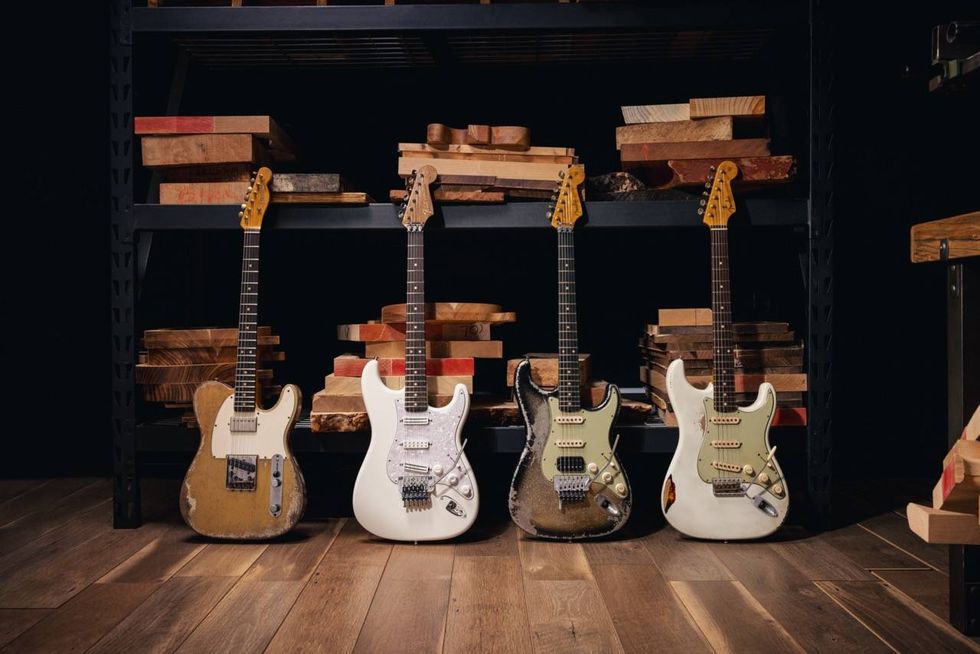
Four Hicks Fender creations (l-r): Ultimate Relic Aztec Gold ’64 Telecaster H/S; Limited Edition Master Built Dave Murray Stratocaster; 1960 Heavy Relic Silver Burst Sparkle Stratocaster HSS; 1961 Relic Olympic White over 3 Tone Burst Stratocaster
“My formative years were spent learning how to use my hands to make the sounds I wanted to make,” he says. “Years later, I look back at that as being such a blessing. As a builder, I’m not sucked into the misinformation pool about tone wood and all of these little minute changes to something that people think is gonna make this huge change in the instrument. It’s more, ‘Let me make the best-feeling instrument for you,’ because the tone is ultimately going to come from you. I can’t make you have the tone that you want. That’s freeing as a builder, and I think it’s freeing for the player, too.”
After getting his hands on that first Strat, he was obsessed. But not necessarily with gear. Back at home with his little 25-watt amp, he realized too late that he needed effects pedals to emulate his heroes: “I have this vision of going home and playing ‘Smells Like Teen Spirit,’” he says. “‘Why doesn’t my guitar sound like that guitar?’” But even after experimenting with “a million” options, he learned a crucial lesson: “After having a distortion pedal, it was like, ‘I still don’t sound like Black Sabbath.’” He eventually found his own path, falling in love with heavy metal and taking any chance he could to practice.
“I wanted the guitar to be as involved in my life as it could possibly be forever,” he says. “In high school, the only guitar class they taught was Introduction to Guitar. I was beyond ‘introduction,’ but I explained to the teacher: ‘I’m just looking for a place where I can come play. If I don’t learn anything new, I’m gonna teach myself stuff. Can I take this class?’ I took it for a semester. When it was over, I said, ‘Can I sign up again?’ He was like, ‘Uh, I guess.’ I took it for two straight years, for four semesters.” That same devotion followed him into college, where he played in bands but also envisioned a life as a teacher and water polo coach. The itch, it turns out, was too strong to not eventually scratch.
“The tone is ultimately going to come from you. I can’t make you have the tone that you want.”
“My roommates would always say, ‘Why aren’t you a music major?’” he recalls. “I knew some music majors, and it sometimes seemed too clinical, the way they would talk about music. I didn’t know if that part of the guitar would give me joy. For a long time, it was, ‘I’ll have some other career, and the guitar will always be there for me to come home and decompress with.’”
He got the push he needed from his future wife. “I came home from work,” he says, “and she told me, ‘I don’t think you love what you’re doing. I think you love guitar. There’s a school in Hollywood [called the Musicians Institute].’ At this point, I was tinkering with guitars all the time. I wanted to make my guitars feel better, and I didn’t have the money to have somebody constantly adjust these things for me, swapping out pickups or whatever. When we came home [from touring the school], I was like, ‘I have to do this.’ I signed up and started there the next semester [in 2009].”
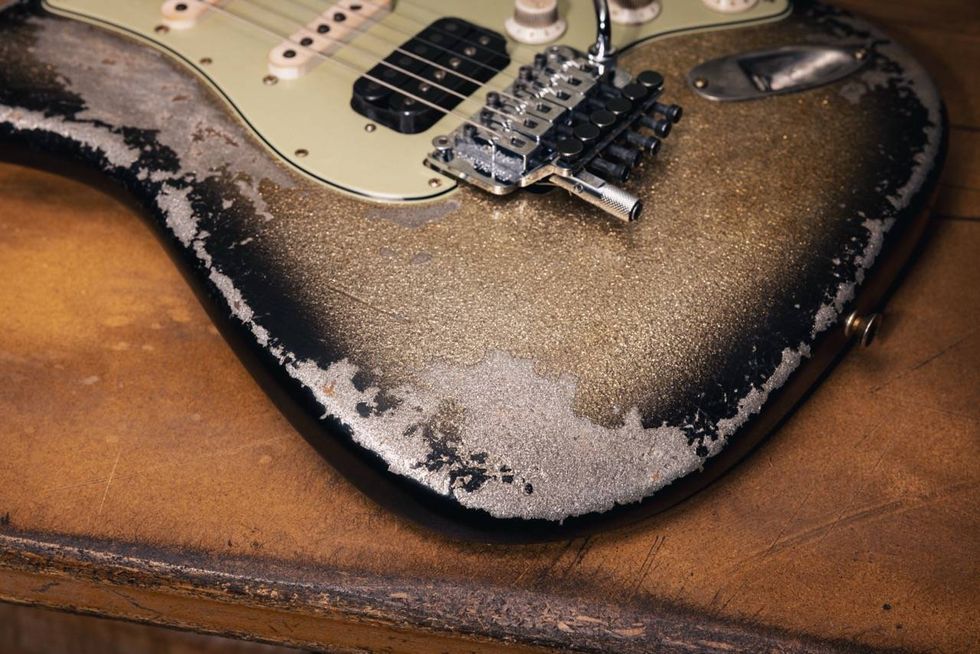
A closeup of the body and headstock of Hicks’ 1960 Heavy Relic Silver Burst Sparkle Stratocaster HSS.
He learned a lot in the Guitar Craft Academy program, focusing six months on the electric guitar and impressing one of the instructors, longtime Fender employee Dave Maddux. “He was the first person to say to me, ‘Judging by the builds you’ve done in school, I think you could make a good go at this,’” Hicks says. “He put me in contact with some people, and when I graduated, I had a job lined up at Jackson Custom Shop, where I shaped necks and did fretwork. That’s been a main focus my whole career: making the neck feel as good as possible.”
He bounced around a bit at Jackson, including a stint on the Fender production line. But these early days were anything but boring: He was only on the job for a few weeks, working on necks for the EVH Wolfgang, when he first met Eddie Van Halen, who was on site with master builders Chip Ellis (Fender) and Mike Shannon (Jackson).
“I wanted the guitar to be as involved in my life as it could possibly be forever.”
“It’s Fender—we have tours all the time,” Hicks says. “This guy comes over, leaning on me, and he looks like some dad wearing a baseball hat. Then I’m like, ‘Oh, Eddie Van Halen is just standing here watching us work.’ The guy I was working with was in the middle of complaining: ‘Man, these stainless steel frets. With just these Wolfgangs, we’ve gotta do 12 stainless steel necks today.’ Eddie [playfully] said something along the lines of, ‘I’m sorry my guitar is such a pain in the butt.’ It was incredible.” (The story has a full-circle coda: Toward the end of Hicks’ run at Jackson, Van Halen held a friends-and-family show at the Forum, and the virtuoso gave +1s to everyone who worked on his guitars. “My dad was sitting next to Tom Morello, telling him that his son made Eddie Van Halen’s guitar,” he says with a laugh. “I had to say, ‘Dad, please stop talking to Tom Morello. And also, I didn’t make his guitar. Chip made his guitar. I make Wolfgang guitars.’ He was so excited to talk to somebody, and he just happened to be talking to Tom Morello.”)
After a couple years at Jackson, Hicks “got noticed a little bit” and made the jump over to the Gretsch Custom Shop, where he earned his stripes as a “guitar detective,” helping with a meticulous recreation of Malcolm Young’s “Salute” Jet. Gretsch initially thought they’d have access to the AC/DC icon’s original axe—but after both Young and his tech suffered health issues, they were left only with photos, dimensional specs, and a lot of question marks.
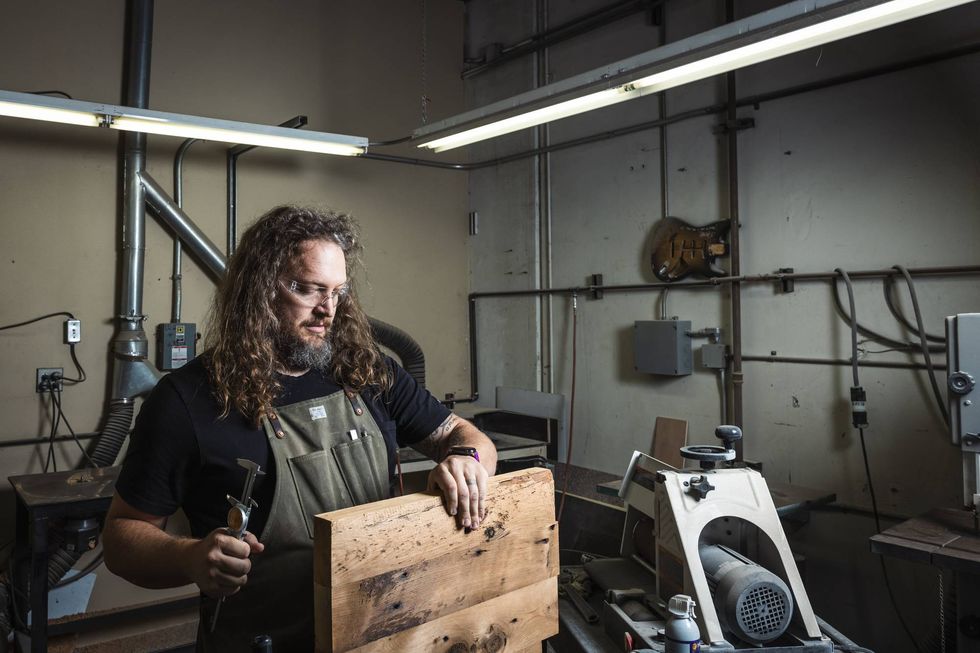
“There were a lot of things that had been done to it over the years,” Hicks recalls. “It had one pickup in it and three knobs. What do those do? No one could really tell us. During some of my digging, I contacted a guitar shop in Melbourne, Australia, that had it in there before a tour. They took photos of it just for fun, so they sent me a bunch of them. That’s how I learned about the weird tone caps that they had in it—they were like wah-pedal tone caps instead of normal tone caps. It was essentially two master volumes and a tone. That’s the fun stuff of doing an instrument like that.”
“I thought to myself, ‘I don’t know if I’m growing anymore.’ I didn’t like that feeling.”
Hicks grew super comfortable at Gretsch—almost too comfortable. “I thought to myself, ‘I don’t know if I’m growing anymore,’” he says. “I didn’t like that feeling. I didn’t want to wait around anymore to see if it’s going to be my turn.” When he got an offer to run production at the high-end manufacturer James Tyler Guitars, he leapt at the opportunity—finding a mentor in the titular builder, who “ran his shop like a pirate” and followed his gut above all else. “When everyone was doing the roasted necks, he was like, ‘I don’t really like how it sounds, so we’re not doing it,’” he says. “I remember some of his finance guys saying, ‘We can charge more.’ But he didn’t care.” After Tyler’s health took a turn, Hicks wound up running production and building simultaneously, often working two shifts a day to help steer the ship opposite general manager Rich Renken. This was another valuable learning moment, but he felt like there was unfinished business back at his old stomping grounds.
After a serendipitous phone call with Fender’s Ron Thorn, who told him a spot was opening up at the Custom Shop, that feeling only solidified. “As soon as Ron said this, it was like, ‘That’s the thing. I have to know if I can do it,’” Hicks recalls. “I think I left Tyler in good hands, so there were no bad feelings. It was an emotional day, coming in here, being welcomed back. It was an interesting first day, too, because you know everyone’s name. [laughs] It just felt right. It felt like coming home.”
He returned with a wealth of knowledge, but none of it prepared him for one particular build: making a new model for his favorite guitarist of all time, Iron Maiden’s Dave Murray. “It was completely insane,” he says. “They were about to start this multi-year tour and wanted another guitar. I was working really closely with his tech, fine-tuning his model a little bit.” He decked the bridge, adjusted the neck angle, oil-finished the neck—tailoring it as best he could to Murray’s preferences. Despite all that hard work, it was still tense waiting for feedback. “I shipped it off and got an email a couple days later from Dave,” he recalls. “It just said ‘Regarding the guitar’ [in the subject line], and it’s a Schrödinger’s cat situation: ‘I’m gonna open this email, and one of two things happens: He either likes the guitar, and that’s good, or he doesn’t like it, and now what do I do?’ He said how much he loved it. His guitar tech reached out and said it was going to be his number-one for the tour. And now we’ve announced that we’re launching the master-built version of that.”
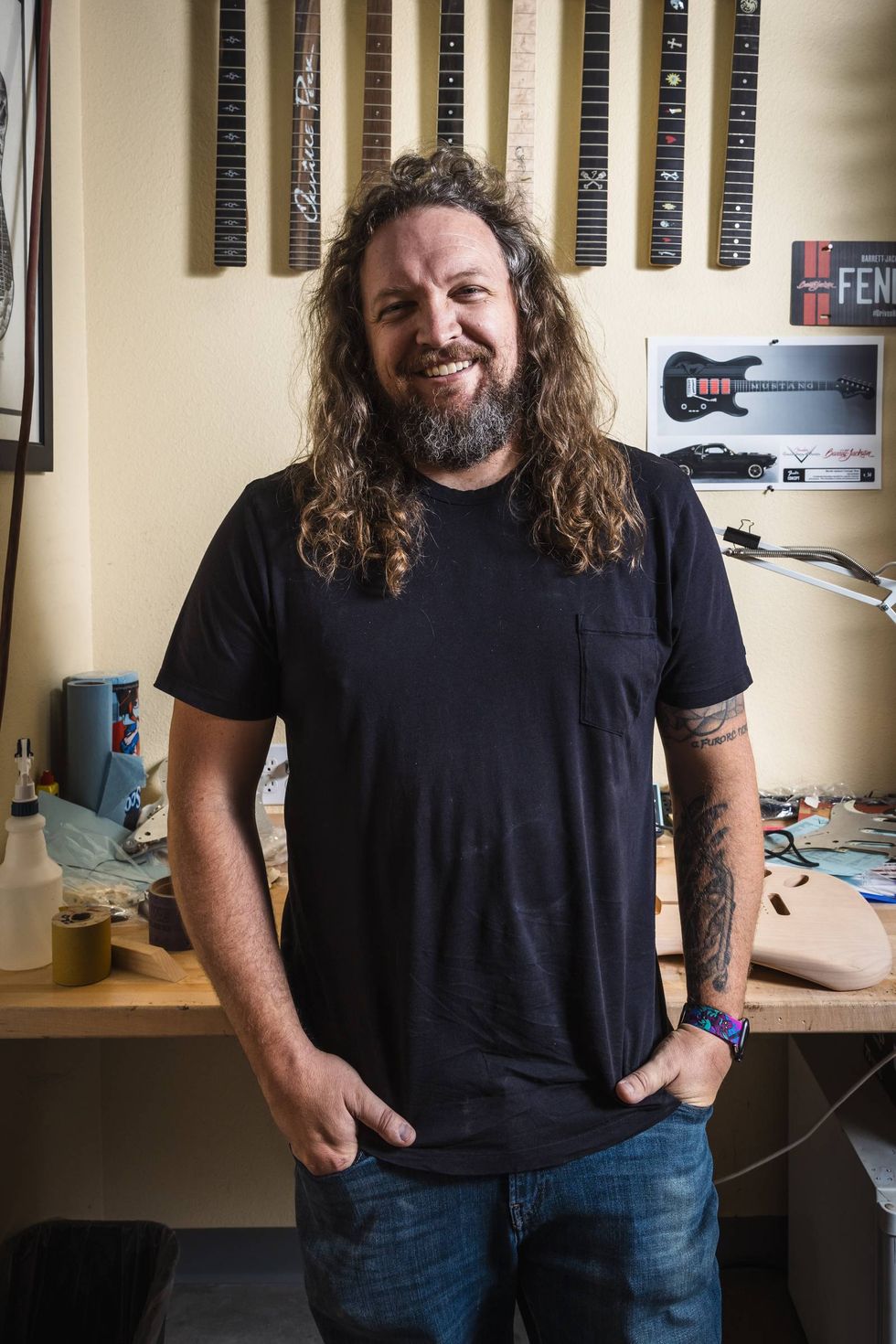
Hicks at his workbench.
Hicks once envisioned the guitar dominating his life—and between his day job and his own creative pursuits, that’s pretty much come true. “The bigger balancing act,” he says, “is learning how to turn the guitar off for a little bit when I’m at home with my kids,” he says. Those worlds are colliding even more than usual now, though, as his nine-year-old son is taking guitar lessons. (The kid has access to a pretty sweet setup, too, including Hicks’ Fender Tone Master Pro workstation and Tone Master FR-12 amp. Plus, he’s playing what Hicks calls “the nicest 3/4-scale Squier in the entire world,” after his hours of re-fretting and tweaking.)
Back home at Fender, Hicks is master-building the life he always wanted: “Man,” he says, “it’s been a dream come true.”