
Twin brothers Tim and Nick Frank were college students in their Canadian hometown when they built their first guitar.
It was the late 2000s, and Tim Frank was working a summer job at a canoe club that had taken over a decommissioned firehouse on Ward’s Island, just south of Toronto’s harborfront. There, he and his brother had access to a backyard shed equipped with a bandsaw, a MacGyvered drill press, and a dream.
It wasn’t the first time either of them had experimented with lutherie. When they were teenagers, Nick had gifted Tim a copy of a Dan Erlewine book on guitar repair, and Tim started doing fixups for his friends while Nick defretted his bass so that he could play more like Jaco Pastorius.
Building their own guitar posed a whole other challenge. The first one they built together at the canoe club had problems, but it showed a lot of promise. Tim and Nick kept honing their skills at college in Halifax, working out of a tiny room in Tim’s house that they converted into an ad-hoc workshop. When they returned to Toronto, they found a home in a 2,600-square-foot warehouse space in a century-old building in the city’s east end, which is where they decided to go all-in and start their own guitar company in 2014.
Fast-forward to today, and the Frank Brothers Guitar Company is established as an international purveyor of boutique guitars, with a small but mighty catalog of one-of-a-kind designs. Led by Tim and Nick, with business support from their older brother Jon, Frank Brothers has carved out a niche with its unique, vintage-inspired aesthetics and high-quality craftsmanship.
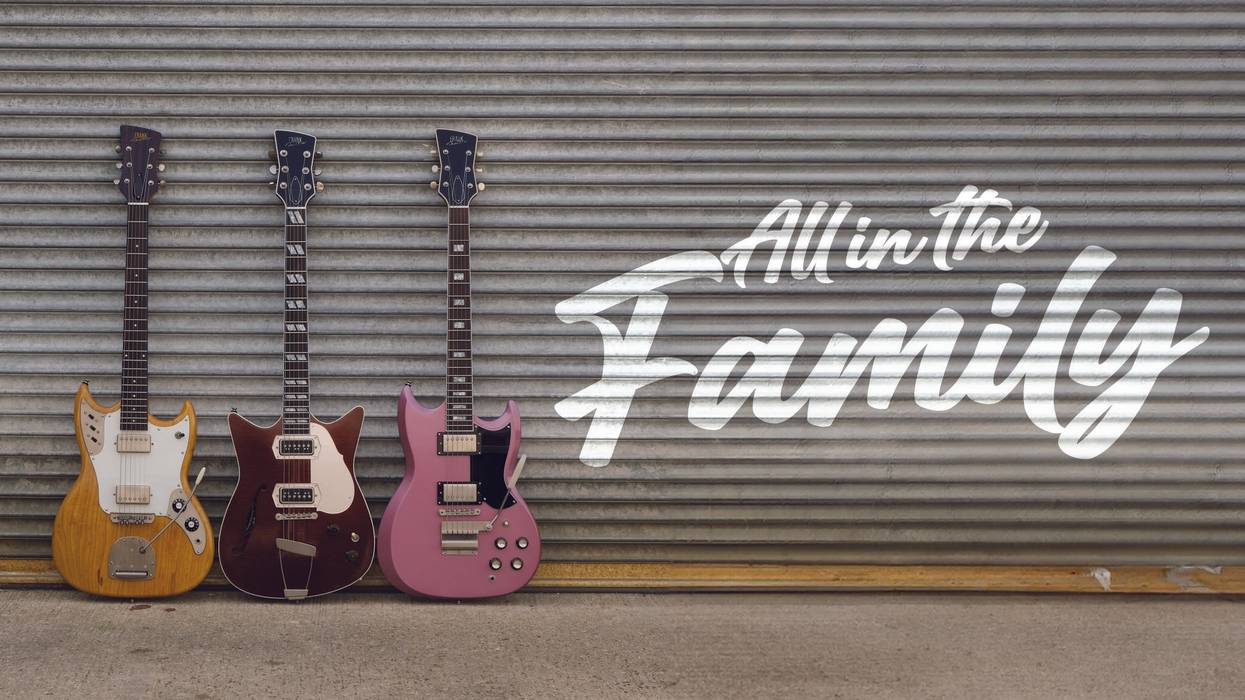
The company’s signature model is the Arcade, a double-arched solid body noted for its eye-catching look, comfortable playability, and warmth, sustain, and openness. When Frank Brothers brought the Arcade to the NAMM show just a few years into the company’s tenure, an early Reverb review commended the “superb build quality” and described playing it as “a raw and overwhelming experience.”
Since then, Frank Brothers’ reputation has continued to grow. The company’s roster of clients includes Phish’s Trey Anastasio, Barenaked Ladies’ Ed Robertson, Zac Brown Band’s Clay Cook, Walk the Moon’s Eli Maiman, Dispatch’s Brad Corrigan, Arkells’ Mike DeAngelis, the Beaches’ Leandra Earl, and solo artist James Bay, as well as live and session players for John Mayer, Vulfpeck, and Lou Reed.
It’s been just over a decade since the Frank Brothers first broke into the boutique-guitar market. But for the full story of the family business, you have to go way further back.
A Local Legacy of Music
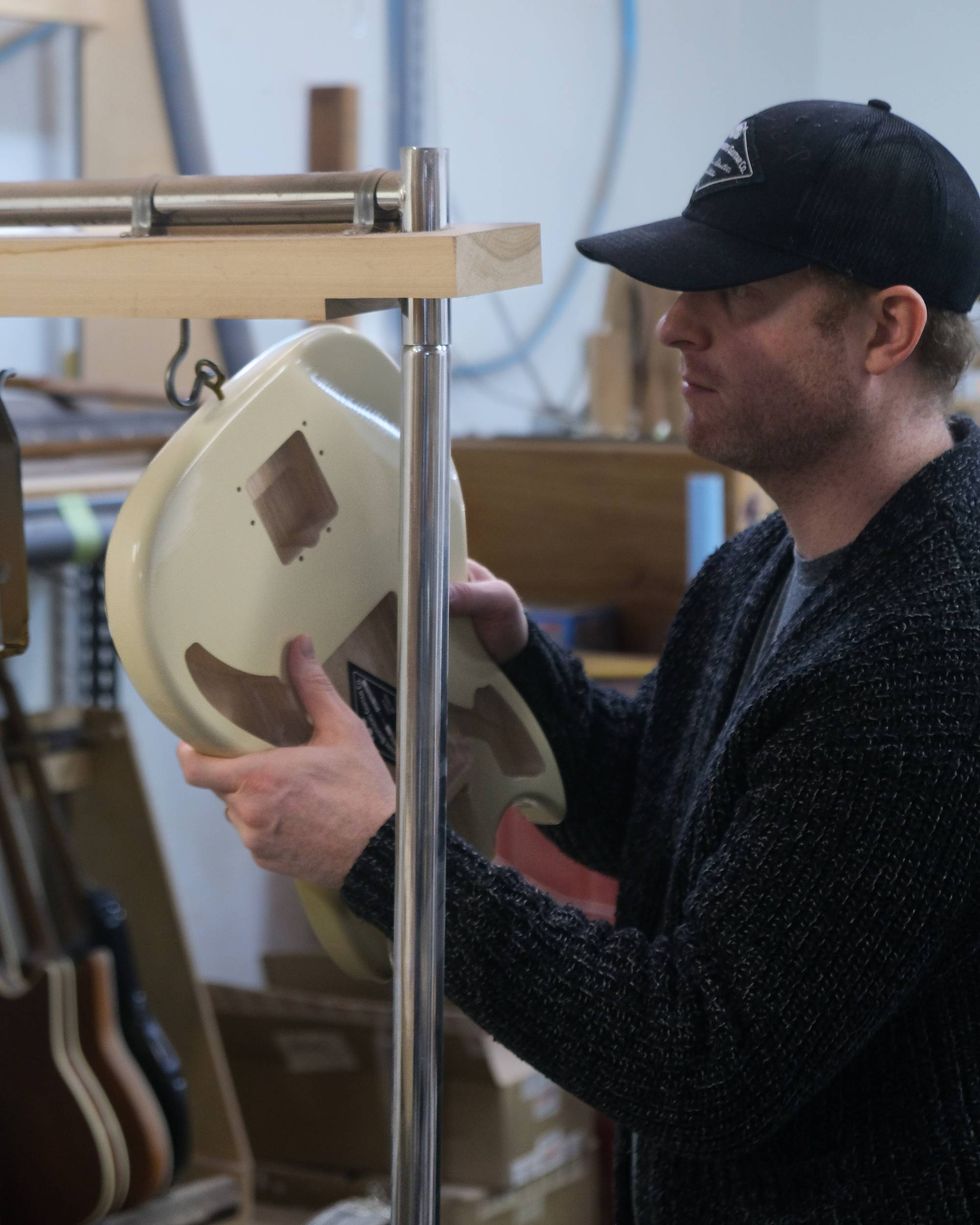
Tim Frank, who handles finishing, hangs a routed and drilled Sonar body before final assembly.
In the Frank family, there’s an ingrained appreciation for craftsmanship in musical instruments that’s been passed down through generations. The brothers’ father, Jim Frank, was an award-winning recording engineer who worked with artists like Alice Cooper, Peter Gabriel, Bob Seger, and the Guess Who. Through him, the brothers learned about the value of high-fidelity sound. Their grandfather, Philip Frank, was an acclaimed violinist who played with Arturo Toscanini’s NBC Symphony Orchestra and recorded with a golden-era Stradivarius. He taught them respect for quality instruments. “We grew up with this understanding that not all instruments were made the same, and that they didn’t have equal value or sound, and that there were some instruments that were just special,” Tim Frank says.
So, when the brothers started building their own guitars professionally, they wanted to make instruments that would sound great, feel great, and play great—and last for generations. “When we first started, there was this newbie attitude where we didn’t know any better, so we tried to achieve something that we didn’t have the skills for at the time,” Tim says. “But we were always chasing perfection.”
The Frank brothers also had access to a wealth of knowledge and guidance from several master luthiers based in Toronto. When Jean Larrivée gained international respect for his steel-string acoustics in the 1970s, he enlisted several highly talented craftspeople to help build Larrivée Guitars. When he later relocated to Canada’s west coast and then onward to California, Larrivée left behind a community of people like William “Grit” Laskin, Linda Manzer, David Wren, and Tony Duggan-Smith, who stayed in Toronto and became renowned luthiers themselves.
“There’s been a culture of guitar-making here in Toronto since the ’70s, and these people were still around,” says Tim. “We got the opportunity to talk to some of them, ask them questions.”
Finding Their Niche
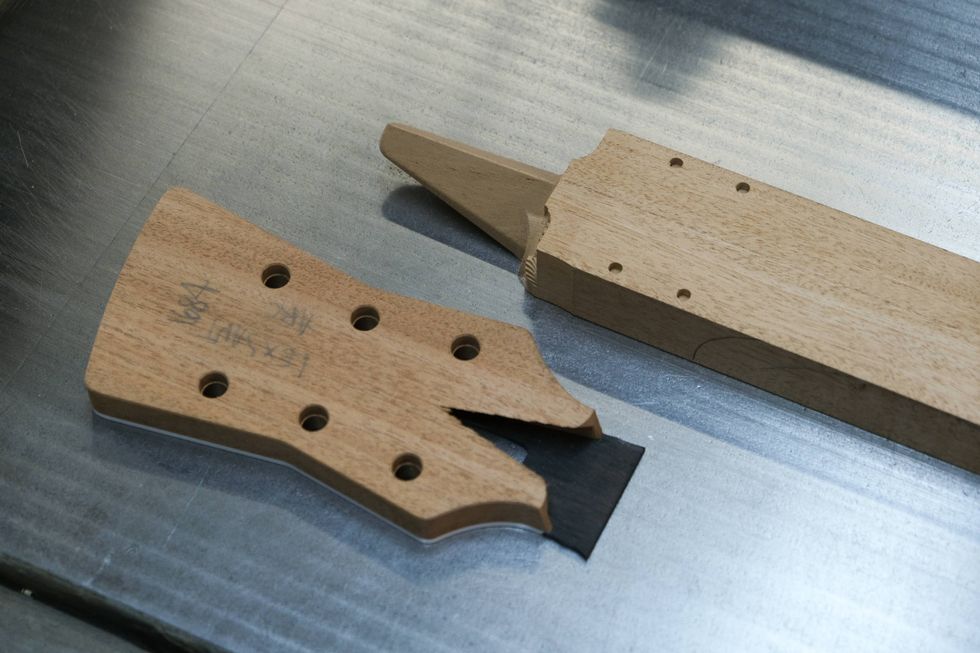
Headstock and neck, featuring Frank Brothers’ dovetailed v-joint, ready for assembly.
In a world of Fenders and Gibsons, the twins wanted to stand out. For inspiration, they looked to the retro Japanese imports of the ’60s and ’70s. These were models that took the recognizable silhouettes of classic American guitars and twisted and stretched them into funky new shapes that still resembled the originals, but were different enough that the companies making them wouldn’t get sued. “We wanted to make something that was familiar but different,” Tim says. “Something that people would recognize, but would also be its own thing.”
Drafting their concepts by hand, Tim designed the body and Nick the headstock, each of them sketching separately. When they put their two pieces of draft paper together, the designs complemented each other perfectly. Call it twin telepathy.
By the time of their third guitar build, they had zeroed in on what would be recognized today as an Arcade. The design features an arched top and back, an extra-deep neck tenon, and their signature “blended heel,” with a 25" scale length, a 12" radius, and a deluxe, hand-painted finish.
“We grew up with this understanding that not all instruments were made the same.”—Tim Frank
A couple of years ago, they added two additional models, both with a body design that looks a tad like a Gibson SG but sits more like a classic Fender. The Radar Deluxe is a set-neck mahogany guitar with a 24 3/4" scale length and a 12" radius with Kalamazoo-style parts. The Sonar is a California-inspired design with an alder body and a maple bolt-on neck, with a 25 1/2" scale length, a 9.5" radius, deep body contours, and Fullerton-inspired parts such as a Mastery vibrato and a chopped T-style bridge.
That brings Frank Brothers’ current catalog to six models in total, all fully customizable. There are four different Arcade models, with the base edition starting at $4,495, the thinline at $4,695, the signature at $5,795, and the semi-hollow at $6,795. The Sonar is the most affordable at $3,895 and up, while the Radar Deluxe starts at $4,395.
Almost all of Frank Brothers’ guitars are custom models that are made to order. Occasionally, they’ll make a few “brothers’ choice” guitars that they’ll sell on their website, and some are made for their 11 dealers in Canada, the U.S., United Kingdom, Netherlands, and Japan.
In the early days, it would take about 12 weeks to make one guitar. But their two-man operation has since doubled with the addition of two craftspeople so they can keep up with demand. Nowadays, the company makes two or three guitars a week; last year, they built 138 total.
A Meticulous Process
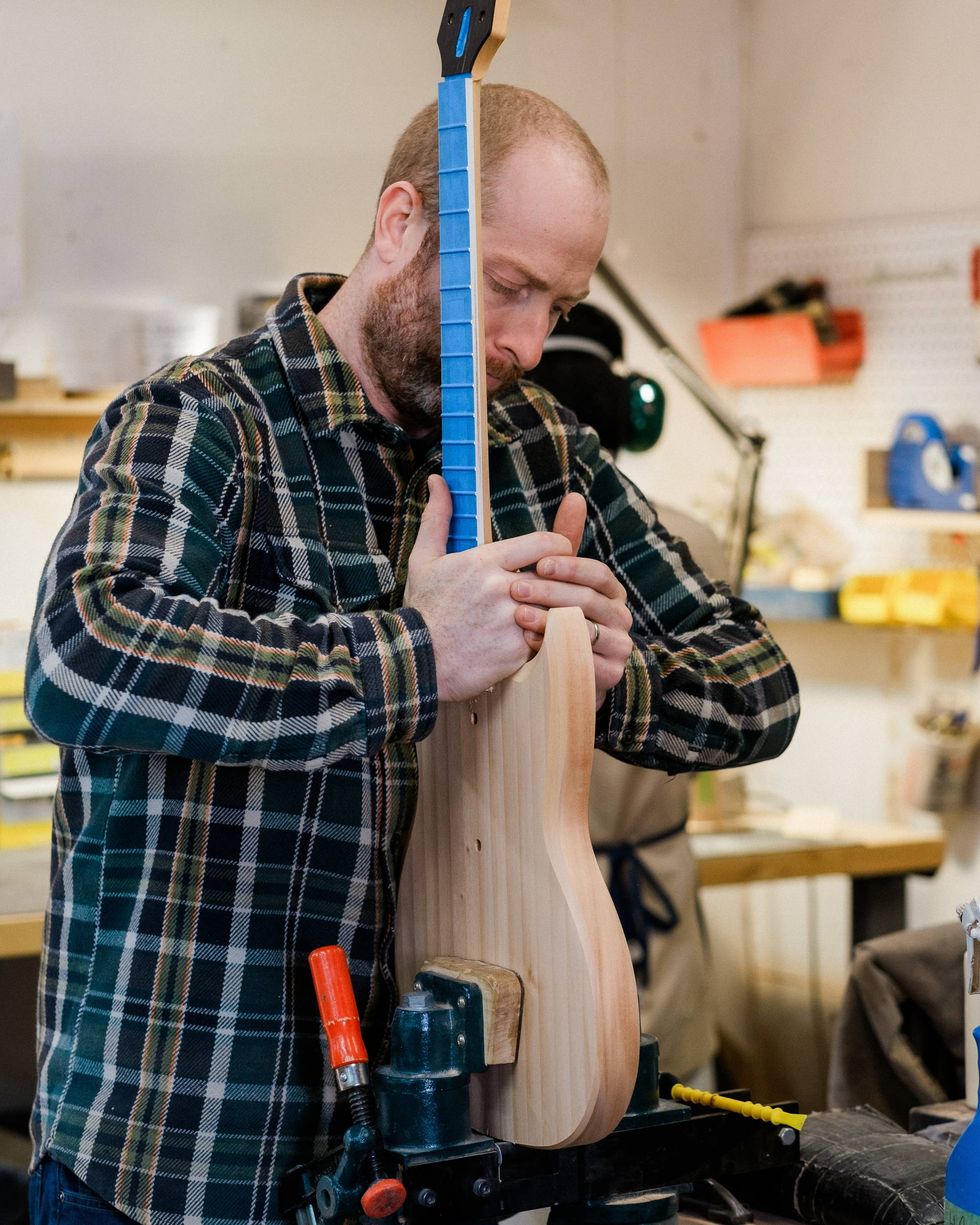
Frank Brothers’ woodworking is Nick Frank’s domain. Here, he checks the fit between a body and neck.
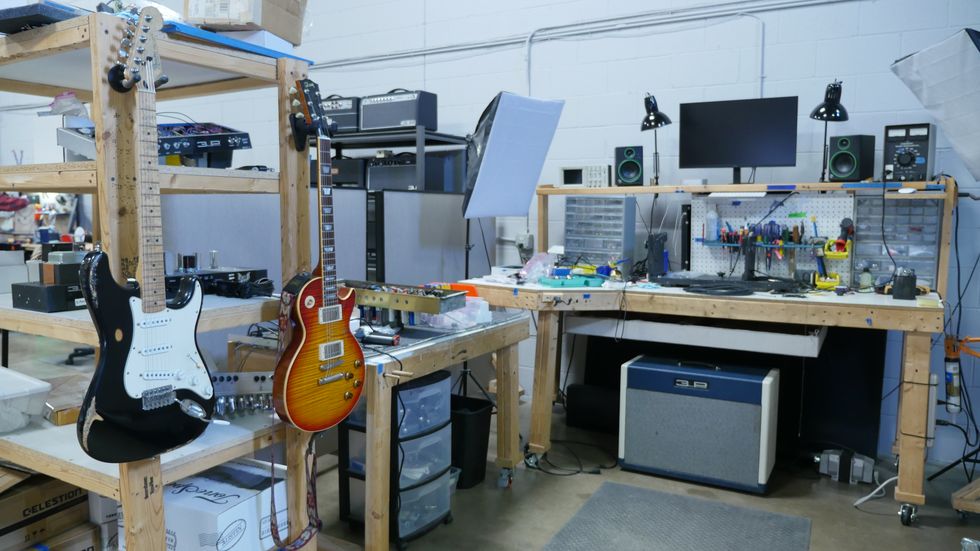
Step into the Frank Brothers workshop in Toronto and you’ll instantly be greeted by the rich, earthy aroma of freshly cut wood. On the day Premier Guitar stopped by, the air was filled with the sweet smell of Spanish cedar, evoking a sauna or a cigar box. (In this case, the guitar being built was for a cigar-loving client, so it was an intentional choice.)
Frank Brothers mostly uses mahogany for the Arcade model and the Radar Deluxe, but some are made with korina instead—for clients, like blues guitarist Josh Smith, who are seeking a body similar to mahogany but with a bit more presence and clarity in the mid-range. The Sonar is typically alder or maple.
“There are few people you can be as ruthlessly honest with as your brothers.”—Tim Frank
The company brings in ethically sourced shipments of new woods a few times a year, letting them dry out for over a year before cutting them into smaller chunks for body blanks, which are further dried for another six to 12 months until they’re ready to be milled. The milling process itself happens in gradual steps using their novelty-size jointer and Haas CNC machine to gradually pare down and shape the wood as its natural tension is released. “We’re not just milling it and then making the guitar,” Tim says. “We’re milling it, letting it rest, letting it de-stress, milling it again, and shaping it over time so that we get the most stable piece.”
During our visit, the CNC machine was in the process of milling the radius into a fretboard, having already been resurfaced three previous times. When it comes time for the fret slots, they’ll cut them in a pocket style rather than a straight line through the wood so that the fret tangs aren’t visible from the sides. Tim says this creates a firmer fit. “It’s a little detail that adds fractions of an amount of extra stiffness,” he says. “But, you know, we’re going for fractions.”
Once the fretboard gets glued to the neck, they use a highly precise straight edge to re-level the wood with sanding blocks until they reach their straightness tolerance of one half of a thousandth of an inch—less than the thickness of a human hair. They repeat that process again as they build in the tension of a single-action truss rod, and again as frets are installed.
Frank Brothers also take an unusual approach to their joints. For their angled headstocks, they use a “diamond” volute joint popularized by Martin acoustics prior to the First World War and typically found today on high-end classical or flamenco guitars. Tim Frank says it’s a highly labor-intensive practice, but it gives them a more sturdy, durable joint and, as a side benefit, the process uses a template that reduces wood waste. And then there’s Frank Brothers’ secret ingredient, the “blended heel.” Because the Arcade body is arched on both the top and the back, there’s no flat reference surface to build the heel. Instead, they do the build inside a block of wood, and only once they’re ready to glue the neck in do they cut the shape of the guitar.
“You get this big, Bo Diddley-looking thing with the neck in it,” Tim says. “And then we put it on the machine, and then we cut it out. It’s more like carving a statue from a block of marble than it is building a piece of furniture or a traditional guitar.”
While both brothers have a hand in each guitar from first cut to final finish, the woodworking is Nick’s area of focus. Tim’s specialty is the finishing, done entirely by hand with a nitrocellulose lacquer and great attention to detail, making it the most time-consuming part of the whole process.
Frank Brothers opt for classic colors like candy apple red, Pelham blue, shoreline gold, and sunbursts, but they put their own retro-inspired spin on these by tweaking and re-toning the paints so they appear aged. While finishing, Tim even takes it an extra step further by using a razor blade glued to a toothpick to meticulously scrape the color off along the edges to reveal the bony white binding.
“At this price range, it’s expected that it has to sound good, play great, look great,” Tim says. “But where we have a lot of fun is with those really small details—finessing those things into making these guitars go beyond expectation.”
“It’s a little detail that adds fractions of an amount of extra stiffness. But, you know, we’re going for fractions.”—Tim Frank
By the time a Frank Brothers guitar is ready to play, roughly 60 hours of manual labor have been undertaken at their Toronto workshop. Tim Frank says their pursuit of perfection is ultimately what has allowed them to grow their client base almost entirely by word of mouth.
“The feedback we get from people that play our guitars—even in Toronto, where the weather and humidity fluctuate like crazy—is that they really don’t need to mess with them,” Tim says. “They’re super, super stable because of all that engineering. The end result is a guitar that you don’t need to futz with much. And also, we think it makes for a better-sounding guitar—something that’s more responsive, a little bit more lively, and with better sustain.”
A Guitar to Last Generations
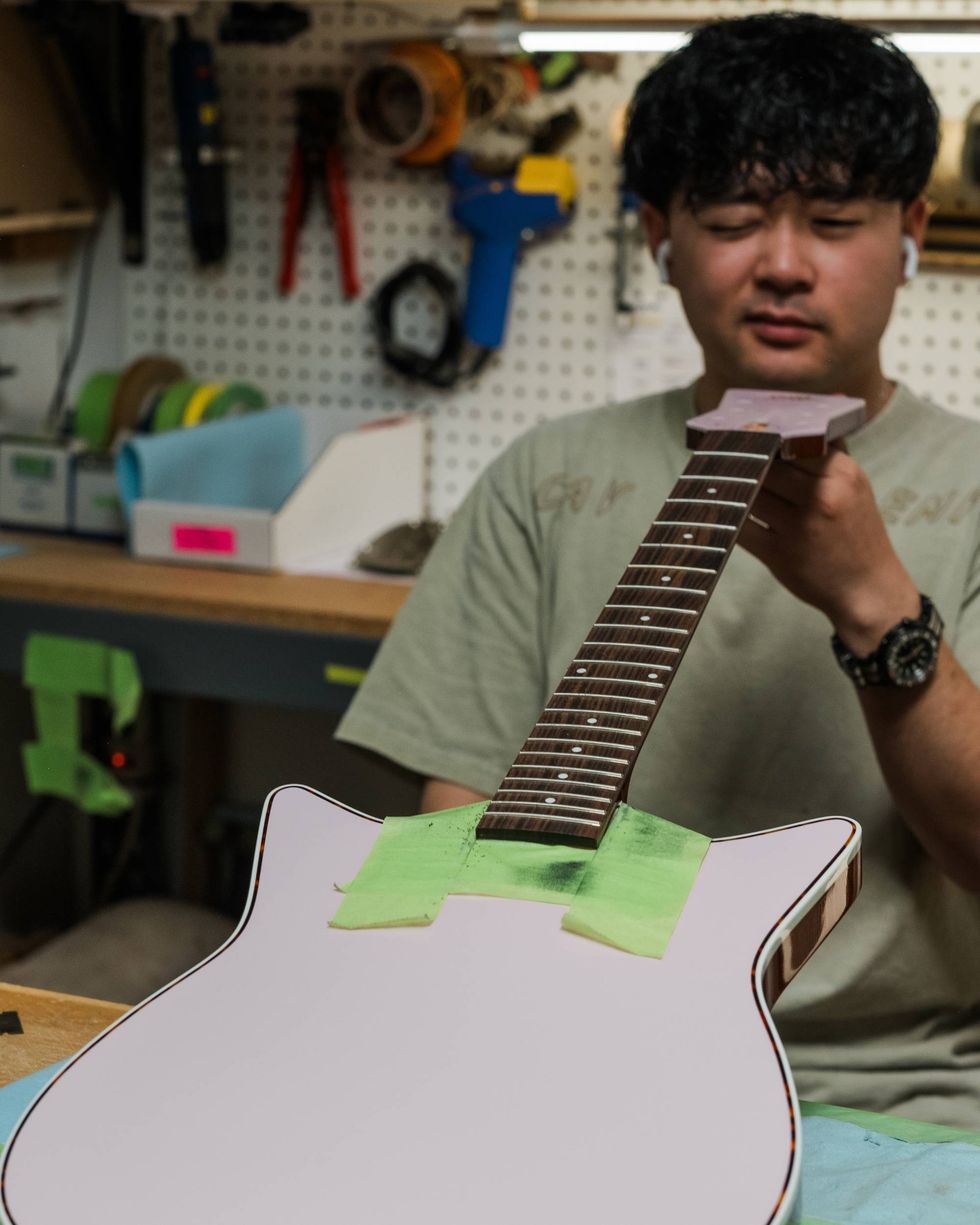
Luthier Sota Mori eyes up the neck on a Frank Brothers Arcade.
For the Frank Brothers Guitar Company, it’s all in the name. The Frank family fostered an appreciation for fine instruments, and now that the brothers are running their own family business, that brotherly dynamic powers everything they do. “There are few people you can be as ruthlessly honest with as your brothers,” Tim says. “That relationship has really influenced the way we build guitars and the level that we work at. We’re really focused on the details.”
Tim defines that standard as “heirloom quality”—the idea that a Frank Brothers guitar should be something that you’d be proud to pass on to your children and grandchildren, the same way their father and grandfather passed on their musical legacies.
“We’re trying to make something that you would not only be proud to own and play yourself, but also want to pass along to the next generation,” Tim says. “We’re trying to make timeless guitars.”