



Pedalboards tell stories, and this year's submissions prove it! From the minimalist who ditched the road case and went back to a One Spot on the floor, to the collector building a “Starboard” entirely from famous guitarists’ gear, to the neurosurgery videographer crafting soundscapes for the nervous system—these rigs reflect real lives and real gigs. Bass players with bamboo builds, experimentalists with dual boards, and portable warriors powering entire rigs from USB banks all made the cut. Here are seven boards with stories to tell.
New Wave Happy Place
Reader: Stephen Jackson
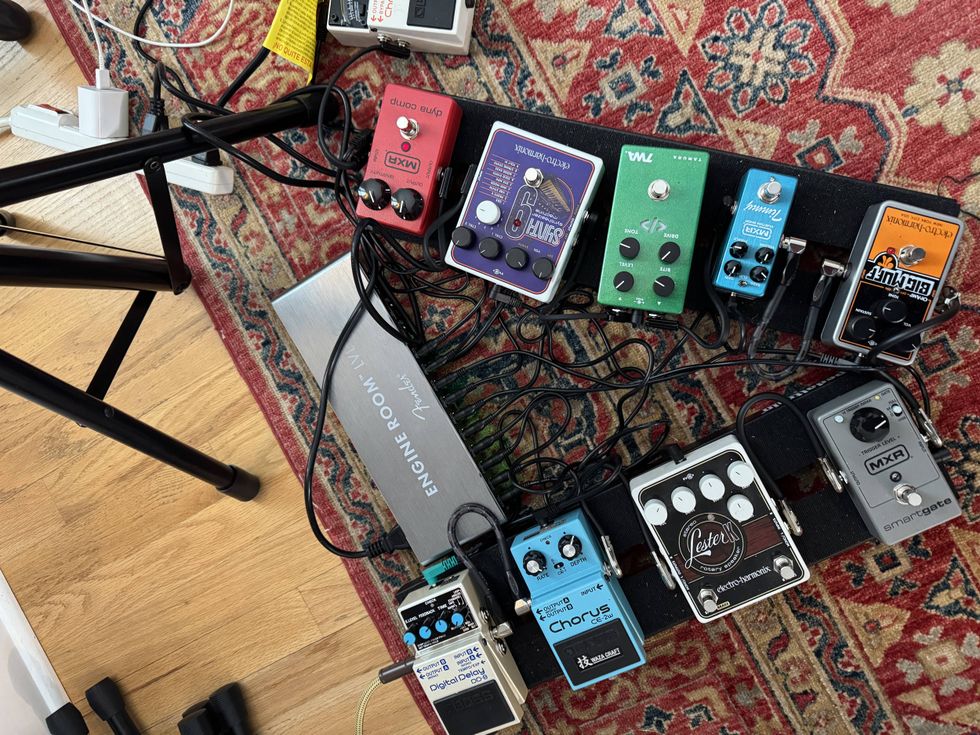
I’m a pretty ordinary guitar player, but I’ve loaded up on ten pedals that make me sound halfway decent. For me, my happy-place sonics are from the diffuse new wave genre of the late 1970s to mid-1980s. I just can’t get enough.
I prefer keyboard-dominated new wave that’s generally kind to enthusiastic but ordinary guitarists. I like it nice and dark—the Cure, Siouxsie and the Banshees, or the Cocteau Twins—or more pop-ish with some grit, like the Psychedelic Furs. I also love what I call “skinny guitar rock new wave”—earlier Talking Heads or Elvis Costello.
My pedals are powered by a Fender Engine Room LVL12, which is great for cutting down amp hum. Yes, there are battery packs that power pedals and may even help reduce cord hum, but they make me nervous—I forget to charge my phone or my vacuum stick, let alone a battery pack.
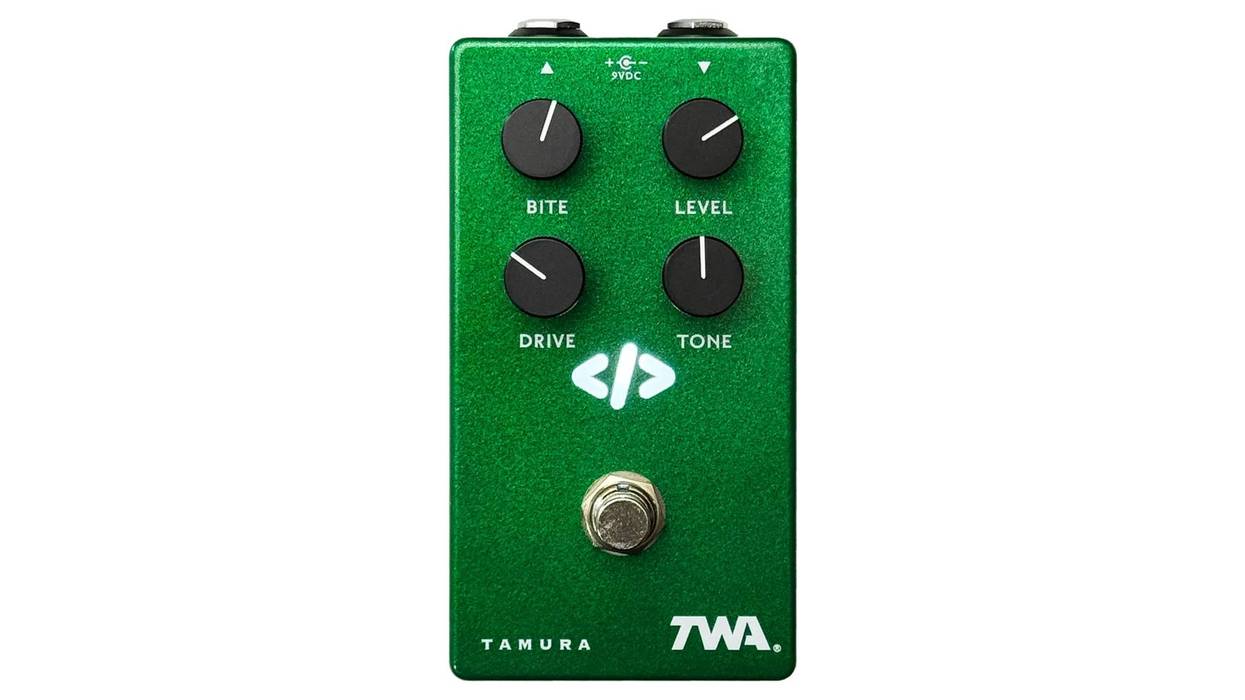
The first port-of-call from guitar to amp on my rig is a Boss TU-3 Chromatic Tuner. Next is an always-on MXR Dyna Comp compressor. Following that is a new wave synth staple, an Electro-Harmonix Synth9. Then the overdrive pedals: a newly-released entry in the Tube Screamer lineage, the TWA SC-01 Source Code, which is commonly on and dialed up relatively mellow; a kicked-up MXR Timmy; and a seething and spitting Electro-Harmonix Op Amp Big Muff Pi. My skinny rock songs get the SC-01 treatment or a Timmy on occasion. Oddly enough, the Big Muff is at home when turned down to backing some electronica—Berlin, for instance—as well as noisy new wave.
Next up is an MXR Smart Gate. Before I added that—and the Fender Engine Room—my Fender Jazz Bass had an annoying hum. Not anymore.
Finally, there are three stomps that, along with the Synth9, get my sound to the electronica and pop new wave happy place: an Electro-Harmonix Lester K stereo rotary speaker pedal, a Boss CE-2W Waza Craft Chorus, and a Boss DD-8 Digital Delay. My advice: never fear a chorus pedal.
Portable Power
Reader: Adam Thomas
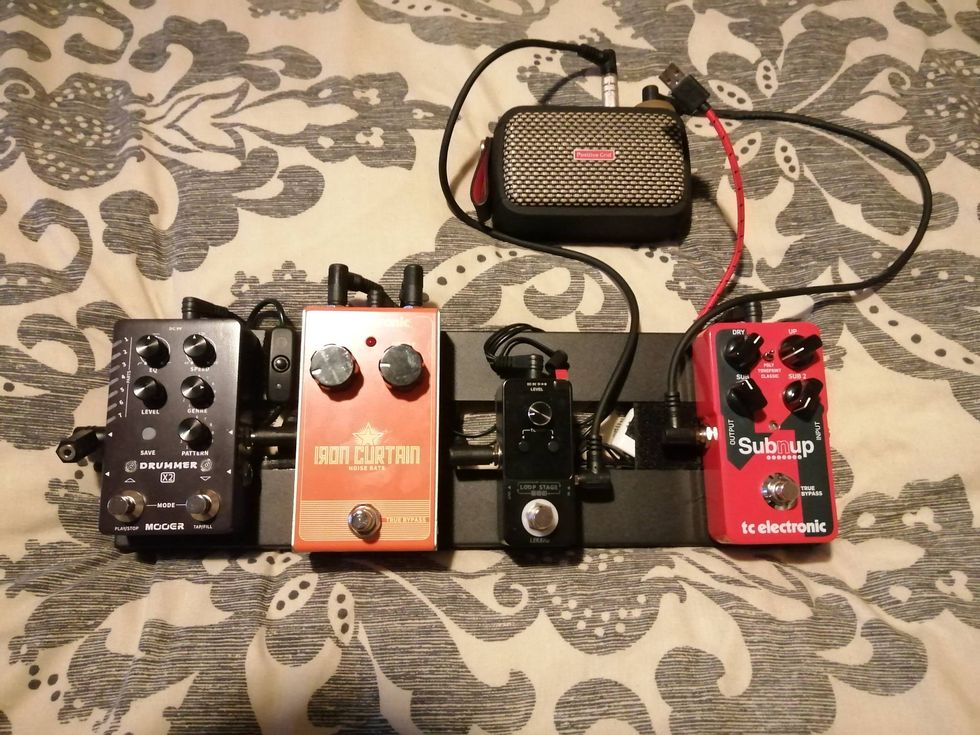
The board itself has a Li’l-moXie power supply hiding underneath. The red USB cable plugs into any USB power bank and powers the whole rig. The guitar output plugs straight into the [TC Electronic] Sub ’N’ Up [Octaver] pedal for the creation of bass lines and general low-frequency ambience. From there the signal travels to the Spark GO to be given a thorough going-over before it heads into the Lekato Looper. The second layer of the loop probably needs a true bypass from the Sub ’N’ Up and a different preset on the GO—no problem if you have the Spark Control X.
Next I send the signal into the [TC Electronic] Iron Curtain noise gate to get rid of any little imperfections created by the looper, and off we go to the Mooer Drummer X2 to provide some rhythmic accompaniment. I send the final output to a SubZero 15" portable PA (battery powered) via a stereo splitter line, giving me more options than you can shake a stick at for the entertainment of your fellow man, no matter where you may find them.
Experimental Lab
Reader: Kurt Nolen
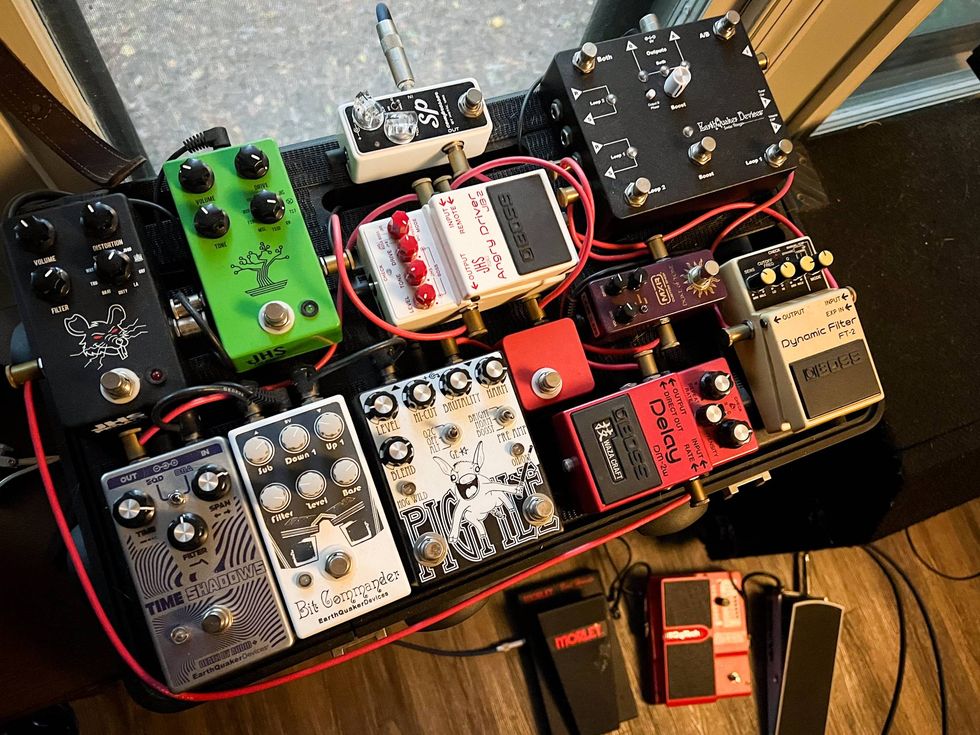
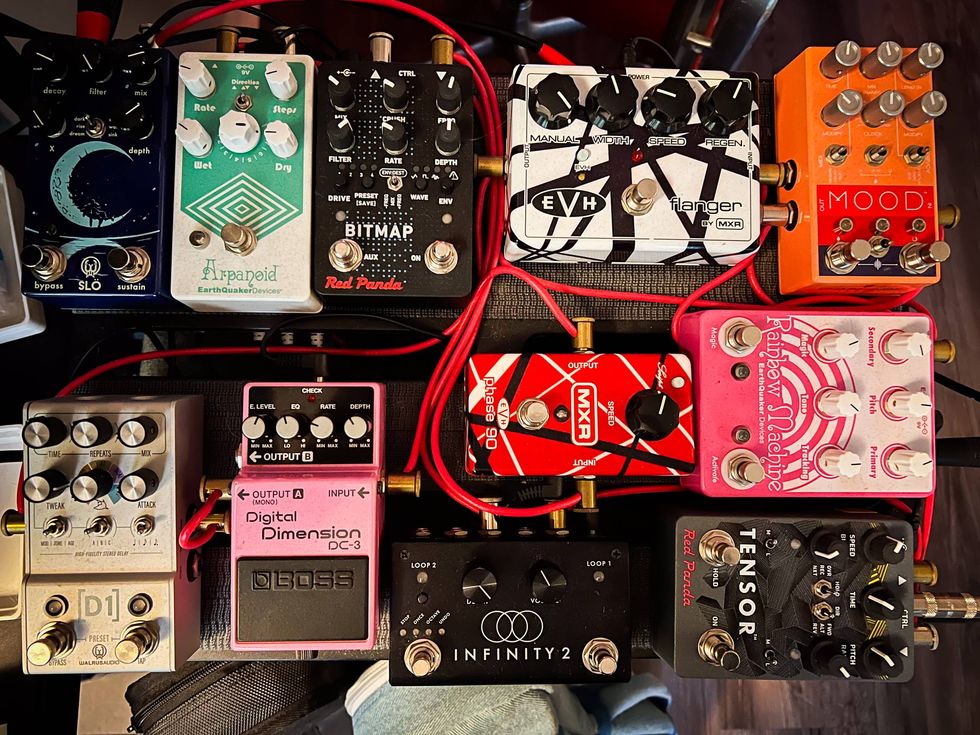
I’m the Medical Photographer/Videographer for the University of North Carolina School of Medicine Department of Neurosurgery, and frequently need to produce educational/academic or communications-related videos. Sometimes this material can use more narrative styles of music, but frequently it needs textural soundscapes that reference the subject matter in the video and drive viewer interest without being distracting. Want to evoke the sound of your globus pallidus? What does your nervous system sound like? What would high-intensity, focused ultrasound treatment sound like if you could hear it? This rig does it. I’m also an experimental composer and noise artist in my free time and needed something that could serve that purpose—or for sitting in with my friend’s Oingo Boingo cover band.
Board #1 (front of amp): guitar into Ernie Ball VPJR, DigiTech Whammy 4, Morley Bad Horsie, Xotic SP Compressor, Boss FT-2 Dynamic Filter, EarthQuaker Devices Swiss Things—loop 1 out to MXR Duke of Tone, Electrofoods Ultd Pigpile fuzz, EarthQuaker Devices Bit Commander, EarthQuaker Devices Time Shadows V1, Boss JB-2 (with JHS Red Remote), JHS Bonsai, JHS PackRat, Boss DM-2W to loop 1 return.
Board #2 (amp FX loop or loop 2 on EQD Swiss Things if running direct): FX out to EarthQuaker Devices Rainbow Machine, MXR EVH117 Flanger, MXR EVH Phase 90, Boss DC-3, Walrus Mako D1 Delay V2, Red Panda Bitmap, EarthQuaker Devices Arpanoid, Chase Bliss Audio MOOD, Red Panda Tensor, Pigtronix Infinity 2, Walrus Audio Slö Multi Texture Reverb to FX return (or Swiss Things loop 2 return if direct).
Legendary Pedals
Reader: Paul Martin
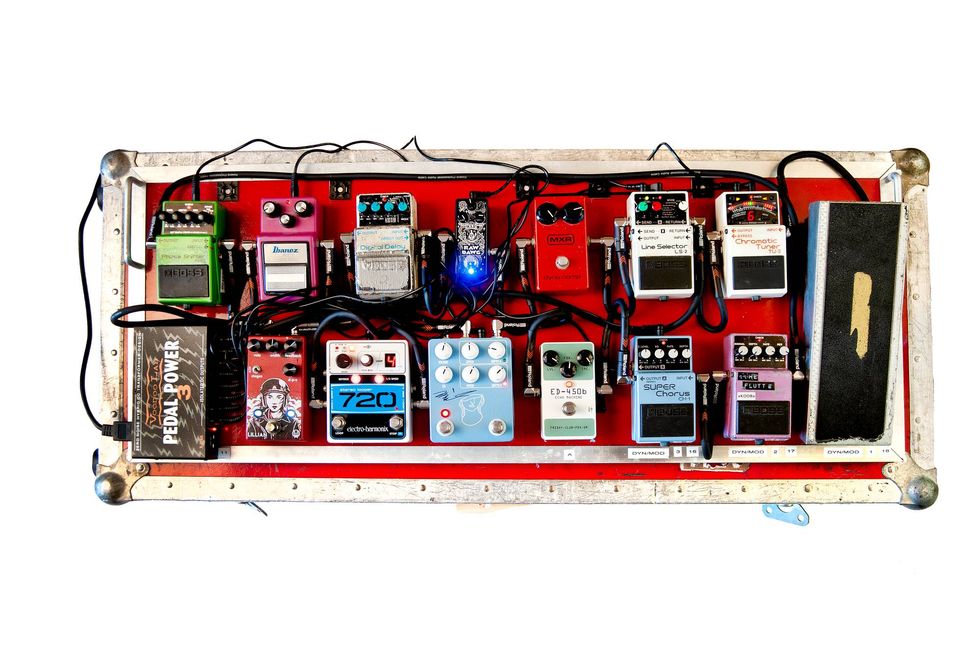
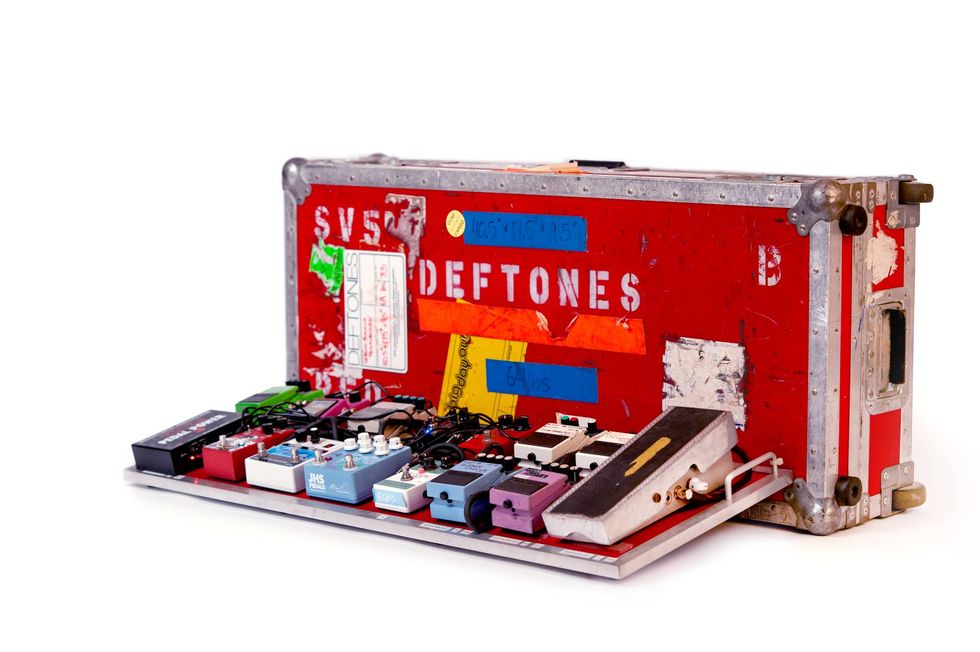
This is my “Starboard.” I call it that because it’s made up of pedals previously owned by famous guitarists. I mostly bought them from artist sales on Reverb, with a couple from Techno Empire and Pedal Pawn in the U.K. I was randomly collecting artist-owned pedals for a while, but when I bought [Deftones bassist] Sergio Vega’s pedalboard I decided to put a board together. The line selector switches between the top row for soloing and bottom row for clean. The board itself was owned by Sergio.
Top row: Boss PH-3 Phase Shifter, owned by Andy Taylor (Duran Duran and the Power Station); 1980s Ibanez AD9 Analog Delay, owned by Mitch Holder, a go-to session guitarist for Frank Sinatra, Barbara Streisand, and Lionel Richie; Boss DD-2, owned by Kiko Loureiro (Megadeth); signed MXR EG74 Eric Gales Raw Dawg Overdrive (limited to 250); vintage MXR MX-102 Dyna Comp, owned by producer and musician Dennis Herring; Boss LS-2 Line Selector, owned by Evanescence; Boss TU-3 Chromatic Tuner, owned and signed by Tommy Emmanuel.
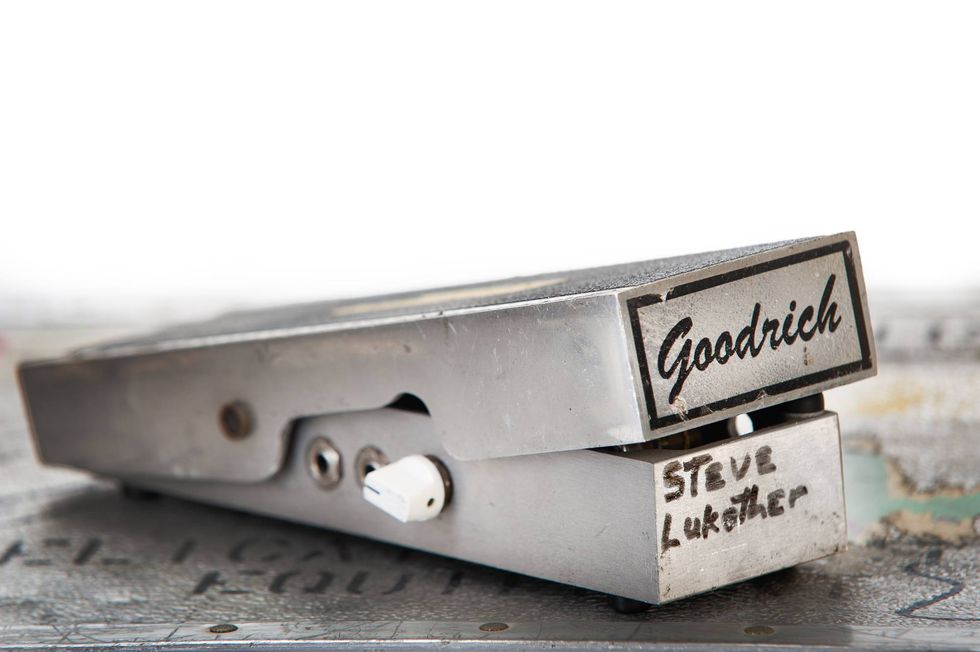
Bottom row: Walrus Audio Lillian Analog Phaser; Electro-Harmonix 720 Stereo Looper, owned by Malcolm Cecil, who invented the TONTO analog synthesizer and was responsible for the sounds on Stevie Wonder’s first three albums; JHS Artificial Blonde Madison Cunningham Signature Vibrato, signed by Madison when she was in Dublin supporting John Mayer; Friday Club ED-450b Echo Machine, owned by Isaac Brock (Modest Mouse); Boss CH-1 SUPER Chorus, owned by Daryl Stuermer (Genesis and Phil Collins); Boss HF-2 Hi Band Flanger, owned by Tad Kubler (the Hold Steady); and Goodrich Model 122 Volume Pedal, owned by Steve Lukather (Toto). From soloing on Stevie Nicks’ “Stand Back” to virtually all of Michael Jackson’s Thriller, it doesn’t get much cooler than that.Bamboo Bass Rig
Reader: Dino von Wintersdorff
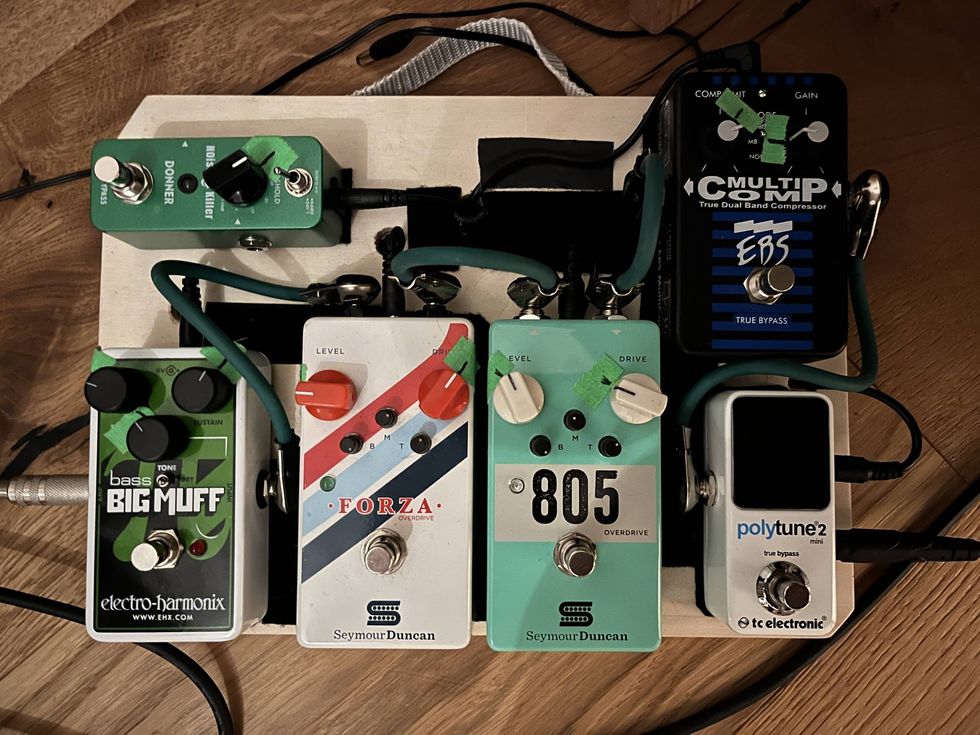
My bass pedalboard: Starting with a TC Electronic PolyTune 2 tuner, the signal goes into a Seymour Duncan 805 Overdrive, then a Seymour Duncan Forza Overdrive, an Electro-Harmonix Bass Big Muff, and finally a Donner Noise Killer. [An EBS MultiComp sits top right as well.] All on a board made out of bamboo and plywood, giving a fresh vibe on the stage!
First I got the Seymour Duncan Forza to have some nice controllable overdrive for the bass—the 3-band EQ helps get a nice tone. Then I found the clean signal was too boring and I added the SD 805 to have an always-on slight crunch and tone shape, and I love it! Sometimes the Muff and Forza are on at the same time, but the 805 isn't. So switching back to only 805 mode can be wild—there are times onstage that I would hit not only those three pedals, but also the tuner, instantly killing my signal!
No Board Required
Reader: Sam Paige
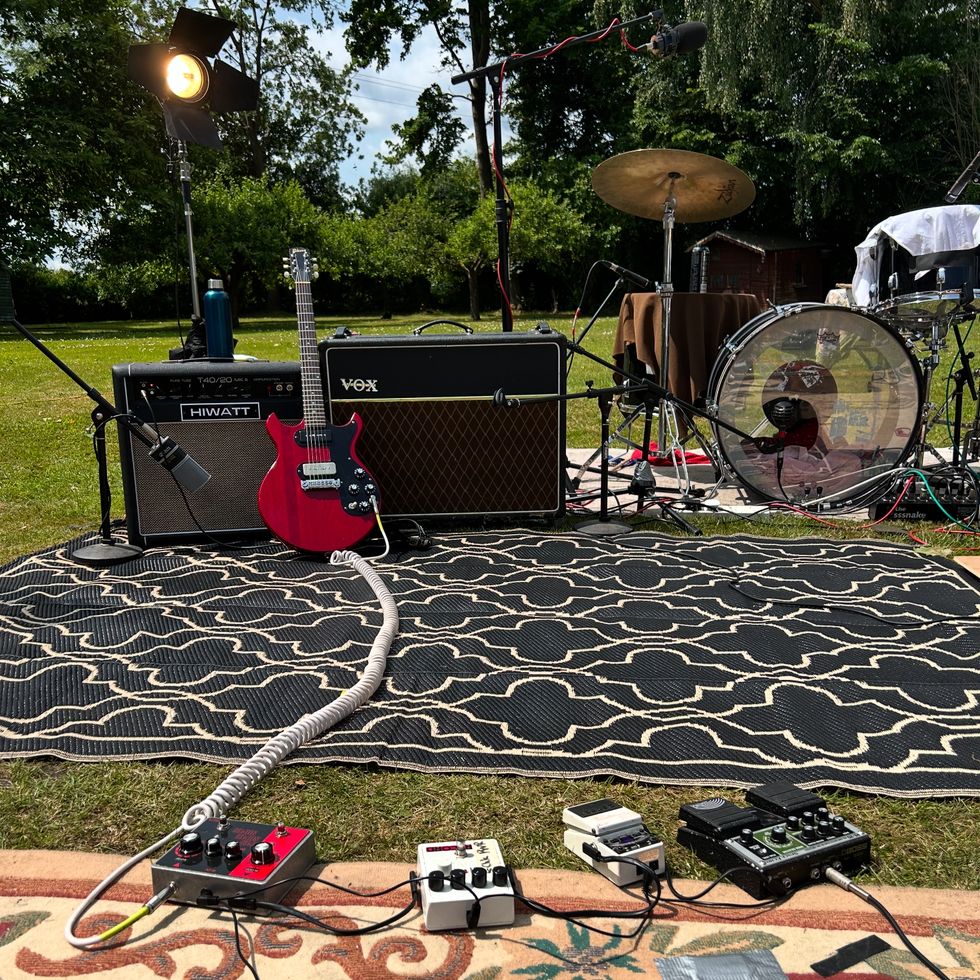
So obviously, yeah, there’s no board. It’s on the floor. In the 20-plus years I’ve been playing—starting with a few daisy-chained pedals to a fully-loaded [Pedaltrain] Novo 24 and nearly doing my back in taking the case offstage—I’ve got back to the pick-and-mix life of a [Truetone] 1 Spot and whatever I fancy.
Recently a band I fronted for six years or so fell apart, and as one door closed another opened. Starting in a new project, this was the first few weeks of bringing some old pedals and the 1 Spot to a new adventure and finding a new footing again.
Chain: Defects Super Super Super, something of a clone of the rare Death By Audio Super Fuzz War. Fuzz on one side, then boost. Inside there are dip switches for each side to shape EQ, add gain, add mids—usual setup is “full Fuzz War” with added mids, and currently a full-range boost on the other side. Second, the Electro-Harmonix Mel9, a sort of impulse buy based on seeing one of my favorite guitarists, Mr. John Dwyer, use it. It’s janky, has trouble with certain power supplies, and seems to have no built-in compression. So your effect out is either too quiet, just right, or blows your head off. I love it. It hasn’t left a setup since I bought it. Next, the Boss TU-2—god knows how old it was when it got to me (I rarely buy new), but I’ve had it for at least a good 15 years. A bit hard to see in the direct sunlight, but at least it won’t break. And a Boss RE-20 [Space Echo]—the more I use it, the more I’ve grown to love it—the perfect amount of bounce for echo effects. It’s forever inspiring and reliable. I keep thinking of trading in for one of the newer models, either to downsize or expand, but I can’t relegate this pedal to the shelf, or the draft listings on Reverb or eBay.
Double Trouble
Reader: Randall Brown
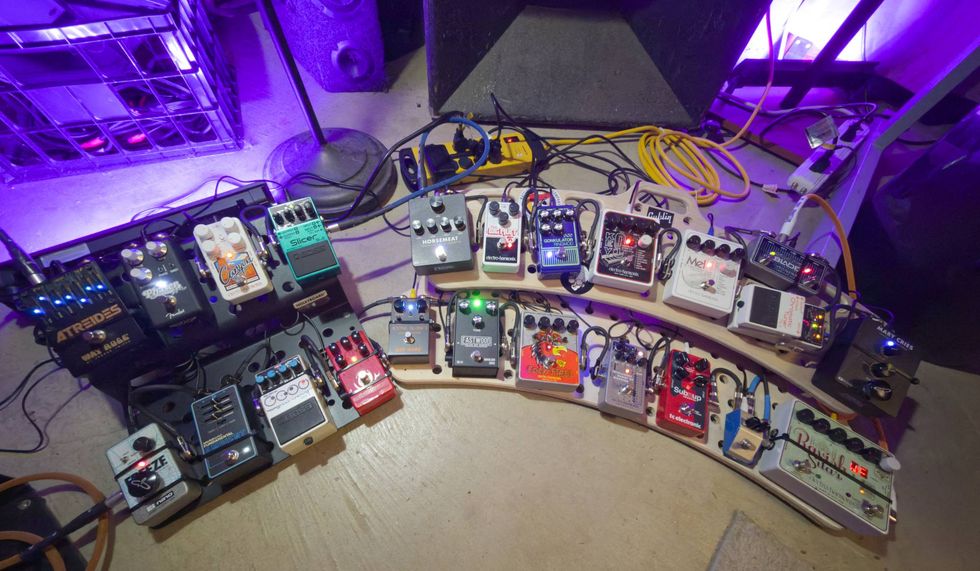
I spent years as an “only use the amp’s drive channel” guy, then started looking at EHX pedals out of nostalgia for a long-lost Muff Fuzz. Over the last 15 years or so, I’ve collected this batch of circuit friends with the idea of building wide tonal flexibility. I’m influenced equally by classic riff lords like Black Sabbath, contemporary psychedelic outfits like Osees and King Gizzard, and the ultra-modern trips of St. Vincent.
One of my favorite recent discoveries is a parallel mix of the EHX Cock Fight and the Fender Waylon Jennings Phaser—a slow-modulated buzz that really straddles the synth/buzz-guitar fence. I still pay the most attention to the magic that Electro-Harmonix puts out. In my drive to build the mega-board I have now, I started with the Freeze first. I also keep an eye out for additions to what I call the “fake bored keyboardist” section. The Freeze, Canyon, Key9, and Mel9 are the cornerstones of that. There are some days when I think I should go back to a single overdrive or go straight into the amp. But all the sounds are just too much fun!
My guitar goes into a PRS Mary Cries compressor, then a Boss TU-2, then into an Electro-Harmonix Switchblade Plus. From the Switchblade, two signal chains go to two different amplifiers.
Roland JC-120 signal chain: Electro-Harmonix Ravish Sitar, Tonebutcher WeeWah auto wah, TC Electronic Sub ’N’ Up, Electro-Harmonix Intelligent Harmony Machine, Electro-Harmonix Cock Fight, Eastwood BB-01 Manalishi Drive, Way Huge Stone Burner, Catalinbread Bicycle Delay, Boss DD-2 Digital Delay, Walrus Audio Fundamental Series Ambient, Electro-Harmonix Freeze.
Fender Hot Rod Deluxe signal chain: Electro-Harmonix Mel9, Electro-Harmonix Key9, DOD Gonkulator, Electro-Harmonix Nano Big Muff Pi, PRS Horsemeat Transparent Overdrive, Boss SL-2 Slicer, Electro-Harmonix Canyon, Fender Waylon Jennings Phaser, Way Huge Atreides Analog Weirding Module.



![Rig Rundown: The Black Crowes’ Rich Robinson [2026]](https://www.premierguitar.com/media-library/youtube.jpg?id=66952027&width=1245&height=700&quality=70&coordinates=0%2C0%2C0%2C0)