

Advanced
Intermediate
- Use tapping for extended chordal playing.
- Explore contrapuntal lines.
- Create chords and melodies that would be impossible with one hand.
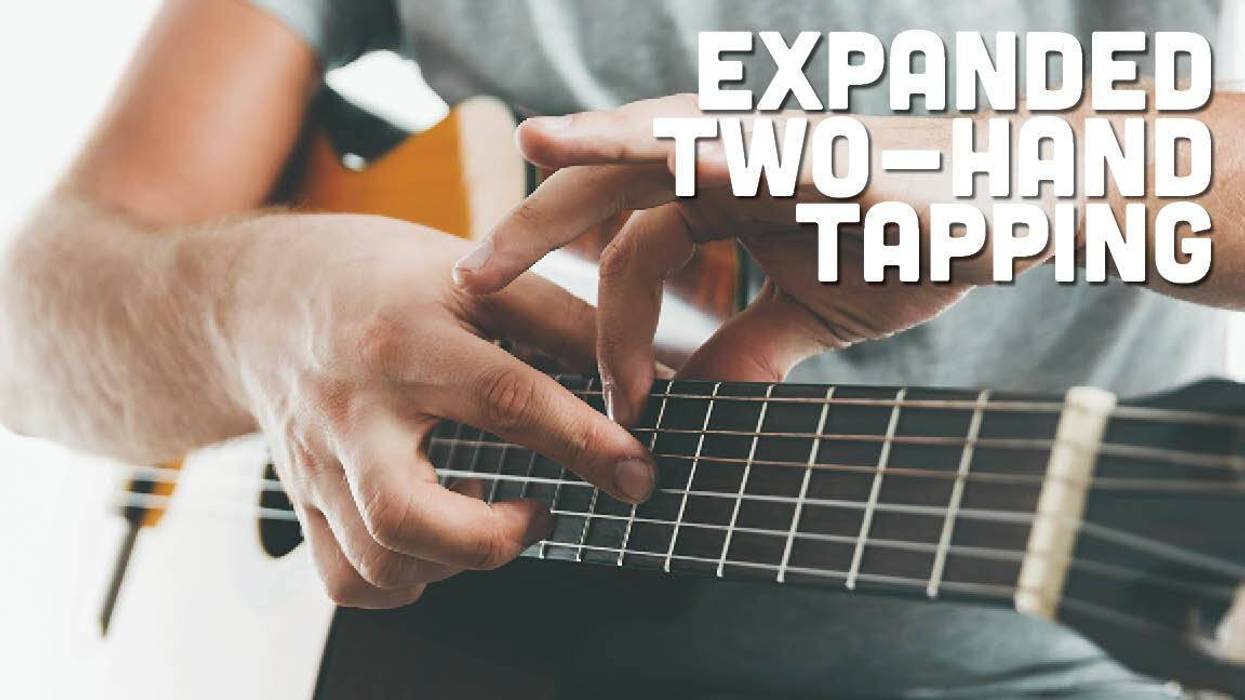
I’ve always loved the unconventional technique of using two-handed tapping in a “chordal” way. In my younger years, I found myself utilizing it for the wow factor. As I matured in my musicianship, I began asking myself, “What is the practical application of this, and how can it be used in a more musical situation?” I began to use the technique as a way to expand solo/chord-melody guitar playing in the style of players such as Stanley Jordan and Victor Wooten. But that is a whole other ball game in terms of time, practice, and development.
As for how this can be used in a simpler and more typical situation, I found the rhythmic,
percussive, and chordal elements of this technique to be extremely fun and expansive when working with small groups such as duos, trios, and quartets. This is especially exciting when applying it to ethnic rhythms such as Latin, Anatolian, and Middle Eastern rhythms.
When I practice this, I think of two main things: left hand and right hand apart, and left hand and right hand together. I would say left and right hand apart is an easier starting point as it doesn’t require the same coordination. I generally like to utilize root, fifth, and octave with the left hand, and extensions like thirds and sevenths with the right hand as they are the color tones.
Explanation of tabs: Below each column of the noted tab, I use the letter R to indicate right hand and L to indicate left hand. They are stacked in a way that represents the tabs. For example, if you see the letter L all the way at the bottom and the letter R on top of that, that would mean your left hand is tapping the lower note while your right hand is tapping the higher note.
Let’s start off with a straightforward syncopated rhythm that focuses on the left and right hand playing apart from each other.
Ex. 1
Ex. 1: Left hand and right hand apart. This example creates a typical 3+3+2 rhythm by playing two individual notes on the left hand, followed by two notes together (two-note combo) on the right hand, repeat, then finish with one note on the left hand and one combo on the right hand.
Ex. 2
Ex. 2: This is the same rhythm and pattern as the first example, but we begin to have some melodic movement in the right hand.
Ex. 3
Ex. 3: Left hand and right hand begin playing together. This example has a bit of a Latin flavor and the juxtaposition of strong down beats in the left hand and syncopations in the right hand creates a cool effect.
Ex. 4
Ex. 4: This is the same rhythm and pattern as Ex. 3 but we have some movement with the extensions of the chords.
Ex. 5
Ex. 5: This example begins to incorporate sliding in the right hand. Whenever I present a new technique, I simplify the overall example to focus on the new technique.
Ex. 6
Ex. 6: This is a standard progression based on the first eight measures of “Blue Bossa.” Clearly, I like minor keys. This example demonstrates more bassline movement with the left hand and application of the style over a longer chord progression. We are keeping the left hand and right hand apart to ease into a busier left hand.
Ex. 7
Ex. 7: This example utilizes all the prior concepts, including slides in the right hand, hammer-ons and pull-offs between the two hands, both hands together, and both hands apart.
I hope these examples help with getting started on some basic—and some not-so-basic—tapping
techniques while playing something that sounds musical and usable.