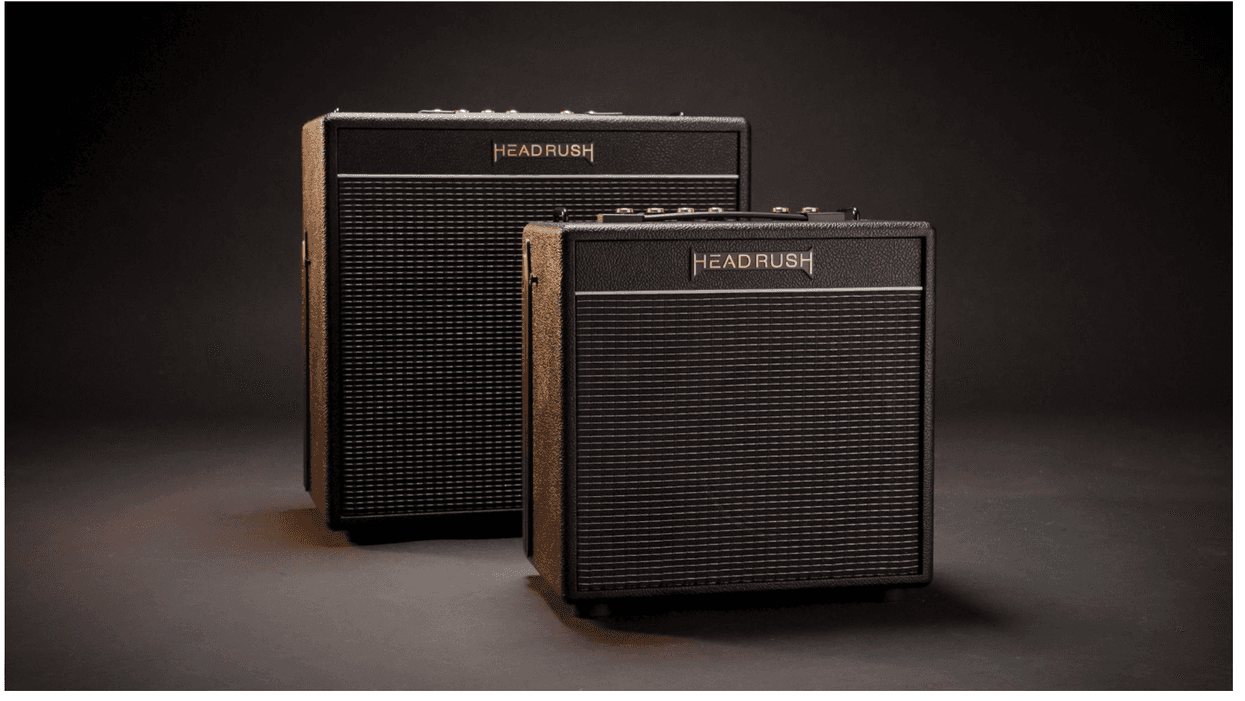
Hylight UK has introduced their new Custom SD 2x12 amp, a 20-wattcombo that builds upon the company’s legacy dating back to the 1960s.
With modern features such as Effects Loop and Line Out, the new Hylight Custom SD "Shiny Diamond" combo (VR204C-212F) is powered by a pair of EL84s and offers clean headroom and bright chime, ideal for crunchy British rock.
The amp delivers 20-watt output at full power and has a built-in attenuator (via splitting the transformer, activated with a toggle switch on the front control panel) which can dial back the output to ½-watt. Its preamp tube configuration includes four 12AX7s/ECC83s and the combo comes standard equipped with a pair of Fane F70 12” speakers. Other speaker options include Fane A60s, Crescendos reissue, A30, F30, F25, and F90. Hylight also offers Celestion speakers options upon request.
This 20-watt combo is made in England with the best available components for those guitar players who are looking for a classic British sounding amp based on the early 70’s models.
Hylight Electronics has been making high quality amps since the 1960's. Bands such as Pink Floyd, the Moody Blues, the Rolling Stones, and The Who have all used Hylight-made amps to help create their legendary sounds. With their military-spec chassis, point-to-point wiring, and marine-grade cabinets, Hylight amps are known for their rugged, professional build quality.
The new Highlight Custom SD 2x12 carries a street price of $3799. For more information visit hylight.co.uk.
Beloved and influential Los Angeles trio Failure – Ken Andrews, Greg Edwards, and Kelli Scott – announce Location Lost, their seventh studio album and fourth since reuniting in 2014 after a 17-year-hiatus, along with a spring North American tour. The LP features nine new tracks that showcase a focused, modern and ever-evolving vision of Failure’s utterly unique sound, led by first single "The Air’s on Fire."Location Lost will arrive April 24th as the first release under Failure Records/Arduous Records/Virgin Music Group.
Recorded after the completion of the recent Hulu/Disney+ documentary Every Time You Lose Your Mind, Location Lost doesn’t arrive as a victory lap or a nostalgia exercise. Instead, it sounds like a band actively negotiating where — and who — they are now. “It’s very different,” Edwards says plainly of the follow-up to 2021’s Wild Type Droid. “There are sounds and parts that really don’t have any precedence within the Failure world.”
“The Air’s on Fire” embodies this sense of disorienting unfamiliarity. Almost immediately after finishing editing the documentary, Andrews suffered a serious back injury that required surgery. The operation was technically successful; the recovery was not. The single is the album’s most literal confrontation with Andrews’ medical trauma, its oppressive atmospherics and crushing bottom end mirroring his struggle to breathe on his own. “That song is directly about my surgery and waking up,” he explains. “I basically coded. Everything was spinning. I kept saying, ‘Turn the air on. I’m fine—just take me home.’ I was definitely not fine.”
Listen to “The Air’s On Fire” HERE and watch the video for the track, directed by Sean Stout, HERE.
WATCH & SHARE “THE AIR’S ON FIRE” OFFICIAL VIDEO
At the opposite emotional pole is the largely acoustic, straight-up breakup song “The Rising Skyline” featuring Paramore frontwoman Hayley Williams, an artist whose longtime public admiration for Failure has unquestionably helped introduce the band to an entirely new generation of listeners. The album also delivers dose after dose of Andrews, Edwards and Scott’s signature creative and instrumental interplay, from the warning bell-like guitar chimes on propulsive opener “Crash Test Delayed,” to the elastic, bass-driven groove of “Halo and Grain” and the grinding, methodical wall of sound on “Solid State,” which wouldn’t have sounded out of place on 1996’s all-time-classic Fantastic Planet. Other songs such as the slow-burning, dream-inspired closer “Moonlight Understands” and the stuttering “Someday Soon” emerged from singular, unrepeatable moments.
Failure will premiere material from Location Lost on their spring headline North American tour, kicking off with an album release show on April 21 at Zebulon in Los Angeles and wrapping in Toronto on May 20th. All Under Heaven is supporting all headline dates starting May 3. Their run of shows also includes festival appearances at Las Vegas’ Sick New World, Chicago’s SPACE ECHO @ Radius and Daytona Beach’s Welcome to Rockville. Tickets go on sale to the public this Friday, February 20th at 10am local time. For tickets links and more information, visithttps://www.failureband.com.
Failure’s musical communion has intrigued critics, fans, and peers for more than three decades. Following Comfort and Magnified, the trio created what is largely considered one of the ‘90s most influential and innovative albums, 1996’s Fantastic Planet. The 17-track collection earned rave reviews and onboarded a trove of new fans and also led the band to headline Lollapalooza’s second stage and craft one of the era’s most recognizable videos, “Stuck on You.” After a 17-year hiatus, Failure returned with The Heart Is a Monster in 2015, followed by 2018’s In the Future Your Body Will Be the Furthest Thing from Your Mind and 2021’s Wild Type Droid.
‘LOCATION LOST’ TRACK LISTING
01 - Crash Test Delayed
02 - The Rising Skyline ft. Hayley Williams
03 - Solid State
04 - The Air's on Fire
05 - Halo and Grain
06 - Someday Soon
07 - Location Lost
08 - A Way Down
09 - Moonlight Understands
FAILURE TOUR DATES
Apr 21 Los Angeles, CA - Zebulon (Album Release Show)
Apr 25 Las Vegas - Sick New World Festival
May 02 Chicago, IL - SPACE ECHO @ Radius
May 03 Cleveland, OH - Grog Shop
May 05 Nashville, TN - Basement East
May 06 Atlanta, GA Masquerade - Hell
May 08 Daytona Beach, FL - Welcome To Rockville Festival
May 09 Asheville, NC - Eulogy
May 10 Carrboro, NC - Cat’s Cradle
May 12 New York, NY - Le Poisson Rouge
May 13 Cambridge, MA - Sinclair
May 14 Hamden, CT - Space
May 15 Washington, DC - Union Stage
May 16 Harrisburg, PA - Arrow at Archer Music Hall
PG Editorial Director Richard Bienstock has interviewed Slash more than a few times throughout the last couple decades. So, we’ve called on him to join us in celebrating the Guns N’ Roses guitarist as we discuss his sound, his riffs, and his look! Tune in to find out about the time the two went guitar shopping and when Slash showed up at Richard’s desk.
The Grand Ole Opry, George Gruhn of Gruhn Guitars,and Martin Guitar have partnered to create a limited-edition Martin HD-28 Grand Ole Opry 100th Anniversary guitar. Opry member Vince Gill was the first artist to ever play the one-of-a-kind instrument when the guitar was introduced to the public for the first time and played it on the 100th Anniversary Opry show on November 28, 2025.
To purchase the limited edition Martin HD-28 Grand Ole Opry 100th Anniversaryguitar click HERE.
The Martin HD-28 Grand Ole Opry 100th Anniversary is a one-of-a-kind instrument handcrafted to honor a century of music, storytelling, and unforgettable moments on country’s most iconic stage. For generations, Martin guitars have been in the hands of countless artists who shaped the sound of country music from the Opry’s hallowed ground—heard by millions and woven into the very history this guitar celebrates. Built on the foundation of Martin’s legendary HD-28, it delivers the bold, balanced Dreadnought tone players have long trusted: powerful bass, clear trebles, and rich overtones shaped by forward-shifted scalloped X-bracing and time-honed craftsmanship.
To mark the Opry’s 100th anniversary on November 28, 2025, Martin’s artisans added exclusive details found only on this guitar. The headplate features a custom inlay of the historic WSM microphone rendered in mother-of-pearl and abalone, a tribute to the broadcast that carried country music nationwide. A matching commemorative inlay theme continues along the ebony fingerboard, celebrating a century of Opry history and the artists and moments that defined the genre from this storied stage.
Handcrafted with a solid spruce top, solid East Indian rosewood back and sides, bold herringbone top trim, and elegant antique white binding, this special HD-28 also features a comfortable Golden Era Modified Low Oval neck that feels effortless in the hands. Together, these elements blend Martin tradition with Opry heritage in a single, remarkable instrument. It’s a playable piece of history made for those who keep the circle unbroken.
One of the great paradoxes of guitar sonics is that reverb, an effect invented to give electronic and recorded sound more natural ambience, can also make the instrument feel otherworldly. It’s reverb that transforms guitar and amp into waves crashing off the Malibu cliffs, and reverb that makes the Stones’ “Gimme Shelter” sound like the darkest of moonless city nights.
That midnight tone is among those that lives in Keeley Electronics’ Andy Timmons signature Nocturne, a versatile stereo pedal perfectly at home exploring reverb’s dual potential to recreate natural atmosphere or sounds that seem beyond physical dimensions.
Exploring the Atmosphere
Inspired by the Keeley Andy Timmons Halo delay/reverb, the Nocturne focuses on reverb exclusively, offering three flavors: nocturne, spring, and plate. While the latter two are the most conventional, they can be dialed in to break free from the constraints of their mechanical counterparts. All three modes give you control over tone, reverb level, decay, and modulation. But the pedal also has alternate functions that enable the tone and decay knobs to control a high-pass filter (which tailors the low end) and pre-delay (a powerful and often overlooked parameter that shifts the space between transient notes and the onset of the reverb).
Spring and plate do the most basic versions of their job well, but they happily go beyond the norm. In spring mode, the modulation control governs the mechanical “boing” overtones in the reflections, which range from realistic to totally over the top. Though I preferred the more subtle settings, which enabled me to capture the essence of gentle slap heard in my old Fenders and Ampegs, it was also easy to move between big and clangy or smaller and subtly ambient.
“It made me slow down, allow the notes to hang, and listen—and even led to new music for a documentary soundtrack I’d been struggling with.”
For most conventional guitar-tone tasks, the plate mode would be my go-to. It’s especially effective for high-gain sounds, where you can dial in the sense of a big amp in the studio. I used the Nocturne both in front of a solid-state amp and in the effects loop of a modified Bassman 10, which has Fender-style and pentode preamp channels and EL34 power tubes. The pentode channel can be set to preserve more low end than a typical guitar preamp, so the high-pass filter was especially useful there. More important, though, was the Nocturne’s high headroom, which meant it could live in the effects loop, on the receiving end of preamp and other drive sources, without complaint—even when powered by a basic 9-volt supply (18-volt is optional).
Dark Reflections
While both spring and plate are effective day-to-day tools, it’s the eponymous nocturne mode that opens up the pedal’s creative potential, delivering lush, modulated sounds with distinct echoes blended into long decays. I often got lost in the swirl of shimmering sustain while playing simple thirds and drones. It made me slow down, allow the notes to hang, and listen—and even led to new music for a documentary soundtrack I’d been struggling with. Things got more interesting when I grabbed an EBow, where the sustain and feedback-like harmonics let me create a sonic bed with far more texture than many synths, and far more expression than a sample.
As these experiences suggest, I often found myself playing to the effect in Nocturne, letting it serve as a guide, and treating it as an extension of my guitar and amp. Using the assignable expression input to change parameters while playing only enhances the sense of interactivity here. It’s that responsiveness to player input—and the fact that so many big sounds don’t completely obscure dynamics—that make the nocturne mode so effective as a creative tool.
The Verdict
While there are plenty of creative and powerful spatial effects on the market, the Nocturne is one of the few I know that works like it was designed for the guitarist without dumbing things down. It’s easy to get started and the basic sounds are satisfying, but it also invites you to go deeper. Preset capability (you can create up to 72 with MIDI) means that in a performance setting you can switch easily between completely space-altering effects and more earthly ambiance. The high fidelity and headroom make it a powerful studio tool.
Though it takes time to master some functions (it took a few tries to get the expression pedal assignments right) the layout remains super intuitive. That essential simplicity makes Nocturne equally suited to pedalboard minimalists and MIDI-based rigs. But whichever camp you’re in, you might want to leave a note for family and friends when you plug in, because you’re likely to get lost in space.