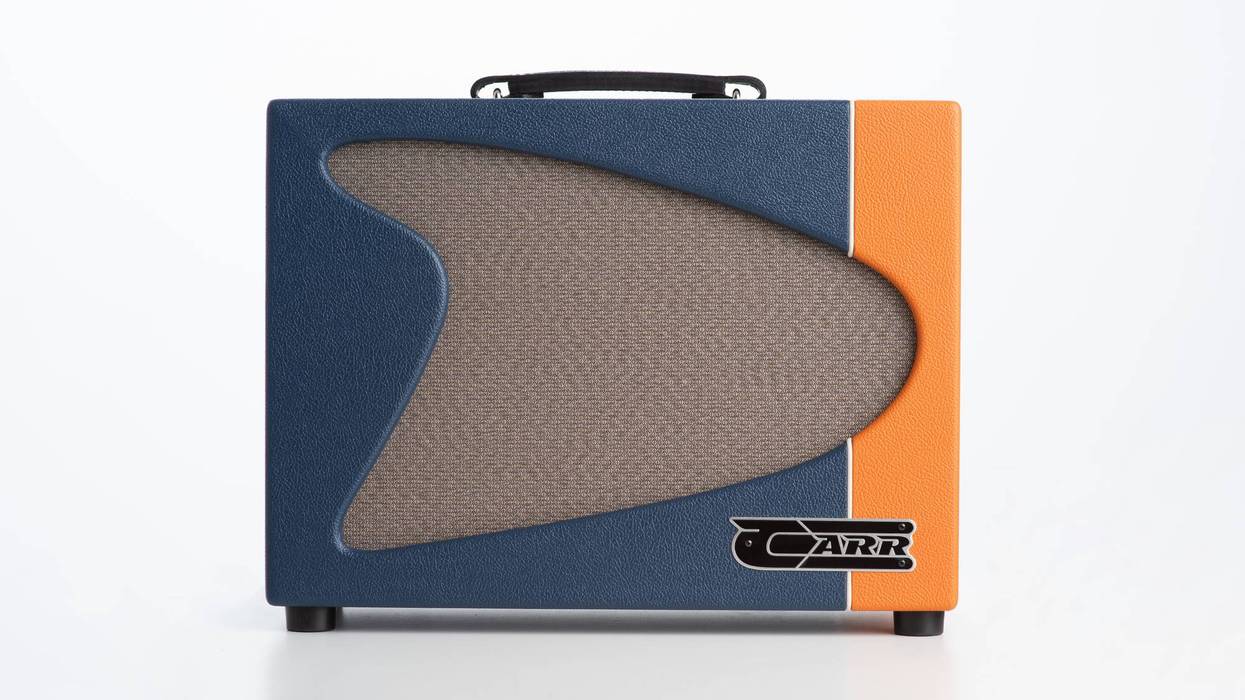
When one thinks about 5-watt amps, it’s often in terms of compromise—things like consideration for the neighbors downstairs, or the houseplant that would flourish in the space where your Hiwatt stack lives. On one hand, Carr’s 5-watt, 1xEL84-powered Trail Rider offers a viable path to such compromises. And with an excellent attenuator on board, it can sound alive and characterful at volumes no louder than your TV. But with the brakes off, the Trail Rider also has the potency to blast a whole city block. And with so many beautiful sounds and colors available at full power, restraint can be difficult.
Bermuda Triangle Address
When you think of a 5-watt amp, you probably envision something about the size of a Fender Champ or Vox AC4. But the Trail Rider, at roughly 20" wide, 15" tall and 9" deep, is almost the same size as Carr’s much more powerful Bel-Ray. The dimensions might be less than ideal for some 5-watt amp shoppers looking to maximize space. Thankfully, it looks smashing. But the ace visuals, the expertly crafted plywood cabinet has a practical benefit—it accommodates a 12", 50-watt Celestion A-type speaker, which plays a major role in the Trail Rider’s overachieving performance.
The Trail Rider’s tube complement—two 12AX7s and a single EL84 (along with a 12DW7 for reverb drive and return)—suggests fundamentally English inspirations. And the spirit of the Vox AC4 definitely dwells within the Trail Rider. But like most Carr amps of more recent vintage, the Trail Rider’s vocabulary transcends oceans, borders, and boundaries. Two switchable voices make up the basic tone foundations here. The Voxier of the two is called V67, the other is T57. You probably won’t need three tries to guess that the “T” is for tweed.
Deluxes and Bassmans define tweed tone for most. But tweediness can be a lot of things. Fender’s amp designs in the mid- to late-’50s evolved quickly, and when designing the Trail Rider, Steve Carr homed in on the point at which the tweed amps went from a single tone control that governed the high end, to a 2-knob EQ that controlled bass and treble independently. That simple enhancement opened up a lot of tone shaping range in tweeds like the Pro, Super, and Bassman, and Carr uses that simple but magical formula to fantastic effect in the Trail Rider. Its EQ section is a powerful tool that lends the amp an expansive vocabulary.
Trails Less Taken One shouldn't be afraid to experiment with radical, unconventional, even uncomfortable shifts in EQ settings on the Trail Rider. In fact, messing with convention is half the fun. Situating the treble and bass at noon reveals the essence of the two voices, but also the basic flexibility of the amp. At these EQ settings—and in either V67 or T57 voices—the first 25 percent of the amp’s volume range offers sweet, lively clean tones that shine on their own, but sound dynamite with drive and distortion pedals. With amp volume in the 30-to-50 percent range, the Trail Rider starts to growl on its own. These textures can be accented with pedals to very cool ends, and the Trail Rider, in spite of its low power, won’t flinch at the addition of fuzz. But it's the Trail Rider’s own beautiful organic breakup that really highlights the EQ’s transformative power.
Treble-down/bass-up settings, for example, worked with the 12" Celestion to coax thick, burbling, jazzy tones from a Telecaster. Meanwhile, cranking the treble generates lead and chord tones that’ll rip, white hot, through the thickest, most muddled mix, and conjures focused, overtone-rich, and very unique distortion textures. These extreme EQ settings are often revelatory and inspiring. They’re also all genuinely useful. Even at its trebliest settings the Trail Rider’s output is never abrasive, and the interactivity of the bass and treble lends a painterly measure of control that is fun, satisfying, and, in a stage or studio setting, immensely practical.
These rules also apply when you wind up the Trail Rider and let it rip. When you get into the upper reaches of the volume, the details and differences that separate the tweed and Vox voices become less discernible amid the natural compression. But at full-blast, playing the Trail Rider is like being drenched in honey. There’s no grating stridency, and the distortion has a smoothness, dimension, and sense of size that’s reminiscent of a black-panel Fender Bassman.
“At full-blast, playing the Trail Rider is like being drenched in honey.”
The Trail Rider feels immediate, too. It’s very dynamic, and sensitive to variations in guitar volume and tone input, which puts even more color at your disposal. You get a sense of incredible efficiency in this circuit—as if your signal is running a flawless baton race, picking up some thickness here, some gain and top end there, and never breaking pace. Tone suck in this circuit simply feels nonexistent.
The Verdict Steve Carr’s designs are always a treat. And his knack for spinning something new and imaginative from familiar touchstones never fails to surprise. Tweed- and Vox-like flavors are here in abundance, and in many shades. Yet the Trail Rider never feels like an imitation, and it tends to be so sweetly immersive that everything outside the sound you make with it becomes incidental. It pairs beautifully with any guitar (though Telecasters and the ES-335-style designs were especially tasty matches). And the onboard spring reverb meshes seamlessly into the overall tone picture—often feeling like the only effect you’ll ever need.
If there is any compromise or let down involved with playing the Trail Rider, it’s that its attenuated voices, however sweet, can’t match the electric thrill of experiencing the amp at full power. Another sobering factor is the price: $2,900 for a 5-watt amp. But what you hear and feel from the Trail Rider makes the power rating a poor measure of its value. The heirloom-level build quality goes a long way toward justifying the cost.
Above all else, the Trail Rider’s expansiveness, versatility, and shape-shifting capacity to range from clean to crushing could make more than a few amps in your collection redundant and ripe for sale. Viewed through that lens, the Trail Rider’s price could well add up to math that makes sense.
If you type the name Chase Bliss into Google, the first thing that comes up—after the official website for the Minneapolis-based pedal maker—is a Reddit thread with a question: “What is special about Chase Bliss pedals?”
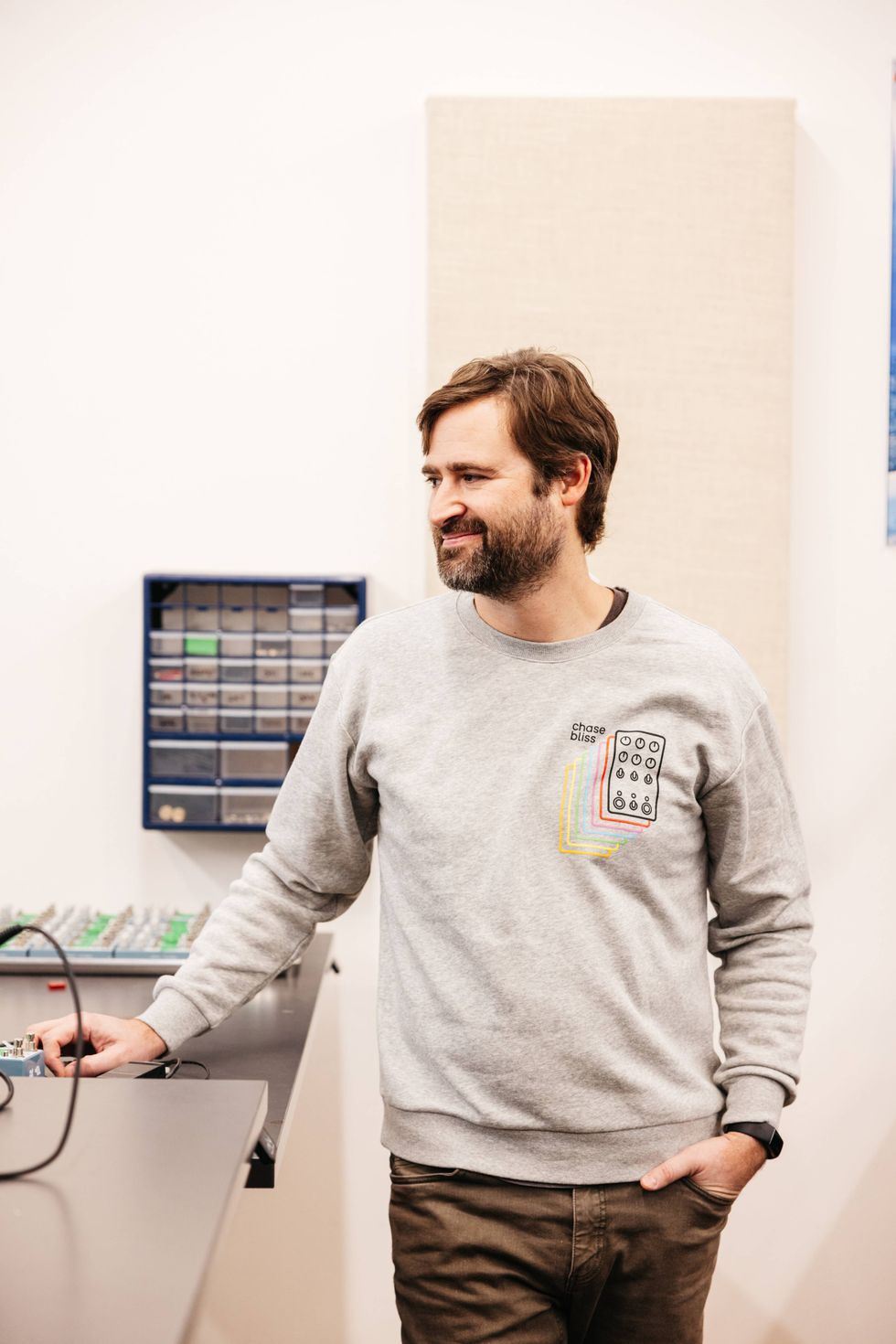
Joel Korte at Chase Bliss HQ in Minneapolis.
All photos courtesy of Chase Bliss
It’s a fair query. These days, Chase Bliss has an esteemed reputation among boutique guitar-pedal brands, lauded for their unique and innovative effects, high-end build quality, and tweakability that gives players virtually infinite possibilities.
At the same time, the brand can be polarizing. User experiences tend to vary. While Chase Bliss products are typically embraced by experimental players, studio geeks, and gearheads who spend hours dialing in a tone that’s just right, the sheer array of features stuffed into each stompbox can be overwhelming for some. Considering Chase Bliss pedals start at $399 and run up to $999, with some discontinued models going for well over a grand on the secondhand market, they’re not an especially easy sell.
So, what’s special about Chase Bliss? It depends what you mean.
There’s the ideology, described by founder Joel Korte as “digital brain, analog heart”—an electrical engineering concept that combines warm analog tones with digital control. There’s the novelty, with several one-of-a-kind pedals that do things that no other pedal does. And there’s the versatility, as Chase Bliss products are likely to reward users willing to make it over their steep learning curves.
“We make a huge effort to offer something new to the sonic landscape,” Korte tells Premier Guitar. “I never wanted to do just the same old thing. People who take a chance on us, they know they’re going on a bit of a journey. Hopefully they’ll be surprised and inspired.”
Passion for Pedals
In 2003, Joel Korte was a college freshman trying to decide what to declare as his major. He spent a lot of that year strumming his purple Stratocaster and fiddling with the on-board effects on his little practice amp, so he emailed some of his favorite gear manufacturers and asked what skills you needed to design audio equipment. They all said electrical engineering, so that's what he declared.
Five years later, though, things were going poorly. After graduating from college, Korte, then 24, settled for a corporate job that he hated, and lacked the motivation to pursue his real passion. A lifelong stutterer, he was going through a flare-up of the speech challenge that was making his life difficult. Above all, he was grieving the loss of his older brother Chase, who had been pursuing an acting career in California when he was killed by a drunk driver on Interstate 40 in early 2007. By his own admission, Joel Korte was headed toward an “unhappy life.”
“People who take a chance on us, they know they’re going on a bit of a journey.”
After taking a year and a half to mourn, Korte remembered how his brother’s approach to life was guided by American writer and philosopher Joseph Campbell’s mantra: “Follow your bliss.” That shook something in the young engineer, reigniting a fire that had been snuffed out.
Korte quit his job, enrolled in grad school, and doggedly pursued a new job at ZVEX Effects. After several emails and phone calls to founder Zack Vex, he landed a part-time gig at the Minneapolis-based workshop. At ZVEX, he learned everything he could about stompboxes—so much so that after four years, he left to start his own business. By 2013, he had developed the prototype for his first pedal and began operating out of the spare bedroom of his apartment in South Minneapolis. He named his new company in honour of his late brother and his ethos: Chase Bliss.
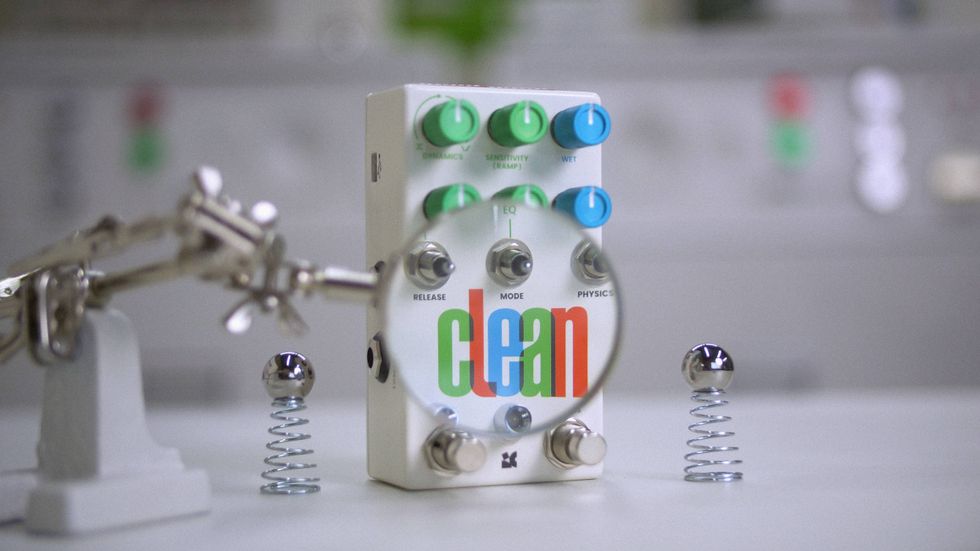
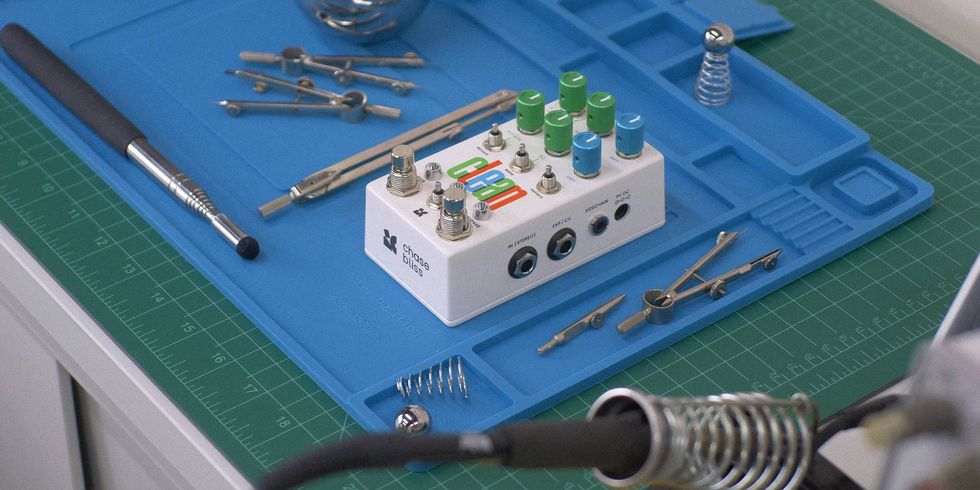
The Chase Bliss Clean Creative Compressor, released in 2024.
Infinite Possibilities
Whenever Korte played on his own or in bands, he found himself wishing the knobs on his effects pedals would go just a bit further, or for an extra switch that wasn’t there. “I wanted to be different,” he says. “There wasn’t that kitchen-sink approach [in other pedals] that I thought there could be. So, I just started to do things the way I wanted, as someone who loves guitar pedals. I wanted to create this blank canvas where someone could have infinite possibilities.”
Before leaving ZVEX, Korte had been put in charge of restructuring the Lo-Fi Loop Junky into a real-time version of the looper’s variable-voltage modulation and degradation. The result was the Instant Lo-Fi Junky, and it hooked Korte on the sound of lo-fi vibrato. By late 2013, he had developed the first Chase Bliss pedal, the Warped Vinyl, a vibrato-chorus hybrid designed to simulate the wavering, fluttering sound of a record that was left out in the sun for too long.
Korte wasn’t concerned with the Warped Vinyl’s marketability, but it was an immediate success, selling more than 500 within the first year. Encouraged by the critical and commercial response, Korte got back into the workshop and developed Chase Bliss’s second pedal, the Wombtone. Introduced eight months after the Warped Vinyl in August 2014, the Wombtone offered vintage, ’70s-style analog phaser tones with highly tweakable digital controls.
With the business taking off, Korte couldn’t keep up on his own (even with his parents’ help). In 2015, he hired his first employee, Zack Warpinski—who now serves as director of operations—and kept things rolling with two new products, the Gravitas tremolo and the Spectre flanger, along with updated MkII versions of the Warped Vinyl and Wombtone.
Over the next three years, Chase Bliss continued to expand its product lineup. The Tonal Recall arrived in 2016, giving players warm, sweet, vintage-style analog delay with digital-control amenities like tap tempo, expression/MIDI control, and patch saving, and tape-like saturation thanks to re-issued versions of the sought-after MN3005 bucket-brigade delay chips. Brothers was introduced in 2017, an overdrive pedal built with two independent JFET/IC analog channels that offered six unique boost, drive, or fuzz circuits in one package.
“I wanted to create this blank canvas where someone could have infinite possibilities.”
In 2018, Chase Bliss added Thermae, another delay that used the same MN3005s as the Tonal Recall but added pitch-shifting interval features so that players could create cascading, rhythmic harmonies. At the same time, they added their first overdrive pedal, the Condor, which also served as an EQ, filter, and preamp boost.
By that point, Chase Bliss had become one of the hottest names in guitar pedals. But that didn’t necessarily mean the business was on solid ground.
Korte and his son Chase—named after Joel’s deceased brother and the company’s namesake—solder together.
Turning Point
In 2019, Korte entered a long development cycle for two ambitious ideas. The first was a Kickstarter-funded collaboration with YouTuber Scott "Knobs" Harper that would eventually become the Blooper pedal, a multi-layer performance looper with a full suite of sound design. The second was a partnership with Benson Amps for a gain pedal called the Automatone Preamp MkII that would combine boost, EQ, overdrive, and fuzz.
As Chase Bliss and its collaborators started working on those pedals, Korte saw a big problem. It would take too long to push the new products through development and onto the market, and revenues from their existing lineup wouldn’t keep them afloat until then. One of the guitar world’s most critically acclaimed and sought-after pedalmakers was quickly running out of cash. “I was looking at the finances and I was like, ‘We're fucked,’” Korte recalls.
What he and his small team needed was something new that they could sell in the interim to fund the ongoing development of the Blooper and the Automatone. At the time, Chase Bliss had recently come out with its first fully digital effect, a reverb called the Dark World that was made in collaboration with Keeley Electronics and Cooper FX. Korte figured they could leverage the work they did on the Dark World into another all-digital offering that could generate interest—and money—while he worked on the Blooper and Automatone.
Chase Bliss linked up with Old Blood Noise Endeavors and Drolo Effects. Only six months later, they’d finalized the Mood pedal, a micro-looper and delay with two channels: one that samples and loops brief moments, and another that offers a full suite of spatial effects that let players stretch, slice, twist, and freeze those moments. The two channels pass audio back and forth to create otherworldly ambiences and weird, wonky soundscapes.
Korte summarizes the development: “You know how sometimes you’ll work so hard on a song and you’ll spend so much time on it? That was the Blooper and the Automatone. And then all of a sudden you’ll write a song in five minutes, and it just comes out of you. That was Mood.”
“The way that I loved to design, with the digital brain and analog heart … that was no longer feasible for us.”
Launched in June 2019, it was an instant hit and became the company’s best-selling pedal—a title it still holds to this day. By 2020, Chase Bliss had managed to push both the Blooper and Automatone to market, along with the CXM 1978 reverb, just in time to enjoy a massive sales boost brought on by pandemic lockdowns. “The direct orders from our website just exploded,” says Korte.
That allowed the company to not only secure its financial position but also expand significantly. In 2022, Tyler Devonald, who'd joined Chase Bliss five years earlier, opened an Amsterdam office with Liz Groshens to handle shipping, repairs, and distribution for European customers; it's since grown to three people. What used to be a one-man operation in a Minnesota basement is now a 23-person employer with a global presence. But the expansion hasn’t been without challenges, and it was Chase Bliss’ presence in Europe that forced Korte to change the way he had been making pedals for over a decade.
Digital Revolution
Two years ago, Chase Bliss arrived at another crossroads. A part used in several of its pedals made them noncompliant with sales regulations in the United Kingdom and European Union. The problem was with the light-dependent resistor, or LDR. A fairly common component in guitar effects, particularly modulators, it gets paired with an LED to form an opto-isolator that changes the level of resistance in an analog signal based on how much light is hitting it.
Since the beginning, that’s how Chase Bliss had achieved its “digital brain, analog heart” designs. By using a digital micro-processor to exert precise control over the LED, which then determined how much resistance the LDR would add to the clean signal, Chase Bliss could achieve smooth, organic-sounding analog tone with all of the versatility of digital mechanics. But the LDRs also contained cadmium sulfide, a toxic substance that’s not allowed to be sold in the UK or EU.
While Chase Bliss assured existing customers that any risk from the material was “incredibly low,” they were forced to discontinue five pedals: the Warped Vinyl, Condor, Thermae, Dark World, and Preamp MkII. For Korte, it meant that after more than 10 years of designing, he had to abandon his signature style. “The way that I loved to design, with the digital brain and analog heart … that was no longer feasible for us,” he says.
By then, Chase Bliss had already introduced a number of all-digital pedals that skipped the banned LDRs, and they quickly pivoted to working with digital potentiometers and voltage-controlled amplifiers (VCAs) to replace the troublesome resistors.
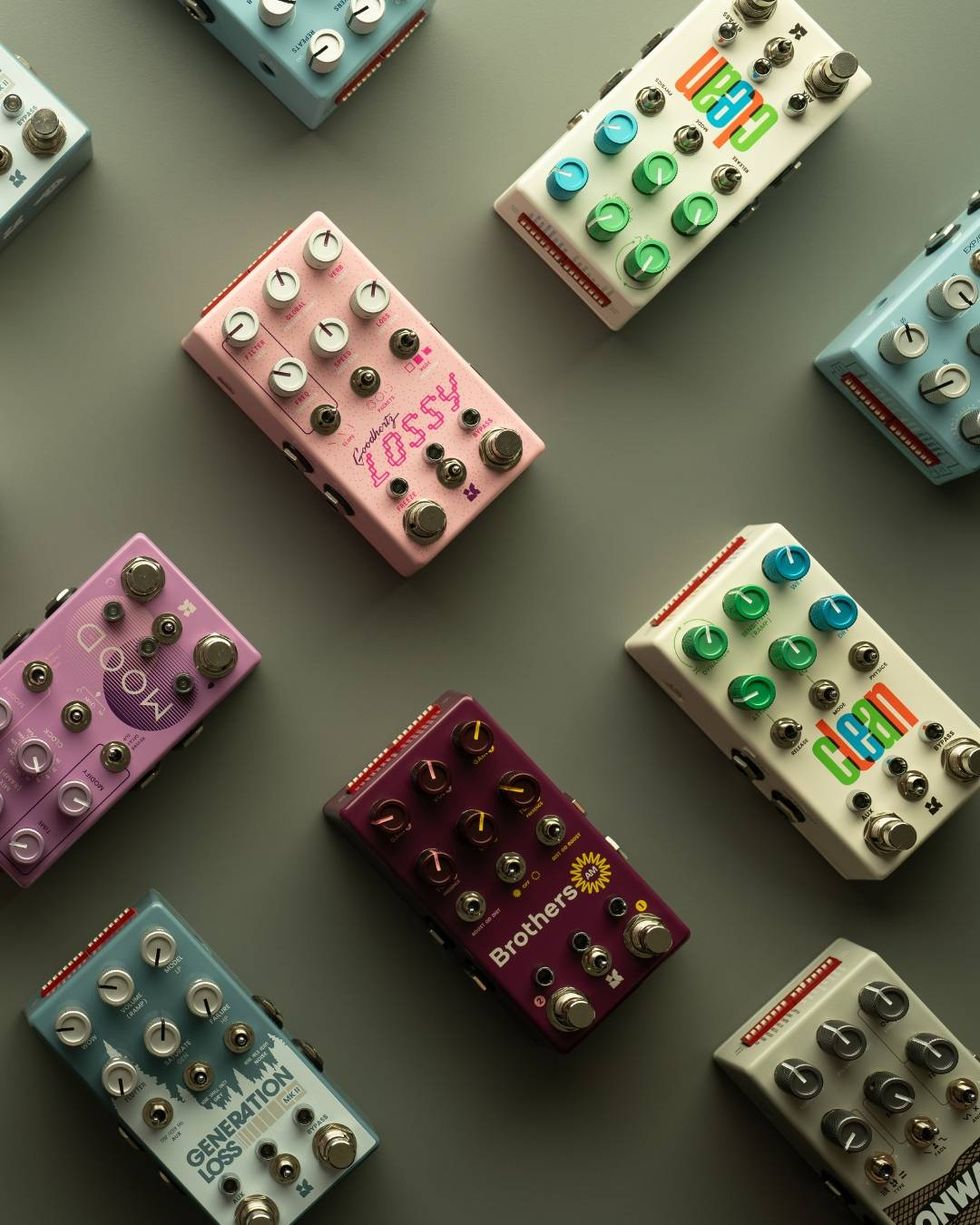
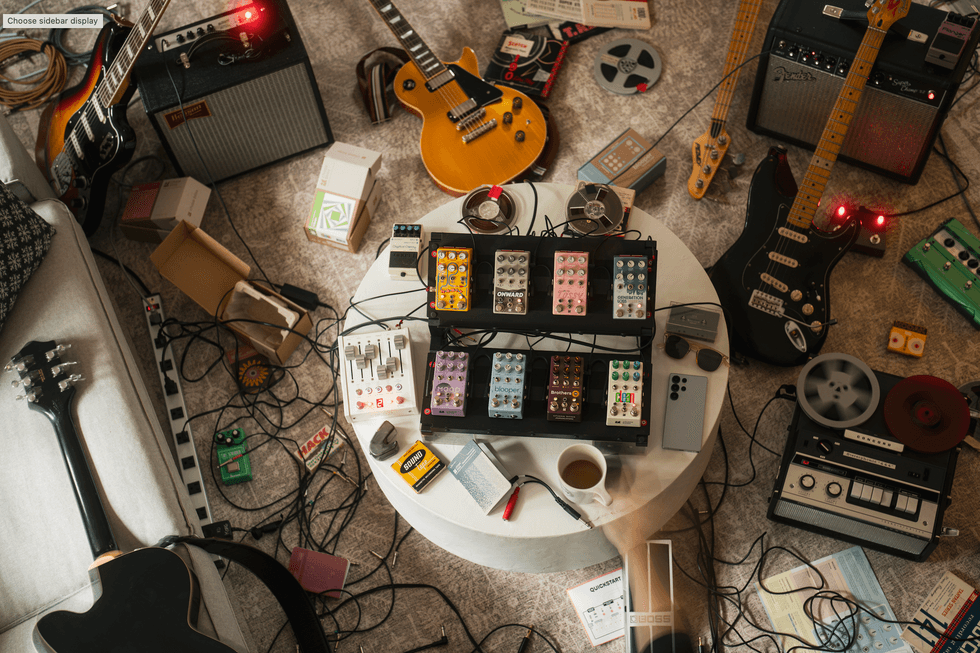
As of the writing of this article, Chase Bliss has a catalogue of nine pedals. That includes the Blooper, Generation Loss, the CXM 1978, the Mood MkII, and the Brothers AM, a collaboration with Analog Man that pays tribute to the latter’s King of Tone dual-circuit analog overdrive. It also features newer additions, among them: Lossy, an audio degradation emulator; Onward, a dynamic sampler pedal; Clean, a 2-stage stereo compressor; and Big Time, a stereo echo collaboration with Electronic Audio Experiments inspired by early-’80s rackmount delays.
Leap of Faith
Thirteen years ago, Korte was headed for an unhappy life and decided to do something about it. Since then, he’s turned a solo venture into one of the most well-known and highly regarded guitar-pedal brands. All these years later, Korte’s eyes well up when he considers how Chase Bliss’ success—and his entire career—stand as a lasting, heartfelt tribute to his late brother.
“I attribute so much of what’s happened to him,” Korte says. “When I had the finite nature of life presented to me in the way that it was when he died, it made me take some risks that I don’t think I ever would have. Back in 2013, I bet the farm, and then I bet the farm again, and then the farm got bigger, and I just kept betting the farm … And it worked out.”
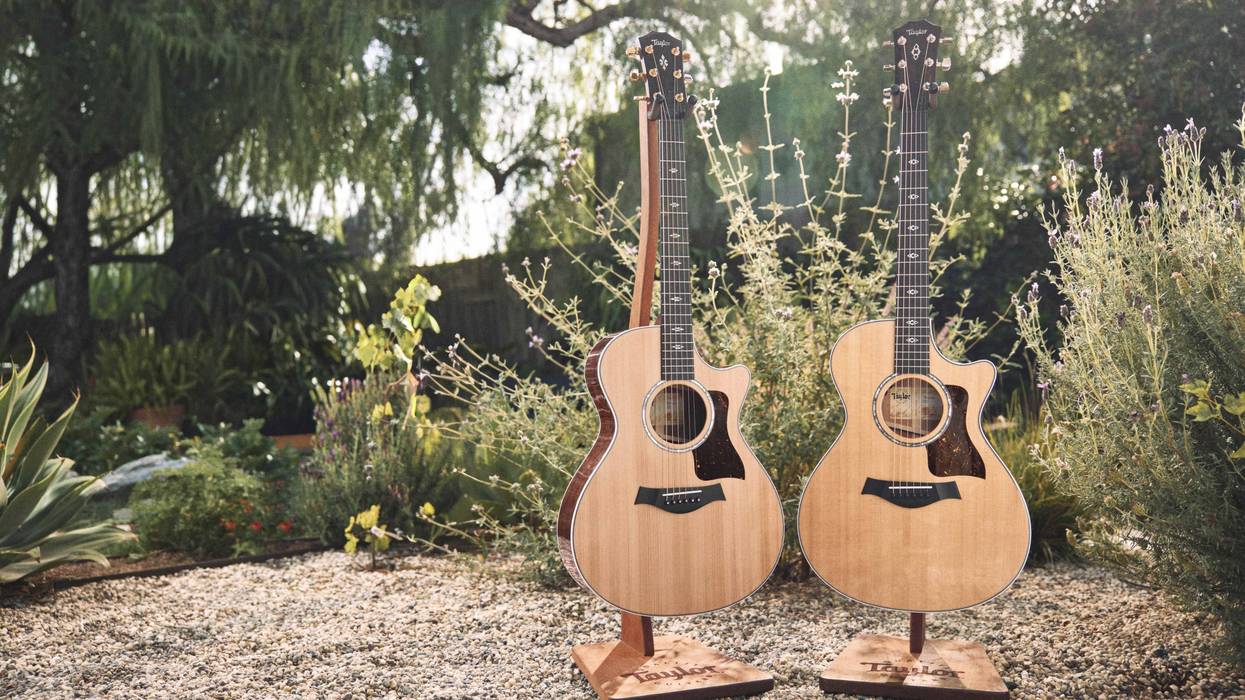
Taylor Guitars continues to evolve the acoustic guitar experience with the introduction of the Next Generation 512ce and 712ce, two new Grand Concert models that bring a powerful combination of tonal character, player-focused innovation and effortless playability to one of Taylor’s most comfortable body shapes.
If you’ve been reading along for all the long years I’ve been writing this column, then you probably know a little something about my kids, co-workers, and friends. That’s the trick for me with writing: Something is going on in my life or rattling around in my head, and I start thinking about connections, mostly with guitars and history.




![Rig Rundown: The Black Crowes’ Rich Robinson [2026]](https://www.premierguitar.com/media-library/youtube.jpg?id=66952027&width=1245&height=700&quality=70&coordinates=0%2C0%2C0%2C0)