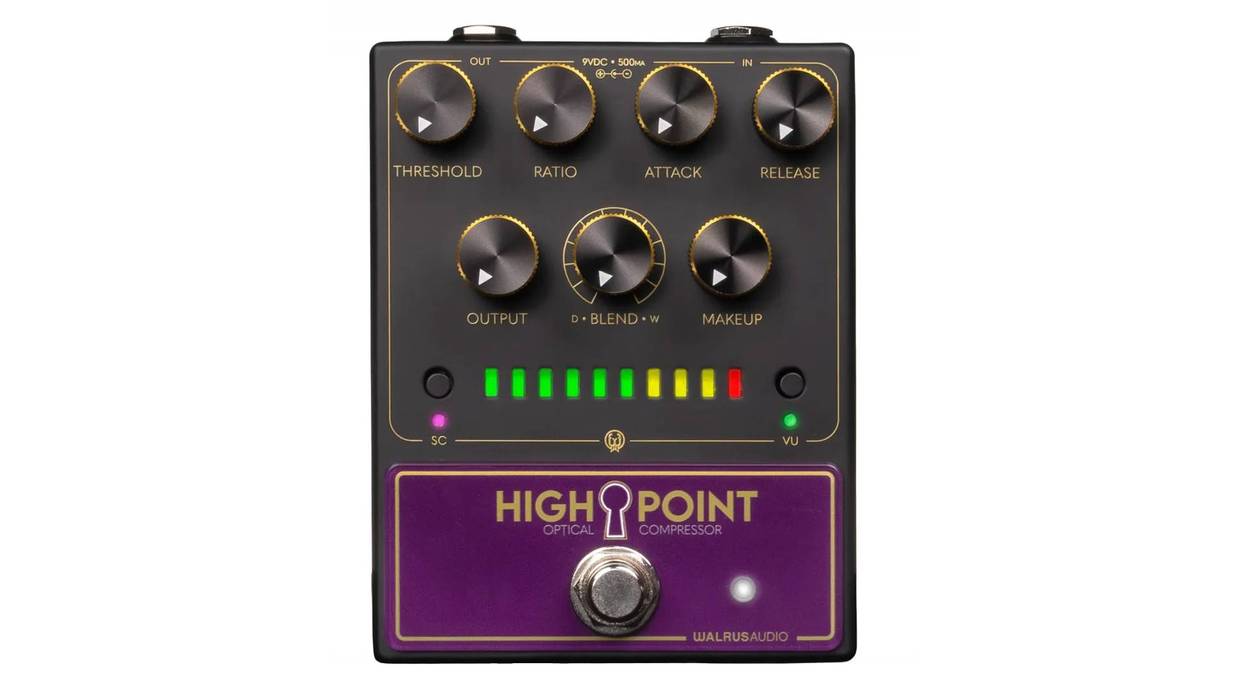
Wampler Pedals announces the release of the Golden Jubilee™, a dual-voice high-gain pedal designed by Brian Wampler.
The Golden Jubilee delivers the punch, feel, and harmonic richness of classic hot-rodded ’80s high-gain amplifiers in a rugged, pedalboard-ready format.
Engineered as a complete gain platform, the Golden Jubilee features two purpose-built, complementary voices: tight, articulate American boutique high-gain and aggressive, saturated British crunch. The channels are designed to operate independently or stack together, providing seamless transitions from defined rhythm tones to saturated, singing lead sounds.
Independent channel controls and intuitive voicing and stacking switches allow players to shape tones quickly without menus or complex switching. The pedal is designed to perform consistently across clean tube amplifiers, solid-state platforms, and digital rigs, delivering reliable amp-like response in any setup.
Key Features:
Two distinct high-gain voices in one pedal — American boutique distortion and British crunch, voiced to complement and stack
Complete gain solution — rhythm, lead, and stacked high-gain tones in a single unit
Independent channel controls with simple voicing switches
Consistent amp-like feel across tube, solid-state, and digital platforms
Premium U.S.A. construction built for long-term reliability
The Golden Jubilee is built for players who require professional-level performance, flexibility, and durability in a streamlined format.
I love to learn about the history of an instrument when I am tasked with creating something new. Many people are unaware that I make over 45 different types of stringed instruments. When I say that, I’m quick to add that although I make six or more styles of steel-string or classical guitars, these do not count toward that number of 45.
The Irish bouzouki, like this one built by Manuel Delgado, is descended from Greek roots, via a trip to a luthier in Kent, England.
When I research instruments, I am often taken down a historic trail that will tell me about the culture of the instrument. One such instrument led me to learn about the connection between Irish and Mexican culture. Not only do these cultures share the Catholic faith, they both faced colonialism and fought for cultural resilience. There was also a large immigration of Irish people who went to Mexico, especially in the years after the Irish Potato Famine. During the 1846-1848 war between Mexico and the United States, many Irish defected to join the Mexican army, viewing it as a Catholic versus Protestant war. Together, they formed the Battalion of St. Patrick (Batallón de San Patricio).
With that history in mind, I thought I would share my history of building the Irish bouzouki, an instrument I was introduced to by a client who wanted one custom-made. I named the model the “Jeannine,” after my Irish-American mother-in-law. (Did I mention my wife is of Irish descent? Mooneyham … Pretty darn Irish.) Most know the Irish bouzouki in its teardrop form. To give an idea of the size of the instrument, think mandolin, then an octave-mandolin, then a cittern, and then the Irish bouzouki.
However, the instrument did not evolve from the mandolin family. It was the Greek bouzouki that gave rise to the Irish bouzouki. In the 1960s, the Greek trichordo was introduced to the Irish. Originally with a bowl back shape and three courses, it took a different form when a local Irish folk musician changed the bottom course strings to two individual strings and then later brought the instrument to a well-known luthier in Kent, England. There, it received a custom-made four-course, three-piece, partially staved back, giving birth to the Irish bouzouki and its new shape.
The Irish bouzouki has a distinct sound, and once you hear the instrument isolated from other instruments, you can pick it out much more easily in traditional folk, Celtic, or English music. Its distinct clear, bright sound is often described as “jangly,” but for anyone unfamiliar, I describe it more as a bassy drone blended with a mandolin-style tone.
When I was asked to custom-build a bouzouki, I wanted to do something unique and decided to make two models, each slightly different from the other, and very different from the teardrop style most commonly known. I built both with a double Florentine cutaway, Palo Escrito sides and back, Honduran mahogany necks, African ebony fingerboards, and Spanish cedar tops. On one of the models, I wanted to blend visuals that would capture both cultures using lush green inlays and abalone shell around the rosette, while blending in the bright colors in the center of the rosette and on the purfling.
Visual design aside, the tone and sound I was building for was a warmer, softer attack with the mids being highlighted, so it would be neither bass- nor treble-dominant. The bracing style and wood combinations created a rich tone with a unique warmth, and I know my clients were happy with the end result. It is difficult saying goodbye to a new instrument, but the bouzouki was one I especially wish I had more time with, because I enjoyed playing it for the short time I had with it.
Hopefully I will get around to building one of these again, but one of the challenges of building in the old-world technique (as opposed to having others make the instruments for you and just slapping your name on it for the credit) is that there isn’t much time outside of the orders for extra builds.
So for now, somewhere in the world live two custom Delgado “Jeannine” Irish bouzouki models that blend my Mexican heritage with my wife’s Irish heritage and carry my mother-in-law’s name. My “Irexican” (Irish/Mexican) daughter’s wish for you is, “May your pockets be heavy and your heart be light.”
Tom Bukovac is not a guitar player. Well, technically, he is—but more so, he’s a musician who plays guitar. He’s someone who always strives to make the best musical choice above all else. Bukovac, a first-call Nashville session guitarist and four-time winner of the Academy of Country Music Guitar Player of the Year award, has played on over 1,200 sessions for artists such as Taylor Swift, Keith Urban, and Sheryl Crow, while also being called upon to tour with heavyweights like Joe Walsh and Vince Gill.
Bukovac has gained legions of fans via his YouTube channel (@501chorusecho) where he regularly posts his Homeskoolin’ lessons. There, he imparts nuggets of musical wisdom with humor via extended segments of playing, proving him to be a seemingly endless font of creativity—with a killer collection of guitars.
His latest release is 2024’s In Stereo, an album of original music he co-headlines with fellow Nashville session wizard Guthrie Trapp.
Chords Are the Key
One of Bukovac’s superpowers is his profound understanding of chords, which informs both his lead and rhythm playing. Watch how he uses organ-style voicings to play through a blues in G.
Ex. 1 is inspired by his playing here. While he’s thinking G7 for the entirety of the first four bars, note how he employs various three-note chord fragments, including F and C triads—but not to create a chord change. Think of it more as splashing various “colors” over these four bars of G7. For example, the F triad (F–A–C) brings the b7 (F), 9 (A) and 11 (C). These first three examples are played fingerstyle.
Ex. 1
Bukovac often plays solo in his videos. But even when he’s improvising with single notes, he often deftly uses his fret-hand thumb (usually) to play bass notes that imply the chords he’s hearing in his head. Here, he adds just a few subtle thumps to propel the rhythm as he solos.
Ex. 2 explores similar territory. Be sure to palm-mute the bass notes to keep them nice and punchy. Note your fret-hand thumb should fret all of the notes on the 6th string except the final one, where your 3rd finger is a better choice.
Ex. 2
Bukovac is an encyclopedia of chord voicings, and he is remarkably musical in how he composes with them. This video is over seven minutes of inspired, beautiful music. There’s so much here to explore, even if you just randomly skip around.
Ex. 3 is a variation on his intro here—just simple seventh chords, but voiced in a unique way. Note how the melody clearly sings out, being so far from the accompaniment. There are no thirds in any of these chords; you can alternately think of them as power chords with melody notes on top.
Ex. 3
Grab Yer Pick
Bukovac is equally skilled using a pick. In this video, he’s employing hybrid picking—alternately or simultaneously using the pick and fingers.
Ex. 4 begins in the key of E, then borrows from E minor for the final two chords. In measure three, fret the down-stemmed notes with your middle finger, executing the slides with your pinky.
Ex. 4
Now, for something completely different, as Bukovac’s got a wide range of styles in his bag, here he shows his country-style pickin’ prowess.
Throughout his solo, over F7 throughout, Bukovac again keeps things interesting, here by employing different textures. Played with your pick, Ex. 5 travels from triads to dyads to single notes, ending with some death-defying open-string pull-offs. Be sure to pick close to the bridge for those to give ’em extra bite, and don’t forget the slapback echo.
Ex. 5
In the first two bars of the previous example, Bukovac uses Dm and Cm triads over F7. Let’s use some Bukovac-style creativity to see how we can take this knowledge a step further. You likely already know that, when soloing, you can use the D minor pentatonic scale (D–F–G–A–C) over F7 — remember it’s the same as F major pentatonic (F–G–A–C–D). But how about using the C minor pentatonic scale (C–Eb–F–G–Bb) over F7? The rule of thumb is you can play the minor pentatonic scale a fifth above the root of a dominant seventh chord. Ex. 6 demonstrates with a Bukovac-style lick. Note that the C minor pentatonic scale brings into play the F7 chord’s 5 (C), b7 (Eb), root (F) and 9 (G). The phrase colorfully touches upon C Dorian (C–D–Eb–F–G–A–B) by including an A, the 3 of F7 at the end of bar 1, as well as a D, its 13, at the end of bar 2.
Ex. 6
Bukovac is especially expressive in the way he bends. In this video, he’s executing two half-step bends simultaneously, using the pick.
Ex. 7 is a similar phrase, and, of course, these bends need to be in tune. If this proves to be challenging, the thing to do is simply slow things down. Bend by turning your wrist only, keeping your fingers stationery as it turns. If that doesn’t feel comfortable, try pulling both strings towards the floor. Tricky….
Ex. 7
Next, over the same groove, Bukovac uses his pick-hand index and middle fingers to create a melody over an open D-string drone. Ex. 8 explores similar territory; execute the final bend by pulling the 3rd string towards the floor to allow the open 4th string to continue to ring.
Ex. 8
Practice Creativity
Like so many of his longer videos, here, Bukovac—off the top of his head—continually finds new musical ideas, taking time to explore each one.
Ex. 9 is based on another idea from the same video. Note the final two examples are played with the pick.
Ex. 9
As Bukovac does, let’s create a couple of simple variations on Ex. 9,as demonstrated in Ex. 10.
Ex. 10
Finally, inspired by Bukovac’s creativity, try exploring your own by simply taking time to fool around with the previous two examples. Don’t think too much. Just start playing, and you’ll undoubtedly discover some brand-new ideas of your own.
Interscope Records today announces the release of U2 - Days Of Ash, a brand new standalone 6-track EP from U2. Out now, listen HERE. Watch lyric videos HERE.
In advance of a new album in late 2026, the U2 - Days Of Ash EP is a self-contained collection of five new songs and a poem - "American Obituary," "The Tears Of Things," "Song Of The Future," "Wildpeace," "One Life At A Time," and "Yours Eternally" (ft. Ed Sheeran & Taras Topolia) - an immediate response to current events and inspired by the many extraordinary and courageous people fighting on the frontlines of freedom. Four of the five tracks are about individuals – a mother, a father, a teenage girl – whose lives were brutally cut short. A soldier who’d rather be singing but is ready to die for the freedom of his country.
“It’s been a thrill having the four of us back together in the studio over the last year… the songs on Days of Ash are very different in mood and theme to the ones we’re going to put on our album later in the year. These EP tracks couldn't wait; these songs were impatient to be out in the world. They are songs of defiance and dismay, of lamentation. Songs of celebration will follow, we’re working on those now… because for all the awfulness we see normalized daily on our small screens, there’s nothing normal about these mad and maddening times and we need to stand up to them before we can go back to having faith in the future. And each other.
“If you have a chance to hope it’s a duty…” is a line we borrowed from Lea Ypi.
A laugh would be nice too. Thank you.”
Bono
“Who needs to hear a new record from us? It just depends on whether we’re making music we feel deserves to be heard. I believe these new songs stand up to our best work. We talk a lot about when to release new tracks. You don’t always know… the way the world is now feels like the right moment. Going way back to our earliest days, working with Amnesty or Greenpeace, we’ve never shied away from taking a position and sometimes that can get a bit messy, there’s always some sort of blowback, but it’s a big side of who we are and why we still exist.”Larry Mullen Jr.
“I’m excited about these new songs, it feels like they’re arriving at the right time.”
Adam Clayton
"American Obituary" speaks to the shocking event the world witnessed in Minneapolis, Minnesota on January 7th, 2026 where Renée Nicole Macklin Good, an idealistic mother of three, was shot at almost point-blank range while exercising her right to peacefully protest, a right that is protected under the First Amendment of the United States Constitution. This unarmed mother was then described as a “domestic terrorist” by a government who will not withdraw the description even though they know it’s not true. Or mount a proper enquiry into what happened for the sake of everyone involved.
"The Tears Of Things" borrows its title from a book by Franciscan friar Richard Rohr, which examines, through the writings of the Jewish prophets, how one can live compassionately in a time of violence and despair. The song imagines a conversation between Michelangelo’s David and his creator… where the young man with the sling and five smooth stones refuses the idea that he has to become Goliath to defeat him... he’s also revealed as having heart shaped pupils half a millennia before the heart shaped emoji, which puzzles visitors at the Galleria dell’Accademia in Florence, Italy, to this day.
The star of the lyric, Sarina, in "Song of the Future" honors the life of 16-year-old Sarina Esmailzadeh, one of thousands of Iranian schoolgirls who took to the streets as part of the Woman, Life, Freedom movement in 2022. These protests were sparked by the death of Jina Mahsa Amini, a young Kurdish-Iranian woman who died in Tehran on September 16th that year from injuries sustained following her arrest by the so-called "morality police" for not wearing a hijab in accordance with government standards. Seven days later, Sarina was beaten by the Iranian security forces and died from her injuries, the regime claiming she killed herself. The song aims to capture Sarina’s free spirit, the promise and hope of her short life.
The Days of Ash EP includes a reading of "Wildpeace" - a poem by Israeli author and poet Yehuda Amichai - by Nigerian artist Adeola of Les Amazones d'Afrique, with music by U2 and Jacknife Lee.
"One Life At A Time" is written for Awdah Hathaleen, a Palestinian father of three. A nonviolent activist and English teacher, Awdah was killed in his village in the West Bank by Israeli settler Yinon Levi on July 28th, 2025. Awdah was a consultant on the Oscar-winning documentary “No Other Land,” made by Palestinians and Israelis. At his funeral, one of the directors, Basel Adra, spoke of the slaughter of his friend and the experience of Palestinians being erased “one life at a time.” U2 took that line and turned it around to suggest that a peaceful resolution will be wrought “one life at a time.”
"Yours Eternally" sees Bono and The Edge joined on vocals by Ukrainian musician-turned-soldier Taras Topolia, as well as Ed Sheeran. In the spring of 2022, following Russia’s invasion of Ukraine, Bono and The Edge traveled to Kyiv to busk in a metro station at the invitation of President Zelensky. A couple of days prior to that, Ed connected Taras Topolia, and by extension his band Antytila, with Bono. Bono, Taras and The Edge met for the first time on that subway platform. They’ve been friends ever since. Taras is the inspiration for "Yours Eternally," a song written in the form of a letter from a soldier on active duty with a bold, mischievous spirit to match Ukraine’s.
"Yours Eternally" will also be proudly accompanied by a short 4½ minute documentary film directed by Ukrainian cinematographer and filmmaker Ilya Mikhaylus, that will be released on Tuesday, February 24th - the 4th anniversary of Russia’s invasion of Ukraine. Shot in December 2025 while Mikhaylus and his crew were embedded alongside the 40,000-strong Khartiya Corps, the film captures the extraordinary daily lives of Alina and her fellow soldiers fighting on the frontlines of the war.
U2 Days of Ash EP is accompanied by the return of Propaganda as a one-off digital zine, with a limited-edition print run. Forty years ago, in February 1986, the first issue of Propaganda dropped through the letterboxes of U2 fans around the world. Aspiring to match other fan magazines at that time, Propaganda was born out of the punk-era D.I.Y. zine culture that embraced attitude, ideas and dialogue. In the spirit of those early issues, this standalone EP will be accompanied by a one-off limited edition print run plus digital e-zine drop of Propaganda titled "U2 - Days Of Ash: Six Postcards From The Present… Wish We Weren’t Here." This 52-page special publication accompanies the release of the Days Of AshEP and includes exclusive interviews with "Yours Eternally" film director Ilya Mikhaylus and film producer Pyotr Verzilov, as well as musician and soldier Taras Topolia. It also includes song lyrics; notes from the four band members; plus a Q&A interview with Bono. Read Propaganda HERE.
Question:What record are you most looking forward to this year?
Joe Sutkowski
Dirt Buyer/This Is Lorelei
A: To be so honest, I don’t really know very much about upcoming releases, but I do know that Gorillaz is putting out a new record and I hope that it’s good. The singles have been pretty cool. The thing that I appreciate about Damon Albarn is that he’s a serial collaborator and just kind of does whatever he wants, and that’s Gorillaz. It’s always been his weird version of pop music that nobody else can touch.
Sutkowski’s extremely unique “Jesus Strat,” which he snagged off of Craigslist in New Jersey.
Obsession: Right now I’m totally obsessed with old Pokémon cards. I have a pretty huge collection at this point. I have binders full of slabs and top-loaders; some of my favorite cards from the vending series from 1998. The art is mostly all crudely drawn and looks like it was made by a child. There’s this Onyx (a big and long rock-snake Pokemon) card where he’s crying and taking refuge from a storm inside of a cave. There are so many cool cards like that and I’m so passionate about it. Scalpers are ruining collecting, but you can still find affordable gems.
Photo by Eric Lee
Augusta Koch
Gladie
A: My most anticipated record this year would have to be a new rumored release from Aldous Harding. It’s been four years since her last release, Warm Chris, which was a masterpiece in my book. Her albums are always such inspirations to me. She builds these incredibly beautiful sonic worlds you can dive into. Fingers crossed these rumors are true.Obsession: My current obsession these days is watching videos on projection mapping and trying to figure out how to do it, and staying in on weekends working on all my little projects.
Jom Grana
Reader of the Month
A: I don’t really stay up to date on upcoming releases, plus I have my own bands (Mindless Pop, Warpten, Irrevocable) busy trying to record and release hopefully this year, too. But! I do know that most of the bands I’ve been listening to since forever are still alive and kicking: Streetlight Manifesto are dropping The Place Behind The Stars on June 24 so I’m hoping this doesn’t jinx them, and while a new RX Bandits record isn’t coming anytime soon, their vocalist Matt Embree is releasing his solo album Orion this March 7.
Obsession: HBO Max’s The Pitt.
Richard Bienstock
Editorial Director
A: The new Black Crowes album, A Pound of Feathers. I’m a day-one Crowes fan. Sure, they work within a very specific lane, but they do it with overwhelming personality. You can hear the Stones, the Faces, and a dozen other classic-rock touchstones, but that kind of swagger and soul can’t be carbon-copied. You either have it or you don’t. The Robinsons have it. I was genuinely psyched when they got back together (again!) a few years back, and thought 2024’s Happiness Bastards was a strong, if somewhat straight-ahead, comeback. Even better was last year’s Amorica reissue, a deep dive into what’s arguably their creative peak.
Based on the two songs they’ve released from A Pound of Feathers so far—which dropped the day I’m writing this, actually—I’m fully in. “Profane Prophecy” in particular opens with a killer Keith Richards-style riff, features some smoking slide guitar, and finds the band sounding looser and more playful (those call-and-response backing vocals) than they have in years. Plus, they always kill it onstage.
Obsession: Billy Corgan’s The Magnificent Others podcast. Corgan as a host, like Corgan as a musician, is very much a love-it-or-hate-it proposition. I love the music, and I think I love the podcast, too. Yes, he sometimes dominates the conversation, and yes, almost anything a guest says somehow ends up looping back to his own experiences—but the upside is a run of surprisingly great, weird, and revealing conversations. Steve Vai, Vernon Reid, and particularly Dale Bozzio, were excellent. But so were Chazz Palminteri, Corey Feldman, and freakin’ Carrot Top. It’s a wild mix, and absolutely worth an hour or so of your time.