Royal Bloodreleased a new track “Swallow the Bomb” alongside an exclusive interview with Zane Lowe. This is the second track to be revealed from their highly anticipated new album Dead Companyout November 13 via Warner Records.
Mile End Effects does not do “subtle.” From art to enclosure to audio, Montreal builder Justin Cober’s pedals make big, bold statements. Even against a lineup of effect units that look and sound like Cold War-era machines of destruction, his latest creation, the Sofort, Si Fort, might just be the most devastating yet: a two-in-one design that combines a Sovtek Big Muff and Ampeg Scrambler elements.
Jolly Green Giant
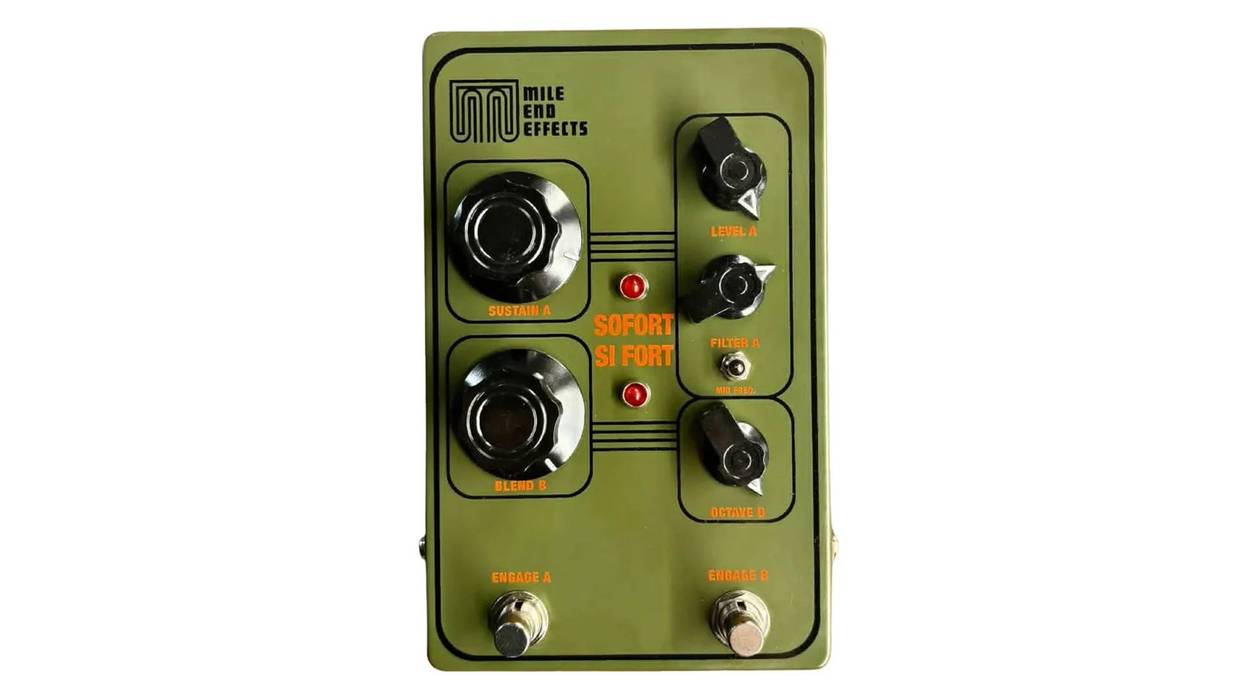
Cober has demonstrated before that the visual aesthetic of his products is important enough that pedalboard-friendliness does not factor into his design decisions. Not surprisingly, this pedal is comparatively mammoth and beautiful. The giant, army-green slab is deliciously retro and Soviet, from its crisp screenprint art and font (handled by Tristan Lacombe, of Montreal psych-rockers Population II) to its chunky Pultec EQP-1-style knobs. (The Sofort, Si Fort continues the sharp orange/olive green color contrast introduced last year on Mile End’s Pique.) In a cultural moment obsessed with optimization at the expense of good ol’ fun, it’s heartening to behold a pedal that exists confidently on its own terms.
Each fuzz circuit has its own footswitch and controls. Section A is the green Russian Big Muff-style fuzz, with knobs for sustain (gain), level (volume), and filter (tone). A three-way switch just below the filter control toggles activates a mid-frequency bump. Paired with the filter knob, it unlocks drastically different EQ emphases that cover ground beyond simply making up for a Sovtek Big Muff's mid-scooped voice.
The B section is the Scrambler-style circuit, which is controlled with two knobs near the pedal’s bottom: blend and octave. Turned fully counterclockwise, octave allows just a hint of crispy harmonic content. At maximum, it shrieks and careens toward full ring-modulated madness. Blend lets you adjust exactly how much of that madness you want prickling the Muff circuit’s smooth-edged thundering. Each effect can be engaged independently. The only potential downside in the layout is that the chicken-head knobs for tone and level in the A section touch at certain settings. Just take care when you’re turning.
Immediately, and So Loudly
While two-in-one pedals are far from novel, the tones contained in these two circuits are so radically different that it’s almost perplexing to hear them emerge from the same pedal. The name Sofort, Si Fort combines German and French words meaning “immediately” and “so loud” and the pedal’s output is both of those things. As imposing as the Sofort, Si Fort’s physical stature is, it’s dwarfed by the enormousness and mass of its sounds.
Within seconds of plugging in and tweaking, I was conjuring Sunn O)))-worthy waves of low-mid bliss, and lively, whirling overtone chaos. The Green Sovtek Big Muff variant is celebrated for its bass presence, and Cober made sure that quality is preserved in the Muff-style circuit here. Engage the A section, and you’ve got a soft-edged, earth-shaking fuzz, with streaks of texture and graininess. The Scrambler-style section gouges and slashes at these massive low-end couch cushions. If you keep the octave low and the blend maxed out, the higher harmonic content will subtly scratch up your signal. As you crank the octave up, though, you'll eventually reach ring-mod meltdown. Utilizing your guitar volume knob at these settings is great fun, and uncovers all sorts of additional textures and tones.
I’m trying not to be too fawning here, but the combination of the smooth, enveloping Muff tones with the jagged yelp of the Scrambler is positively blissful. For me, it blows the RAT-into-Muff combo out of the water in terms of texture and harmonic possibility.
The Verdict
If you’re looking for low-end fuzz authority that never loses its fangs or clarity, and can reach more unusual highs, the Mile End Sofort, Si Fort is the ticket. There is a price to be paid for this much fun—it’s a very noisy pedal. But, like, duh? As we said, subtlety is not the goal here, and players who understand this will extract endless pleasures from the Sofort, Si Fort—which, at $213, feels like a steal.
5x GRAMMY® Award-nominated guitar legend Joe Bonamassa and Sixthman, the leader in festivals and music cruises for more than 25 years, have announced a second northern edition of their world-famous blues-rock celebration, Keeping the Blues Alive at Sea Alaska II, sailing September 14-21, 2027, from Seattle, WA to Juneau, Skagway, Glacier Bay, and Victoria, BC, aboard the beautiful Norwegian Jade. Fans are urged to sign up for the presale now at www.bluesaliveatseaalaska.com to secure a cabin on this highly anticipated Alaska return.
The InterFax Harmonic Percolator HP-1 circuit revealed its magic to me over a long period of time. Like just about everyone, I’ve never played an original. And when I finally encountered a reproduction at a recording session, it was the wrong pedal at the wrong time. I walked away from it vaguely disappointed and moved onto other things. Luckily for me, though, I came to be a colleague of Premier Guitar editor Joe Gore. Joe’s simple guidance for navigating the Harmonic Percolator lit the way to loving the circuit.
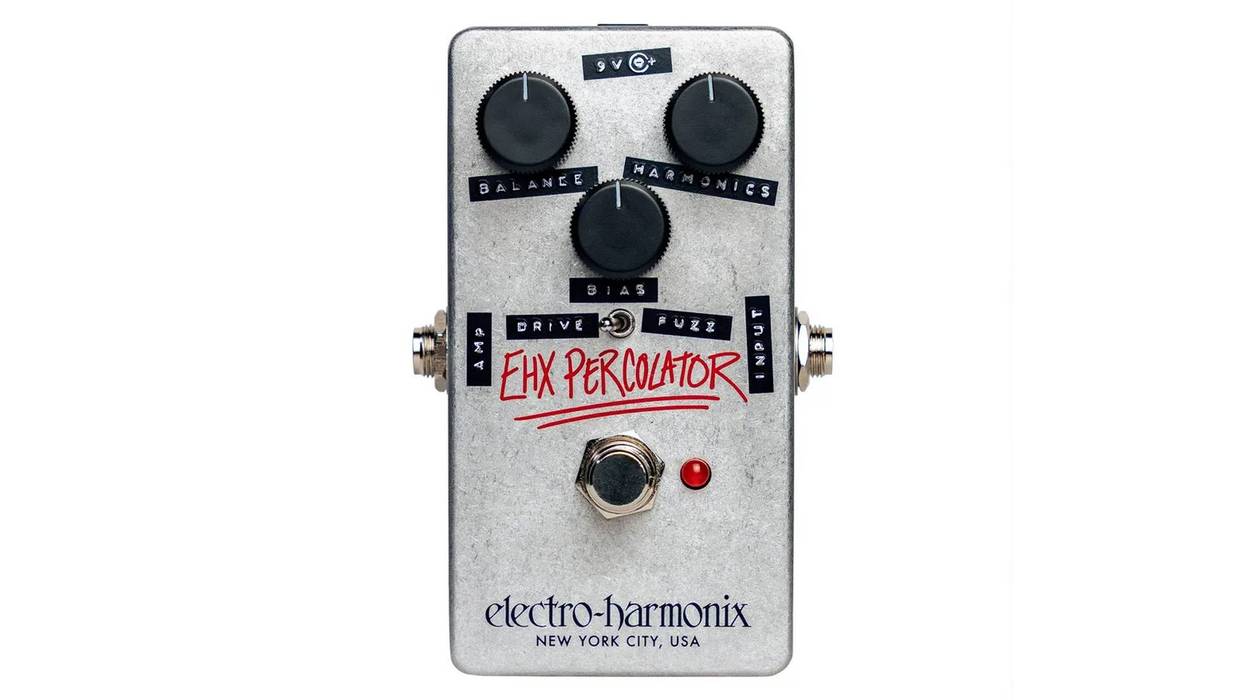
I mention this journey because I think a lot of readers experience a crooked path to grasping the Harmonic Percolator. And one thing the new Electro-Harmonic EHX Percolator does well—apart from kicking up a glorious racket—is make the HP-1 a little more accessible. Interestingly, it accomplishes this by adding another layer of options in the form of a hard-clipping fuzz mode and a bias control.
Bubbling Over
The original HP-1’s mysteries live as much in its fundamental voice as in the interplay between a guitar and its controls, which number just two. The drive and distortion that the pedal generates aren’t really the creamy, hot-tube-saturation sort. And though the harmonics and overtones it produces are indeed lively, the basic voice has a dry, husky edge. Even the compression it imparts can be unusual, in that it seems to strip less oxygen from the signal. The EHX Percolator captures these fundamental, and sometimes alchemical, aspects of the HP-1’s voice.
The EHX’s controls can be less than intuitive. The balance and harmonics knobs—the only ones on an original HP-1—are effectively a master volume and an input gain control (which functions more or less like a guitar volume knob). There is no dedicated gain or tone control. This makes the bias control on the EHX Percolator an extra-cool addition—it alters the distinctive distortion flavor in ways an original HP-1 cannot, and in a manner that a tone or gain control never would. Situating the bias control at noon makes the EHX Percolator sound a lot like a basic HP-1, and a few degrees to either side of noon gives you interesting variations on that core tone. Turning the knob further counterclockwise, however, adds an almost tweed Deluxe-like saturation that can fracture in cool, chaotic ways. At more extreme clockwise reaches, the bias control kicks up busted-speaker scuzz dust and gnarly, tattered voltage-starved effects that verge on fuzzy.
The Hidden Hand And that leads us to another bonus feature the EHX Percolator offers—the drive/fuzz switch. The drive mode lifts the clipping section. Curiously, though, the drive mode often sounds closer to the HP-1 voice than the fuzz side. At bias settings that align with the original HP-1 voice, the clipping doesn’t add much to the pedal’s personality. In fact, I’d argue that it has a flattening effect that strips away the drive mode’s most alluring complexities. Introducing unusual bias settings brings the fuzz more alive, though. And that angular huskiness at the Percolator’s core can, at many bias settings, lend focus to cracked and deviant fuzz tones. These, in turn, can sound fantastic when fed to another sweeter gain source.
The Verdict The EHX Percolator, like its inspiration, is an idiosyncratic thing. But for $99, it’s a crazy-inexpensive and super-cool way to extract yourself from a distortion tone rut. It’s exceptionally responsive to guitar volume and tone input as well as picking dynamics, which stretches its vocabulary even further. For the right player it can be a transformative addition to a stale old gain chain.
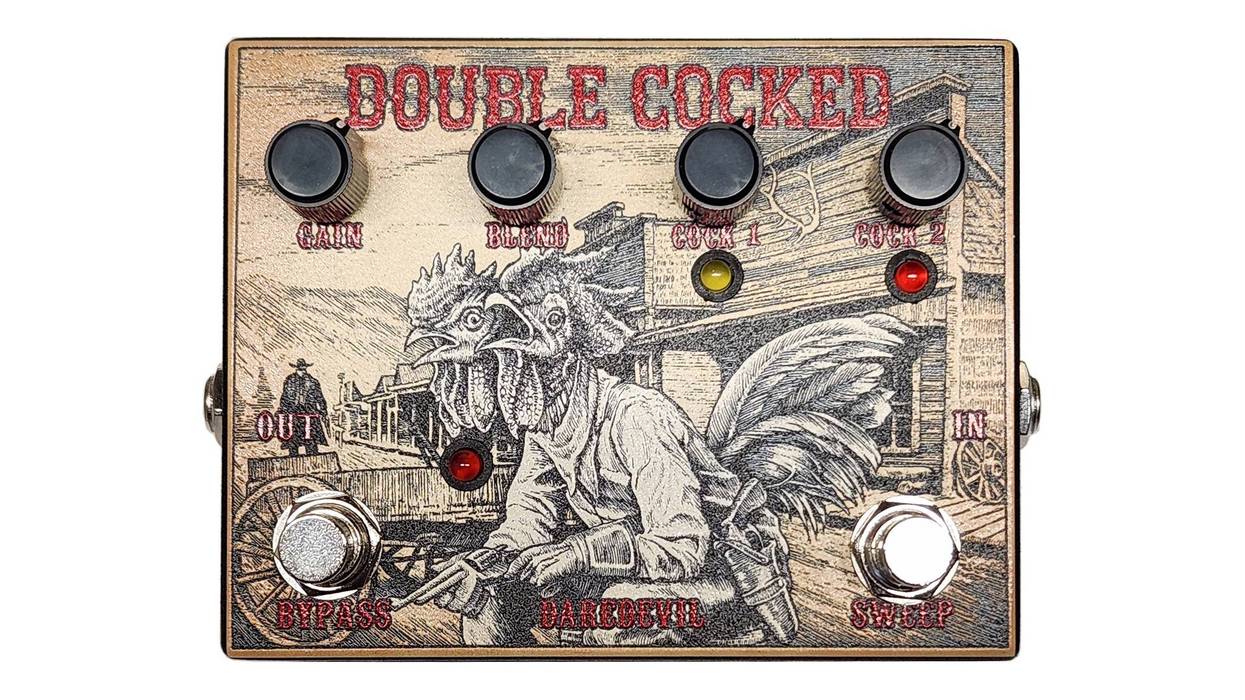
A lot of players spin magic and craft signature tones from a cocked wah. (For those that don’t know, the cocked wah sound is that honking, mid-rangey, filtered tone that you get when you park a wah pedal at a specific angle and leave it there to do its dirty work.) Frank Zappa did it. Mick Ronson did it. So did Michael Schenker. And for the last decade, Matt Pike of High on Fire and Sleep—a man whose entire tone philosophy seems to be “louder, and also weirder”—used various versions of Daredevil’s Atomic Cocked circuit to do that job.
Tucked onto Pike’s board, which is otherwise anchored around crushing sustain and volume that could reasonably be classified as a structural hazard, the new Double Cocked does specialized work. But it’s impressively powerful by itself. The Double Cocked evolved out of Daredevil’s Atomic Cocked, but the functional mission is the same. It’s essentially a wah filter with two fixed, foot-switchable filters. Each filter sweeps a wah-like frequency range and can be set anywhere along that curve. So, you get two cocked-wah personalities, living in one pedal, ready to alternate between traditional rhythm and lead voices—or much less conventional combinations—all without crouching down to twist a knob mid-riff or searching through the sweep of a wah.
Food for Filters
Were the Double Cocked simply two filters, the pedal would be tons of fun. But here, the filters feed into a gain stage that adds dirt and a genuinely useful boost for solos. A FET boost follower does additional post-filter heavy lifting, which makes the Double Cocked plenty powerful without any assist from fuzz, distortion, or a giant stack. A blend knob at the center lets you dial in exactly how much filtered wah signal gets folded into that boosted output, which can be anything from a subtle EQ nudge to what Daredevil describes (quite accurately) as fully saturated Ronson, Schenker, or Slayer-adjacent territory. It may sound simple, but the Double Cocked adds real character and range. You can use it to add subtle peakiness to a solo, or to sound like you’re actively trying to injure your amplifier.
“You can use it to add subtle peakiness to a solo, or to sound like you’re actively trying to injure your amplifier.”
In the most practical terms, the thing that separates a fixed-filter from a regular wah is control. There’s no rocking, potentially floppy pedal to manage. Nor is there the risk of your foot drifting off the sweet spot mid-song. You dial in your voicing once, then just stomp to engage. For riff-heavy, drop-tuned, high-gain playing—Matt Pike’s whole world, basically—that’s a real advantage. But it’s an asset in traditional verse-solo rock environments, too. You can set up a rhythm/verse tone with a unique, musical mid-forward texture that cuts, and have instant access to a second flavor for solos—no scrambling required. As you can imagine, the possible filter combinations and contrasts can be much stranger, too. Incidentally, each unit is signed, numbered, and dated by Pike himself—a nice touch that transforms the pedal into a piece of memorabilia with a very practical purpose.
The Verdict
Though you have to be open to the possibilities of filter sounds to hear the potential of the Double Cocked, it can be full of surprises. It doesn’t exactly chase maximum versatility. And it’s definitely a tool built for a very specific job, and a musician with very particular tastes. But it does that job with real character, and impressive, unexpected musical range. This pedal could live and prosper in musical environments well outside those associated with Matt Pike’s heaviness. But if your tastes, and your rig, are optimized for sludge, doom, or stoner-rock realms—or even just old-school hard rock with a mean streak—this pedal will feel like it was built with you in mind. Because, frankly, it was.