
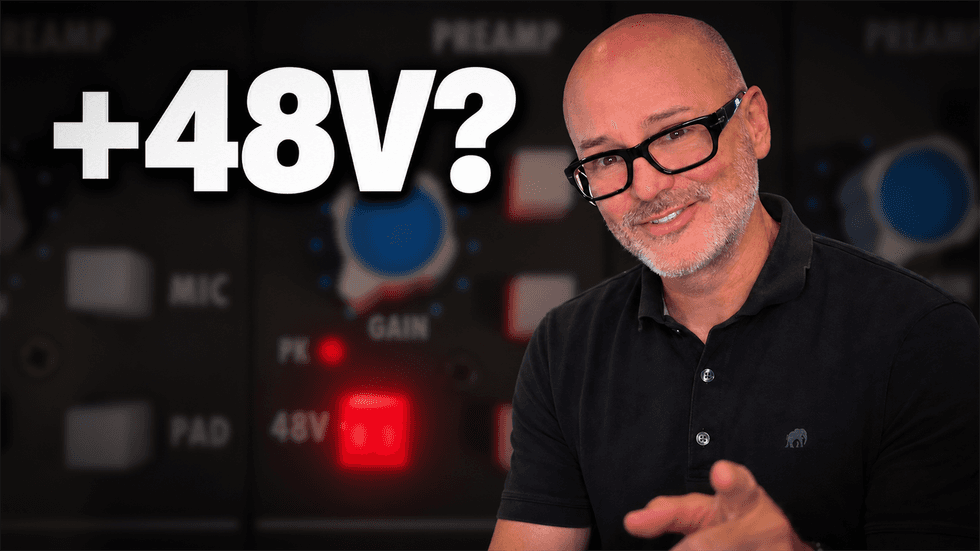

There’s a little button on nearly every modern mixing console marked +48V. On a live sound desk, it may be tucked into the channel settings; on a small recording interface, it might be the only button besides gain and monitor controls. This is phantom power: a clever way to run a microphone’s electronics without a separate power cable. Its name may sound mysterious, but its engineering is beautifully practical.
Life Before +48V
Remember, there are many different types of microphones. But by far the three most common are ribbon, dynamic, and condenser. It is the latter of these that really drove the development of phantom power. As transistorized microphones arrived in the 1960s, designers found they could supply power over ordinary balanced microphone wiring. From there, through a process of simple evolution, the various designs and voltage schemes gradually coalesced into the +48V standard we know today.
Put simply, condenser microphones require electrical power. Their capsules and internal electronics cannot just be plugged into a passive input and expected to work. Early condenser designs, which often used vacuum tubes, required an external power supply. This meant—and still means—connecting a specialized cable from the mic to the power supply, then running a standard XLR cable from the power supply to the equipment receiving the signal. This is still the case today with both vintage and modern professional large-diaphragm condenser mics, such as the U47, 251, or C12.
That said, certain modern active ribbon microphones, as well as some dynamic microphones with built-in electronics, also need external power, so each microphone’s manual is the final authority.
Caution: Passive ribbon mics deserve special care. A properly wired connection should not put DC across the ribbon, but faulty cables, mis-wired adapters, or making connection changes while phantom power is already on can remove that protection. Hence the old safety-first guideline: Never use +48V with a passive ribbon mic, and leave phantom power off whenever the microphone does not require it. Active ribbon mics, on the other hand, are designed to use phantom power.
What is +48V?
In short, it’s 48 volts of direct current. The + describes the positive DC voltage applied to both audio conductors—pins 2 and 3 of a conventional three-pin XLR connection, with pin 1 serving as the ground and completing the electrical circuit. Interestingly, the audio signal effectively ignores this voltage, allowing +48V and the audio signal to share the same cable. It does not mean that the audio signal itself is 48 volts, and it has nothing to do with a mic’s output level or the gain setting on a preamp. The power is there on the cable, but because the same voltage is applied to both audio conductors, it is effectively invisible to the differential audio signal. Hence the term “phantom” power.
“Never use +48V with a passive ribbon mic, and leave phantom power off whenever the microphone does not require it.”
Where the Power Comes From
In a live PA, the mixing console or stage box commonly sends phantom power to condenser microphones onstage. In a studio, the recording console or microphone preamp does the same. In a desktop setup, an audio interface with a phantom-capable XLR mic input usually supplies it.
Keep in mind that controls vary by device. One console may offer a separate +48V switch for every channel, while another may switch a group of inputs together. On an interface, a single button may cover multiple mic inputs. Know which inputs the control affects before turning it on, especially in a setup that mixes condensers, passive ribbons, and other equipment.
Best Practice
When connecting mics, make sure your monitors and headphone levels are completely down and/or muted. This helps avoid loud pops that can damage your speakers and your ears. Bring each channel’s gain all the way down, and connect all mics before switching phantom power on or off.
If a condenser is silent, +48V is one of the first things to check. If an unfamiliar ribbon, adapter, or vintage microphone is on the stand, identify its power requirements before pressing the button.
Phantom power made the condenser microphone easier to use just about everywhere: on a vocal in a bedroom, above a drum kit, at a broadcast desk, or across a stage full of microphones.
Until next time, namaste.