

When you hear songs played on guitar, it’s common to hear familiar chords that use open strings: D, C, G, Am, etc. These can make for some beautiful music, but at some point there might be an interest to explore more of what’s possible. One way is to include open strings for new ways to play voicings with close intervals, and also expand the possibilities of the fretboard.
I started to get interested in chords with open strings around the late ’90s. I think I came across the idea from an Eric Johnson video when he mentions “a real pretty Wes chord” (which you can find in Ex. 6). It wasn’t until much later, though, that I started to really explore them. I remember being intrigued by some of the things that were possible when an open string (or two or three) was included in a chord, and how the sound/timbre of the voicing changed when mixed with the fretted notes.
I’d like to start by showing two close voicings I came across (which are not otherwise possible without including an open string) and explain the process I worked through to find them.
I’ve always loved the sound of harmony moving in thirds, so for these examples I’ll be exploring B major sounds and G major sounds focused around the root, 3, 5, 7, 9, and #11.
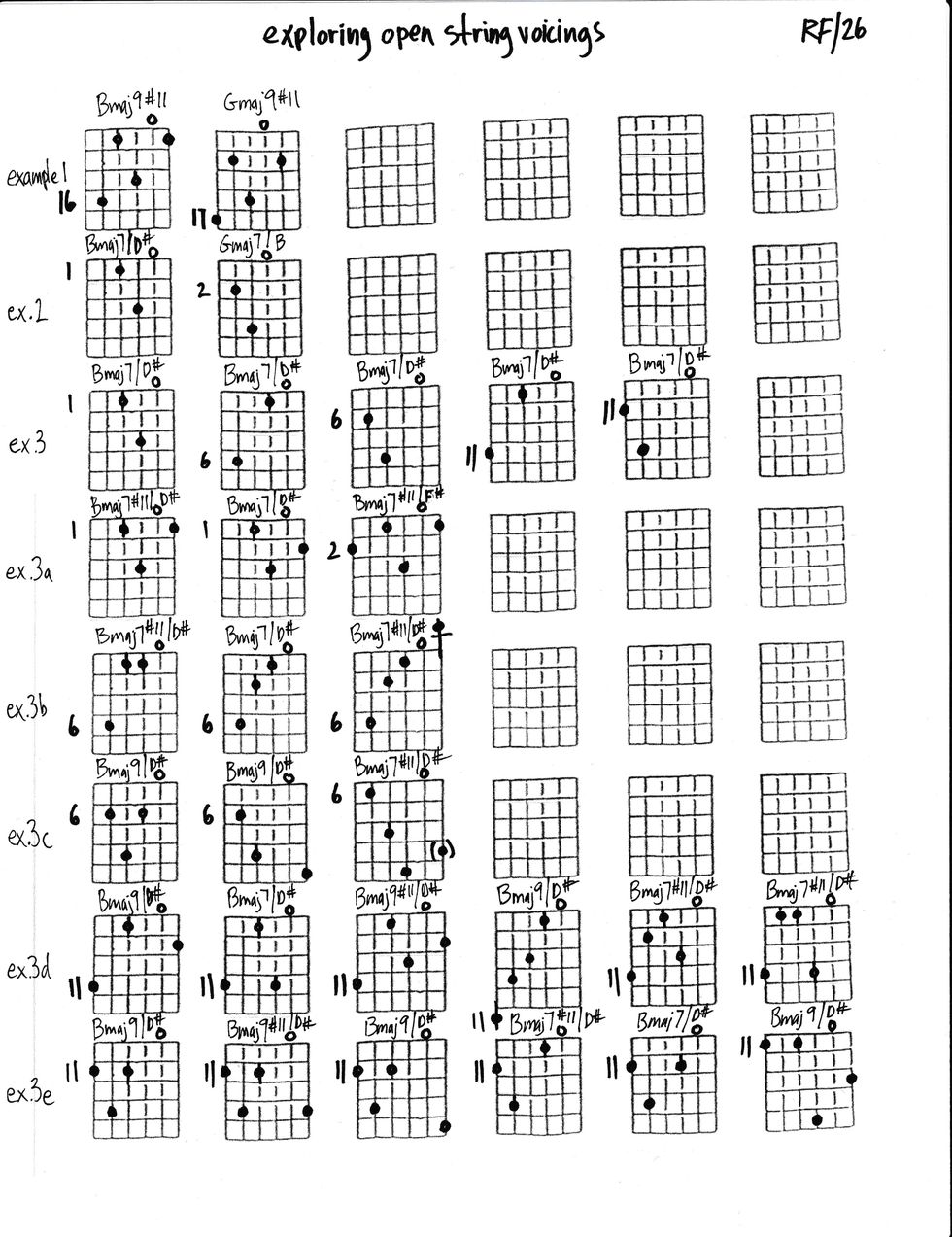
Ex. 1
Here’s where I eventually ended up: a chord containing the root, 3rd, 7th, 9th, and #11 with two whole steps on the bottom. On a piano, this wouldn’t be too challenging, and normally on guitar, it wouldn’t be possible. But with the addition of the open string we are able to easily get to it.
Something that I find somewhat challenging about these voicings is that the lowest sounding note is not always on the lowest string of the voicing—it might be somewhere in the middle. So when I work on new voicings, I’ll try to play through them one note at a time from lowest note to highest note, then highest to lowest—I think it helps my ears connect with what my eyes are seeing.
Ex. 2
When I started exploring the idea of major 7th chords with open strings, I probably started with something like this: 3rd, 7th, and an open string as root. (You could also start with the 3rd or 7th as an open string, depending on the key.) In this range, we have a familiar fretted interval—a 5th—with an open string a half-step above the 7th.
Ex. 3
After working on the open-string idea for a while, the term “zones” kept coming back to me. Playing in “positions” on the guitar is pretty common, but that has more to do with giving each finger a specific fret. I think the term “zones” leaves a little more interpretation as to what’s possible in each place on the neck. For instance, in this example, there are five “zones” that give us all the possible ways to play these two fretted notes with the open B, and each one of them offers a slightly different area, sound, and range on the fretboard. These will be the shapes we start with as we work through some of the possibilities of each one. Work through Examples 3a through 3e to hear some of the different colors. Even though the last voicing has the 7th an octave higher, it seemed too good not to share here.
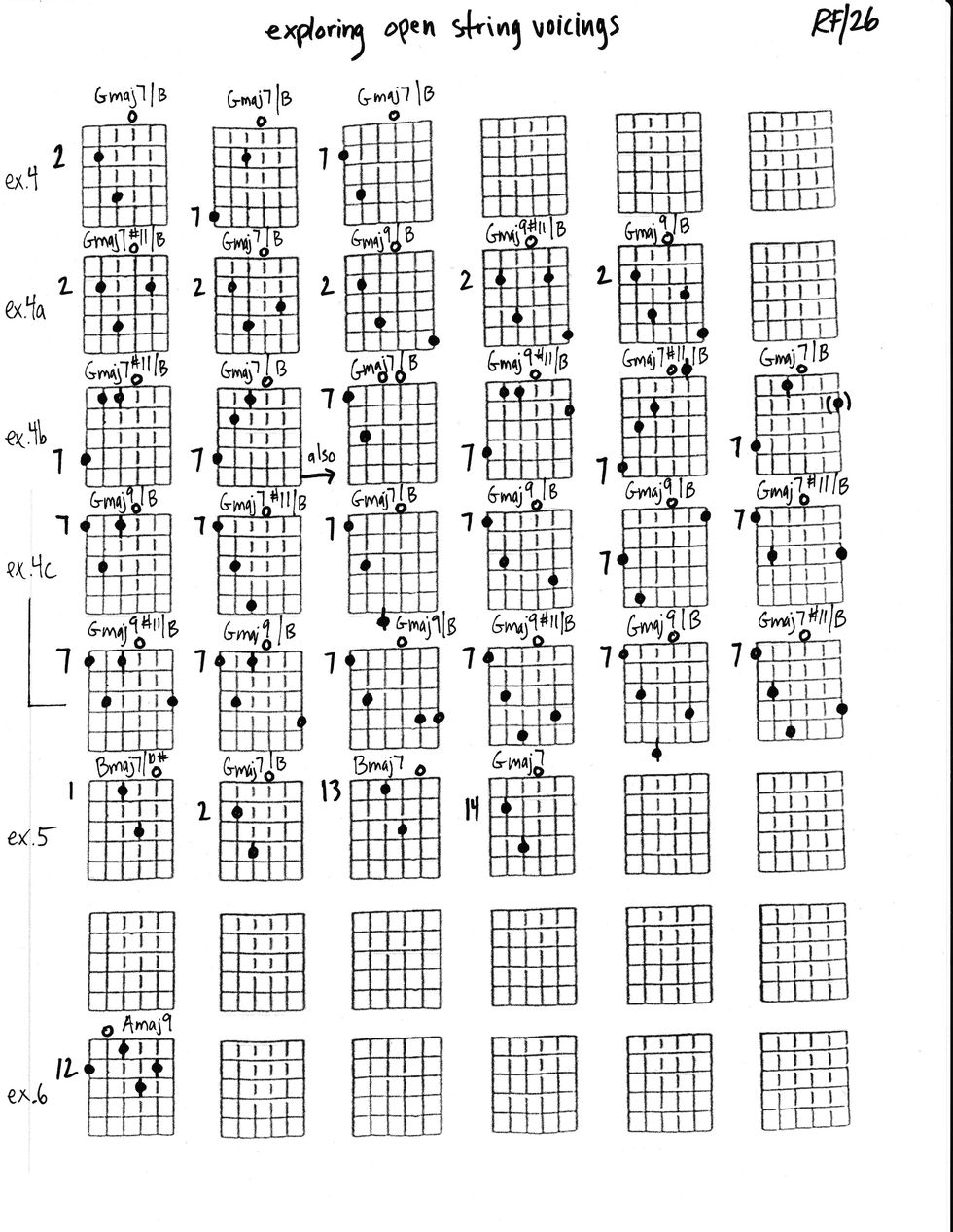
Ex. 4
Similar to Ex. 3, these are the possibilities for B, F#, and open G—shapes to build from as we explore these zones.
Ex. 4a gives us a usable range of F# or G in the low end up to an A (the 9th) on the high E string.
The zone for Ex. 4b offers the possibility of adding a note on the 5th string, since the B and F# are on non-adjacent strings. The second voicing also might look familiar as a Bm triad (on the bottom three strings), and the third voicing also allows us to play that same voicing, but with two open strings.
Ex. 4c gives us access to the highest range—reaching up to a high D on some of the voicings here.
Eventually, as I kept exploring, I came across the two chords from Ex. 1 by moving Ex. 3a up an octave and adding the 9th, which gives us Ex. 5. An important idea with this voicing is that with the fretted notes in the lower octave, an open string would create an interval of a half-step, but by moving the fretted notes up an octave, that same open string would then create an interval of a major seventh.
Ex. 6 (Eric Johnson’s “Wes chord”...)
I hope you found something interesting here, or maybe are able to come away with a new voicing you haven’t seen or thought of before. I always try to remember that it’s not so much about how many voicings one knows—it seems more about knowing one or two that you can really use and that can become part of your playing.
If you’d like to dive a little deeper into things like this, I’ve got a Patreon page dedicated to it: https://www.patreon.com/ryanferreira.