

Reader: Jean Pierret
Hometown: Palo Alto, California
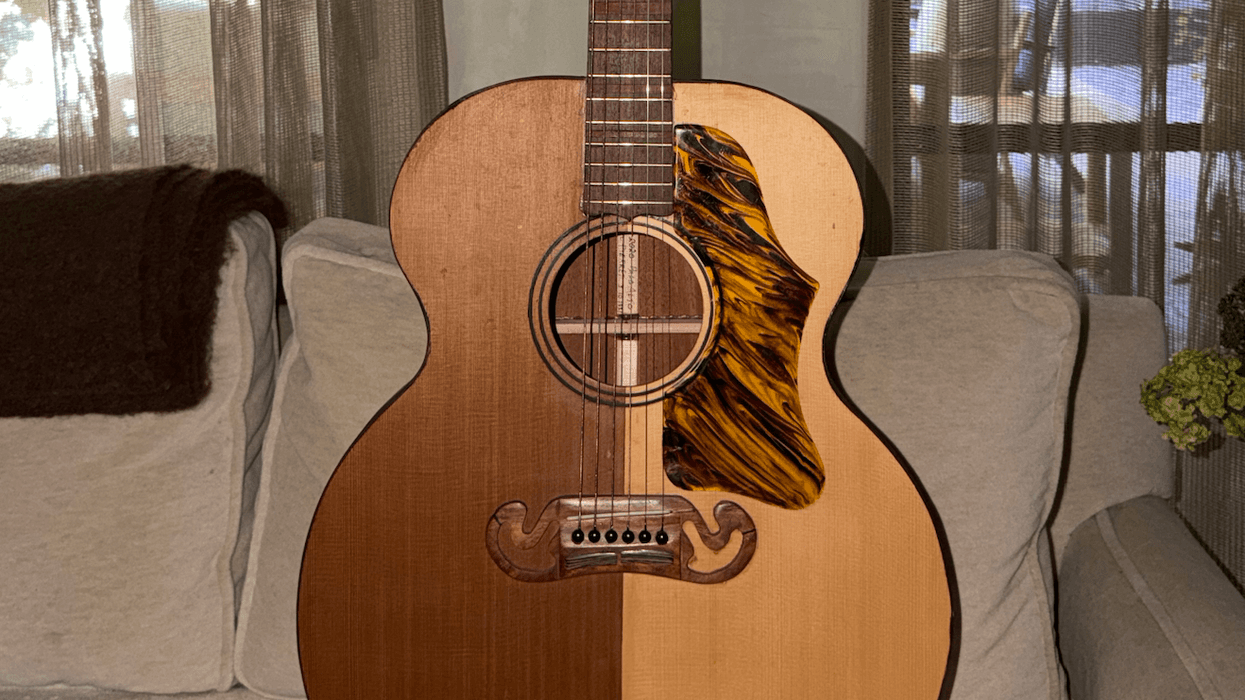
Guitar: J-200-style acoustic
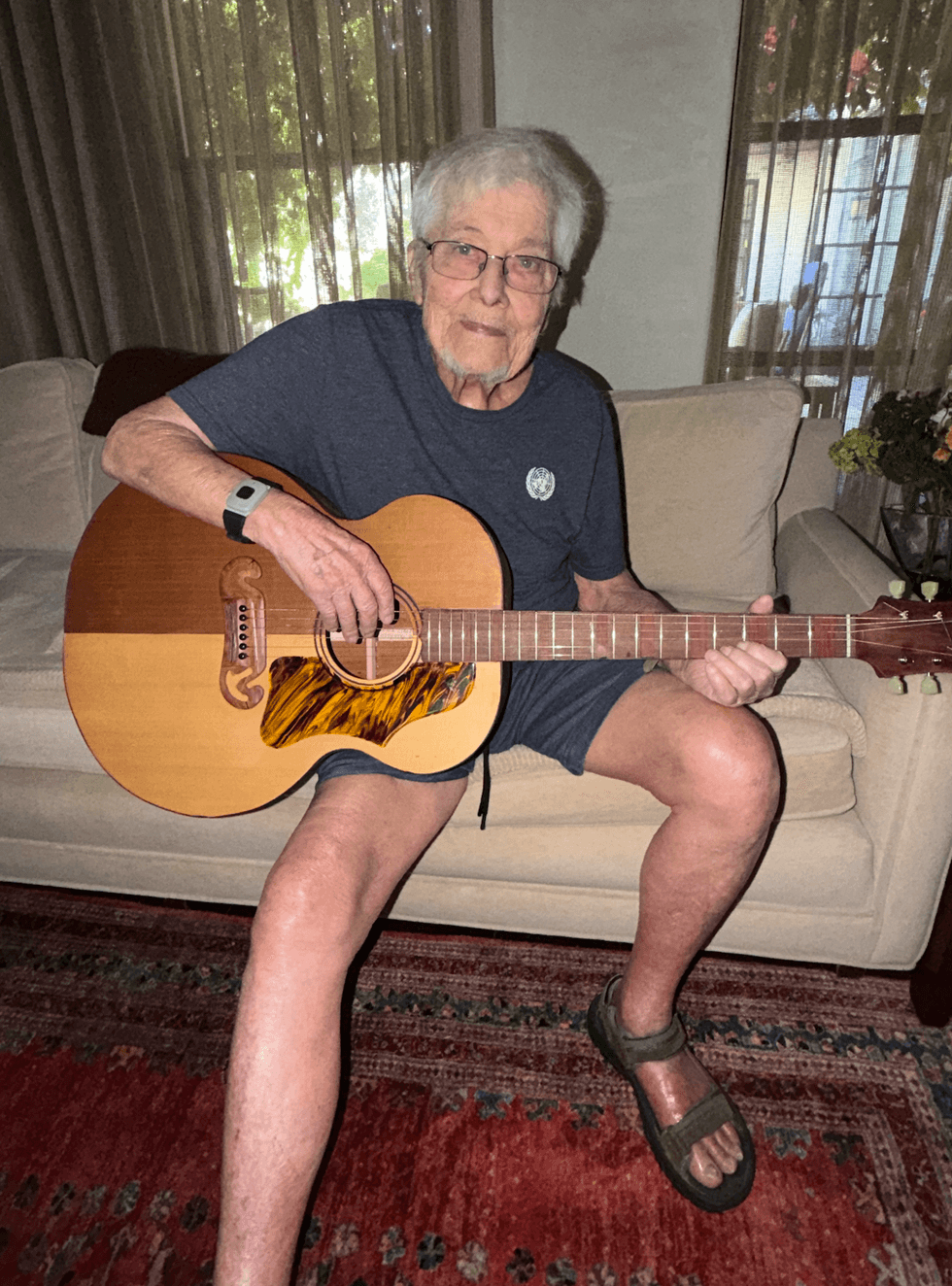
The luthier at home with his creation.
I built my first guitar in the early 1990s. I have built more than 100 guitars since, and I have given almost all of them away. Twelve are left in my workshop in Palo Alto.
I attended a Jesuit school in the Belgian Congo in the 1940s. While I was there, I used to play hooky and go out in a canoe to collect biological specimens for a friend at the Royal Belgian Institute of Natural Sciences. I spent time with Congolese fishermen along the Congo River, who showed me how to make long lines. I used to cross the river, 30 minutes each way, to a bookshop that was also a liquor shop, with friends waiting for me on the other side. One day a classmate brought a guitar to school, and it was the first one I ever saw. I fell in love with it on the spot—the object itself, the wood, the sound. I could not play, but I begged him to let me hold it. It would be the last guitar I would see for a long time after that.
After university in Brussels, I trained as a social worker and got a job, but I didn’t enjoy it. I then spent years traveling and doing research diving with a friend from the Congo who had become a biochemist—Brazil, Cabo Verde, the Seychelles, the Persian Gulf during the war, and eventually Papua New Guinea, where I ran a small research station on a tiny island and met my wife, Diane, in 1978.
“On a trip into the Amazon I saw what was left of a mahogany forest: nothing but stumps, and planks the loggers had laid down in the mud to walk on. I carried some of those cutoffs home and later built several guitars from them.”
When Diane and I returned to California in 1989, I filled the empty space in our shipping container with wood—kuila and other hardwoods. After that I got in the habit of carrying a folded duffel bag in my luggage when I traveled, so I could bring more back—cypress from a lumberyard in Guatemala, pochote from the Costa Rican coast, various pieces from Tanzania. On a trip into the Amazon I saw what was left of a mahogany forest: nothing but stumps, and planks the loggers had laid down in the mud to walk on. I carried some of those cutoffs home and later built several guitars from them.
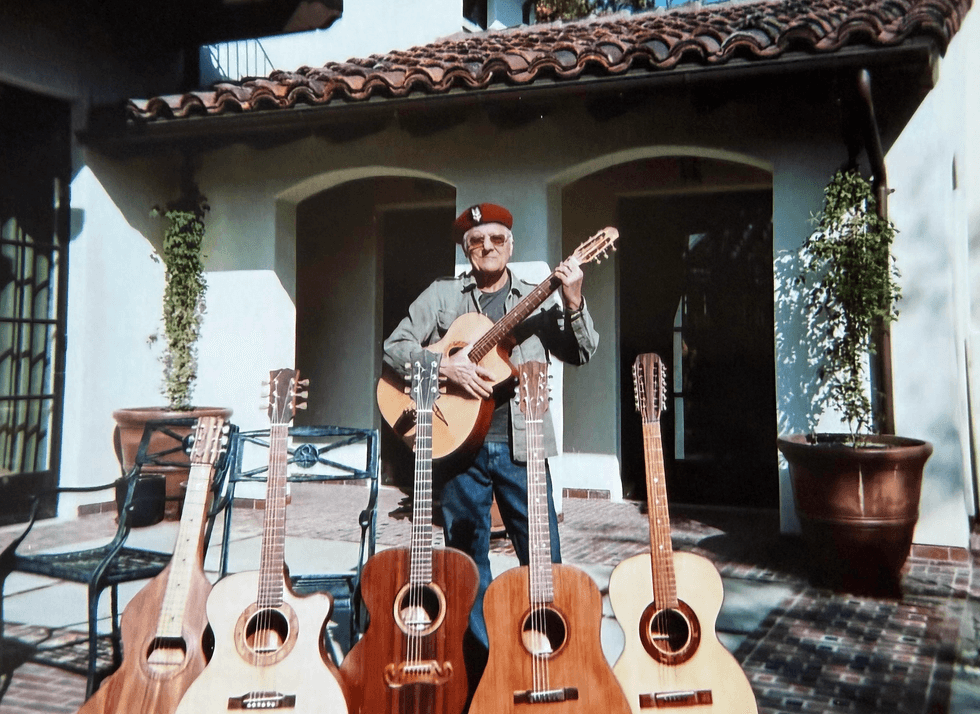
Pierret’s life of adventure—and a deep fascination with wood—informed the construction of more than 100 guitars.
I set up a workshop at our house in Palo Alto and started buying tools. I had been interested in wood since I was young, though I was never formally trained. I began by making inlaid tabletops, and by the early 1990s I had moved on to guitars. I worked from plans I ordered, I read a lot about people making guitars, and I picked up supplies at Gryphon Stringed Instruments in Palo Alto. A guitarist who lived next door would come by and test each finished build and tell me what to adjust. Once, a packing crate came from Papua New Guinea, where they have so much good hardwood they use it for shipping crates. I took it apart and made a guitar out of it. Our neighbor thought it was one of the best-sounding guitars I had made.
I do not work from a mold. I build the neck, the braced top, and the back as complete units first, then fit the sides freely between them, Spanish-style, even on steel-strings. I keep trimming until everything is seated cleanly, then glue in sequence—top to neck, then sides into the neck slot and tail block, then the back.
I built this J-200-style flattop from Gibson plans, but the woods are my own. The top is split: red cedar on the bass side, Engelmann spruce on the treble. Someone told me it was a good idea to have a stronger wood on the treble side, and I took the advice. The back and sides are mahogany. The bracing is white pine—the wood the U.S. Navy once used for masts—reinforced with quarter-cut redwood I got from an old garden post. The neck is more of that same redwood. The bridge is a red Pacific hardwood, from the same family as African padauk.
The joy of building guitars, for me, is in the transformation. You put a string on a box of wood, and suddenly you have something completely different. The sound of a guitar is just so wonderful— it is the wood communicating with the world.