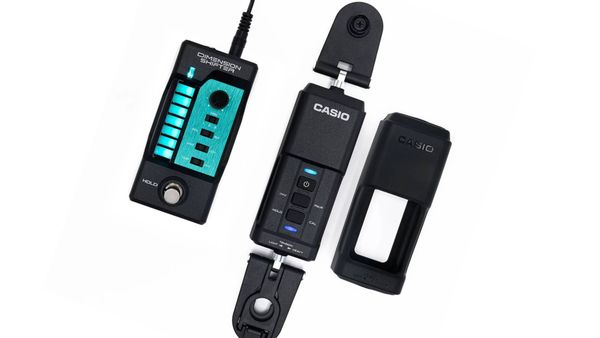
Casio’s Dimension Shifter is a beautiful and thoughtful idea. It reveals an understanding about how electric guitar players tend to move as they play, and the lyrical, maybe even balletic and poetic, manner in which motion can transform the music they make. The fundamental notions behind the Dimension Shifter are not new—essentially, it combines the basic mechanical concepts behind the expression foot pedal and the B-Bender into a wireless digital expression tool. But where an expression pedal weds the player to a single location, and the B-Bender (and its cousin, the Palm Pedal) can only alter the pitch of one or two strings, the Dimension Shifter enables a player to change effect parameters using the pull-and-release, strap-tension-based mechanical action of a B-Bender—all as they meander about a performance space. Depending on your average state of animation on a stage, this might not seem like a big deal. But for any player that tends to get lost in their musical reveries or likes to interact more intimately with bandmates while they sweep a filter, tweak their delay feedback, or increase the modulation rate of flange, it’s a very liberating technology.
Motion Stirs the Potion
I experienced a few hiccups setting up the Dimension Shifter. The problems were resolved quickly, but the user manual wasn’t a big help in solving the issues I did encounter. In general, though, the Dimension Shifter is pretty easy to set up and operate. The pairing between the strap transmitter and the receiver is automatic. You can easily adjust the strap-pull tension. And once you’ve got your connections in place and understand the basic functions of each button clearly (the labels on the receiver and transmitter themselves are a bit cryptic) using the unit becomes fairly natural.
To Casio’s credit, they kept the controls to a minimum. In terms of what you’d potentially use in performance, there are just a few essentials. There’s an inverse switch that reverses polarity, and therefore the direction of expression sweep—so if a modulation speed is at its slowest before you pull on the strap and at its fastest at the end of the range, you change that order by hitting a button on the transmitter. You can also freeze a setting in the sweep using the hold switch, quite like you would use a fixed wah. Which, with delays, reverbs, and modulation effects, enables very fluid movement—ramping, if you will—between radical effects settings. Both of these functions can be activated via switches on the transmitter or receiver. You can also use the knob on the receiver to establish a minimum and maximum range for an effect sweep, just as you would set the heel position on an expression pedal.
Even if you use the Dimension Shifter with just a single effect, it can have a profound impact on the way you play. Again, the function of the Dimension Shifter is fundamentally the same as an expression pedal, but it definitely feels different—and this leads to different results. The way I might use a delay feedback swell with bends or vibrato arm manipulation often felt more cohesively connected to the instrument, and you can experience a sort of unified, glued-together sense of playing when you pair the Dimension Shifter with certain techniques and effects.
I suspect, though, that multi-effects users—or those who use a single effect with multiple presets—will have the most fun with the Dimension Shifter. When you can quickly switch between presets to establish radically different baselines for the Dimension Shifter to work from, the possibilities multiply—and so, quite literally, do the dimensions
The Verdict
Though the Dimension Shifter is ultimately fun, inspiring, and, for certain kinds of kinetic performers, a tool that frees them from foot pedal constraints, there is room for refinement. The transmitter is still a bit clunky. And you have to wonder if a smaller, slimmer, rechargeable apparatus that loses the two AAA batteries is possible without sacrificing the unit’s mechanical functionality. It probably goes without saying, too, that a lot of aesthetic purists will not love the idea of the Dimension Shifter dangling from their strap (perhaps there is a way to cover the unit in vintage Ace strap material?) There’s also the issue of the 20-hour battery lifespan. And the fact that, for those of us who don’t use multi-effect units or digital effects with multiple preset options, the Dimension Shifter is an expensive way to manipulate the expression functionality on a single effect.
But it was very easy to feel and imagine how the Dimension Shifter could be transformative for many players onstage. I could manipulate echo feedback all day long with the unit and be happy. And the action of tugging on the guitar to shift my flanger’s modulation speed felt much more natural and tied to the instrument than a foot treadle does.
I hope that the Dimension Shifter succeeds, and gains enough traction with players that it can continue to evolve. It may not be a totally seamless solution now, but it’s easy to imagine how ongoing development, streamlining, weight shedding, and miniaturization could make the Dimension Shifter into a really magical, even essential, part of many players methodology. It’s off to a super-intriguing start.
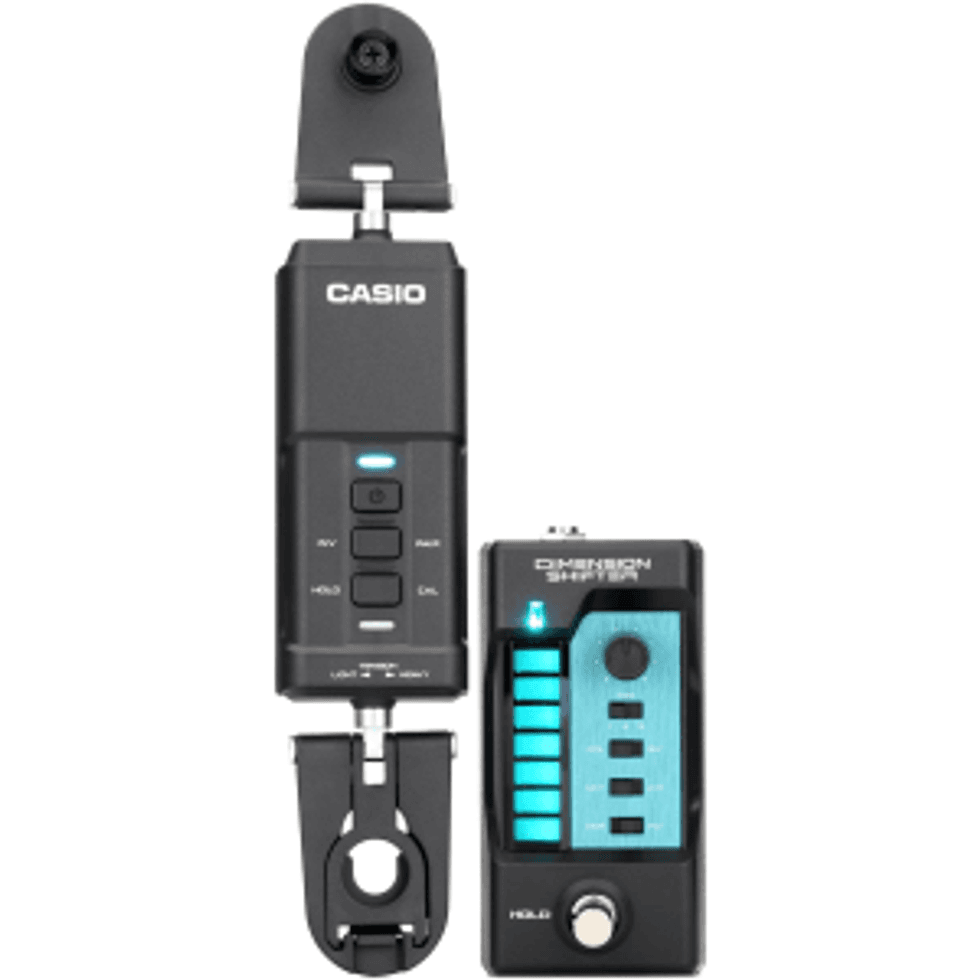
Dimension Shifter Wireless Expression Controller
Wireless Expression Controller with Adjustable Tension, Bluetooth, and Calibration Controls



![Rig Rundown: The Black Crowes’ Rich Robinson [2026]](https://www.premierguitar.com/media-library/youtube.jpg?id=66952027&width=1245&height=700&quality=70&coordinates=0%2C0%2C0%2C0)