

“It has to be more about the music than about myself.”
Jimmy “Scratch” James is explaining his approach to guitar from his home in Seattle. It’s one of several conversations we have over a few weeks, on FaceTime and by phone. “I play the guitar like a drum,” he adds, “and even though he was a bass player, not a guitar player, I think about [legendary Motown bassist] James Jamerson a lot.”
“Nobody ever forced older music on me,” he continues. “But that old music—James Brown, Wilson Pickett, Sly Stone—it’s like being at your grandma’s table, and she serves you food that sticks to your ribs. You can go to a drive-through, and that food may look good, but it’s not gonna stick to your ribs the way your grandmother’s food is gonna do. That’s what it’s like listening to those old records.”
It’s been almost a quarter century since the retro-soul movement took root, with record labels like Daptone, Colemine, and Big Crown bringing artists like Sharon Jones, Charles Bradley, and Lee Fields to listeners’ ears; sounds first pioneered more than 60 years ago in places like Memphis, Muscle Shoals, and Detroit. But Jimmy James is a modern-day part of that revival.
Soul and funk place a strong emphasis on the ensemble rather than the individual, so it’s rare for a guitar player to stand out within those genres. But two instrumental bands out of Seattle, True Loves and Parlor Greens, have provided breakout space for James, who may be the retro-soul scene’s first guitar hero. Indeed, the nickname “Scratch” is a reference to rhythm guitar players of the past who brought a percussive beat to their fretwork—musicians like Nile Rodgers of Chic and, before him, Jimmy Nolen of James Brown’s band.
“I gave myself that nickname as an homage to them,” James explains, “But people just call me Jimmy.”
The difference between Parlor Greens and True Loves, Jimmy explains during a call on a rare day off from gigging, “is like the difference between Motown and Stax.” I’ve asked him why he needs two full-time bands. “In the True Loves, we have a horn section, so it’s more groovy that way, like a pop thing. Parlor Greens is an organ trio, and since there are only three of us, I naturally have more sonic space there. I’ve been with True Loves longer, but I love the two bands equally.”
James, now 45, is a double threat on guitar. He’s a rhythm player who “scratches” deep in the pocket of the groove but who’s also able to explode into psychedelic lead-guitar thunder reminiscent of his fellow Seattleite, Jimi Hendrix, who was a big influence on him.
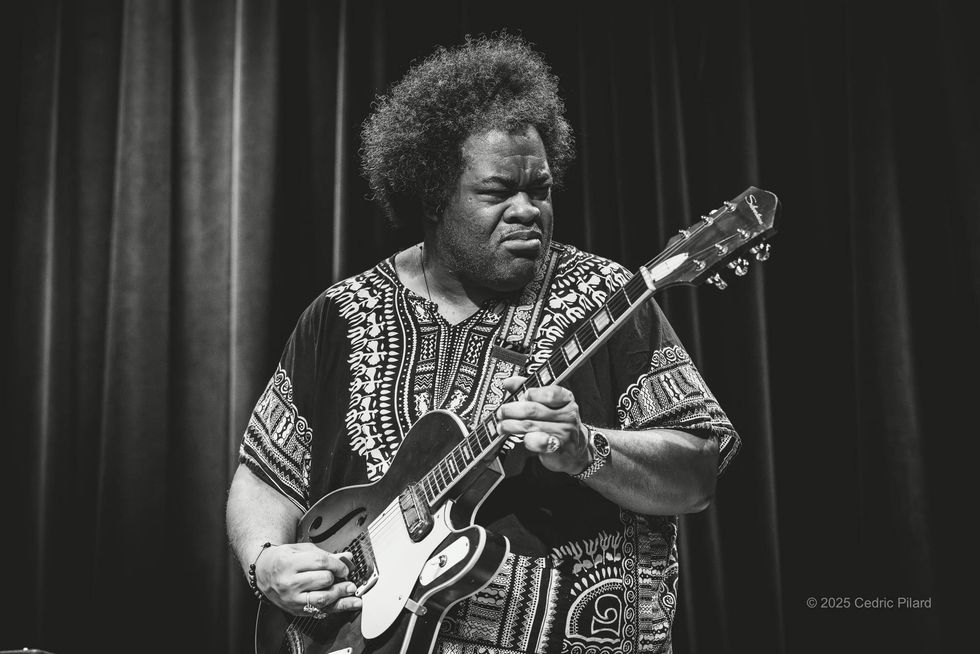
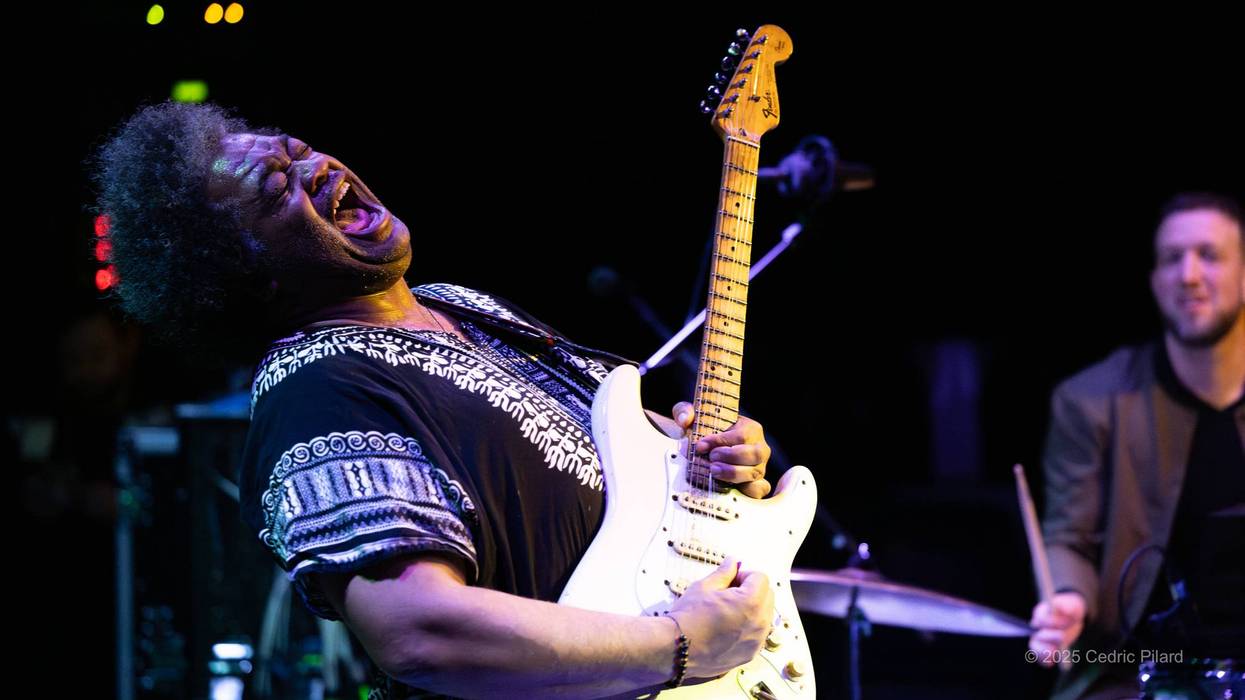
James’ go-to vintage Silvertone has its stock single-coil gold-foil pickup in the neck position and an old Epiphone humbucker in the bridge.
Photo by Cedric Pilard
“The thing I love about Hendrix,” James tells me, “and also jazz guys like John Coltrane, Louis Armstrong, and Charlie Parker, is they took risks. I remember Hendrix once, in 1969, went on The Dick Cavett Show and said, ‘The reason I make mistakes is because I’m trying new things.’ I respected him, and he represented freedom to me. They all tried new things. But Hendrix was always expanding. Every time I heard him, I felt like I was going into another dimension, another galaxy.”
“That old music, it’s like being at your grandma’s table, and she serves you food that sticks to your ribs.”
It was during middle school that James’ late older sister first played “Purple Haze” for him. “Let me tell you, that scared me—I never heard anything like it,” James remembers. “I thought it was heavy metal at the time, because my sister was listening to a lot of Metallica then. So I thought Hendrix was current at that time. Of course, I later found out.”
A native of the Holly Park section of South Seattle, James has no spouse or children. He lives to play, and he walks the earth with four ghosts looking over his shoulder.
“My family is all gone—my grandmother, my mother, and my two sisters,” he explains. “They were Leola, Marie, Regina, and Chelsea. They were all musicians, and they all had a profound impact on me. My grandmother was a singer and a championship jitterbugger. My mother was a vocalist, and she sang in a local group called the Champelles. This was the mid ’60s. They opened up for Johnnie Taylor, Solomon Burke, and the Sweet Inspirations. That group had Whitney Houston’s mother, Cissy, in it. My oldest sister, Regina, she was a pianist and flutist. The younger of my sisters, Chelsea, was a drummer, and she played in a band in Seattle in the ’90s called Tribal Therapy. Chelsea used to say to me, ‘Pocket and tempo are everything. Stay out of the way and play the part that fits the song.’
“They’re all gone now,” James says wistfully. “Everything I do is still for them, and it always will be. I started out as a drummer, around the sixth grade, because that’s what my sister played. But then I heard Motown guitar lines like ‘My Girl,’ which was played by Robert White. And I heard Eddie Willis playing the guitar line on ‘I Second That Emotion,’ and I loved that. My mom helped me move the drums that I had over to a friend’s house so we could play. He was playing guitar, but we swapped instruments, and as soon as I started playing some open notes, fooling around on the guitar, I realized that that’s what I was into.”
James’ mother bought him an acoustic guitar in those early days. “I started picking things up off of records, Chuck Berry, B.B. King, Muddy Waters, John Lee Hooker,” he recalls. “But I also liked folk music. And I liked soul. The first rhythm and blues thing I learned how to play was ‘Mustang Sally.’ Then, in high school, I was in the band, and most high school bands play jazz, but we were more into Kool & the Gang and James Brown. And I couldn’t read music. The horns could read music, but we just had to pick it up and figure out which notes went together.
Jimmy “Scratch” James’ Gear List
Guitars:
1964 Silvertone 1454
1995 Squier Stratocaster
2019 Fender Custom Shop Tele
2022 Fender Custom Shop Stratocaster
Fender ’62 Jazzmaster Reissue
1980 Guild X-170 Archtop
1960s Harmony Rocket
Amps:
Fender Hot Rod Deluxe
Peavey Delta Blues
Templo Devices Nomad 50 Watt Battery Amp
Strings, Picks, & Cables:
D’Addario flatwound strings
Ernie Ball roundwound strings
“Super heavy” picks
Lava cables
“I remember one time I got a bad grade, and my mother took my guitar away. Man, I whimpered, and I cried, and later she told me, ‘That’s when I knew how badly you wanted to play, you never moped like that over anything else.’ I just could not think of anything else; I just wanted to play guitar. I felt safe in the music, I just knew I wanted to play.”
On the road today, James totes two main axes. One is a 1964 red Silvertone that he picked up about 16 years ago at Georgetown Music in Seattle. It has a stock single-coil gold-foil pickup in the neck position, but the bridge pickup is an old Epiphone humbucker that was installed when Seattle luthier Chris Lomba was rehabbing the guitar.
“We bought that instrument from some guy, really for parts,” Lomba recalls on the phone. At the time, Lomba was the resident luthier and guitar tech at Georgetown, where James was a frequent customer. “I remember pulling things out of the scrap pile and just putting it together for Jimmy. And we put in new frets and a new bridge,” Lomba remembers. “The Epiphone pickup in the bridge position was just something we had lying around, like a spare. The amazing thing about that Silvertone is really how much he loves it. Jimmy believes in that guitar 100 percent, and he’s always concerned about its well being.”
“I don’t really mess around with pedals, because I like the sound of the guitar just how it is.”
James’ other go-to axe is a 1995 Mexico-built Squier Stratocaster that his mother purchased for him. Resources in the family were stretched thin, and his mom worked overtime six days a week to make sure her son got the instrument.
“She didn’t need to do that; it was hard for us financially. But we went to a place called American Music so that I could get some fresh strings for another guitar, and I was eyeing that Stratocaster in the store and trying to play it cool; I didn’t want her to notice how much I was looking at it,” James recalls. “Finally, she said to me, ‘You really want that guitar, don’t you? Go ahead and put it up on the counter, you never ask me for nothing. I’ll figure it out.’ I miss my mother; she’s been gone for four years now. I named that Stratocaster ‘Bessie’ for my favorite blues singer, Bessie Smith.”
I ask James how he’s processed so much loss in his life, and he tells me, “I just play through it. I wish they were here. I wish they could see what I’ve done and where I’ve gone around the world to play my guitar. We were all close through music. And playing music is the closest I’ll be to them.”
Watching Jimmy James play through it is to experience an artist conjure his apparitions; it’s a guitar seance onstage. His solos flow as though he’s lighting candles to illuminate a spectral pathway back to the here and now for his lost family. When Jimmy James opens that door, his facial expression becomes otherworldly—his jaw drops agape, silently mouthing the notes ringing through his pickups as he frets them. His wailing, full-step bends soar towards the heavens. He’s playing for his ghosts.
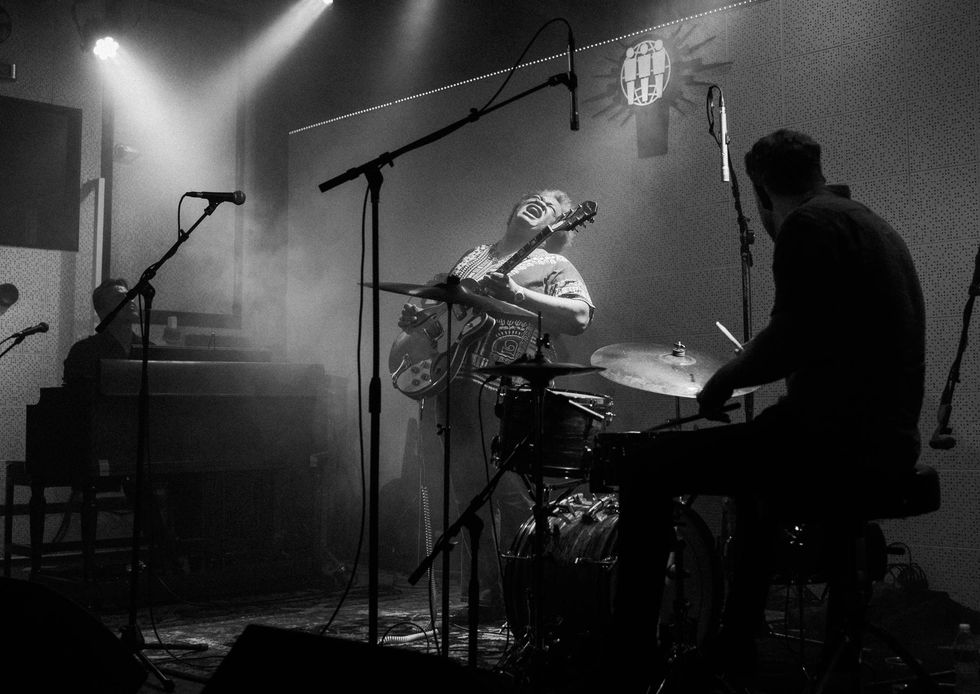
Jimmy James live with the Parlor Greens, featuring organist Adam Scone and drummer Tim Carmen.
Photo by Mitch LaGrow
James is precise and articulate, tending to pick each note, avoiding hammer-ons and pull-offs unless the solo cries out for it. His tone is clean and stompbox-free; his guitar cable runs straight to his amp. When he is ready to open this ethereal portal in a solo, he strides over to the amplifier and quickly flips an overdrive switch. It’s all the crunch he needs.
“I don’t really mess around with pedals,” James explains. “Sometimes, if it’s a very powerful amp and there’s too much headroom for it to break up, I’ll put something in front of it. But very rarely, because I like the sound of the guitar just how it is.”
Parlor Greens recently dropped a new record, Emeralds. The last track, “Queen of My Heart,” is James' homage to his late mother. The recording contains the last words she ever spoke to him, in a video selfie sent to his phone shortly before she passed. His guitar leads cry out in an emotional letting-go, a projection of the hurt in Jimmy James’ soul.
“James Jamerson once told his son, ‘If you don’t feel it, don’t play it,’” James relates to me. “That’s how I approach it. Oscar Wilde said something, too: ‘You can only be yourself, because everyone else is taken.’ That’s what it is. If you take Jimi Hendrix’s guitar and hand it to B.B. King, and you take B.B.’s guitar and put it on Jimi Hendrix, they are still gonna sound like themselves. And my mother instilled that in me. She’d tell me, ‘Have a sound! When you hear a Motown track, you know it’s Motown before the words even hit.’”
I comment to Jimmy that, for a 45-year-old man, a guy who grew up in Seattle during the peak of grunge, his spirit feels pretty old. He explains that listening to that classic music from the ’60s and ’70s is what shaped him.
“When I was young, I would hear things like Johnnie Taylor’s ‘Who’s Makin’ Love,’ or ‘California Dreamin’’ by the Mamas & the Papas,” James reminisces. “Musically and lyrically, all that stuff spoke to me. My friends didn’t get it. They’d say, ‘Why are you listening to that grandparents' music?’ But I loved the lyrics and how there was a story to be told. And when you think about the blues, it’s the foundation. So it all felt grounded to me; that older stuff has a deep conviction to it. You can listen to it and know that they worked very hard, and it came from deep within.
“Sometimes I do feel like I was born at the wrong time. But after my mother passed, I had a dream. I came to her, and I said, ‘Mom, what’s the point of my living? Why can’t I be with you all? We could be a family again. And in this dream, she said to me, ‘Don’t be anxious for nothing, baby. You got better things coming your way. Just you wait.’ And she always had that wisdom. Music can change a lot of things.”

![Rig Rundown: The Black Crowes’ Rich Robinson [2026]](https://www.premierguitar.com/media-library/youtube.jpg?id=66952027&width=1245&height=700&quality=70&coordinates=0%2C0%2C0%2C0)