“It has to be more about the music than about myself.”
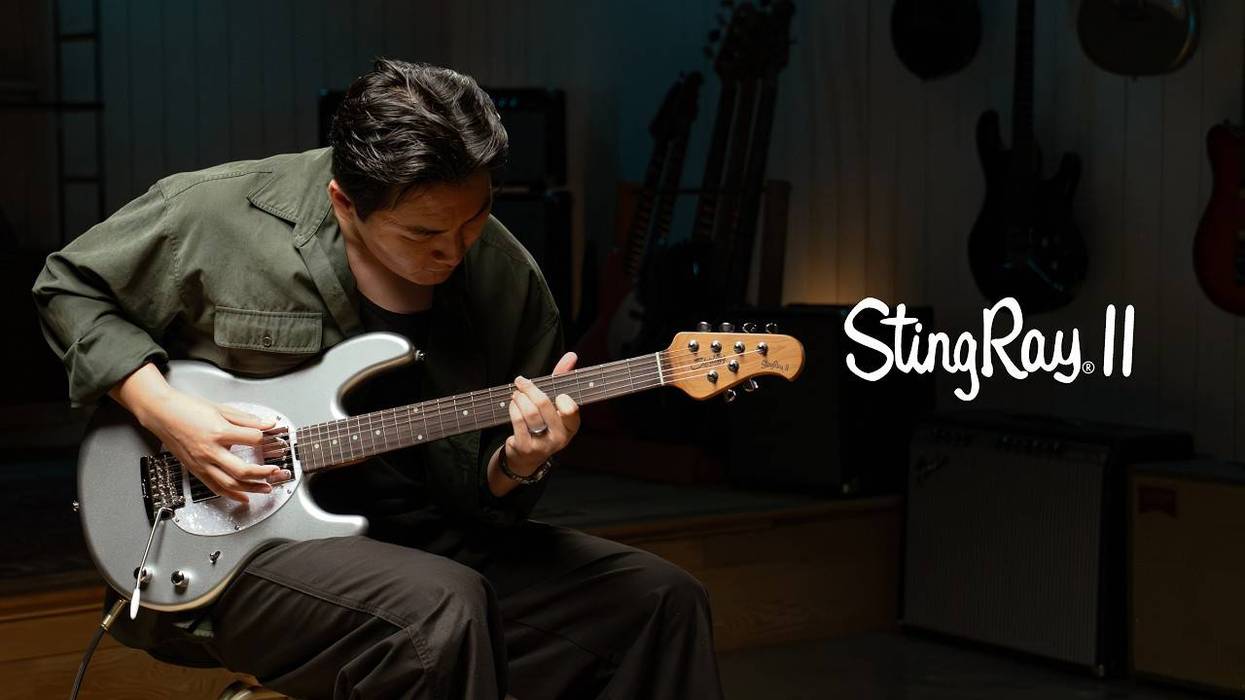
Jimmy “Scratch” James is explaining his approach to guitar from his home in Seattle. It’s one of several conversations we have over a few weeks, on FaceTime and by phone. “I play the guitar like a drum,” he adds, “and even though he was a bass player, not a guitar player, I think about [legendary Motown bassist] James Jamerson a lot.”
“Nobody ever forced older music on me,” he continues. “But that old music—James Brown, Wilson Pickett, Sly Stone—it’s like being at your grandma’s table, and she serves you food that sticks to your ribs. You can go to a drive-through, and that food may look good, but it’s not gonna stick to your ribs the way your grandmother’s food is gonna do. That’s what it’s like listening to those old records.”
It’s been almost a quarter century since the retro-soul movement took root, with record labels like Daptone, Colemine, and Big Crown bringing artists like Sharon Jones, Charles Bradley, and Lee Fields to listeners’ ears; sounds first pioneered more than 60 years ago in places like Memphis, Muscle Shoals, and Detroit. But Jimmy James is a modern-day part of that revival.
Soul and funk place a strong emphasis on the ensemble rather than the individual, so it’s rare for a guitar player to stand out within those genres. But two instrumental bands out of Seattle, True Loves and Parlor Greens, have provided breakout space for James, who may be the retro-soul scene’s first guitar hero. Indeed, the nickname “Scratch” is a reference to rhythm guitar players of the past who brought a percussive beat to their fretwork—musicians like Nile Rodgers of Chic and, before him, Jimmy Nolen of James Brown’s band.
“I gave myself that nickname as an homage to them,” James explains, “But people just call me Jimmy.”
The difference between Parlor Greens and True Loves, Jimmy explains during a call on a rare day off from gigging, “is like the difference between Motown and Stax.” I’ve asked him why he needs two full-time bands. “In the True Loves, we have a horn section, so it’s more groovy that way, like a pop thing. Parlor Greens is an organ trio, and since there are only three of us, I naturally have more sonic space there. I’ve been with True Loves longer, but I love the two bands equally.”
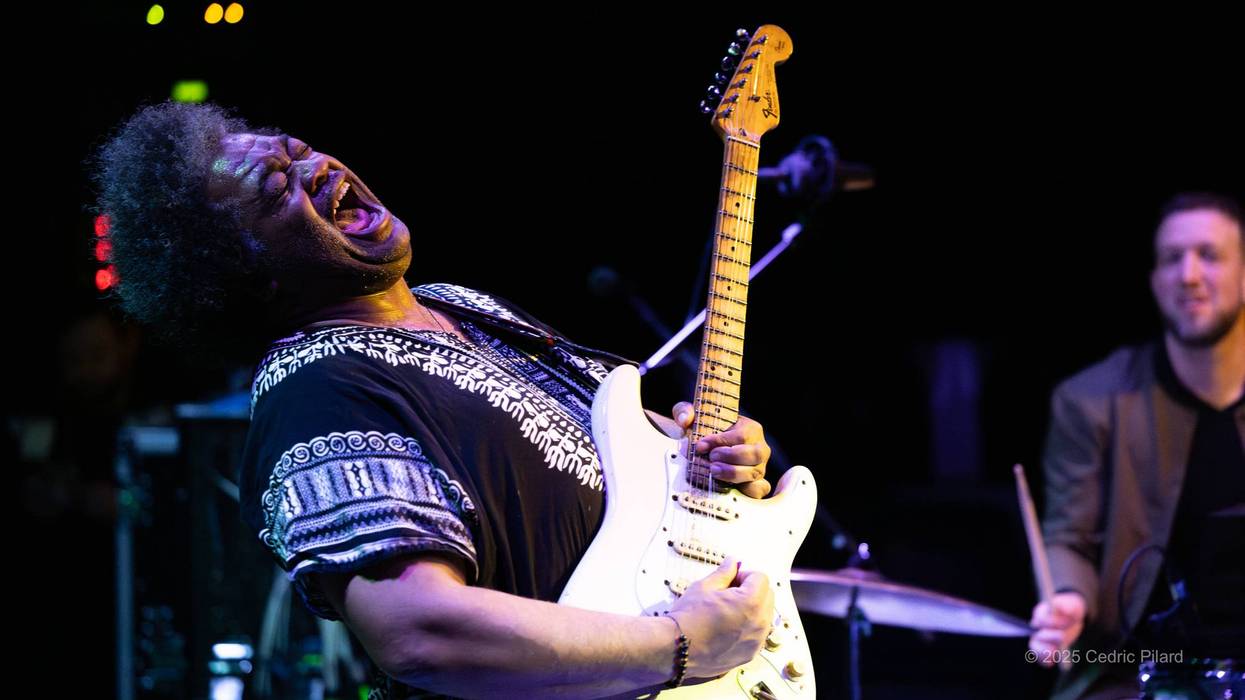
James, now 45, is a double threat on guitar. He’s a rhythm player who “scratches” deep in the pocket of the groove but who’s also able to explode into psychedelic lead-guitar thunder reminiscent of his fellow Seattleite, Jimi Hendrix, who was a big influence on him.
James’ go-to vintage Silvertone has its stock single-coil gold-foil pickup in the neck position and an old Epiphone humbucker in the bridge.
Photo by Cedric Pilard
“The thing I love about Hendrix,” James tells me, “and also jazz guys like John Coltrane, Louis Armstrong, and Charlie Parker, is they took risks. I remember Hendrix once, in 1969, went on The Dick Cavett Show and said, ‘The reason I make mistakes is because I’m trying new things.’ I respected him, and he represented freedom to me. They all tried new things. But Hendrix was always expanding. Every time I heard him, I felt like I was going into another dimension, another galaxy.”
“That old music, it’s like being at your grandma’s table, and she serves you food that sticks to your ribs.”
It was during middle school that James’ late older sister first played “Purple Haze” for him. “Let me tell you, that scared me—I never heard anything like it,” James remembers. “I thought it was heavy metal at the time, because my sister was listening to a lot of Metallica then. So I thought Hendrix was current at that time. Of course, I later found out.”
A native of the Holly Park section of South Seattle, James has no spouse or children. He lives to play, and he walks the earth with four ghosts looking over his shoulder.
“My family is all gone—my grandmother, my mother, and my two sisters,” he explains. “They were Leola, Marie, Regina, and Chelsea. They were all musicians, and they all had a profound impact on me. My grandmother was a singer and a championship jitterbugger. My mother was a vocalist, and she sang in a local group called the Champelles. This was the mid ’60s. They opened up for Johnnie Taylor, Solomon Burke, and the Sweet Inspirations. That group had Whitney Houston’s mother, Cissy, in it. My oldest sister, Regina, she was a pianist and flutist. The younger of my sisters, Chelsea, was a drummer, and she played in a band in Seattle in the ’90s called Tribal Therapy. Chelsea used to say to me, ‘Pocket and tempo are everything. Stay out of the way and play the part that fits the song.’
“They’re all gone now,” James says wistfully. “Everything I do is still for them, and it always will be. I started out as a drummer, around the sixth grade, because that’s what my sister played. But then I heard Motown guitar lines like ‘My Girl,’ which was played by Robert White. And I heard Eddie Willis playing the guitar line on ‘I Second That Emotion,’ and I loved that. My mom helped me move the drums that I had over to a friend’s house so we could play. He was playing guitar, but we swapped instruments, and as soon as I started playing some open notes, fooling around on the guitar, I realized that that’s what I was into.”
James’ mother bought him an acoustic guitar in those early days. “I started picking things up off of records, Chuck Berry, B.B. King, Muddy Waters, John Lee Hooker,” he recalls. “But I also liked folk music. And I liked soul. The first rhythm and blues thing I learned how to play was ‘Mustang Sally.’ Then, in high school, I was in the band, and most high school bands play jazz, but we were more into Kool & the Gang and James Brown. And I couldn’t read music. The horns could read music, but we just had to pick it up and figure out which notes went together.
“I remember one time I got a bad grade, and my mother took my guitar away. Man, I whimpered, and I cried, and later she told me, ‘That’s when I knew how badly you wanted to play, you never moped like that over anything else.’ I just could not think of anything else; I just wanted to play guitar. I felt safe in the music, I just knew I wanted to play.”
On the road today, James totes two main axes. One is a 1964 red Silvertone that he picked up about 16 years ago at Georgetown Music in Seattle. It has a stock single-coil gold-foil pickup in the neck position, but the bridge pickup is an old Epiphonehumbucker that was installed when Seattle luthier Chris Lomba was rehabbing the guitar.
“We bought that instrument from some guy, really for parts,” Lomba recalls on the phone. At the time, Lomba was the resident luthier and guitar tech at Georgetown, where James was a frequent customer. “I remember pulling things out of the scrap pile and just putting it together for Jimmy. And we put in new frets and a new bridge,” Lomba remembers. “The Epiphone pickup in the bridge position was just something we had lying around, like a spare. The amazing thing about that Silvertone is really how much he loves it. Jimmy believes in that guitar 100 percent, and he’s always concerned about its well being.”
“I don’t really mess around with pedals, because I like the sound of the guitar just how it is.”
James’ other go-to axe is a 1995 Mexico-built Squier Stratocaster that his mother purchased for him. Resources in the family were stretched thin, and his mom worked overtime six days a week to make sure her son got the instrument.
“She didn’t need to do that; it was hard for us financially. But we went to a place called American Music so that I could get some fresh strings for another guitar, and I was eyeing that Stratocaster in the store and trying to play it cool; I didn’t want her to notice how much I was looking at it,” James recalls. “Finally, she said to me, ‘You really want that guitar, don’t you? Go ahead and put it up on the counter, you never ask me for nothing. I’ll figure it out.’ I miss my mother; she’s been gone for four years now. I named that Stratocaster ‘Bessie’ for my favorite blues singer, Bessie Smith.”
I ask James how he’s processed so much loss in his life, and he tells me, “I just play through it. I wish they were here. I wish they could see what I’ve done and where I’ve gone around the world to play my guitar. We were all close through music. And playing music is the closest I’ll be to them.”
Watching Jimmy James play through it is to experience an artist conjure his apparitions; it’s a guitar seance onstage. His solos flow as though he’s lighting candles to illuminate a spectral pathway back to the here and now for his lost family. When Jimmy James opens that door, his facial expression becomes otherworldly—his jaw drops agape, silently mouthing the notes ringing through his pickups as he frets them. His wailing, full-step bends soar towards the heavens. He’s playing for his ghosts.
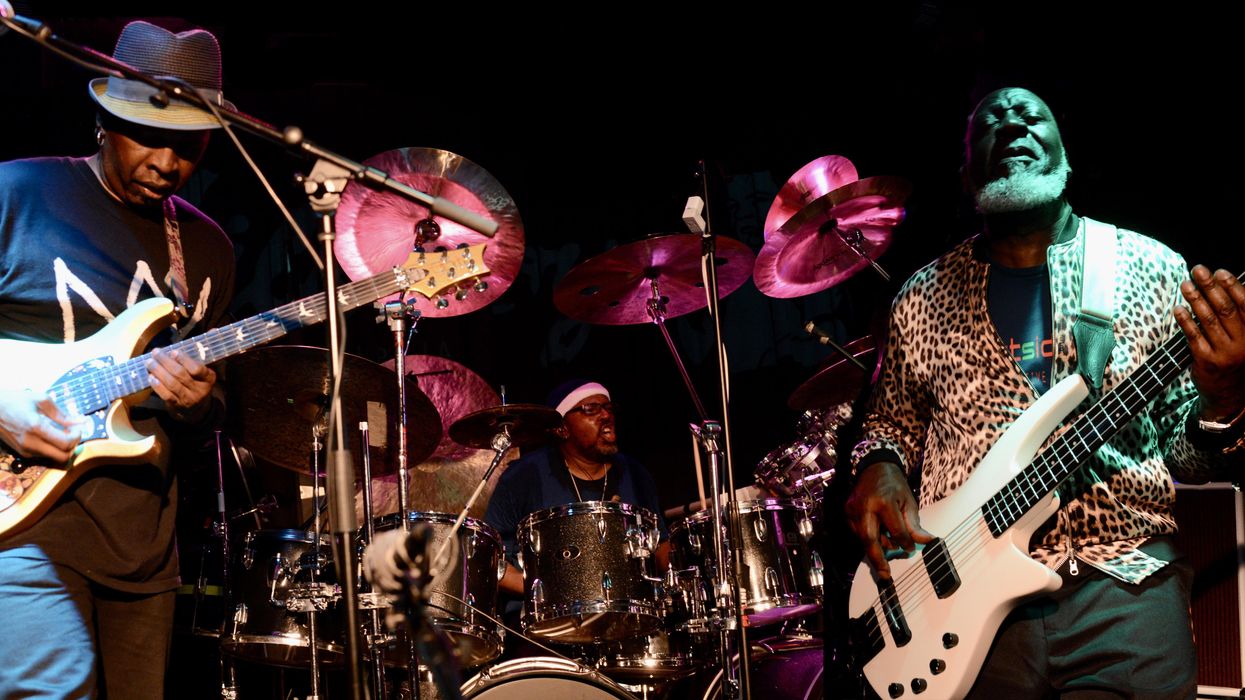
Jimmy James live with the Parlor Greens, featuring organist Adam Scone and drummer Tim Carmen.
Photo by Mitch LaGrow
James is precise and articulate, tending to pick each note, avoiding hammer-ons and pull-offs unless the solo cries out for it. His tone is clean and stompbox-free; his guitar cable runs straight to his amp. When he is ready to open this ethereal portal in a solo, he strides over to the amplifier and quickly flips an overdrive switch. It’s all the crunch he needs.
“I don’t really mess around with pedals,” James explains. “Sometimes, if it’s a very powerful amp and there’s too much headroom for it to break up, I’ll put something in front of it. But very rarely, because I like the sound of the guitar just how it is.”
Parlor Greens recently dropped a new record, Emeralds. The last track, “Queen of My Heart,” is James' homage to his late mother. The recording contains the last words she ever spoke to him, in a video selfie sent to his phone shortly before she passed. His guitar leads cry out in an emotional letting-go, a projection of the hurt in Jimmy James’ soul.
“James Jamerson once told his son, ‘If you don’t feel it, don’t play it,’” James relates to me. “That’s how I approach it. Oscar Wilde said something, too: ‘You can only be yourself, because everyone else is taken.’ That’s what it is. If you take Jimi Hendrix’s guitar and hand it to B.B. King, and you take B.B.’s guitar and put it on Jimi Hendrix, they are still gonna sound like themselves. And my mother instilled that in me. She’d tell me, ‘Have a sound! When you hear a Motown track, you know it’s Motown before the words even hit.’”
I comment to Jimmy that, for a 45-year-old man, a guy who grew up in Seattle during the peak of grunge, his spirit feels pretty old. He explains that listening to that classic music from the ’60s and ’70s is what shaped him.
“When I was young, I would hear things like Johnnie Taylor’s ‘Who’s Makin’ Love,’ or ‘California Dreamin’’ by the Mamas & the Papas,” James reminisces. “Musically and lyrically, all that stuff spoke to me. My friends didn’t get it. They’d say, ‘Why are you listening to that grandparents' music?’ But I loved the lyrics and how there was a story to be told. And when you think about the blues, it’s the foundation. So it all felt grounded to me; that older stuff has a deep conviction to it. You can listen to it and know that they worked very hard, and it came from deep within.
“Sometimes I do feel like I was born at the wrong time. But after my mother passed, I had a dream. I came to her, and I said, ‘Mom, what’s the point of my living? Why can’t I be with you all? We could be a family again. And in this dream, she said to me, ‘Don’t be anxious for nothing, baby. You got better things coming your way. Just you wait.’ And she always had that wisdom. Music can change a lot of things.”
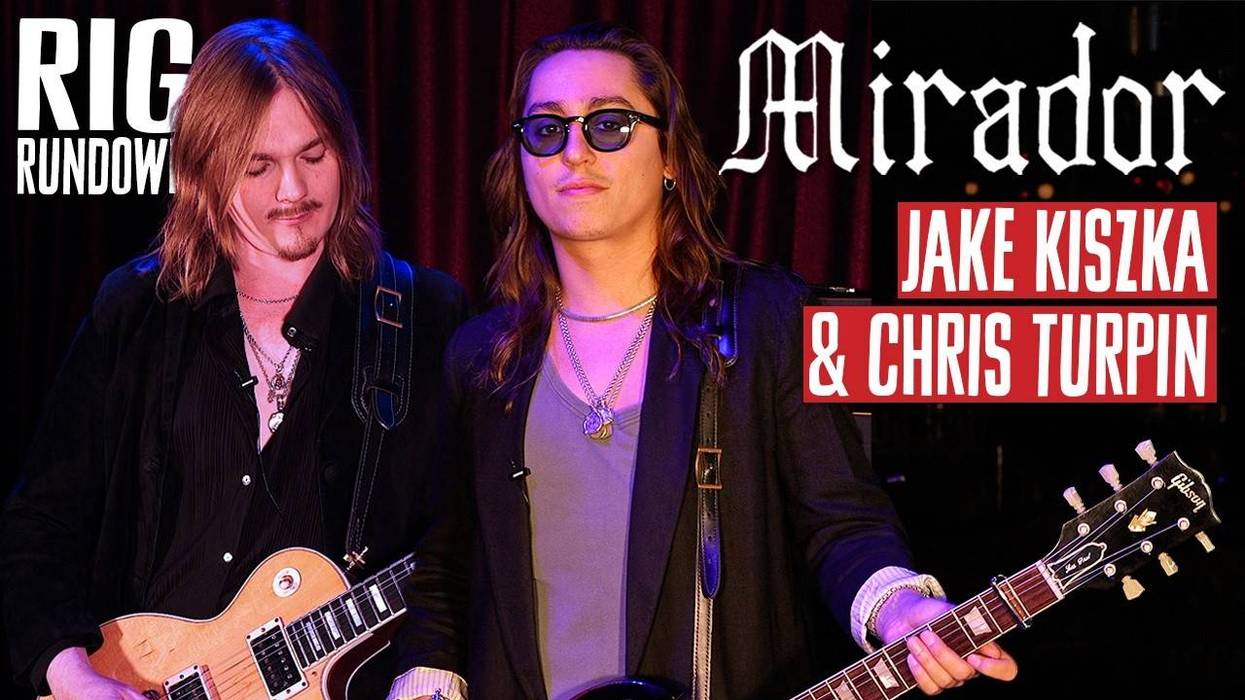
Mirador formed out of the shared passion for good ol’ classic rock ’n’ roll held by Greta Van Fleet’s Jake Kiszka and Ida Mae’s Chris Turpin. The trans-Atlantic band took their blazing, bluesy rock out on the road, and before their show at Nashville’s Brooklyn Bowl, Kiszka, Turpin, and tech Johnny Meyer led PG’s John Bohlinger through the vintage axes and amps they’re using to keep rock alive.
The paint’s been completely stripped from this workhouse 1970 GibsonLes Paul Custom that Turpin scooped from an auction house in Wales, but those sweet, sweet pickups are original. Turpin had to replace both volume pots, and opted to add a Bigsby vibrato. He uses Elixir Strings 19052 Optiweb Strings (.010-.046) on all his electrics and his attacks those strings with Jim Dunlop Ultex Thumb picks. All his instruments are snug over his left shoulder thanks to Pinegrove Leather Guitar Straps. (His custom Mirador Martin 00-28 takes Elixir Strings 16027 Nanoweb Phosphor Bronze strings: .011-.052.)
National With a Novak
Turpin used some electrical tape to secure a Curtis Novak K-Pancake pickup to this 1930s National Triolian. To avoid any unnecessary drilling, the output jack runs via one of the air holes in the top.
6L6 Slammer
Turpin packs a pair of Marshall JTM45 heads, with one serving as a backup. The main one in use on this run has 6L6 power tubes, and runs into a 4x12 cabinet with Celestion Greenbacks.
Chris Turpin’s Pedalboard
<p>Turpin’s pedalboard includes a Dunlop Custom Audio Electronics Cry Baby wah pedal, JAM Pedals Double Dreamer, Analog Man Beano Boost, Analog Man Sun Face, a <a href="https://www.premierguitar.com/tag/boss?utm_source=website&utm_medium=link&utm_campaign=Smartlinks">Boss</a> GE-7, Maxon CS-550, Boss RE-202, and <a href="https://www.uaudio.com/" target="_blank">Universal Audio</a> Golden Reverberator, while his acoustic board carries a Fishman Aura, MXR Carbon Copy, and a Line 6 HX Stomp.</p>
Dearly Beloved
This 1961 Gibson SG is Kizska’s forever-and-always—he calls it “the beloved.” It’s been cracked, taped, and repaired over the years, but it’s still number one. Jake uses custom-made Dunlop coated strings on his electrics.
Juiced-Up Junior
This late-’50s double-cutaway Les Paul Junior was rerouted for a pair of PAF pickups, and is primarily used by Kiszka for slide-playing. The added sideways tremolo unit, from the ’60s, is there for looks only.
Dual Destroyers
Jake runs a dual-amp setup for a monster sound. A Park P50M and a Supro 1932R Royale get the job done, pumped out through a Marshall 4x12 cabinet.
Jake Kiszka’s Pedalboard
<p>Kizska’s acoustic and electric boards carry a pair of Boss TU-3Ws, MXR Micro Amp, TC Electronic Flashback, Fishman Aura, Dunlop Cry Baby, Boss GE-7, <a href="https://www.strymon.net/" target="_blank">Strymon</a> El Capistan, Universal Audio Del-Verb, Universal Audio Golden Reverberator, Electro-Harmonix Micro POG, a pair of MXR Deep Phases, Boss BP-1W, and Boss TU-3.</p><p>A trio of MXR units—DC Brick, Iso-Brick, and Mini Iso-Brick—power the pedals.</p>
When Jason Narducy met Michael Shannon in 2014, it was to celebrate the Lou Reed record The Blue Mask for a one-off performance in Chicago. Narducy, who plays guitar and bass with Superchunk, Bob Mould, and Sunny Day Real Estate among others, was familiar with Shannon’s work in films like Take Shelter and The Iceman—2014 was right around when Shannon became a bona fide Hollywood star. But he didn’t know that Shannon was also a lifelong musician. He sang in choirs and played in orchestras in school, and his indie-rock band, Corporal, put out their debut record in 2010, with Shannon as lead vocalist and guitarist. He portrayed George Jones in the 2022 miniseries George and Tammy, and handled all the musical performances himself.
When Narducy and Shannon realized they loved many of the same artists, they decided to produce more one-time-only shows honoring them: They played Neil Young’s Zuma, Bob Dylan’s Highway 61 Revisited, and joined tributes to T. Rex and the Cars. In 2023, they turned to R.E.M.’s debut Murmur, which was marking its 40th anniversary that year.
Narducy had worked with R.E.M. bassist Mike Mills before, so he invited him to the show at Chicago’s Metro, but it was anyone’s guess if he’d show. Backstage in the green room before the gig, the band was running through tunes with Scott Lucas of Chicago band Local H (named after two R.E.M. songs, “Oddfellows Local 151” and “Swan Swan H”) when someone knocked on the door. It was Mills, who introduced himself to every band member and shook their hands. Of course, Narducy suggested he join them onstage, but Mills politely demurred, insisting he didn’t want to steal the show.
Narducy remembers feeling confused when the crowd exploded during a random moment during the set. Neither he nor Shannon noticed, but Mills had crept onstage to sing backing vocals. He continued to make cameos throughout the set. At one point, he leaned in to then-bassist Nick Macri and yelled, “You’re fucking killing it!”
Michael Shannon (l) and Jason Narducy lead the band through their first R.E.M. gig back in 2023, playing Murmur front to back.
Photo by Cameron Flaisch
Since that show, Shannon and Narducy have undertaken R.E.M.’s Reckoning and Fables of the Reconstruction. When they began collaborating, the pair initially had a “strict code of ethos,” says Shannon. “We would pick a record, play it once, and that was it,” he explains. “Then people said, ‘You can’t just do that once. Do it again. You have to do it where we live.’” Narducy, a seasoned veteran of the road, wondered if Shannon would want to tour. Shannon remembers, “I said, ‘Well, I guess I’ve never been on a rock ’n’ roll tour before. I’ve heard so much about it. Let’s give it a shot.’”
They took Fables of the Reconstruction around the U.S. with a band assembled by Narducy: bassist John Stirratt, guitarist Dag Juhlin, drummer Jon Wurster, and keyboardist Vijay Tellis-Nayak. Narducy met with Julin before the tour to divvy up guitar parts, but otherwise, the band practiced just once together before hitting the road. “We do a lot of research on our own,” explains Narducy. “It does take a lot of homework to learn these songs.”
In February and March 2026, Michael Shannon & Jason Narducy And Friends—the outfit’s official name—are taking R.E.M.’s Lifes Rich Pageant on the road, celebrating the record’s 40th anniversary with 22 shows across the U.S. The run includes back-to-back shows in R.E.M.’s hometown of Athens, Georgia, where Mills, vocalist Michael Stipe, guitarist Peter Buck, and drummer Bill Berry reunited to perform “Pretty Persuasion” in February 2025 with Shannon & Narducy And Friends.
Plenty of artists of a certain caliber are precious about performing in cover projects, but neither Shannon nor Narducy feel an ounce of conflict about it. “A lot of these songs are canonical as far as I’m concerned,” says Shannon. “It’s not like you wouldn’t play Mozart because you didn’t write it.”
“Brilliant songs need to be played,” Narducy adds. “I hope that the audiences sense that we are celebrating just as much as they are. I think we consider ourselves a conduit of reinterpreting these songs. And when I say reinterpreting, not like a vast rearrangement. No one can play like those guys did. Plenty have tried.”
During a show at the 40 Watt Club in Athens, Georgia, Michael Shannon & Jason Narducy And Friends are joined by some familiar faces: R.E.M. bassist Mike Mills (l) and Peter Buck (third from right).
Photo by Mike White
Narducy discovered R.E.M. in high school; decades later, as a professional musician, relearning the band’s catalog has felt like “taking a college course, one that I really enjoy and hopefully makes me a better musician and storyteller.” Narducy sneezes: “Sorry, talking about college makes me sneeze. It’s very rewarding, is what I mean to say.”
As it turns out, Peter Buck’s jangly, genre-defining playing left an unseen mark on Narducy’s own guitar work. “I’m realizing that Peter had a bigger influence on me than I even realized,” says Narducy. He often writes with chords like F# major with the B and E strings open—a “Peter Buck go-to chord.” Ditto A9, which appears in many early R.E.M. tunes. Buck, explains Narducy, would deconstruct Mike Mills’ cowboy-chord skeletons for songs, paring them back to “more of an arpeggiated, single-note approach. That’s obviously one of his signature sounds, and kind of created that jangle-rock thing.”
“Mills’ bass parts are so inventive,” Narducy adds. “You listen to a song like ‘Driver 8,’ that’s not the obvious bassline, especially if you just hear it isolated. It almost sounds like a different song, but married with Peter’s guitar part, it’s just magical, uplifting.”
To tackle Buck’s guitar parts, Narducy uses a Fender American Ultra Telecaster into a Fender Hot Rod III Deluxe—Juhlin plays a Rickenbacker like Buck did, and Narducy worried that two of them onstage wouldn’t jibe as well. A Strymon Mobius injects chorus when needed.
“A lot of these songs are canonical as far as I’m concerned. It’s not like you wouldn’t play Mozart because you didn’t write it.” —Michael Shannon
Stipe’s lyricism, too, is a point of creative fascination for both Shannon and Narducy. “Well, it’s certainly not head-on, you know?” says Shannon. “If he writes a song about love, he’s not writing a chorus like, ‘Baby, let me love you.’ It’s a lot more rooted in mystery. A lot of rock ’n’ roll seems to exist in order to give you an escape from real life and make you feel like you’re in some alternate universe where everything’s super exciting, but he’s like, ‘No, we don’t have to run away from real life when we’re singing our songs. Real life is pretty interesting if you look at it closely.’”
Shannon refers to “Kohoutek,” a track off of R.E.M.’s third record, Fables of the Reconstruction. (In early 2025, Narducy, Shannon, and the band performed that album’s “Driver 8” on Tonight Show Starring Jimmy Fallon.) Shannon explains it as a song about love between young people. “It doesn’t have the typical verbiage that you would associate with a love song,” he says. “It’s talking about sitting in the garden, standing on the porch, building a bridge. And yet, to me, it’s much more eloquent and moving, even though the language outside of the song is less ornamental, more matter-of-fact.
“No one can play like those guys did. Plenty have tried.” —Jason Narducy
“Michael Stipe is unique as a frontman because a lot of times, frontmen present themselves as on top of things, or like, ‘I’m a sexy alpha badass,’ and Michael Stipe is like, ‘Jesus Christ, life is overwhelming and confusing.’ He’s incredibly sexy and a badass and all those things, but he’s so vulnerable and ready to admit that he’s struggling just as much as anybody else. There’s a lineage of front people that have taken that and ran with it, but I think he was one of the first to introduce that point of view as a frontperson in a band.”
Even though Shannon and Narducy initially swore to only do one performance per album, the magic of these R.E.M. gigs hasn’t worn off as they’ve grown into a new tradition. “Even on the very last show of the last tour, there were moments throughout the show where I’m uncontrollably smiling at each member at some point throughout the show,” says Narducy. “It’s just like, ‘Here we are.’”
John Scofield is an absolute titan of jazz guitar. He’s had an illustrious solo career spanning over four decades and he’s shared the stage with the most important musicians of our time. In this lesson we’ll look at his brilliant single-line approach that endears him to jazz audiences around the globe.
Ex. 1 is about as Scofield as we can get without consulting a patent lawyer, though a good case could be made that he took this idea from pianist Thelonious Monk. You can hear this descending whole-tone-based lick in many of Sco’s solos. The notes impart a strong Bb7#11 sound and the final note is pushed off the fingerboard and returned in a vibrato-like motion. That’s another great Scofield-ism that just can’t be ignored.
Ex. 1
Turn up that chorus pedal and hone your string-skipping chops with Ex. 2, a 1980s-style 16th-note funk lick. The basic sound is G7, but with a host of alterations. The G half/whole diminished scale (G–Ab–Bb–B–C#–D–E–F) is clearly important, but it doesn’t explain everything Scofield plays. As Scofield has mentioned regarding playing over vamps like this one, “I’m not really sure what I’m doing. It’s just an in-and-out bop style.” Feel free to include chromatic approaches and blues licks as done here as well.
Ex. 2
The IIm–V–I lick in Ex. 3 shows how Scofield could extend basic bebop mannerisms into something distinctly original. It’s clear that the thinking is F Lydian dominant (F–G–A–B–C–D–Eb) over both the Cm7 and the F7 chords. Scofield would occasionally “summarize” both chords as simply F7.
Ex. 3
Scofield’s now-classic albums with Medeski, Martin, and Wood have garnered mass appeal among funk and jam band enthusiasts over recent decades. Most of his playing on these records is roots-based and you’ll hear plenty of straightforward, blues-inspired licks like this one (Ex. 4) in B minor.
Ex. 4
The B Dorian (B–C#–D–E–F#–G#–A) lick in Ex. 5 is a good example of how Scofield develops a simple motive and answers it with contrasting material. Pinch harmonics can always be used in Scofield’s style. Don’t be concerned with these harmonics generating a specific pitch or even getting them to sound perfect—the randomness is all part of the charm.
Ex. 5
Superimposing ideas in novel ways is important to Sco’s approach and a great way to generate interest over static harmonies. Ex. 6 begins with a simple root/fifth figure in Bb that’s shifted up a half-step to B, and finally resolving back to Bb at the end. It’s an effective way to establish tension and release in a line.
Ex. 6
In recent years, Scofield has embraced a cleaner tone on some of his straight-ahead recordings. Think Vox amp and no RAT. Ex. 7 is an ever-flowing line that he might play over the first phrase of an F blues. Notice how the pickup bar is a G7 idea over the C7 and the first part of measure 1 is actually a C7 line over the F7. This kind of “misalignment” is something that intermediate players often miss, trying to faithfully match the chords all the time. Before long, the music is back on track and matching the chords in a more predictable manner, at least until the eclectic use of an A major line leading into the Bb7. Finish everything up with a Sco trademark major seventh double-stop.
Ex. 7
Ex. 8 is a particularly guitaristic way to play over the second phrase of an F blues. Even though the line is fingered in the 6th position, why not use an open string? The open high E (a #11) gives us the opportunity to get a cool angular sound to the Bb7 line that would otherwise be impossible.
Ex. 8
This phrase (Ex. 9), which begins in the 8th measure of the blues, shows Scofield’s mastery of bebop language. The D7b9 lick pushes into Gm7, which begins the final phrase of the 12-bar form. The IIm–V is clearly a simple sequence from C Lydian dominant (C–D–E–F#–G–A–Bb). The big lesson here is the importance of knowing your bebop fundamentals.
Ex. 9
Now that we’ve broken out the nuts and bolts of this lesson, let’s listen to few essential Scofield tracks to get our ears right. Even jazzers were making music videos in the 1980s.
John Scofield Protocol
“Protocol” from Still Warm, has a classic fusion groove thanks to drummer Omar Hakim and bassist Darryl Jones (both of whom played with Scofield in Miles Davis’ group). Sco’s tone is wide thanks to his signature chorus sound, an often-imitated element of his style.
Wee
When Enroute landed in 2004 it instantly became a classic guitar trio album. Recorded live at the Blue Note, it featured Sco’s longtime trio of drummer Bill Stewart and mentor/electric bassist Steve Swallow. “Wee” is a “rhythm changes” tune, which isn’t that groundbreaking, but the playing takes Denzil Best’s most well-known composition to another planet.
Chicken Dog
In 1998, Scofield teamed up with funk-jazz stalwarts Medeski, Martin, and Wood for A-Go-Go, which is a standout in Sco’s discography. This was the album that introduced him to the jam band scene and informed many of his more recent albums.
After a devastating theft in 2021, the metal band’s guitarist rebuilt his tone empire around some life-changing loans.
Chicago post-metal band Russian Circles had to battle their way back to gear heaven. In 2021, the bulk of the band’s gear was stolen while on tour, leading to a years-long rebuild. As a result, many of the items you might’ve seen in guitarist Mike Sullivan’s Rig Rundown back in 2017 are long gone.
PG’s Chris Kies recently met up with Sullivan at the band’s Chicago practice space, where they’ve resided for nearly 20 years. Check out some highlights from Sullivan’s new, resurrected rig below.
Sullivan has been favoring Dunable guitars of late, borrowing one from tourmate Chelsea Wolfe after his other guitar was nabbed. The green one is based on the Dunable Narwhal, with a more Gibson-like scale—comparable to Sullivan’s old Les Paul. This Narwhal has a mahogany body and neck, maple top, and a coil-tap function for the two humbuckers: a DiMarzio PAF 26th Anniversary and a DiMarzio Joe Duplantier Fortitude signature. Vibrating atop those pickups are D’Addario strings—a set of .011–.056, with the low E swapped for a .058. Sullivan uses a number of different down tunings, all with D-A-D-G-A-D as a starting point.
The white Dunable has a maple neck, a 25.5” scale, and is tuned lower, with a .062 for the low E string. It’s used for drop-A tunings, and has the same DiMarzio pickups.
Gettin’ Hi
Sullivan was turned onto Hiwatts after acquiring some on loan in the wake of the gear theft, and he hasn’t turned back since. The cabinets are loaded with Hiwatt Octapulse speakers.
Mike Sullivan’s Pedalboard
Sullivan runs two pedalboards. The first includes a Peterson tuner, Shure P9HW, Dunlop CBM95 Cry Baby Mini, DigiTech Drop and Whammy Ricochet, and MXR Phase 95.
The motherboard carries a Dunlop DVP3 volume pedal, a Friedman BE-OD Deluxe, Strymon Dig, TimeLine, and Flint, a T-Rex Image Looper, DigiTech JamMan Stereo, MXR CAE Boost/Line Driver, Foxrox Octron3, Electric Eye Cannibal Unicorn, Maxon Apex808, Fortin-Modded Ibanez Tube Screamer, and a Radial Shotgun Guitar Splitter and Buffer.