

In the early 1960s, bands that were playing live were fairly limited by the available amplifiers on the market. Oftentimes the guitars could not be heard over the screaming fans, or the bass would sound muddy and distorted at higher volumes. In 1963, the Kingsmen released the hit song “Louie Louie.” Their bassist, Norm Sundholm, wanted an amp with the capability to play louder and cleaner. As luck would have it, his brother Conrad was an electronics wiz, and together they developed the legendary Sunn Amplifiers.
Word started to spread about Sunn and their new and exciting line of high-powered tube amplifiers. Sunn was building amps out of a family garage in the Portland, Oregon area, and developing models that could pump out 150 watts of tube power. Their solid-state amps, meanwhile, could push a whopping 300 watts. Back in the day, Sunn amps were commonly seen in the backlines of Jimi Hendrix, Led Zeppelin, the Who, Mountain, and any band that liked to play loud.
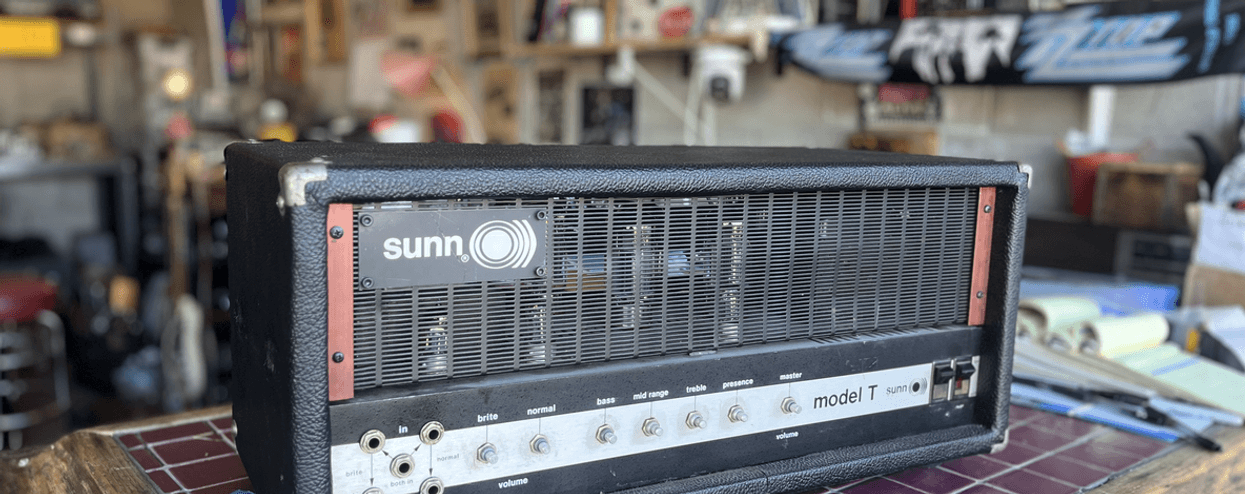
On the bench today, I have a 1973 Sunn Model T. I have had a total of 11 Model Ts on the bench this month, as the band Sunn O))) required some pre-tour servicing. Sunn O))) is known for using a massive wall of Sunn amplifiers—an integral component of their thunderous sound. Although each amp gets a lot of heavy use, they have all been well maintained over the years. My job is to evaluate each one for reliability and make sure that the amps have all the necessary updates.
To start, I bench-test the amp for a good while. During this time, I’m testing for noise issues, power output issues, and overall tube health. The Model T uses three 12AX7 preamp tubes and four 6550 output tubes. Most of the amps have solid replacement tubes installed, so I checked the bias and moved on to the circuitry. I love how clean the circuit layout is in these amps. Everything is hand-wired point-to-point, and all the components are accessible. It’s truly a delight to service old Sunn amps like this.
About half of the amplifiers I saw had the usual upgrades—most importantly, the filter and bias capacitors. I wanted to make sure that the power supplies were refurbished and running strong, so any of the amps with original electrolytic caps got a re-cap. This ’73 Model T had the bias capacitors replaced, but the filters were original. The filter circuit consists of a filter capacitor can, which is mounted to the outside of the chassis. The can houses two capacitors, each 80uf. There are also two very large capacitors inside the chassis, which are each 20uF @ 600V. These caps, coupled with two chokes, are the first stage of the power supply. Most amps use filter capacitors rated for 500V, but the Model T sees voltages up to 550V.
The Sunn Model T was introduced in 1973, which makes this amp part of the first generation. The secret to the massive sound from these amps is in the beefy power supply and the ultralinear output section. Typically, in a normal tube amp, the plates of the output tubes are connected to the output transformer primaries. The tube plates are powered via the output transformer, as the output transformer’s center tap is connected to (typically) the first node of the power supply. The output tubes’ screen grids are connected to a separate node in the power supply, typically the second.
“The pure force that comes from these amps is simply unparalleled.”
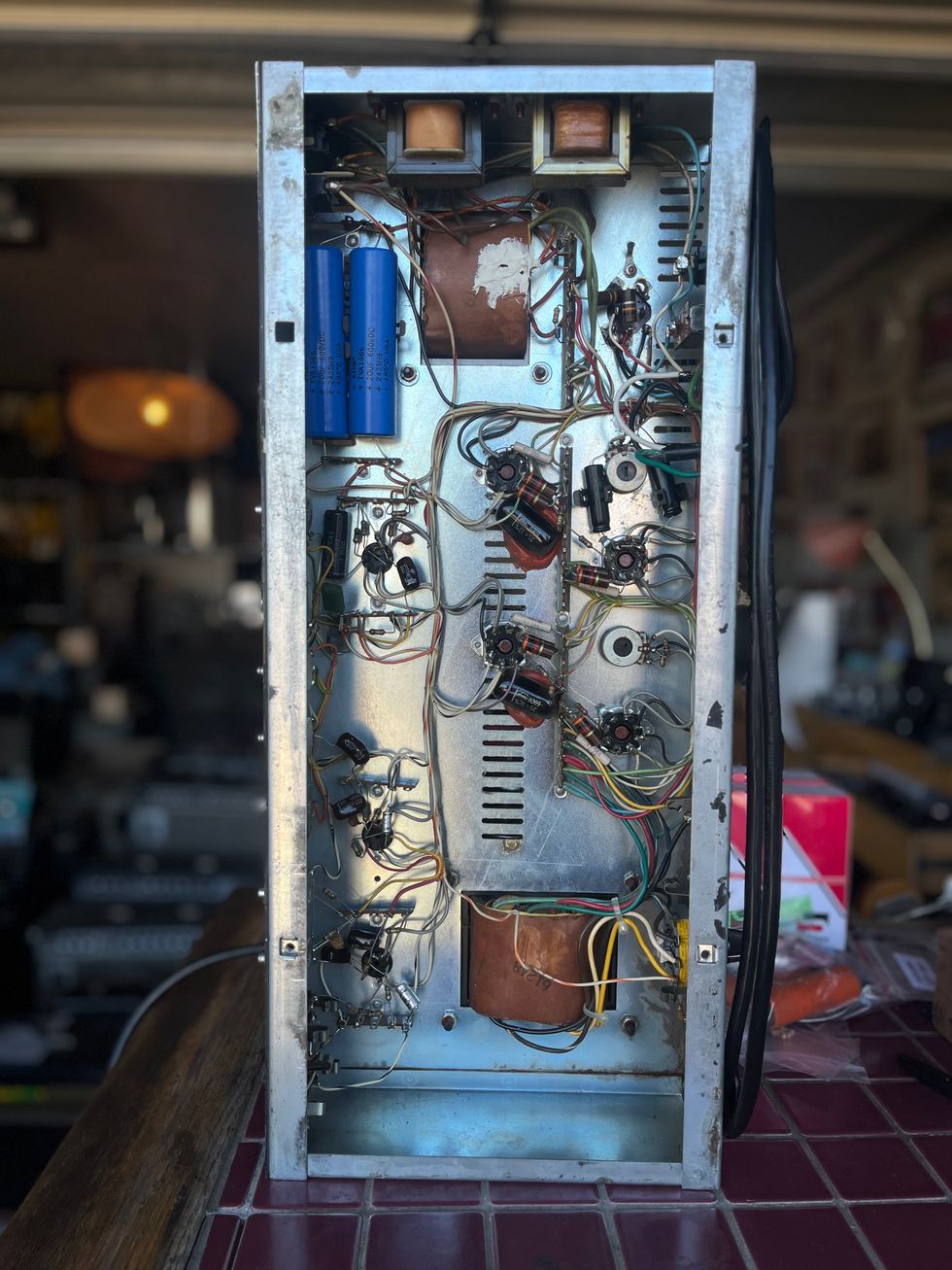
…and the inside.
Ultralinear circuits were invented in the 1950s, originally for hi-fi amplifiers. Hi-fi amps are designed to be loud and clean, as the listener does not necessarily want to hear their records distorting. In an ultralinear output section, the output transformer is specially designed with primary taps for not only the tube plates, but the screen grids as well. This is the main difference between normal vs ultralinear circuits, where the screen grids are no longer separate from the plates. This change in tube operation allows the screens to fluctuate in proportion with the plates, which introduces a form of negative feedback.
Contrary to the typical definition of “feedback,” where a sound loop builds upon itself harshly, negative feedback consists of taking the output signal, which is refined and ready to hit the speaker, and feeding it back into a point in the circuit. By design, this output signal is out of phase with the signal moving through the circuitry. Out-of-phase signals will cancel each other out. This concept of subtraction can be used to remove certain frequencies in order to carve the final output tone. This is the magic of ultralinear amp circuits: They can produce more power with less distortion.
The Model T has two channels: bright and normal. There’s also an option to combine the channels, with the ability to mix the volumes of both for a wider range of character. Plugging into this amp, I can absolutely feel the power behind it. The low end is massive, and I can max the volume without getting too muddy. The pure force that comes from these amps is simply unparalleled, and the strength of the build quality is an added bonus.