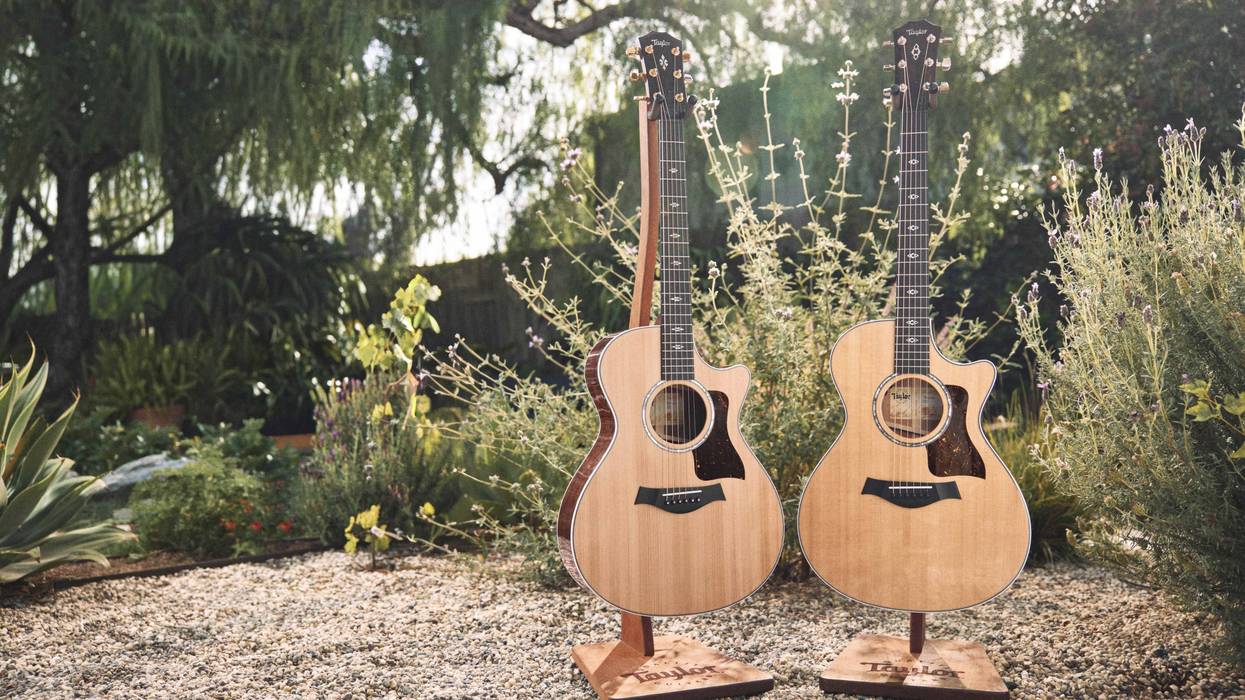
This fantastic ’59 was treated to a refret and pitch-perfect setup by the techs at Carter Vintage in Nashville, so it still plays like a dream, 66 years later.
It’s been a minute since we’ve gotten to share something truly special with you all, and today’s subject is one of the finest: a 1959 GibsonLes Paul Custom.
Gibson introduced the first Les Paul Customs in late 1953, following a couple of prototypes built for Les Paul a year earlier. Les wanted what he called a “more elegant” version of the Les Paul Standard, something that looked sharp on the booming new medium of television. His request was specific: a black guitar with refined appointments and design tweaks to match his playing style.
The original Customs carried two pickups: an alnico “staple” single-coil in the neck and a P-90 in the bridge. They featured black finishes, white binding, gold hardware, and the split-diamond headstock inlay we now associate with the model. The headstock was slightly larger than the Standard’s, and the carve at the scarf joint was lengthened for easier play near the nut.
Perhaps the most distinctive feature was the fretwork. Les requested low, wide frets, which led to the nickname the “Fretless Wonder.” While iconic, these frets can feel unusual to modern players. Still, Les’ highly developed technique probably made frets almost unnecessary for him. Another major innovation appeared on the Custom: the debut of the ABR-1 Tune-o-matic bridge, finally giving players accurate intonation adjustment.
Here’s an interesting twist in the Custom’s story. Les’ original vision called for the Standard to be built from solid mahogany with a gold-painted top, and the Custom to use a maple cap on mahogany, finished in black or white. Gibson flipped those specs. The production Standard ended up with a maple cap, while the Custom was built entirely of mahogany.
The all-mahogany build gave the Custom a darker sound, so Gibson used an ebony fretboard to restore some brightness. Meanwhile, the maple-topped Standard was paired with a warmer Brazilian rosewood ’board. Ironically, it wasn’t until 1968 that the Custom attained the maple top Les had wanted all along.
“Instruments like this inspire players across generations.”
The next major leap came in 1957, when Gibson introduced Seth Lover’s groundbreaking humbucking pickups. By mid-year, the Les Paul Custom carried not two but three humbuckers. This gave players a wide tonal palette spanning jazz, pop, country, blues, and eventually rock. In time, artists like Keith Richards and Jimmy Page made unforgettable recordings on Customs, further cementing the model’s place in music history.
That brings us to the stunning 1959 Les Paul Custom currently here at Carter Vintage. I had the chance to spend a morning with it, and it’s easily one of the best-playing guitars in the shop.
Remember my earlier complaint about the “Fretless Wonder” frets? This one has been given a perfect refret by our repair shop. The result is transformative. Suddenly the Custom plays effortlessly, like a hot knife through butter. The setup is dialed in to perfection, and honestly, I walked away a little jealous. It convinced me that a couple of my own guitars need some attention from our techs.
Plugged into a Deluxe Reverb, the guitar absolutely sang. The original PAF pickups deliver remarkable clarity and punch. There’s excellent balance between the bridge and neck, and the middle position, often prone to phase issues, sounds smooth and full-on. Perfect for bluesy bends or country runs.
The neck deserves its own praise. It’s the quintessential ’59 carve: not too big, not too thin, with shoulders that make it feel more manageable than its actual measurements (.89" at the nut, 1.01" at the 12th fret) suggest. Simply put, it’s a neck that disappears in your hands, feeling comfortable, fast, and inspiring.
This particular Custom has been thoughtfully maintained. Aside from the refret and a new nut, the electronics and pickups remain untouched, and the finish is all original and in excellent condition. At about 9.5 pounds, it’s substantial, but its balance makes it feel lighter than the number on the scale suggests.
The Les Paul Custom has always been a guitar steeped in history. Born from Les Paul’s vision, refined by Gibson’s innovations, it was carried into legend by the players who made it sing. This 1959 example embodies all of that and more. With its perfect refret, killer PAFs, and ideal ’59 neck, it’s a joy to play and living proof of why this model continues to hold such a revered place in guitar history.
For me, it wasn’t just another morning with a guitar—it was a reminder of why instruments like this inspire players across generations.
I’ve been writing about music and music gear, in one form or another, for many decades now. I’ve been playing music—writing, recording, performing, for even longer. And I’ve been reading music magazines—specifically guitar magazines—longest of all.
As a child, music magazines were treasure troves of insider knowledge and practical—or, depending on the artist being interviewed, thoroughly dubious—wisdom. They were to be studied, pored over, dog-eared, and piled in messy, corner-of-the-room stacks that eventually got jammed into messier, stuffed-to-the-point-of-exploding cabinets. With guitar magazines, this fascination, and pack-rat behavior, was amplified in every way. It felt like the secrets to an entire universe were unlocked every month. And not just the basics like how to play, what to buy, and what was new. You learned how to write and arrange music, how to change strings, how to repair necks, how to wire pickups, how to modify amps, how to design a signal path, how to establish your own unique sound. How to create.
This creative spirit is what I feel has always set guitar magazines apart, from back in the days when the industry was crammed full of titles and print was the main engine, to now, when it’s even more crucial to give readers something tangible—to entertain, but also to teach. To explore and inspire. To discuss, commiserate (because let’s face it, this world can often be frustrating and challenging), and build community around our shared obsession.
This mindset led me into journalism and has kept me here all these years. And so it’s with tremendous excitement and pride that I join Premier Guitar as your new Editorial Director. I’ve been reading the title since its inception, and over the years have contributed stories on artists I greatly admire—I’ll point to interviews with Thurston Moore and Jim Campilongo as two recent examples. I’ve known our recently retired Editorial Director Ted Drozdowski since I was a managing editor in my first magazine job out of college (trust me—that’s a long time), and I thank him for this incredible opportunity.
I’ve always loved Premier Guitar for delivering quality content from some of the most knowledgeable people in the industry. And it’s not just about putting the stars of the day in every issue—we tell stories from every corner of our musical universe. This issue exemplifies that approach. We celebrate the unsung heroes who keep our industry humming, with a feature on StewMac and Allparts—companies that have revolutionized the DIY guitar universe, and spotlight the often-overlooked guitar techs whose expertise keeps our biggest names sounding their best, night after night.
We also showcase the standard bearers and icons. We sit down with legends like Vernon Reid, a fellow New Yorker whom I had the privilege of interviewing about his new solo album, Hoodoo Telemetry, which finds him gathering sounds and influences from across space and time. We go deep with ascending talents like Daniel Donato, whom I recently watched deliver some incendiary cosmic country with his band, the aptly named Cosmic Country, ripping truly mind-boggling licks on his DGN Custom Epoch semi-hollow under a perfect late-summer evening sky. We dive into experimental territories with Los Angeles metal band Agriculture and their challenging new record The Spiritual Sound, and visit with Winnipeg’s Living Hour to explore their dreamy, noisy soundscapes.
And on our cover, we have Daron Malakian—a figure who straddles both worlds as one of the oddest and most unlikely mainstream rock stars—examining his creative process with both System of a Down and his own project, Scars on Broadway. His approach to songwriting and guitar playing challenges conventional thinking in the best possible way.
But none of these artists outshine our columnists, who month after month provide some of the most insightful commentary in the guitar universe. Their expertise and passion illuminate everything from technique to tone, from vintage gear to cutting-edge technology. They cover everything from oddities to esoterica to recording to performing, drawing from lifetimes of experience.
And then there’s the gear itself—the star of our show. Whether you’re hunting for your next dream guitar, investigating the latest pedal innovations, digging into amplifier design, exploring software and recording technology, or tracking down that one missing link that’ll finally complete your rig, we’re here to guide you through it all.
There’s also exciting news on the horizon. We’re working on a fresh new look and implementing several behind-the-scenes improvements that will enhance your Premier Guitar experience. Stay tuned—good things are coming.
My goal is simple: to continue Premier Guitar’s tradition of being your most trusted guide through this ever-changing landscape. Whether you’re a weekend warrior, a touring professional, or somewhere in between, we’re here to feed your passion, fuel your creativity—and help you seriously geek out on guitars and gear.
Today at Guitar Summit in Mannheim, Germany, C. F. Martin & Co.® unveiled the OM Mikael Åkerfeldt, a limited-edition acoustic created with the Opeth frontman. Only 74 guitars will be made worldwide, honoring the Swedish musician’s 1974 birth year.
The OM Mikael Åkerfeldt blends Martin’s renowned craftsmanship with bold new features. It pairs a torrefied spruce top with a dramatic three-piece back of Guatemalan rosewood and an East Indian rosewood wedge, accented by European flamed maple binding. For the first time in a traditional body, Martin has introduced its Low Profile Velocity neck—designed for our SC models, and ideal for players used to the speed and comfort of an electric.
Personal details include an ebony fingerboard with black mother-of-pearl Roman numerals and black Liquidmetal® bridge pins for added sustain and clarity. Inside, VTS-treated spruce and Golden Era scalloped X-bracing—as featured on the Modern Deluxe Series—deliver vintage warmth and dynamic response.
“Is this the best guitar I’ve ever played? Including the ones in your museum? I believe so,” Mikael said. “It just sings—the resonance, the clarity, the low end. Everything about it feels magnificent.”
Each guitar includes a laser-etched stainless-steel label and custom Harptone case.
ABOUT MIKAEL ÅKERFELDT
Mikael Åkerfeldt is the frontman, guitarist, and primary songwriter of the pioneering progressive metal band Opeth. Since joining in the 1990s, he has led the group from its death metal roots into genre-defying territory, blending guttural growls with clean baritone vocals and weaving progressive rock, folk, and classical influences into its sound. Under his leadership, Opeth has earned two Swedish Grammis awards and established itself as one of Scandinavia’s most influential metal bands.
Mikael's artistry extends well beyond Opeth. He co-founded Storm Corrosion with Steven Wilson, contributed vocals to Bloodbath, and composed the score for the Netflix series Clark. Ranked among the greatest modern metal guitarists, he is also a devoted vinyl collector and music historian with a deep reverence for tradition and craft. His connection to Martin guitars goes back to the early ’90s, when he sold them at a small shop in Stockholm. Decades later, that relationship comes full circle with his own signature Martin—a collaboration that unites elegance, darkness, and uncompromising creativity.
In December of last year, Tony Rice passed away. He was/is my all-time favorite guitarist. Like many of his fans, my love of his playing has likely transcended obsession. In fact, at the time of writing this, I have transcribed over 100 Tony Rice solos. That puts me in a unique position to share with you not only my favorite Tony Rice licks but what I think might be Rice's favorite licks, if the frequency with which he played them is any indication.
These examples can be found in almost every Tony Rice break. They are integral to his sound and they can become part of your sound too. This comes with one small warning though: These licks are not meant to be parroted off this page. A big hallmark of this sound is to use these phrases but to vary them, and create your own versions of them. Let's remember Rice by innovating on his past achievements the same way he innovated on the achievements of the players that came before him.
How to End a Bluegrass Song
One of the most famous and enduring Tony Rice licks is this signature tag. A tag is a common way to end a bluegrass fiddle tune or vocal song, the most generic tag being the ubiquitous "shave and a haircut." In Ex.1, you can see what's called a "double" tag. The first tag ends on beat 3 of measure two, before the open 3rd string on beat 3. The remainder of the lick forms the second tag, which eventually morphs into a variation of the Lester Flatt "G run."
Rice's note choice is predominantly major pentatonic but includes an occasional b3 that always resolve down to the 2 or up to the 3. As I say to my students, "Blue notes need buddies." Playing these pairs of notes with articulations like slides and pull-offs that cross bar lines is an important part of Rice's style.
Tony Rice Ex. 1
Use Your Chords
If you're familiar with triads on the D, G, and B strings, you can turn those into bluegrass licks as well. Rice has used the triads in Ex. 2 in a handful of different and interesting ways. He's used the last two chord shapes to form the main riff for "Me and My Guitar," and employed those same shapes to punctuate the end of his "Cold on the Shoulder" kick-off. Sometimes you can see him expand this idea by using even more chord shapes to descend the neck. He would use something like Ex. 2 in a G major context but would be heavily implying G Mixolydian mode by using the F major and D minor triads.
Tony Rice Ex. 2
That One Lick
I've seen this passage referred to multiple times as "that one Tony Rice lick." He uses variations of this passage to finish breaks in "Your Love Is Like a Flower," "Ain't Nobody Gonna Miss Me When I'm Gone," and "Gold Rush." It serves the function of a statement piece to assert his personal voice on the instrument before handing off the spotlight to the next instrumental break or verse of a song with vocals.
As you play Ex. 3 be mindful of how you use your pinky. Every note on the 10th fret is played with the pinky, including a brief pinky barre on the 10th fret of the 3rd and 4th strings.
Tony Rice Ex. 3
Pull-Off Central
This lick has been featured in recordings, but I associate it much more with Rice's live sound. Whenever Rice needs a second to think about what to play next, Ex. 4 seems to come to his fingers first. The note choice here lands firmly in the minor pentatonic camp but he manages to create a little bit of an outside sound with the third iteration of the pattern that brings in the b5 at the 6th fret of the G string.
Tony Rice Ex. 4
Escape Notes
Have you ever been stuck up the neck improvising with no idea how to get back down to something more familiar? Me too! So, let me introduce you to escape notes. Sometimes you can find an open string that will continue your line in a linear fashion while freeing up your hand to shift down the neck. Take a look at the F, E, and D eighth-notes in the first measure of Ex. 5. Rather than playing those three notes in position, Rice is using the open 1st string so he has time to shift his hand while continuing his eighth-note line.
There are examples of Rice using variations of licks like this in "Blue Railroad Train," "A Hundred Years from Now," and "Likes of Me." You can use this in a D major context or in a G major context over a D chord.
Tony Rice Ex. 5
Acoustic Bends
It can be done, and in a situation like this we're not necessarily shooting for something perfectly in tune. In Ex. 6 you can see that pulling down on the 4th string at the 3rd fret will bring the note closer to F#, the 3 of the chord, but in practice Rice usually doesn't get all the way there.
Tony Rice Ex. 6
Phrasing
If you asked a random flatpicker at a bluegrass festival to play a Tony Rice lick, they would probably play something like Ex. 7. These types of phrases have endless variations and demonstrate Rice's long-standing influence on bluegrass music. These licks are built from a G minor pentatonic (G–Bb–C–D–F) bone structure but always feature a pull-off from the 2nd fret to the 1st fret on the B string and a slide from 3rd to 4th fret on the G string. This pull-off and slide are great reminders that blue notes need buddies.
Tony Rice Ex. 7
True Minor
Bluegrass isn't all major tunes though. There are standards in minor keys. We're talking about tunes that are actually minor—not just playing minor pentatonic licks over major chords. With that in mind, it would be wrong of me to not mention Ex. 8, one of Rice's favorite improvisational ideas to employ over minor tunes. This kind of lick is all over Rice's original compositions in minor keys and the recordings he made with David Grisman. The idea is framed in a slightly ambiguous way, so you can find Rice using it in A minor and D minor.
Tony Rice Ex. 8
It's an impossible task to completely distill Tony Rice's playing into a single lesson. I would point you to nearly any album in his discography to get the essence of modern bluegrass guitar right from the source. His touch, feel, tone, and vibe forever changed acoustic music and we all will be eternally grateful.
Essential Tony Rice Videos
Tony Rice liked to perform "Me and My Guitar" with an extended jam in the middle. Many licks from this lesson appear in his guitar break at 6:00.
Tony Rice's "Church Street Blues"
There's very little footage of Tony Rice performing his iconic interpretation of Norman Blake's "Church Street Blues." This arrangement may be one of the most difficult to replicate from Rice's catalogue.
Tony Rice's "Old Home Place"
Tony Rice performs on the definitive recordings of multiple bluegrass standards but "Old Home Place" may be the most important. JD Crowe & The New South's self-titled release is considered by many to be a near perfect bluegrass record.
Tony Rice "Shenandoah"
Most folks talk about Tony Rice's hot-style playing but his melodic chord melody approach to guitar is equally impressive. I doubt we'll ever see an accurate transcription or performance of this era of Tony Rice.
Barrows pays homage to the iconic MKII circuit while adding modern refinements that would make even the most discerning vintage purist weep tears of harmonic joy. At its heart, Barrows features a trio of carefully matched germanium transistors nestled within finely tuned circuitry that has been lovingly coaxed to produce everything from light, singing distortion to crushing fuzz tones with nearly infinite harmonic-rich sustain.
The original MKII circuit was the secret weapon behind some of the most crushing riffs ever committed to tape. From dawn-of-metal caveman dirges to the wall-of-sound symphonies conjured by the highest tiers of shoegaze sorcerers, this legendary topology has been the foundation of countless sonic monuments. Now, with Barrows, you can channel that same lightning-in-a-bottle magic while enjoying the reliability and versatility that modern craftsmanship provides.
At its heart, Barrows features a trio of carefully matched germanium transistors nestled within finely tuned circuitry that has been lovingly coaxed to produce everything from light, singing distortion to crushing fuzz tones with nearly infinite harmonic-rich sustain. This isn’t just another fuzz box – it’s a portal to the fabled tones that have haunted the dreams of fuzz fanatics for decades.
Barrows delivers the signature cutting mid-focused tones with plenty of low-end authority and brilliant top-end grind that made the original MKII a studio legend. But unlike its temperamental ancestors, Barrows includes several modern upgrades that transform it from a vintage curiosity into a contemporary powerhouse.
The phase-corrected and buffered output ensures it plays nice with other pedals down the line, while the increased output volume and wide range of fuzz tones make it a versatile sonic weapon. All this power is packed into a compact footprint that saves precious real estate on your pedalboard, because every square inch matters when you’re building your sonic arsenal.
Gone are the days of finicky positive ground power requirements and battery-only operation. Barrows runs on standard 9V power supplies, making it compatible with any common pedalboard power source. The true bypass switching ensures your signal remains pristine when the pedal is disengaged, while the MKII circuit works its germanium magic when called upon.
Each Barrows is lovingly assembled by shrimply the best helmspeople (and one obedient robot) on the high seas of Akron, Ohio, USA.
Tech Specs:
Vintage three-transistor germanium fuzz circuit that is based on the Tone Bender MkII.
Cutting, mid-range focused tones with loads of sustain and volume.
Very responsive to playing dynamics and guitar volume control.
Small form factor will fit on even the most cramped pedal boards.