
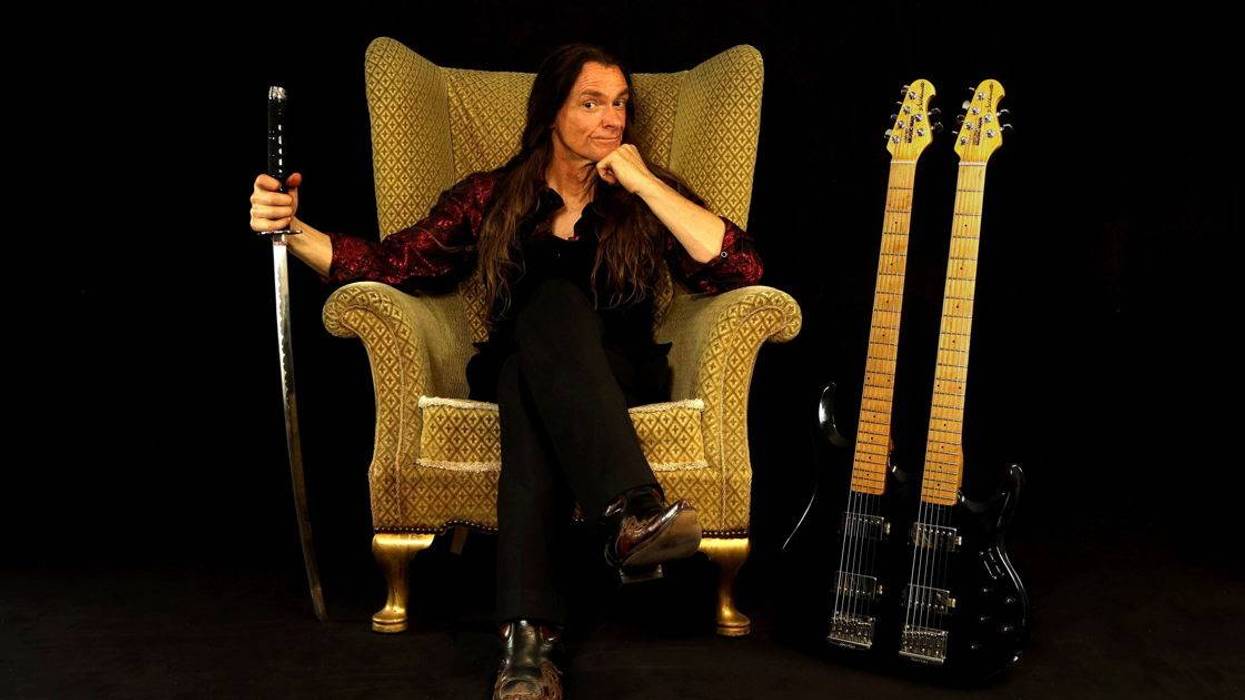

Guitarist Jan Henning is a musical polymath known for his mastery of the electric six-string tenor bass, an instrument that gives him a unique sound for genre explorations that span jazz, classical, and pop styles. In addition to performing for audiences around the world as a solo instrumentalist, Henning is also an active composer, session guitarist, publisher, and educator who frequently guest lectures at universities and music institutions internationally. Musical transcription is at the forefront of all of the aspects of his career, so to streamline his efforts Henning has partnered with German AI-Transcription software developers klang.io and made the company’s Transcription Studio app a key part of his compositional and educational workflows.
Explorations in musical mastery
Henning’s background is in formal studies of jazz and classical music, which has served as the basis of his style on the single and double-necked six-string tenor bass guitar. His compositions utilize a self-developed ‘hand-to-hand’ technique that combines coordinated finger tapping, pull-offs, and overtones to create a rich, melodic sound on a single instrument. “With the one neck, it’s a conversation between the two hands to create the chords and melody,” he explains. “On the double, it’s perhaps more of an overt pianistic thing. Either way, it gives me a clean, unique instrumental voice of my own that I’ve spent many years developing.”
“All my compositions and techniques can come through that, no matter how complex.”
Documenting all of this properly is an important part of Henning’s musical explorations. A skilled musical transcriptionist, he prioritizes notation in his compositional process. “It’s an important connection between what you do with your fingers and how it relates to the piece of music and where it takes you,” he states. “I study music and composition deeply, and also am active in publishing, so it’s very important for me to engage with notation regularly. I enjoy doing it myself, but it can be a time-consuming process.”
“When I became introduced to the team at klang.io and their AI transcription software, I realized there was an interesting opportunity to supplement this skillset in my day-to-day work while also perhaps, finally, developing something that would suit my tenor bass techniques.”
Simplicity and beauty
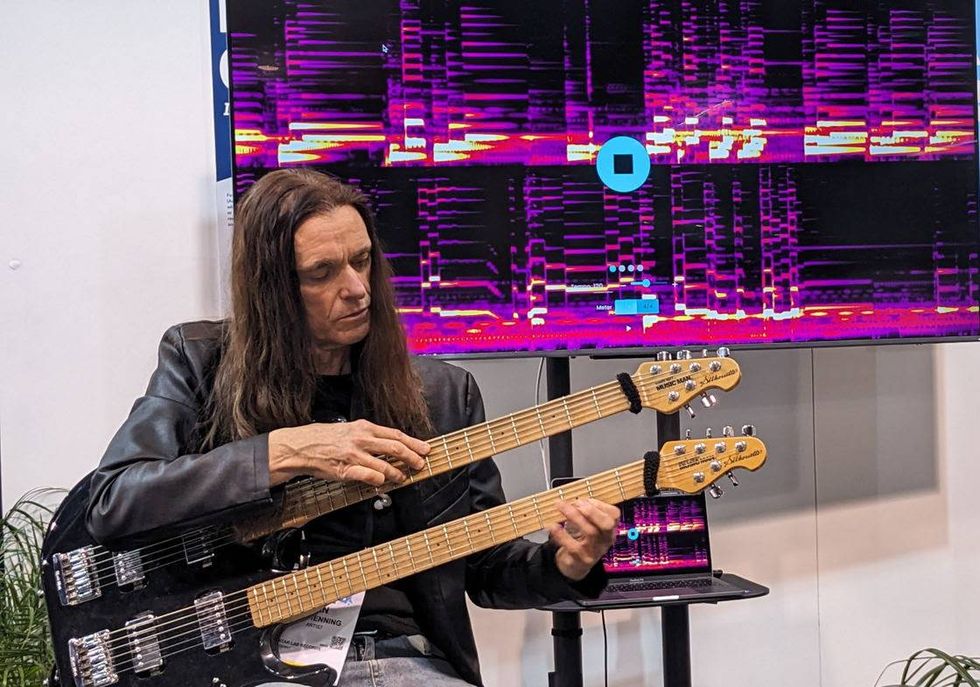
Jan Henning utilizing Customized Transcription Studio Software for his Double-Necked Guitar Compositions with Specialized Features for his Tunings and Stereo Output
The basis of Henning’s initial interaction with klang.io was leveraging their software to provide accurate transcriptions of compositions for his double-neck instrument. The ability to transcribe two separate tracks at once and then immediately output to MIDI and sheet music proved immediately useful. “You wouldn’t think that I would necessarily ‘need’ something like this because I’m well-versed in transcription,” he states. “However, there are certain advantages to streamlining the process for creative reasons and having a tool that you can trust to do the ‘office work’ side of things well.”
“I use it in my compositional workflow on a daily basis and it’s also been incredibly helpful in documenting ideas and generating full scores. For me it was an absolute time-saver and is a serious, useful thing for professionals as well as a helpful tool for beginners that can be used in the educational settings that I work in.”
Henning works with international universities as well as private students through his Martial Arts Guitar Workshop. Transcription Studio has come in handy in both cases to provide his students with an accessible entry point for understanding the connection between playing and transcription in real-time. “It’s an incredible tool for teaching because it provides an instant access point to transcription that can clearly and easily show the relationship between what you play and how it manifests in notation,” he says. “It helps to open the mind of the student because when they can see even the simplest things, a few notes or a short groove, suddenly that world is open to them. That realization can be a major breakthrough between simply starting out, and seeing all the possibilities of what can be played and composed.”
“The conversation around AI technology in music is quite interesting and we are all responsible for how we choose to use it as a tool in the musical world,” he continues. “What’s interesting with klang.io is that the main ‘effect’ is still the fingers, the player, and the music we can make. Transcription Studio simply gives us another avenue to explore that connection and potentially learn much more about it.”
“You decide how far you want to step into the world of notation, but the beauty of the software is the simplicity and how it opens a door to all of it. It’s a connection between your hands, or your voice, and what you can achieve in the future.”
For more information about Jan Henning, please visit: https://jan-henning.com/
About klang.io
Founded in 2018 by Sebastian Murgul and Alexander Lüngen, klang.io GmbH is an innovative, AI-focused music software company that develops tools to empower musicians. The company’s flagship technologies provide quick and precise transcriptions from live and recorded musical sources for a variety of production, performance, and educational purposes. Klang.io’s team of passionate experts in music theory, audio processing, AI research, and software development are based in Karlsruhe, Germany.
For more information about klang.io, please visit: https://klang.io/