
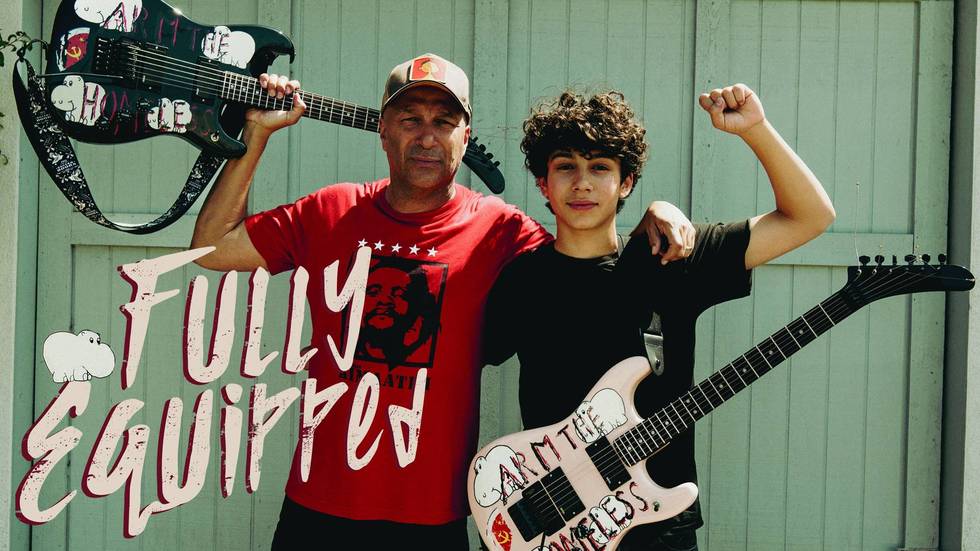
Tom Morello didn’t want Everyone Gets Everything They Want to feel the least bit nostalgic, and it doesn’t. Rather, it’s a contemporary, wide-ranging rock record that mixes heavy riffs, electronic elements, and modern production with stripped-down acoustic and piano songs. Not to mention the fact that several solos are played by a 15-year-old. Even so, much of the gear behind it is made up of old friends. When we asked about the guitars, amps, and pedals he used, he was, unsurprisingly, thorough and exact, even stopping to pull up the track list on his laptop so he could go through the album song by song. “Let me be professional about this,” he said with a laugh.
What were your main guitars on the new record?
Tom Morello: It was recorded over a stretch of time, so it’s a little hard to remember track by track. One was my new SG, which I also played a lot at the recent Power to the People show. It’s got a brutally heavy sound that I really enjoy. I used my “Arm the Homeless” guitar a lot too, both the original and one of the Fender ones. And there’s my first guitar, the $50 Kay I got in 1978 or so, which was refurbished maybe 15 years ago. It plays an intro on the record.
Roman plays a lot on the record too. His main drop-D guitar is the “Atlas Underground” Tele, which is basically a stock Tele I used on the Atlas Underground tour. For the songs in E, he plays the Fender Soul Power model.
What do you like about that Tele, Roman?
Roman Morello: It has a very specific tone when you play it with the bridge pickup, and it’s very easy to play.
And the Soul Power Strat?
Roman: It has a Floyd Rose, and the action is lower on the top strings, so it’s easier to play up high and fast. That made it easier to play “Everyone Gets Everything They Want” on it. It also stays in tune more easily, which is a big help.
You also used an Ibanez miKro, a short-scale model, on the record. What do you like about that one?
Roman: I have a lot of reps on that guitar, so it feels kind of close to home. It’s smaller, so you have more reach, and you can do solos better. It’s also a very good travel investment. It was given to me by my grandma, so it’ll always have a special place in my heart.
Getting back to the SG, is it anything special? A Custom Shop model?
Tom: No, it was a gift. I got it backstage on the Rage Against the Machine tour in 2022. The Gibson rep came backstage holding a Les Paul in one hand and an SG in the other, and I said, “That one’s lighter—I’ll take it!” It has a fantastic, Sabbath-y, brutal low end.
I’ve also seen you recently with an “Arm the Homeless” model in a black finish. Is that a Fender too?
Tom: Yeah, it’s a Fender, but it’s not for sale. We had a black one made for me and a pink one for Roman. The black one is my drop-D guitar, which helps me keep them straight, and we used it on “Adjourn It” on the new record. The regular blue one, the one that’s for sale everywhere, that one I use interchangeably with the original.
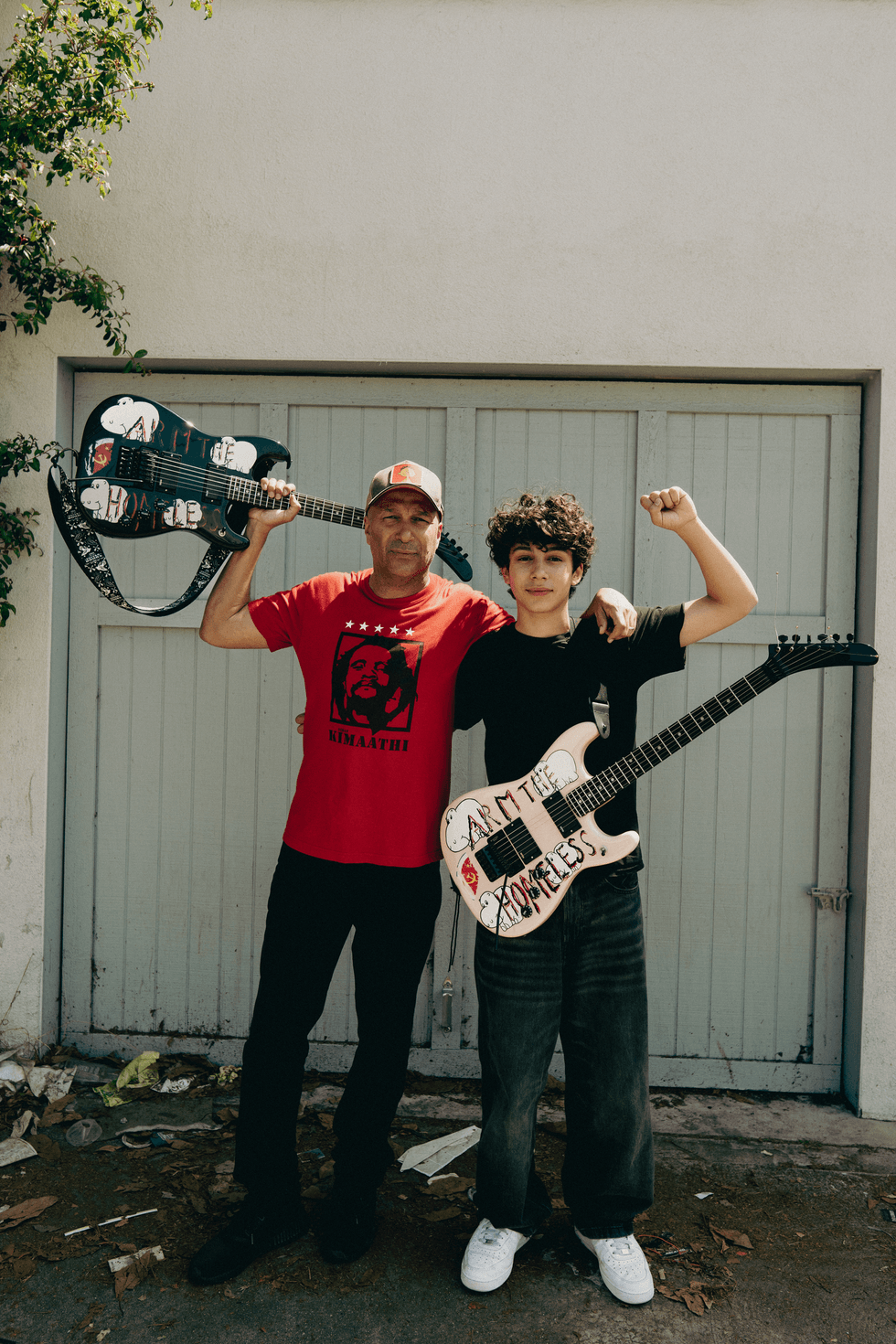
Wood shedding: Morello and Roman step outside with their Fender “Arm the Homeless” model guitars
What amps are you running on the record?
Tom: I’m a creature of habit, so there’s nothing new. It’s my Marshall 50-watt channel-switching 2205 head with a few different cabinets: the regular Peavey 4x12, a stock Marshall 4x12, and a white 4x12. For the Back to the Beginning show [Black Sabbath and Ozzy Osbourne’s farewell concert in July 2025, for which Morello was musical director] we recreated the “Mr. Crowley” video, and we found a white 4x12 like the one Randy Rhoads uses in that video. It’s up in my studio now, and Roman plays through it.
Roman, what do you like about the 2205?
Roman: It’s very versatile. You can be clean with it, or you can go distorted. And the one up in the studio is one of my favorite tones of all time. I can’t think of many that are better.
And pedals?
Tom: The record starts with “Beth From Electronics,” which is the Fender “Arm the Homeless” through the POG pedal. That wasn’t a written song. I just clicked the POG on and started playing a riff, and it’s about 40 seconds long. Afterward I asked the engineer, “Did you record that?” He said yeah, and I said, “We’re gonna start the record with it.” The POG sounds like two or three Black Sabbaths playing at the same time.
“It’s making heavy music in a way I haven’t made it before, while using the things I do best.”
On “Everyone Gets Everything They Want,” Roman plays the solo. He’s an Angus Young, plug-straight-in kind of guy. That song’s in E, so it’s the Soul Power guitar through the Marshall. My part is pretty straightforward, just some Jimmy Page-style guitar doubling.
On “Adjourn It,” the POG is all over the riffs again. My solo uses the toggle switch and the wah pedal. The outro solo starts with the Whammy set to an octave down and then pressed forward.
We recorded “Soldier in the Army of Love” a while ago, and it’s straight-into-the-amp riffing. Roman plays the solo on that one too, plugged straight in. On “Everything Burns,” I went back to the POG for the heaviness on several riffs. “Pretend You Remember Me” is the DigiTech Whammy, as always.
“Untethered,” that one’s played on the Tele, the “Harlem Hellfighters” guitar, through a Fender Twin and then doubled. Sam [Nelson Harris] from X Ambassadors produced it, and I was over at his house without any of my own amps. I asked him, “What do you got?” I like that it came across with a different kind of heaviness.
What are you playing on the acoustic songs?
Tom: “They Can’t Kill Us All” is my Gibson steel-string, the “Black Spartacus.” “The Last Rung on the Ladder” is my “Whatever It Takes” nylon-string.
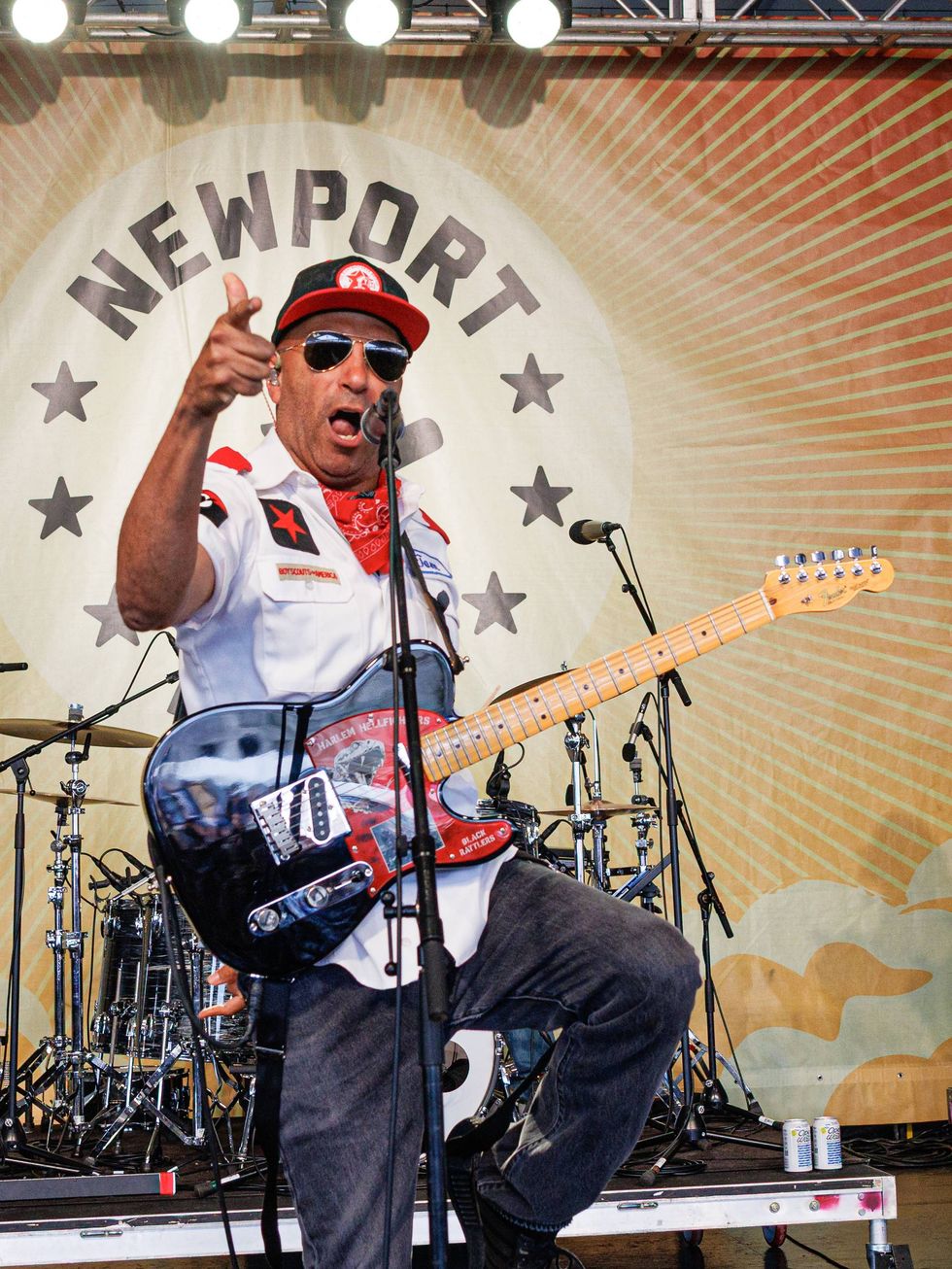
Morello onstage with his “Harlem Hellfighters” Tele at the Newport Folk Festival, Newport, RI, July 26, 2026
Photo by Tim BugbeeWhat’s it like working with Roman?
Tom: His riffs definitely have my DNA, those heavy pentatonic riffs, but they come through a young artist’s mind. It’s not my mind, so I’m constantly surprised by them. The first surprising thing is being in a band with a little kid who happens to be your son. The second surprising thing is when that becomes completely normal. You’re just used to that guy being in the band, and you love some of his riffs, and you put them in your songs.
And how was it working with your dad?
Roman: It’s very fun, obviously, because I like the guy! But he’s also a very, very talented musician and producer, and he has great ideas, so that’s fun as well.
What did you try to bring to your guitar parts?
Roman: Mostly the riff writing. I tried to bring a classic Tom Morello feel, but with a Roman Morello twist. My dad always says it’s weird, because I write riffs that give off the same vibe as his, but they’re something he would never think to write. And some of his riffs are something I would never think to write. We have it in our DNA, I guess, but the way we put it down into a riff is different.
How would you describe Roman as a player?
Tom: At this point he’s a much more technical player than I am. He’s already put in his 10,000 or 15,000 hours. I remember when I was in the middle of learning all the Randy Rhoads solos and the David Gilmour solos, and he’s right in the middle of that now. People ask me, “Does that make you want to practice more?” I say, “No, I’m just gonna let him do that.” I’m going to curate and counsel and borrow, and try to put each of us in a position to succeed.
Do you have a favorite song on the record, Roman?
Roman: I’ll go with one of the classics, “Soldier in the Army of Love.” It was the first song we wrote together. It has a killer riff, it has some singing that will blow you away, and it has my guitar solo in it. It really has everything. Other than that, probably the title track. It has a killer riff as well, and another one of my solos.
Tom, how did you keep a riff-heavy record from sounding like the old days?
Tom: I didn’t want it to feel like I was retreading anything. What this record has in common with the first Rage record and the first Audioslave record is that it feels like being on the edge of discovery. It’s making heavy music in a way I haven’t made it before, while using the things I do best. A lot of that is thanks to the producers. Tyler Smyth and Zakk Cervini have long histories of making more modern heavy music, and Carl Restivo is my longtime musical consigliere. It couldn’t sound like what I’ve sounded like before, four guys in a room. These songs are very much rebellion as self-care, and finding a way to make that come through a Marshall half-stack was the goal.
Tom Morello’s Gear
Guitars
- Gibson SG
- Original “Arm the Homeless” custom
- Fender “Arm the Homeless” (blue, standard tuning)
- Fender “Arm the Homeless” (black, drop D)
- Fender Telecaster (w/ Harlem Hellfighters / Black Rattlers handmade pickguard by Dave Petillo)
- Kay K-20T
- Gibson J-45 “Black Spartacus” (played on “They Can’t Kill Us All”)
- Ibanez GA60SCE Galvador “Whatever It Takes” nylon-string (played on “The Last Rung on the Ladder”)
Amps
- Marshall JCM800 2205 50-watt head
- Fender Twin
- Peavey 4x12 cabinet
- Marshall 4x12 cabinet
- Marshall 4x12 cabinet (white “Mr. Crowley” replica)
Pedals and Plugins
- Electro-Harmonix POG
- DigiTech Whammy WH-1
- Dunlop Tom Morello Cry Baby
- Neural DSP Archetype: Tom Morello plugin (played on “Unconquered” solo, “Adjourn It,” “Untethered” solo, and “atmospheric stuff”)
Roman Morello’s Gear
Guitars
- Fender Tom Morello Soul Power Stratocaster (played on “Everyone Gets Everything They Want”)
- Fender Telecaster “Atlas Underground” (in drop D; played on “Adjourn It” and “Soldier in the Army of Love”)
- Ibanez miKro (used on intro to “Date Night,” taken from demo, played through Positive Grid Spark GO)
- Trussart T-style hollowbody (played on “Unconquered”)
Amps
- Marshall JCM800 2205 50-watt head
- Positive Grid Spark GO