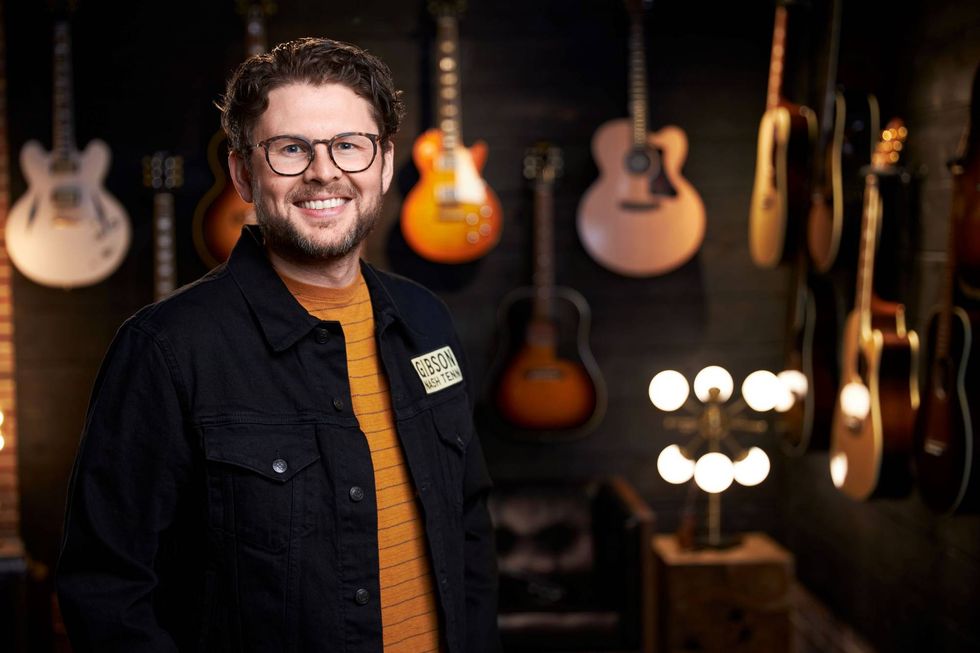

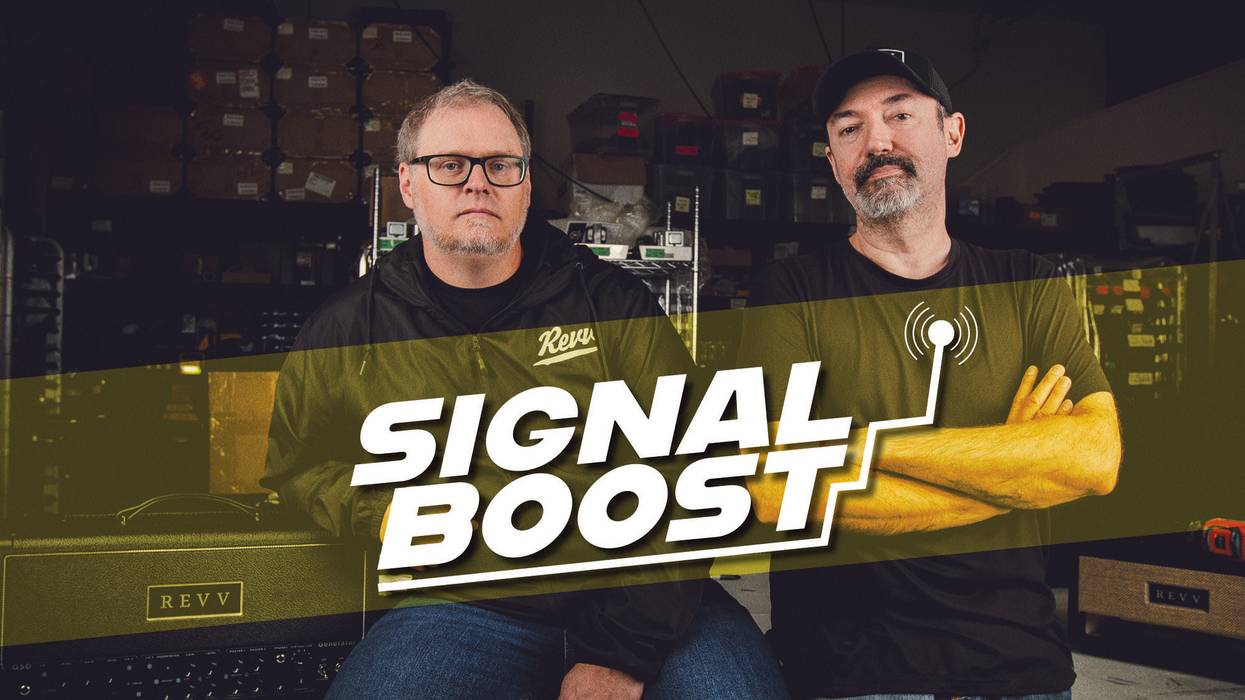

Early on in his run at Revv Amplification, Derek Eastveld knew the company needed a jolt of visibility—a way to supplement the conventional route of print ads and trade shows, a path toward placing gear into the hands of more players. In a prescient move, the VP of sales and marketing turned to YouTube—making human-to-human connections with the folks doing demos and reviews. That organic, word-of-mouth approach, both online and off, became crucial to the Canadian company’s vision.
Take, for example, the 2018 launch of their revered high-gain pedal, the G3. Motivated by a Strymon campaign, Eastveld brainstormed an ambitious plan: “[I said], ‘We’re gonna do what [they] did, but on steroids,” he tells Premier Guitar. “We’re going to blanket YouTube with the G3 pedal over a month.” Eastveld remembers flying to Europe as the first videos launched, having no clue what to expect. (Revv, he says, “sees the video almost always at the same time as the consumer,” staying out of the creator’s way.) “When I landed, I opened my email, and we’d sold almost 200 pedals,” he says. “We thought we were going to sell 500 in the first two years. That really spring-boarded Revv into becoming more of a household name.”
These days, Revv might not have the brand recognition of, say, Marshall or Mesa/Boogie, but they’ve become sleeper staples in certain scenes, gracing the rigs of hard-rock slingers, pop-punk riff-merchants, and versatile Nashville session aces. (Dann Huff used the Dynamis D40 amp head to record his 2025 debut solo effort, When Words Aren’t Enough.) That rise has been fueled not by exorbitant budgets but by genuine, grassroots guitar-geek curiosity—a trajectory solidified back in 2013, when Eastveld randomly struck up a friendship with Revv President & Designer Dan Trudeau.
Becoming a partner in an amp company wasn’t exactly on Eastveld’s radar back then, even if it basically amounted to a dream gig for the gear-obsessed guitarist. Growing up in Manitoba, he was introduced to music by the classic rock spinning on his parents’ record player. “We’d play music trivia, where my dad put on the Beatles and Led Zeppelin and we’d have to guess the tune,” he says. He started playing guitar at age 10, with his older brother Scott (now also part of the Revv team) picking up drums around the same time. Six years later, he began giving entry-level guitar lessons at a local music store, and that’s where he caught the bug for gear. (He recalls, for example, encountering the Danelectro Cool Cat and Daddy O pedals and being impressed by the retro aesthetic.) “I wanted to collect every pedal I could, and I would always have extra jobs on the side that would fund me being able to buy cool gear,” he says.
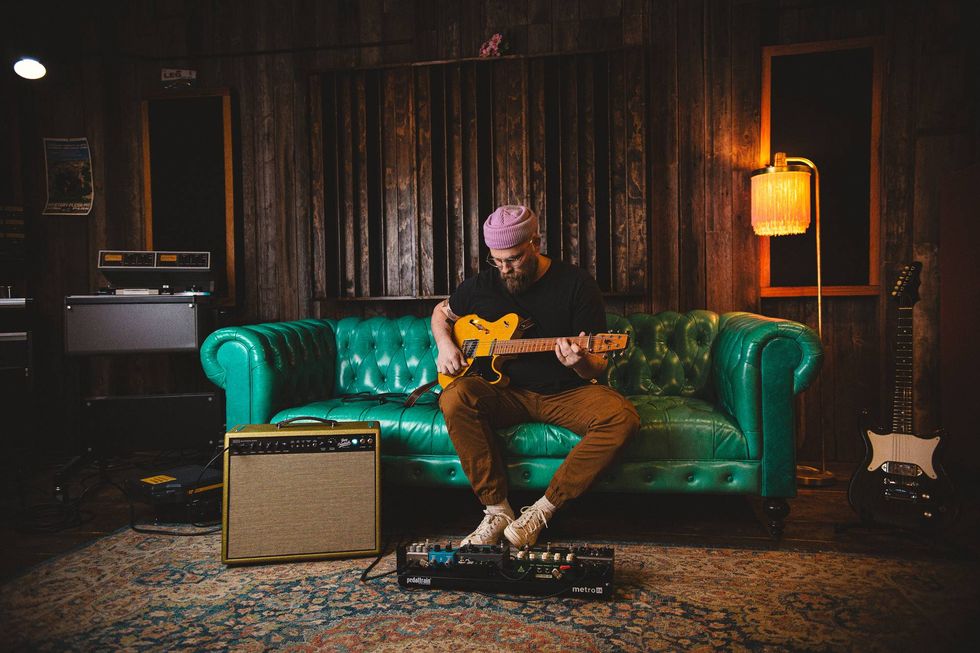
Joey Landreth Playing His Signature D25JL
As exuberant young musicians with loads of gear often do, he started making his own music—and for a while, that seemed like a legitimate career path. “I got involved with Christian hard rock and pop-punk bands around 2000, and we had some regional success in Western Canada, where we’d do mini tours,” he says. “I did that for about seven years, and, like a lot of musicians, I had other jobs.” Some were steady side gigs: He became a stagehand and, eventually, a concert rigger, working “pretty much every major concert that came to Manitoba.” Another day job was equally cool, but more practical: making decals and signs at a screen-printing company, with a speciality in printing on metal. Then, as his band fizzled out, he wound up starting his own screen-printing business—and that’s where Trudeau comes in.
“One day my foreman came up to me and said, ‘I got an email from this guy who used to work for me at another company,’” Eastveld remembers. “‘He’s asking me if we can help out his buddy who’s building guitar amps. I know you’re into the guitar thing. He wants, like, 10 pieces of a panel for the front and 10 pieces of a panel for the back of the amp printed. The job is not worth doing for us, but I know you’re into this stuff, so maybe you want to take a look at it.’”
His curiosity piqued, Eastveld called for more info. Trudeau, it turns out, was having a hard time finding a company that could screen print onto metal. It was a strangely perfect match, given that Eastveld was still a huge gearhead, with a collection that had grown to roughly 10 guitars, eight amps, and 80 pedals. Trudeau, a metal fan and electrical engineer, had been working on amps for local guitarists, but struck sonic gold with his prototype for the Generator, which seemed to fill a void on the high-gain marketplace. When he brought the amp over for a demo, Eastveld promptly plugged it in and was blown away: “I said, ‘Where did you build this, and how did you do it? If you could build me one of these, I’d buy it.’ He starts laughing, and says, ‘Man, I didn’t tell you how much it costs yet!’ I said, ‘That’s okay, because I didn’t tell you how much the printing costs.’”
Back then, Trudeau was hand-wiring the Generators and, given the constraints of his day job, could only finish one per month. But Eastveld knew there was potential here. So he went to Trudeau with a pitch: “I was like, ‘Have you ever thought about having a partner?’” he recalls. “‘No, why, do you know anyone?’ I said, ‘I was kinda thinking about me.’ We went back and forth for a couple weeks and decided in December 2013 that we were gonna partner up.”
He was confident people would flip out over the amp—including guitarist friends like Mark Tremonti, whom Eastveld met through doing band merch. After Trudeau delivered the amp, Eastveld sent it to Tremonti’s manager, Tim Tournier, and asked for his feedback. “He called me right after and said, ‘Holy shit, where did you get this thing?’” he recalls. “I said, ‘It’s a local guy. I just started a partnership with him.’ Tim was playing in a band called Man the Mighty. He said, ‘I want one. I would happily play these live.’ Tim came onboard as an artist. I went to a show and brought one for Mark to check out. He picked one up, and it started to snowball a bit from there.”
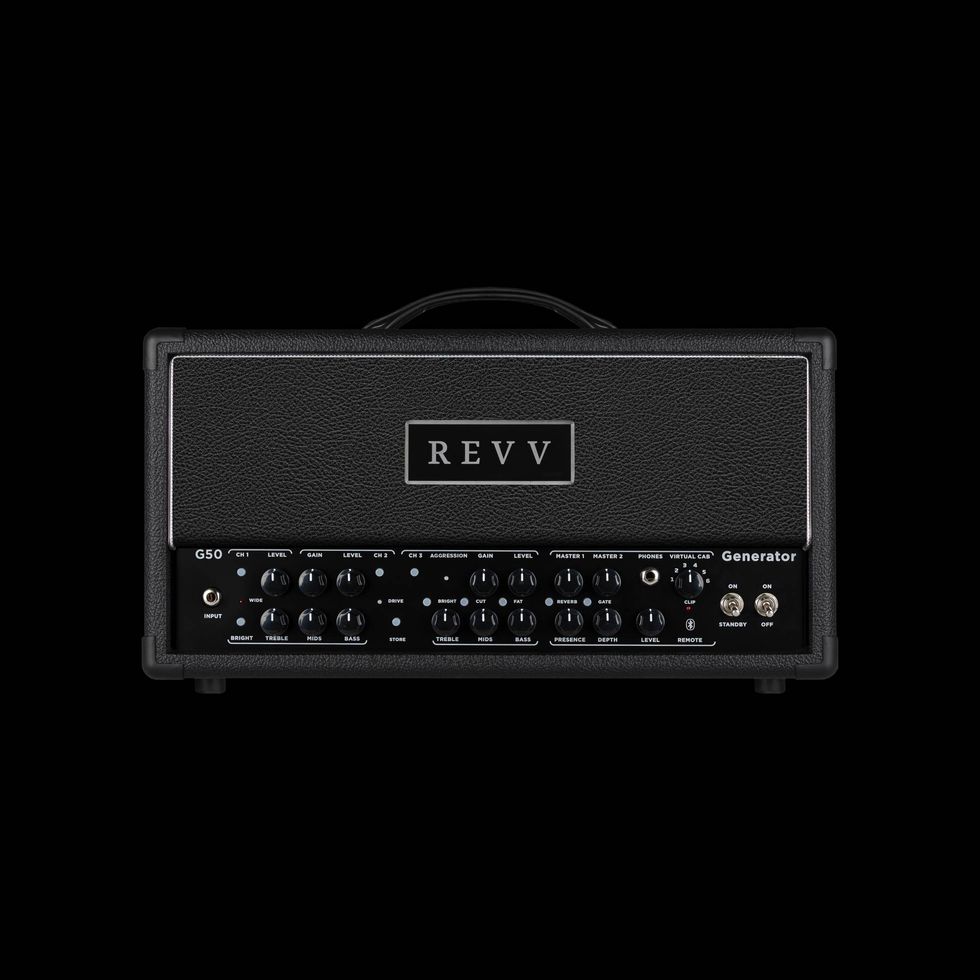
The Generator G50 50-watt head
The Generator 120 has since become Revv’s “flagship” product, featuring four color-coded channels: blue clean, green crunch, purple tight gain, and red fat gain. Everyone who played one back in those early days seemed to rave over it. “We had a product that we felt competed really well against Mesa/Boogie, Peavey—it would at least be in the same class,” Eastveld says. “They’re different things, different flavors. Not saying we’re better in any way, shape, or form, but we knew people would like this.”
But it wasn’t exactly smooth sailing as Revv tried to spread the word, reflected by the company’s confusing first experience at the NAMM trade show, in 2015. They thought they would walk away with 50–100 amp orders, but after the first day, “it became very evident that we were not going to sell anywhere close to that.”
They networked and hustled, even created a promotion to give away a free amp. But with their numbers so minimal, they realized they had to rethink the strategy—which led to their lightbulb-idea with the YouTube community. They reached out to guitarists who had their own channels, some of which were fairly small at the time, and discovered a whole new layer of visibility. Some of these folks would play the amps during guitar demos, which “really started to bring some brand awareness” for the company. By the time of their G3 marketing blitz a few years later, YouTube had become a vital piece of doing business.
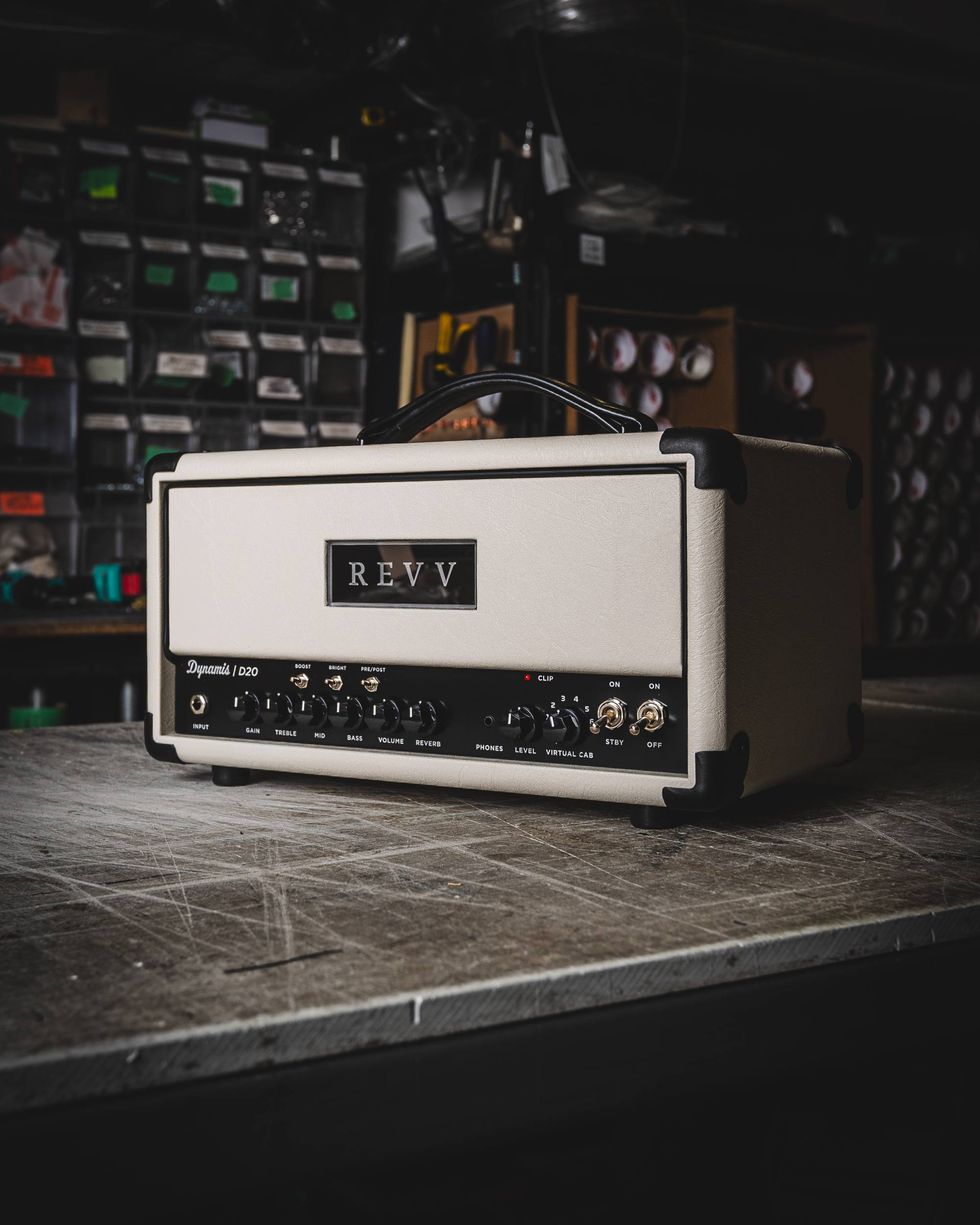
The Dynamis D20 MK2 head
For Revv, it’s all about that hands-on artist connection—getting gear into the right hands, letting people fall in love with it, and trusting that the quality will keep the momentum surging. And there’s no better place to foster a community than Nashville—it may be over 1,300 miles from the Winnipeg area, but it’s become a sort of spiritual home for their Dynamis series. There are currently multiple variants of this amp, including the D20, which has embedded reactive load virtual-cab tech, and the classic D40, voiced with the help of session/touring player Shawn Tubbs (Stone Temple Pilots, Carrie Underwood), with dedicated clean and overdrive channels.
As for how the Dynamis series came to be, Eastveld says, “I told Dan, ‘The clean channel on the Generator is really impressive.’ And I’d never really played a good high-end amp that had a great clean channel. I thought the house-of-worship market and the country market overlaps with the CCM market quite a bit now. And the tones these guys go for—if we just warmed up the clean channel on the Generator a little bit to where it took pedals a little better, I think it would do really well in that space. That being said, I don’t think anyone will pay attention to it if it’s a four-channel amp that just has a great clean channel. Most people hear with their eyes first. They see the Generator and see a lot of knobs and four channels and that it looks like a high-gain amp—if we do something a little different, maybe a nice clean channel and then maybe a crunch channel that can get saturated but not super high-gain, I think there would be a really big market for that. We’re probably going to want more than one line.’”
Working with Tubbs was crucial on two levels—first, he was “really influential” in the voicing of the D40, but he also “opened a bunch of doors” through his connections with other session players. Eastveld has also found a home-away-from-home in Nashville, traveling there for weeks at a time to work and host events. “It’s unbelievably welcoming,” he says. “The Southern hospitality thing is very true. There was no gatekeeping.” These days, you’ll probably find Revv all over the studios of Music City.
The company is continuing to evolve: Their current lineup features numerous amps, including the recently unveiled Generator G25, their “high-gain answer to the D20”; a handful of speaker and cabinet models; and an array of pedals, highlighted by their recent invention, the Dirtdog, which replicates the sound of a modded—and, eventually, blown-out—Princeton amp clone Joey Landreth used to record Dog Ear, his 2025 album with the Bros. Landreth. “That’s the kind of stuff we get excited about,” Eastveld says, “where we’re like, ‘Yeah, that’s something that doesn’t exist.’”
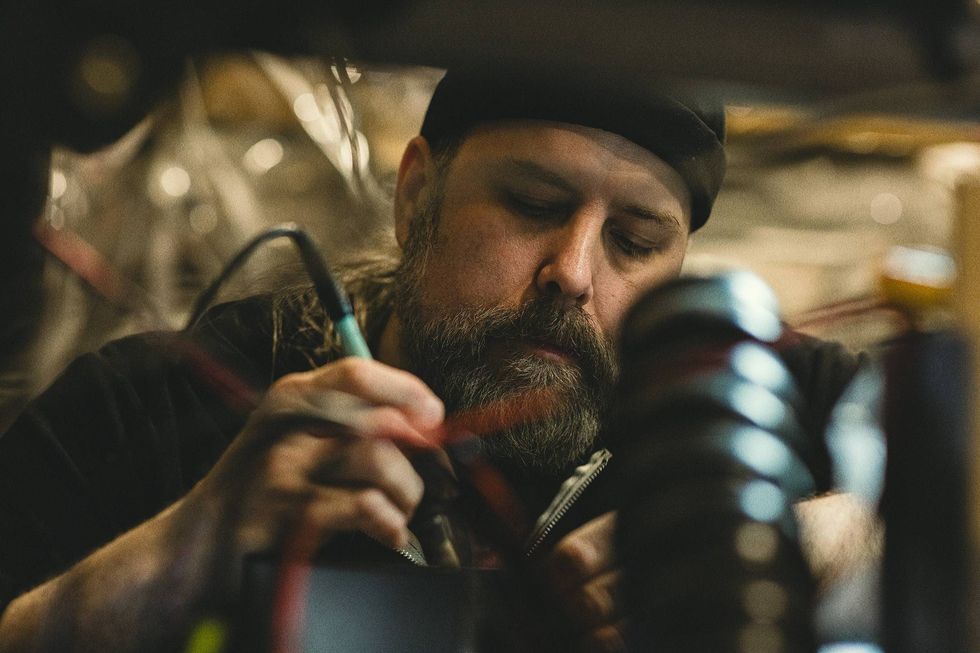
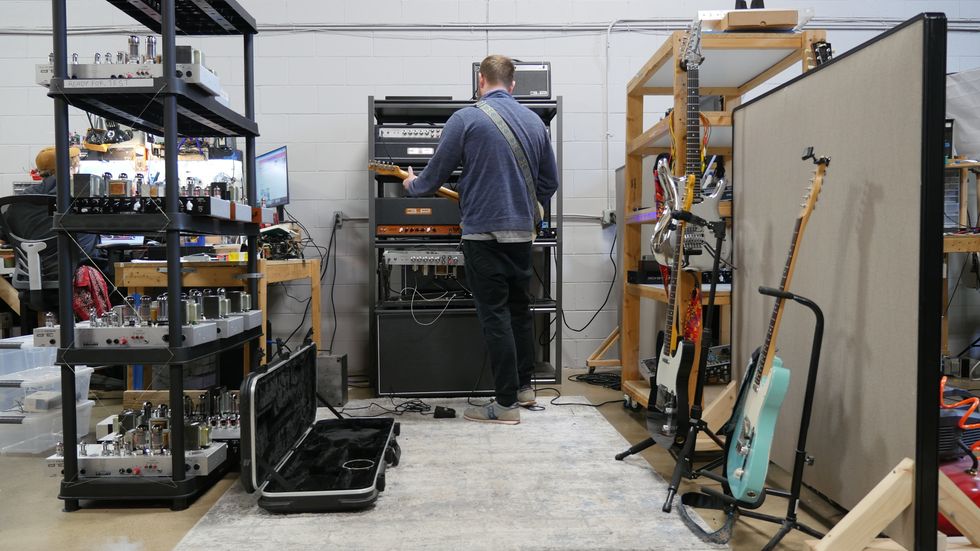
Revv’s Scott Kroeker building a Dynamis D40
That’s the whole philosophy—bringing to life the specific sounds that guitarists can’t currently access, that may only exist in their heads. “We all have different tones that we’re going for,” he says. “People don’t realize—there isn’t much stuff out there that’s bad. It’s just not for you.”
And that quest to seek out the next inspiring tone is what keeps Revv from feeling like just a job, “It’s connected to the thing that I’ve loved since I was 10,” Eastveld reflects. “I still love going to guitar stores and finding a new amp or pedal or something I’ve never played, then plugging into it and having that moment: ‘This is so cool. This feels so different or sounds so different.’
“Most of what I do is not playing guitar,” he continues. “But I don’t get up in the morning and go, ‘Ugh, I have to go to work today’—ever. This is the best job I could ever ask for.”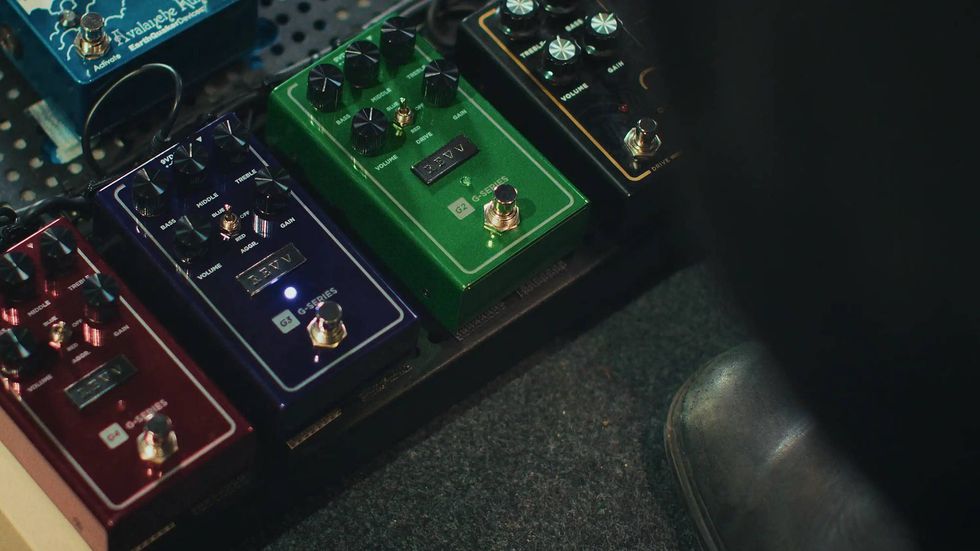
Revv G-Series pedals