
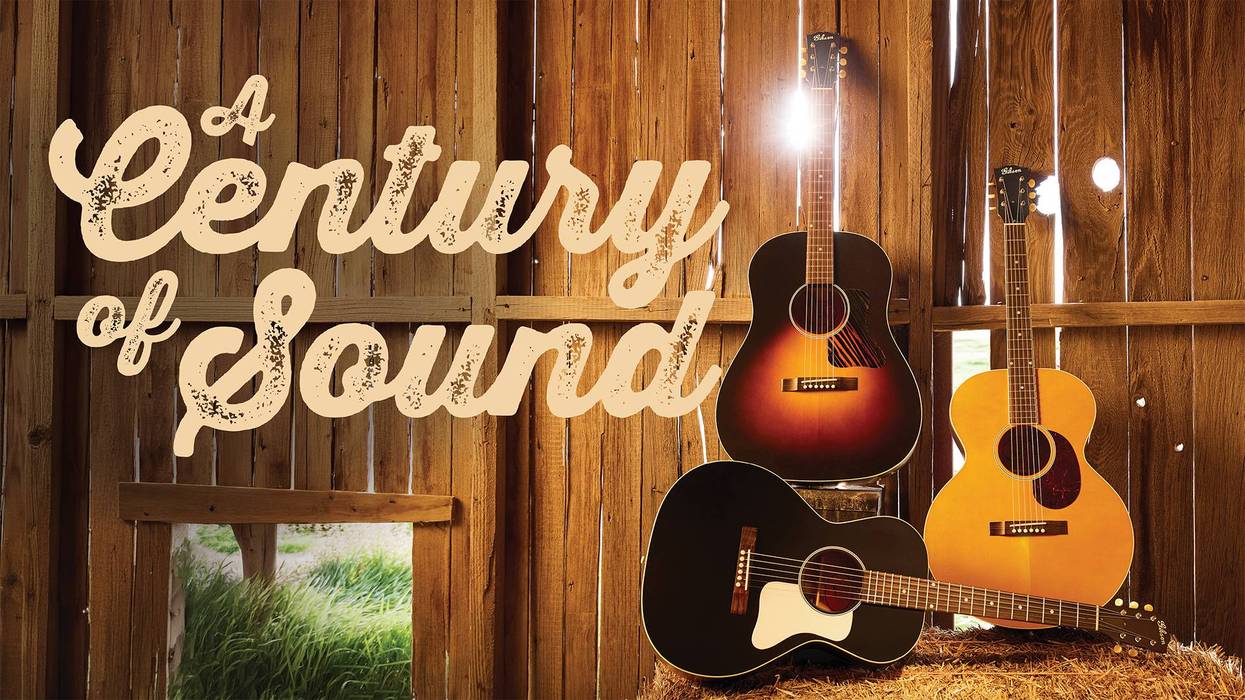

Mat Koehler was fired up, with a manifesto in his back pocket. A Wisconsin native and vintage-guitar obsessive, he’d been working at Gibson for years, first as a product specialist at the Custom Shop and Gibson Memphis, before rising up through the ranks and being promoted to Vice President of Product in 2023. If anyone knew the brand’s rich acoustic history, it was him—and he wanted to reclaim it. “I can’t stand unimaginative boutique builds, and by that, I mean when people take Gibsons and put their name on the headstock,“ he tells Premier Guitar. “There’s probably a lot of craft there, but there’s no art.”
Determined to showcase Gibson’s immense potential in that space, he rounded up his teammates and sat them down for an impassioned rallying cry. “I said, ‘Guys, take a look at all of these beautiful guitars,’” Koehler recalls. “I just showed the body shape. I had the prices of all of them. ‘These are all for sale now. What do you think?’ They said, ‘These are killer. What are they—Made to Measure?’ ‘No.’ Then I revealed all of them—like 15 different brands using our shapes, our pickguard patterns, all of it. I keep seeing it happen, especially with 12-frets—these very expensive boutique builds. I said, ‘If we want to fight back at this, let’s do it in a more accessible way. Let’s capture the spirit of what other people are picking up on.’ We were late to the game to our own history in some ways.”
That argument became the launching pad for Gibson’s Century Collection, a new line of 12-fret flat-tops marking 100 years in the acoustic game. (For the uninitiated, the “12-fret” descriptor refers to the point where the guitar’s neck meets its body.) The campaign tips its cap to the pivotal year of 1926, when founder Orville Gibson’s namesake company introduced a flat-top version of the popular L-1 archtop. (One notable photograph shows Delta blues icon Robert Johnson, all decked out in a spiffy suit, posing with one of these 12-frets.) “One of the reasons Orville gravitated toward carving archtops was to differentiate from flat-tops, but I think the marriage in 1926 of the flat-top with the archtop rim shape is the perfect middle point of the two designs,” Koehler says. “If it hadn’t happened 100 years ago, we may just have ended up with a dreadnought and a parlor. Having those archtop rim shapes completely changed the game and allowed Gibson to have this range of acoustic products that I know other brands would kill to have.”
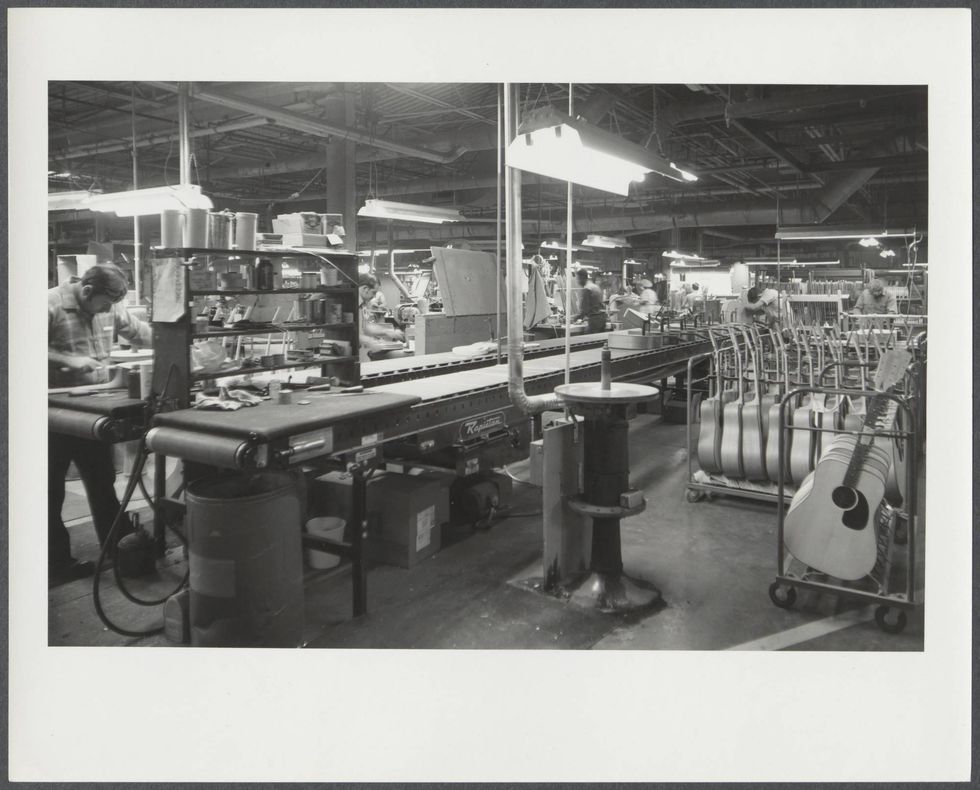
Archival photo from inside the Gibson factory.
The three Century models—fresh interpretations of their classic J-45 “workhorse,” the small-body L-00, and revered J-185 Jumbo—intentionally conjure the past: using lightweight bracing, a thin satin nitrocellulose lacquer finish, and a decidedly old-school look. (“It was really important to maintain that Depression-era aesthetic,” Koehler notes.) But the VP also says there was a bit of “serendipity” involved in the rollout. While the 10-decade mark made for an obvious marketing hook, they were also confident these instruments would appeal to a real niche of musicians—specifically singer-songwriters with a lighter touch, who aren’t able to pay highest-end boutique prices. “We saw this trend with players moving to a more small-bodied, couch-guitar experience,” Koehler says. “More intimate settings for acoustic guitars outside of the bluegrass circle. There’s this amazing history to tie in with everything, but to me it’s about creating great tools for artists, offering them something different that they couldn’t get anywhere else.”
Koehler—who formerly ran a vintage shop named Holy Grail Guitars—was confident these new models would make an impression, given his own first exposure to the 12-fret world. Mike Voltz, a good friend and retired Gibson luthier, showed him the light years ago: “I was kinda resistant: ‘Whatever, old man,’” he recalls with a laugh. “He put one in my hands—I think it was an original early-’30s L-00 or something, and it absolutely blew my mind. I was like, ‘I have to know what’s happening here.’ He explained to me how lightly braced the instruments in that era were—whether on purpose or not. My feeling is that it’s probably because it was the Depression and they were trying to use as few materials as possible to brace these guitars. I remember it weighed nothing. It changed my whole perception of what an acoustic guitar was. Until then, I was used to a jumbo body with a glossy finish and an electronics package. This was completely different to me. This was feeling it up against your body, playing fingerstyle. It was like playing a completely different instrument to me. That was the eye-opening experience I kept in the back of my mind for how we could incorporate 12-frets.”

Gibson Acoustics Sr. Product Development Manager Robi Johns
Crucial to fostering that vision was Robi Johns, currently Sr. Product Development Manager at Gibson’s acoustic “Craftory” in Bozeman, Montana, where he first arrived in 1990, shortly after the facility opened. Before that point, the guitarist wasn’t particularly interested in joining a big company—he was perfectly happy as an artist and educator, studying under classical-guitar master Christopher Parkening and passing along his knowledge as an adjunct instructor at Montana State University. But he found another calling at Gibson—not as a master luthier, even if some consider him that, but as a sage player who understands the resonances of these instruments, how they speak.
“We were late to the game to our own history in some ways.”—Mat Koehler
When he describes the models in the Century Collection, his voice rises and falls gently, almost in a meditative state. “Everything I do is derived from my long, long, countless hours as a guitar student—practicing every morning, listening to every note,” he says. “My perspective is always from there. Therefore, I’ve worked with many artists—I think about 100 so far for Gibson—and I’m able to interpret what they want, and perhaps what they need, even if we don’t express it, and then design it into an instrument with all the wonderful builders here. It’s a wonderful history, and it’s very exciting. It’s also a lot of hard work, but we’re so proud of what we’ve done in the past three or four decades.”

Gibson Vice President of Product Mat Koehler
As Johns notes, Gibson didn’t just stick to their early-days acoustic sweet spot. “When we went to the guitar market in the early 1900s, we didn’t say, ‘Here’s the Gibson model, with five variations of that,’” he says. “Gibson acoustics were there when the broadcast industry was developing, so our timing was impeccable. We just kept changing. These small-bodies—they’re great for blues, great for radio. Singing cowboys need something ostentatious, so we created the Super Jumbo and made it kind of gaudy. In the ’60s, we came out with the Dove Hummingbird—there was a guy in the Custom Shop, Hartford Snider, who designed the first Hummingbird pickguard. We did this with style. We were just changing with the culture. That’s what draws the artists in. The artists are remembering the body style, remembering the feel and the look.”
One of those artists was Jackson Browne, whom Johns calls a good friend and a “connoisseur of acoustic instruments.” Together, they worked hard to perfect the songwriter’s signature Model 1, which the Gibson veteran describes as a sort of vintage reclamation project. “Jackson took the time to guide us slowly back to the essence of the tone of the 1930s with the Jumbos that were coming back,” he says. “They wanted the culture back. They wanted the sound back.”
“It was really important to maintain that Depression-era aesthetic.”—Mat Koehler
Of course, every one of these artists is chasing something unique to them—the roster runs from bluesman Keb’ Mo’ to Alice in Chains’ Jerry Cantrell, who have both designed signature acoustic models with Gibson. And a key turning point for the company—or at least a moment of real cultural overlap—came early in Johns’ tenure. “If you think about 1989, 1990, that was the beginning, the essence of the timeframe when Unplugged began,” he says. “Now all of these legendary artists were thinking, ‘What if I do an intimate version of that song with an acoustic?’”
Over the years, Johns has connected with many of those guitarists, including Sheryl Crow, with whom he’s collaborated on multiple designs. “She [originally] said, ‘My favorite guitar is a Country Western. But I don’t want to wear it out on the road.’ So she sent it, and we looked at it, and that’s how we learned how to build some of the earlier models.”
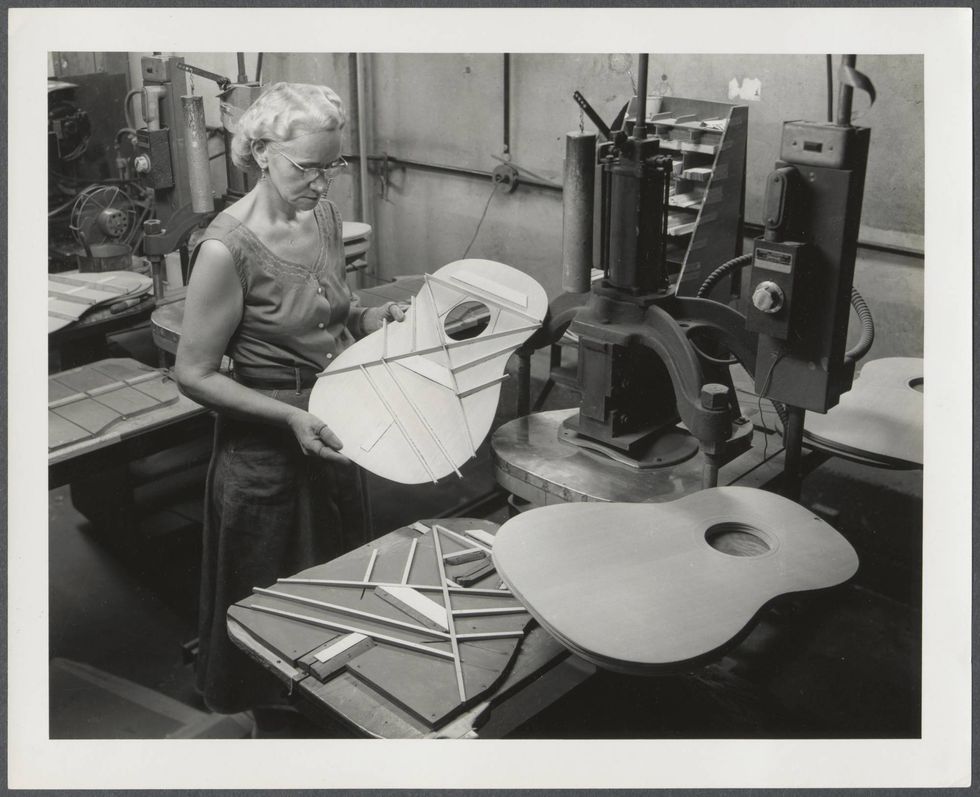
Archival photo of a worker inspecting bracing.
“Nowadays, my role has evolved to listening to artists sometimes,” Johns continues. “A rock artist named Orianthi wanted an acoustic. I said, ‘She’s a shredder!’ She came out and visited Bozeman. I’m sitting there, saying, ‘What do I do?’ She said she loves J-200s because she loves Elvis. I sat there for a couple hours listening to her shred on a J-200. I said, ‘Hmm, you can’t really shred on an acoustic like an electric, so let’s make a hybrid here.’ So we got an ES-345 neck that we scanned off the guitar that we loaned for the movie A Star Is Born. We put an electric neck on it for her. This is the essence of creating a tool designed for an artist based on their love of a Gibson icon model.”
“We want guitarists around the world to be able to get the essence of what was most precious to Gibson at the turn of that century, without paying the price of a Custom Shop guitar.”—Robi Johns
But not all of us have a guitar designed around us, and another driving force behind the Century Collection is putting these instruments in more hands. Asked who he pictures playing them, Koehler is specific: “Definitely singer-songwriter, fingerstyle guitarists,” he says. “They’re the fastest-growing segment of the acoustic market.” Johns says the company had also picked up on a pull toward this vintage character: “We did notice a growing faction of buyers gravitating toward the romance of the Depression-era guitars and pre-war guitars of any brand, of any style,” he says. “At the same time, we looked at this subjectively—We were there! These are Gibsons! Let’s share that. A small-body was a guitar you heard on the radio. The 185 was like the archtops of the time, but it’s a flat-top. And the round-shoulder J-45 happened in the Golden Age of Hollywood, when people wanted bigger instruments. It’s the most versatile of all of them. Each one has a sound.”
The equation behind this collection, Johns says, is simple: history plus accessibility. “We want guitarists around the world to be able to get the essence of what was most precious to Gibson at the turn of that century, without paying the price of a Custom Shop guitar. We work hard on these guitars, and now we’re able to share them with everyone.”
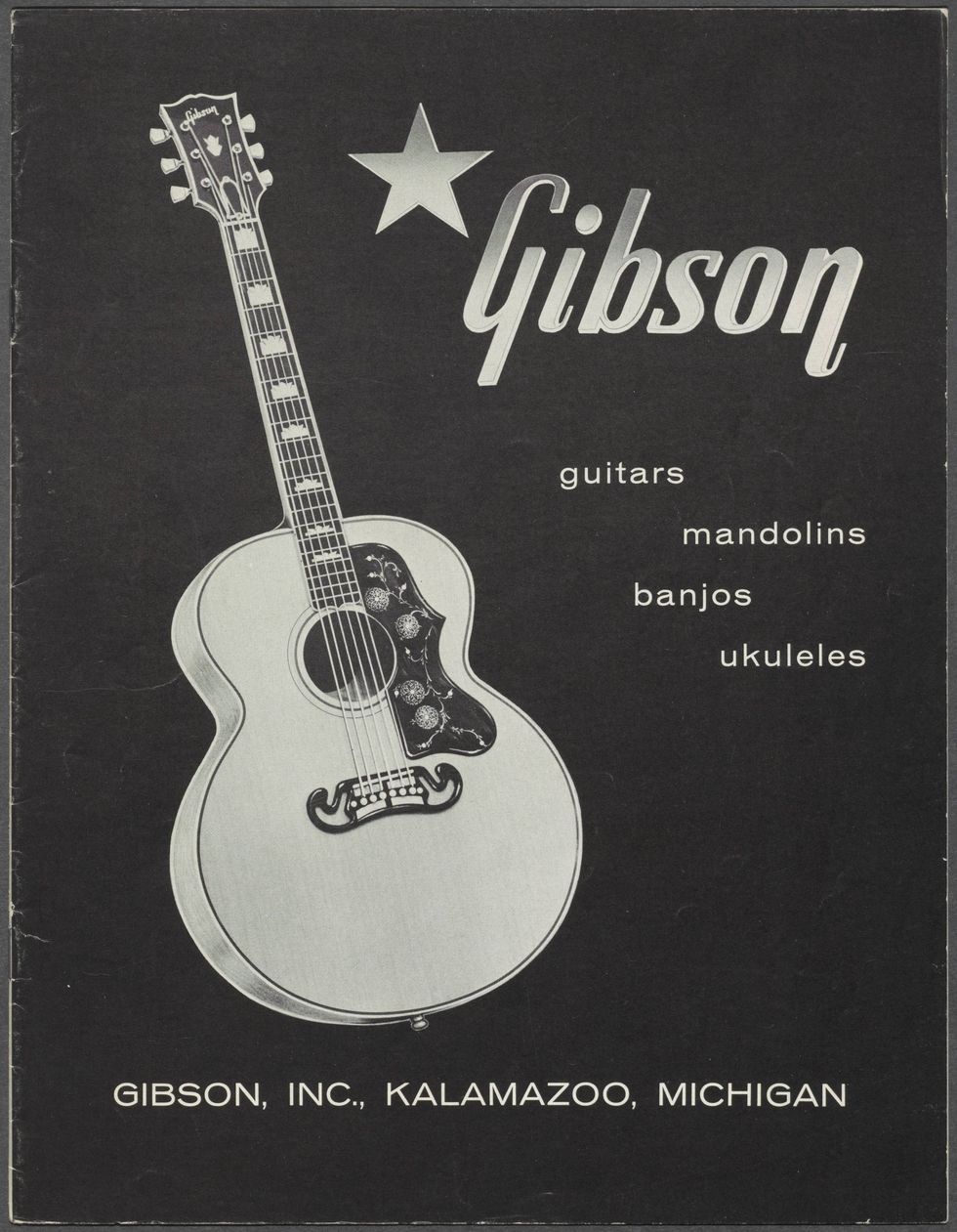
Cover of the 1959 Gibson catalog
Koehler isn’t entirely sure where the Century line is headed, but he’d like to see it become home to future models in the 12-fret family—“from square-shoulder to jumbo bodies to other archtop flavors and different small-body orientations.” Wherever it leads, though, Johns just hopes they keep “teaching people what’s possible.”
“Not that we’re the only good guitar maker,” he adds. “We’re just unique in our way. It’s part of American musical history, something you can’t pull away from. The sound in somebody’s head possibly came from listening to a record—a J-45 in the background, or an L-1 from Robert Johnson.”
Johns continues. “There was a famous artist who didn’t play a Gibson. But he came into our showroom one day, and he ran his thumb across the strings on an Advanced Jumbo, a round-shoulder from the ’30s. He said, ‘Robi, that’s the sound that’s been in my head ever since I was a little kid!’ And he meant it.”






![Rig Rundown: The Black Crowes’ Rich Robinson [2026]](https://www.premierguitar.com/media-library/youtube.jpg?id=66952027&width=1245&height=700&quality=70&coordinates=0%2C0%2C0%2C0)