In the world of boutique bass building, lineage matters. Knowledge is passed from mentor to apprentice, from workshop to workshop, and from one generation of builders to the next. Few contemporary builders embody that tradition more clearly than Wil DeYoung.
Today, DeYoung serves as general manager and oversees the custom shop for Spector, one of the most recognizable bass companies in modern music. And though his path to becoming a builder was buoyed by family tradition, his rise to his current positions was more circuitous. In fact, DeYoung didn’t even start out wanting to build instruments. Long before he found himself guiding Spector’s future, he was a college jazz student searching for a place in music. And before he worked with some of the most respected builders in the industry, he was tinkering with inexpensive instruments on his own to better understand how they worked. “My dad dropped out of college to open a record store,” DeYoung says with a laugh. “I was probably doomed from the start to be obsessed with music.”
Growing up in Michigan, music was a constant presence in the DeYoung household. Records by Steely Dan, Joni Mitchell, Larry Carlton, and other artists from the golden era of sophisticated studio musicianship formed the soundtrack of his childhood. Like many aspiring musicians, DeYoung’s first instrument arrived in the form of an inexpensive beginner guitar package that quickly found its way to a corner of the basement, which is surprising considering curiosity and generosity would become the hallmarks of his career.
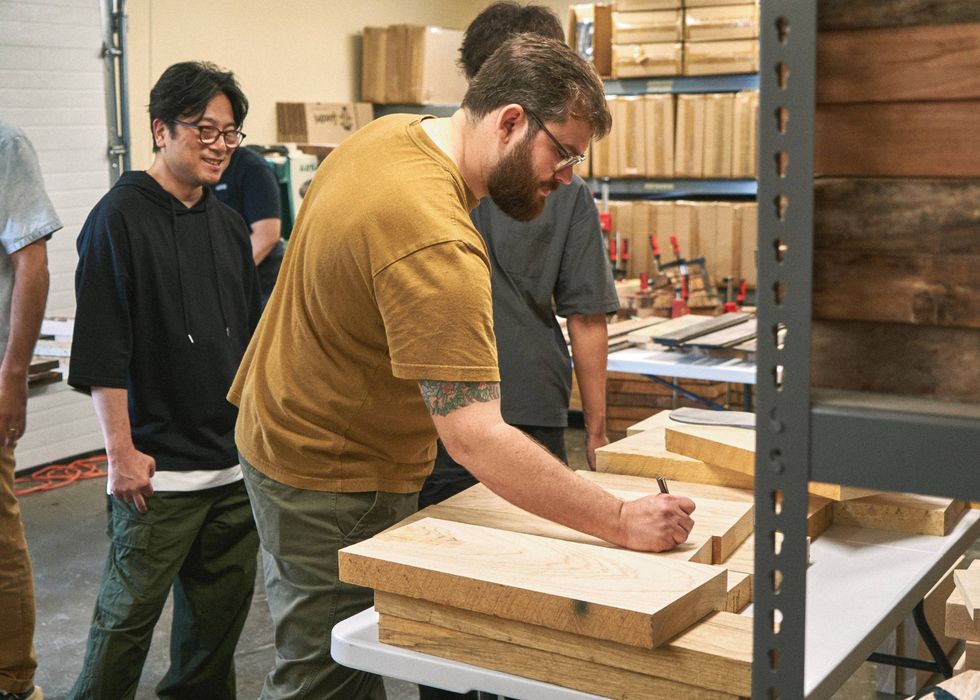
Picking out woods with a dealer
DeYoung’s formal musical journey began in middle school, not on guitar or bass, but on trombone. Around the same time he joined his school’s band, the church his family attended featured a praise band that needed a bass player. Recognizing their son’s passion for music, DeYoung’s parents bought him a Mexican-made Fender Precision bass. He’d already been plucking his way around a double bass on the side in orchestra and jazz band, but this time, rather than gathering dust, the new instrument became a gamechanger. “I learned a lot on that bass,” he recalls. “It started in church, but then it expanded into every musical opportunity I could find.”
Upon graduating high school, DeYoung enrolled as a music education major at Adrian College before shifting his focus to performance and jazz studies. While saxophone remained his primary instrument academically, bass and guitar steadily became larger parts of his musical identity. He started taking guitar lessons with Professor Dick Lange, and before long, he discovered a well-known truth: Bass players tend to stay busy. “My professors used to tell me, ‘We know you want to be a guitar player, but don’t stop playing bass—every guitar player needs a bass player,’” DeYoung recalls. “That turned out to be absolutely true.”
“The more instruments I worked on, the less it became about my playing and the more it became about what’s possible.”
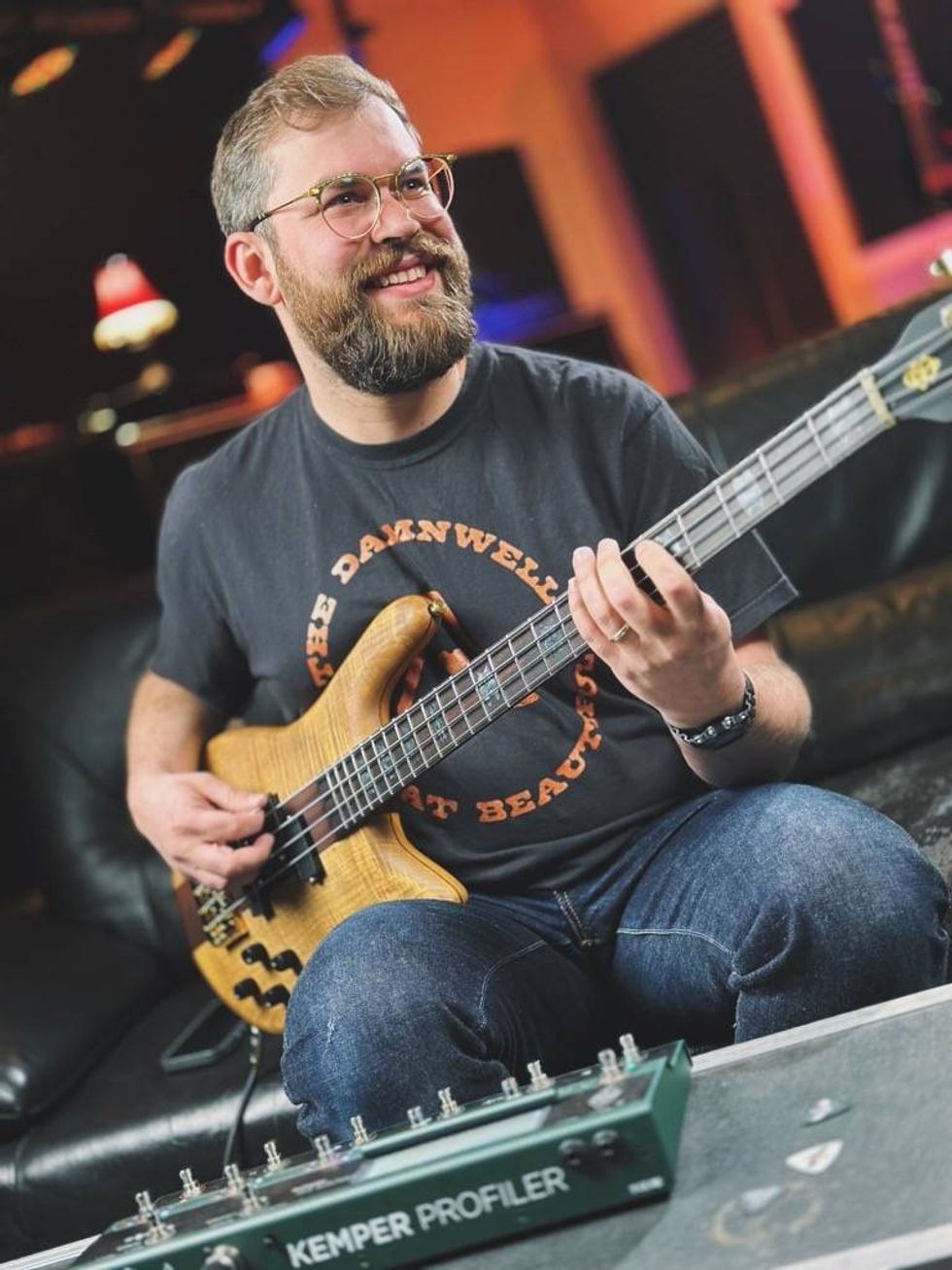
Wil DeYoung, holding a Spector prototype bass
Yet even as his playing developed, another fascination began to emerge. He wanted to know why instruments felt the way they did. What began as simple curiosity evolved into a hands-on education in repair and modification. DeYoung bought inexpensive instruments, disassembled them, experimented with setups, reshaped necks, and gradually taught himself the fundamentals of guitar construction. “The more instruments I worked on, the less it became about my playing and the more it became about what’s possible,” he says. “I wanted to know how far I could push things.” That curiosity eventually led him into repair work at Guitar Center in Toledo, Ohio, where he spent years developing practical skills—setups, re-frets, acoustic neck resets, bridge repairs, and countless other jobs provided daily education in what works, and what doesn’t, when it comes to instrument design.
Perhaps the most important lessons came from the builders who welcomed him into their shops. One of the earliest was Michigan bass builder Matt Kiefer of Better Mousetrap Guitars. At a time when boutique basses were becoming increasingly sophisticated, Kiefer’s instruments represented the modern aesthetic that appealed to DeYoung: multi-laminate necks, exotic woods, extended-range designs, and meticulous craftsmanship.
Equally influential was archtop builder Denny Kopp of Kopp String Instruments in Ohio. Though DeYoung would go on to a career centered around bass-building, his deepest passion remains the archtop jazz guitar. “I’m still obsessed with archtops,” he says. “D’Angelico and D’Aquisto are the pinnacle for me.” Kopp became both mentor and inspiration. During the construction of DeYoung’s own custom archtop, a 17" Betty Swing Archtop, Kopp documented nearly every step of the process, sharing photographs, explanations, and detailed notes. The experience provided a masterclass in craftsmanship and generosity.
“It was incredible,” DeYoung recalls. “He didn’t have to do any of that. He just loved building guitars and loved sharing what he knew.” Watching a single builder transform raw materials into a finished instrument left a profound impression: “I couldn’t help but be hooked at that point.”
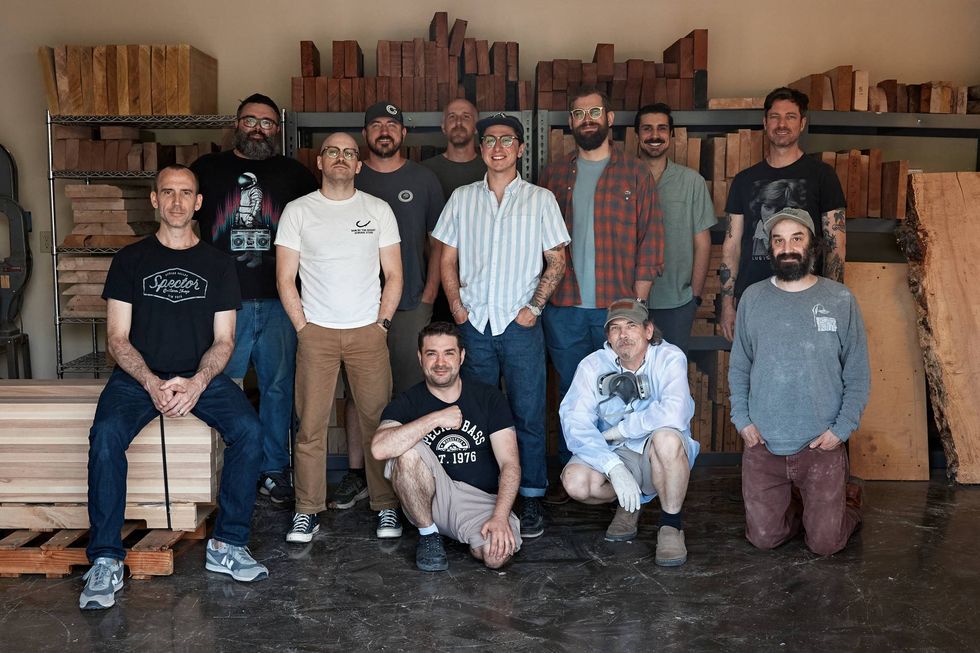
The current Spector team (l-r): Colin, Justin, Adam, Drew, Jesse (kneeling), Rob (in back), Fen, Wil, Kris (kneeling), PJ, Christian, Andy (kneeling)
While pursuing graduate studies in jazz guitar, DeYoung knew repair work alone would never satisfy him. He had learned how instruments functioned, how to diagnose problems, and how to improve existing designs. He knew after watching Kopp build him a guitar that what he wanted was to start from scratch. “I’d done enough repair work to understand both the possibilities and the limitations,” he says. “I wanted to see what could happen when you build an instrument from the ground up.” An opportunity to do just that arrived when his future wife, Mia, relocated to New York City. “I figured I’d follow her and see what happened,” DeYoung recalls. “Worst case, I could keep doing repair work, but I knew I wanted to build.”
For a young bassist immersed in jazz, there was one destination that stood above all others: Fodera. Like many players of his generation, DeYoung had spent years listening to artists associated with the company. Victor Wooten, Matt Garrison, Janek Gwizdala, James Genus, Lincoln Goines, Lincoln Schleifer, and Anthony Jackson represented the pinnacle of modern bass playing. Their sounds—and the instruments behind it—had become part of his musical DNA. “That sound was always in my head,” he says. “Why wouldn’t I want to work there?”
The problem was that he had never built a bass professionally. Undeterred, he began calling the company—repeatedly. Over the course of several months, he continued reaching out until persistence finally paid off. “I basically annoyed Laura Fodera into giving me an interview,” he says with a laugh. The interview itself was not what he expected. “I showed up wearing a button-down shirt and khakis, ready for a normal interview.” Instead, he was led directly into the woodshop. “They handed me a bass body and said, ‘You’re going to carve this.’” The practical test functioned more like an audition. Fortunately, it was exactly the kind of challenge DeYoung had spent years preparing for through repair work, experimentation, and self-directed learning.
“I wanted to see what could happen when you build an instrument from the ground up.”
In 2015, he moved to New York City and joined Fodera. Once there, he approached the position with a singular goal: learn everything. “I wanted to understand every part of the build,” he says. “Whether it was my department or not, I wanted to know how it worked.” He stayed late, went in on weekends, and sought opportunities to work in every area of production. Alongside founders Vinny Fodera and Joey Lauricella, builders Aaron Younce and James Michelson became important early mentors. Over time, DeYoung carved necks, routed bodies, installed electronics, fabricated wooden pickup covers and control knobs, performed fretwork, and eventually assumed responsibility for final assembly and setup. For much of his tenure, every bass leaving the shop passed through his hands before reaching its owner.
The role also exposed him to one of the company’s most ambitious technical initiatives: adapting Plek technology to meet the demands of modern electric basses. While Plek systems had originally been developed around acoustic guitars, Fodera’s instruments presented entirely different challenges. Long-scale neck-through basses behaved differently under tension, requiring extensive experimentation and collaboration with the German manufacturer. “We spent a lot of time helping refine what the machine was doing for basses,” DeYoung says. “It taught me a tremendous amount about precision and consistency.”
Years later, when the opportunity emerged to join Spector, DeYoung found himself unexpectedly connected to a much deeper story. The history of Spector and Fodera intersected decades earlier through a woodworking co-op in Brooklyn—Vinny Fodera was Stuart Spector’s first employee. What initially appeared to be a simple career move soon felt more like a continuation of a lineage.
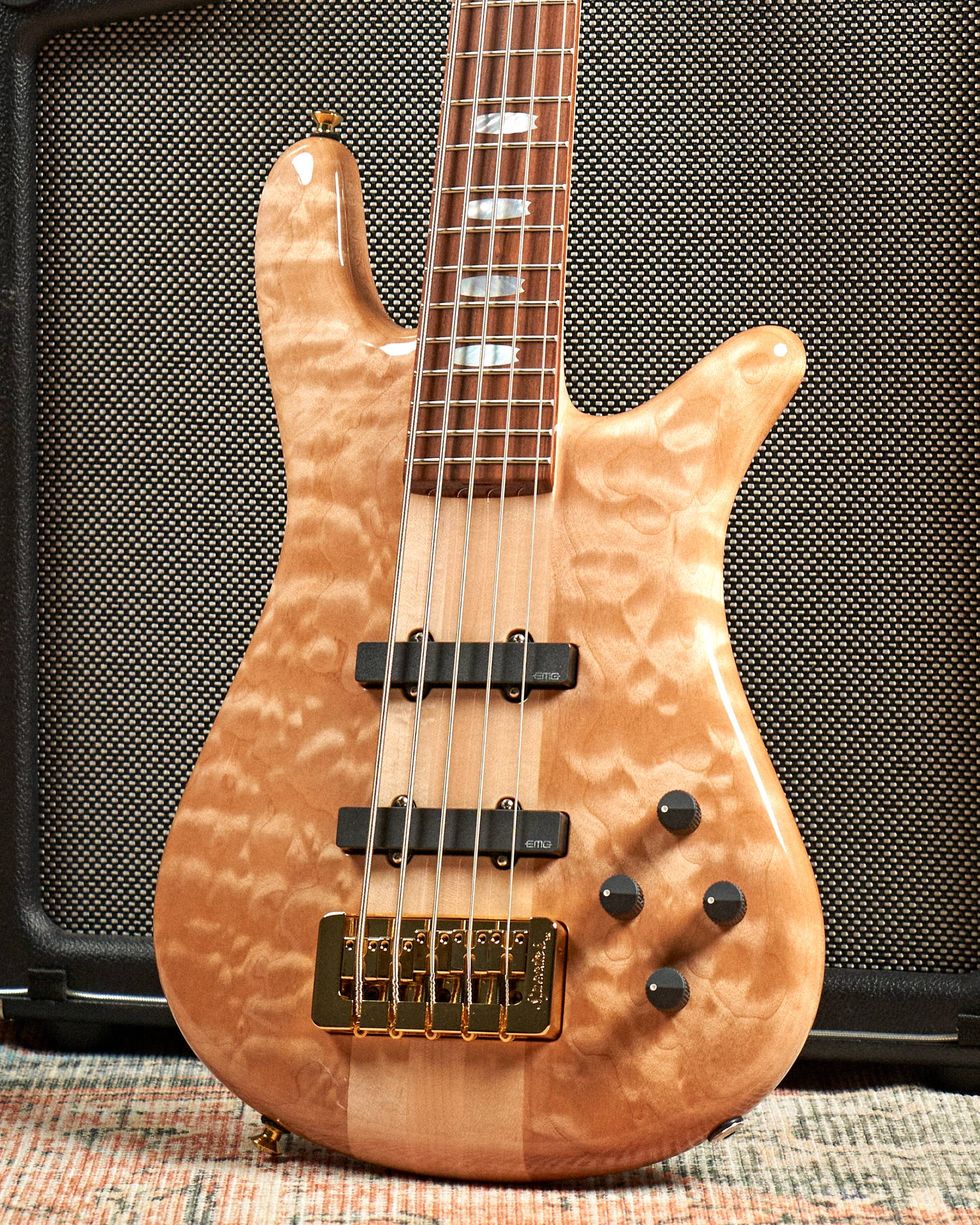
A Woodstock Select bass, launched earlier this year on Spector’s website; solid quilted maple, maple neck, pau ferro fretboard, EMG J pickups, HAZ 9v circuit
At Spector, DeYoung inherited a legacy unlike any other in the bass world. Stuart Spector and Ned Steinberger created one of the most influential bass designs of the 20th century. The elegant and now-iconic NS body shape transformed the way players thought about ergonomics, comfort, and performance. A generation of bassists, including Sting, Doug Wimbish, Eddie Jackson (Queensrÿche), Rachel Bolan (Skid Row), Guy Pratt (Madonna), and Graham Maby (Joe Jackson), embraced the design. Yet honoring a legacy requires more than preserving the past. For DeYoung, the challenge has been balancing heritage with innovation.
“Anything that’s built for 45 or 50 years is going to be built differently and look differently than it did in the beginning,” he asserts. “It’s going to have all these different benchmarks along the way, indicative of different eras. I spent a lot of time with different instruments evaluating what worked and what didn’t. I wanted to build something that really delivered on the original intention of the design but also included the best of everything that Spector has done over 50 years.”
“Being an enabler of people to grow their own skills and think critically about the jobs that they’re doing, so they can improve the instrument, is such a rewarding thing.”
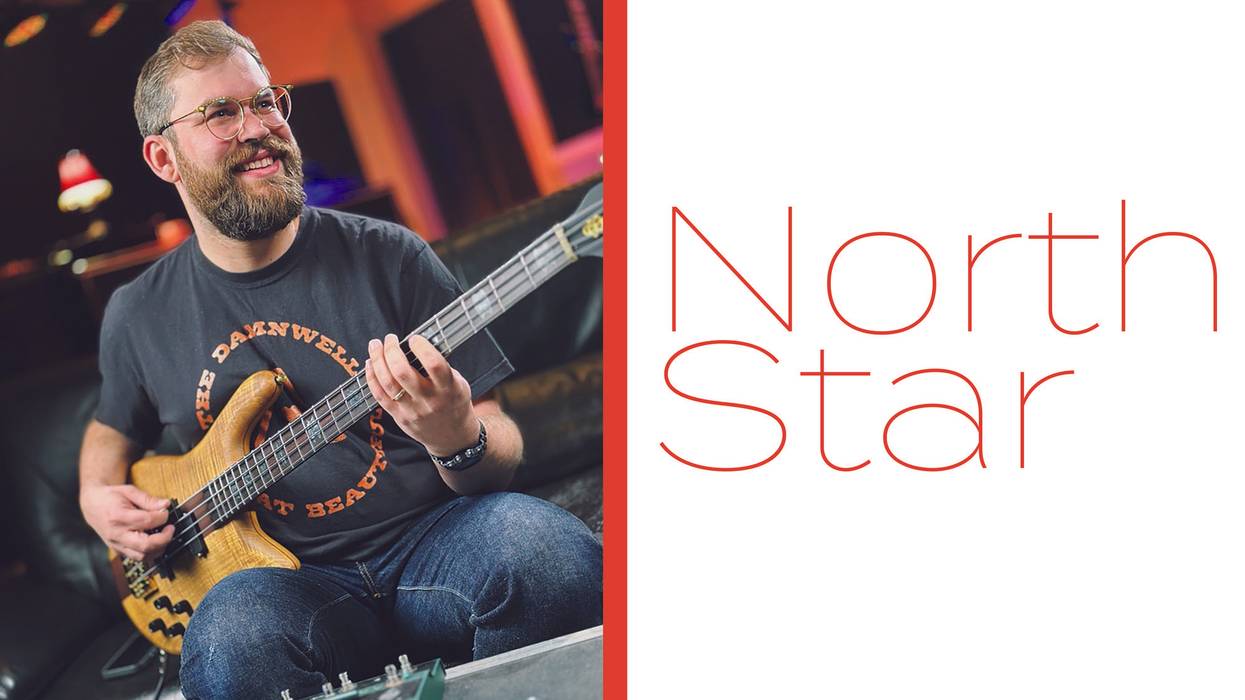
What he noticed right away about the NS-2 was that some important design elements had changed over the years, whether intentionally or not, including the shape of the body, the neck thickness, and overstand of the fretboard to the top of the body. DeYoung took all of that into consideration when he developed a plan centered on having one definitive, idealized 3D model of the 4-string NS-2. He now refers to that bass as the brand’s “North Star.” Everything else—5-string, short scale, and so on—would be based off one standardized design. “I wasn’t designing from the ground up, but the ethos of every tiny detail mattered,” he attests. “Everything had to be reconsidered.”
The other goal for embarking upon what he now dubs his “revision process” was the import business of Spector, which had historically been separate from instruments coming out of the Custom Shop in upstate New York. “Over the years, there were various Spectors—whether they were made in Korea, China, Indonesia, or Europe—that all had their own identity.” Having elements of the Custom Shop’s craftsmanship flow downstream into the international product line and to a wider audience became part of his grand plan. “If you buy a $179 Squier Strat or buy a $20,000 Masterbuilt Strat, and you put those side by side, you see the same design language. It’s still identifiably a Strat. The pickguard is the same shape; the neck carve is essentially the same—all the stuff that makes it a Strat is still there. And that wasn’t necessarily the case with Spector.”
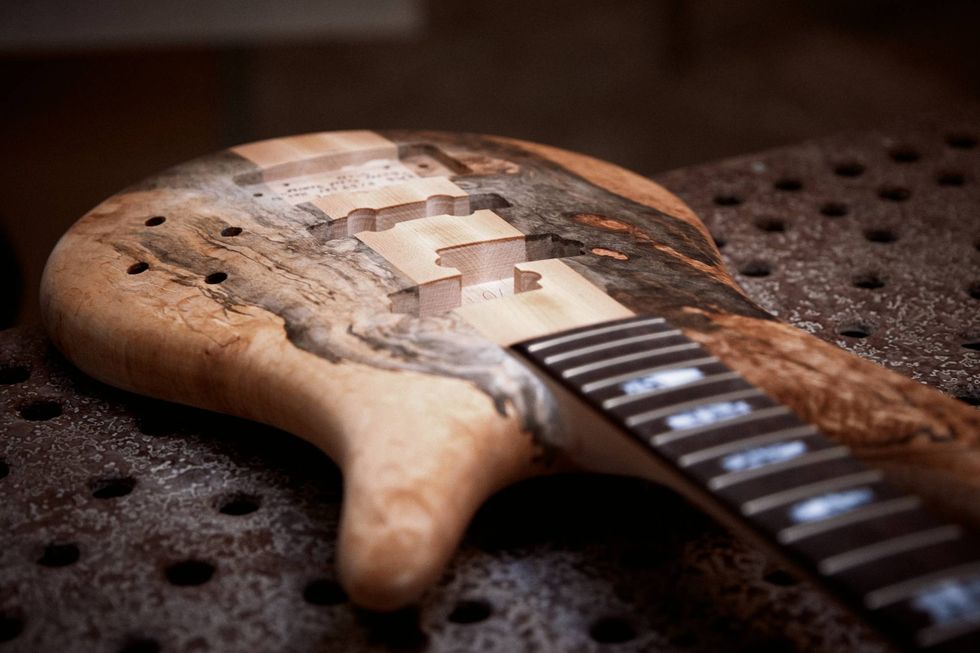
A bass during the sanding process; solid chestnut wings, maple top, rosewood fretboard
DeYoung’s persistence with Korg USA, Spector’s parent company, about disseminating the design language to their international partners, ultimately led to his appointment as general manager, and recently came to fruition with the introduction of the Icon series, based out of Indonesia. “The Icon was designed in the Custom Shop with the same neck profile, the same body curves, it has crown inlays, and the same headstock shape,” he explains. “I made sure that all the 3D drawings that we’re using were the same, just adapted for a bolt-on neck for the [Indonesian] factory in the format that they needed. When you put it side-by-side with a custom-shop build, we want people to recognize the design language but also know what it’s going to feel and sound like. It’s a known thing. The NS-2 is iconic.”
Another one of DeYoung’s first initiatives at Spector was to import the holistic approach to bass building he learned at Fodera. “It felt like such an opportunity to open doors for people," he says. It’s a perspective that harkens back to his time with Denny Kopp. Yes, DeYoung got hooked on building, but it’s also abundantly clear that he adopted the concept of generosity Kopp embodied so thoughtfully throughout that process. “Being an enabler of people to grow their own skills and think critically about the jobs that they’re doing, so they can improve the instrument, is such a rewarding thing."
Though he’s been handed the keys to the proverbial castle, DeYoung clearly understands his role as caretaker of an iconic brand, and remains focused on the same qualities that first drew him into the craft: curiosity, continuous improvement, and a deep respect for the musicians who bring these instruments to life. “My role is to bring in a new perspective and a different way to think about things,” he says. “When it comes to guitar building, there’s no one right way to build a guitar.”