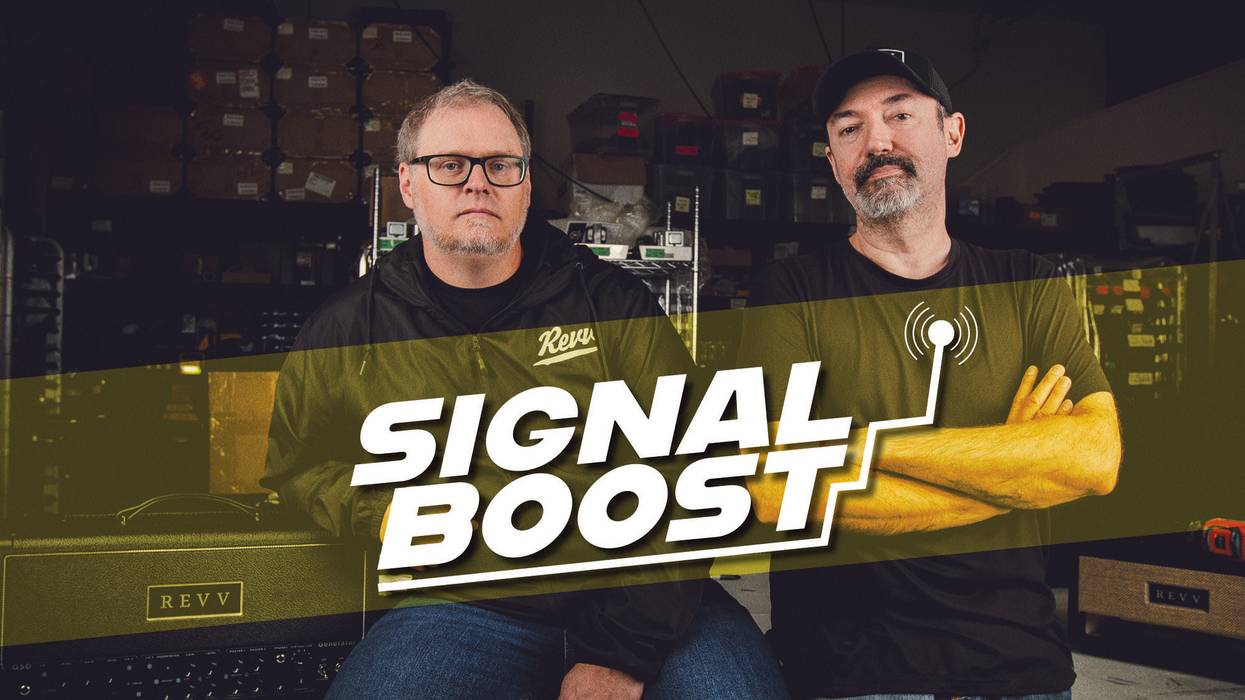

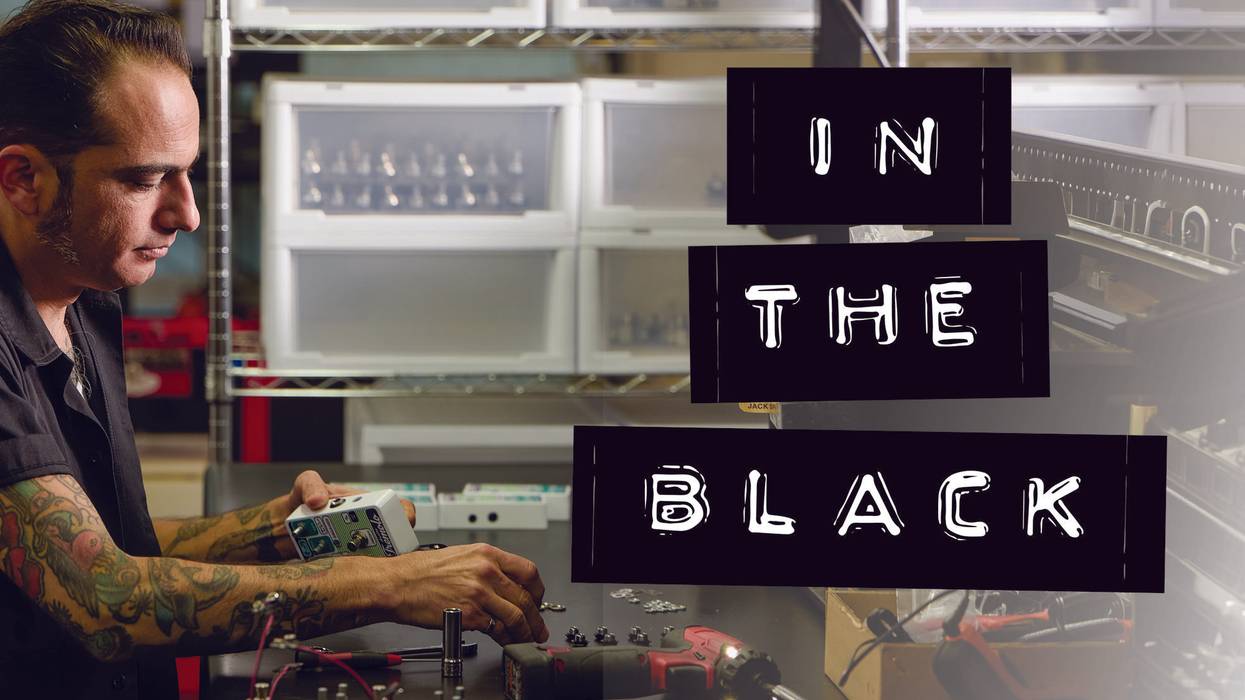

A big-budget Hollywood biopic of pedal-maker Jack DeVille would open in the eye of a furious winter storm—or, more specifically, The Great "Snowpocalypse" that rocked Portland with a record-breaking blizzard back in 2008. Our protagonist, a sharp and scrappy auto mechanic, has been racking up extra hours in the evenings and weekends: working a side gig as a builder with a burgeoning pedal company, taking on freelance gear repairs here and there, experimenting with electronics to learn the core theories that eventually powered his own brand, Mr. Black.
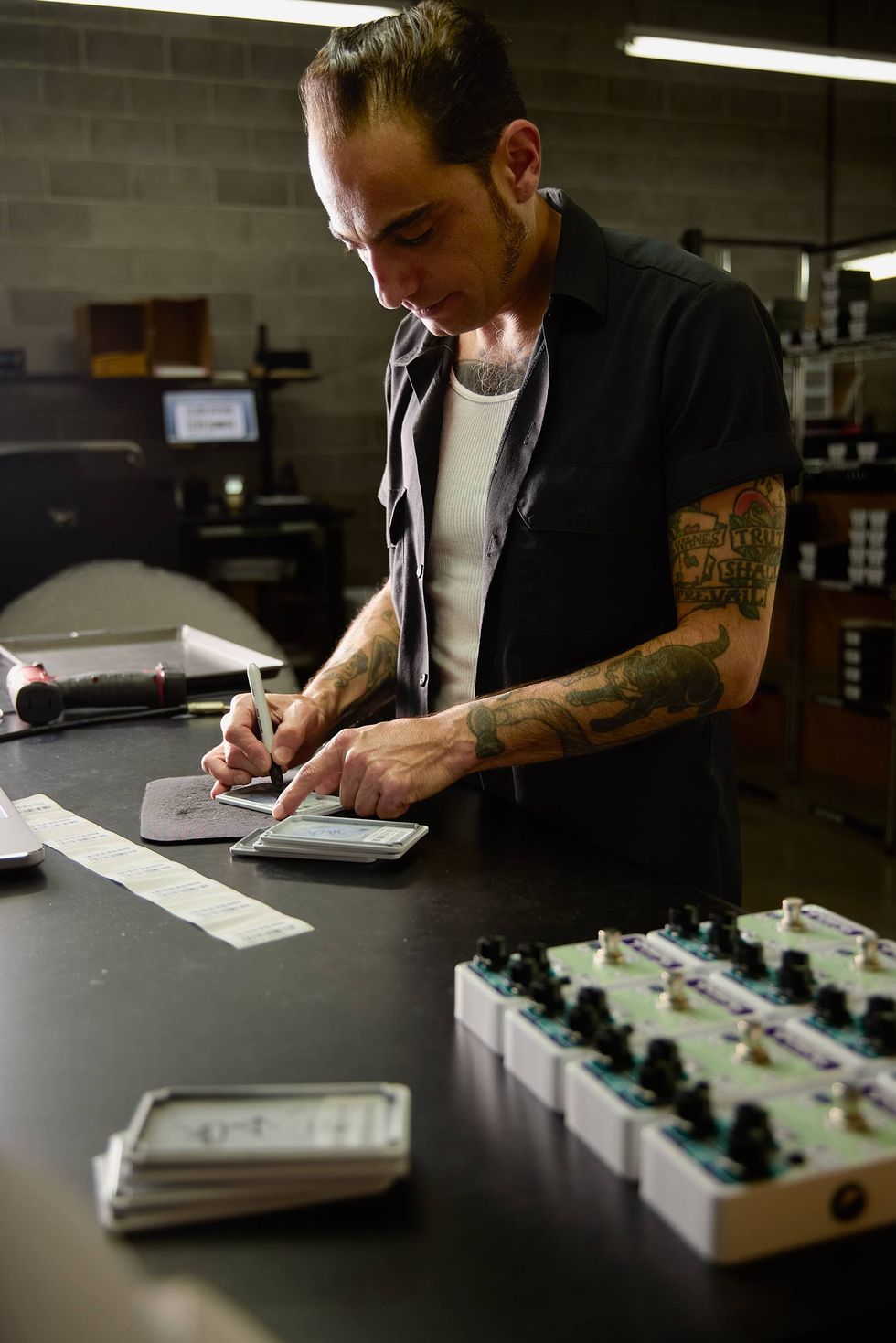
Photo by George Barberis
As the snow pours, he takes a crucial step: unveiling his first creation, the Jack DeVille Dark Echo, with all the homespun hustle you can imagine. “I put an ad on Craigslist: ‘Want a delay pedal?’” DeVille tells Premier Guitar. “There wasn’t much [out there] for delay in terms of small-manufacturer ‘boutique’ guitar effects. It’s hard, and that’s probably why. But I thought, If I can make something good, I bet I can sell them. So I did! And a couple people bought ’em.
“It’s gonna sound cheesy and poetic, but this is actually true,” he continues. “On December 23, 2008, I had my ad up, and some guy way down in Southwest Portland was like, ‘I wanna buy this, but I can’t leave my house. You’ll have to deliver it.’ For what it’s worth, there was, like, three feet of snow. But the pedal was $200. I was like, ‘Fuck, dude.’ On Christmas Eve, I actually did ride the bus, spend my $2.25 or whatever, and take a five-hour ride to sell this pedal. But that paid rent.”
Later that night, someone else hit him up: “Hey, I want to buy my husband this guitar pedal.” So DeVille journeyed around a half-mile to a local bar named Dots, where he sold his second Dark Echo.
“That’s when it clicked,” he recalls. “I was like, ‘These cost me $40 to manufacture, but I made $400 this afternoon. If I can do this 10 times per month, I’ll be able to pay my bills.’ Little did I know I was starting a manufacturing company.”
After years of continued grind and word-of-mouth buzz, DeVille is now one of the most respected boutique pedal makers in the business. But there have been no shortcuts—a theme that carries all the way back to his childhood in California.
There were many small but pivotal steps that led DeVille to create Mr. Black. The first was probably falling in love with metal. “I was really into Metallica," he says, highlighting the thrash kings’ 1988 classic, …And Justice for All. “I thought that was the pinnacle of music—until I heard Slayer.”
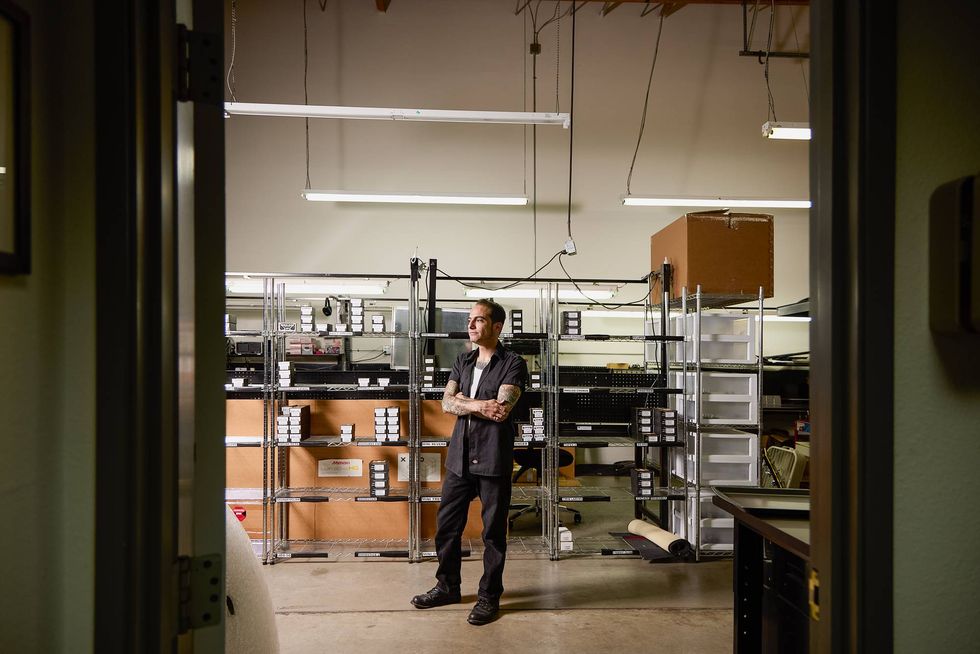
DeVille observing near ready-to-ship stock.
Photo by George Barberis
At age 10, back in his original home town of Berkeley (following his family’s brief stint in Oakland), DeVille started taking guitar lessons—and he says that, by around seventh or eighth grade, he was studying under Doug Doppler, a technically gifted player who expanded his knowledge of theory and the instrument’s “technical side.” By ninth grade, he started his first band—but his attention soon drifted elsewhere. “I didn’t like school or any of that,” he says. “So I quit in the ninth grade. I liked girls and getting high, so that’s what I was doing with my time. But that led to some pretty tumultuous years—got my ass locked up for a while, then got out of that.”
By 17, he was renting a “dumpy little apartment” with some friends, working at a junk shop and playing in a punk band. A few years later, he grabbed a copy of the Berkeley Daily Planet newspaper and spotted an eye-catching job posting for a nearby paint shop: “Mechanic, No Experience Necessary.” As it turned out, he was really good at the job, and next enrolled at a local community college for aviation, aspiring to be a helicopter mechanic.
“If I have a new thing I’m working on, it has to change the way you play and pull something out of you.”
DeVille eventually switched gears again, and found work at an Oakland car shop—that is, until a pivotal 2007 trip to Portland, where his sister was living. His then-girlfriend Nancy was there, too, and she fell for the city. “Two days into the trip, she said, ‘I’m moving here. You can come if you want to.’” The idea seemed to make financial sense—on levels both large and small. During his first trip to Dots, staring down at his massive but affordable plate of fries, he knew the truth: “That was the clincher,” he said. “It was an easy thing to figure out.”
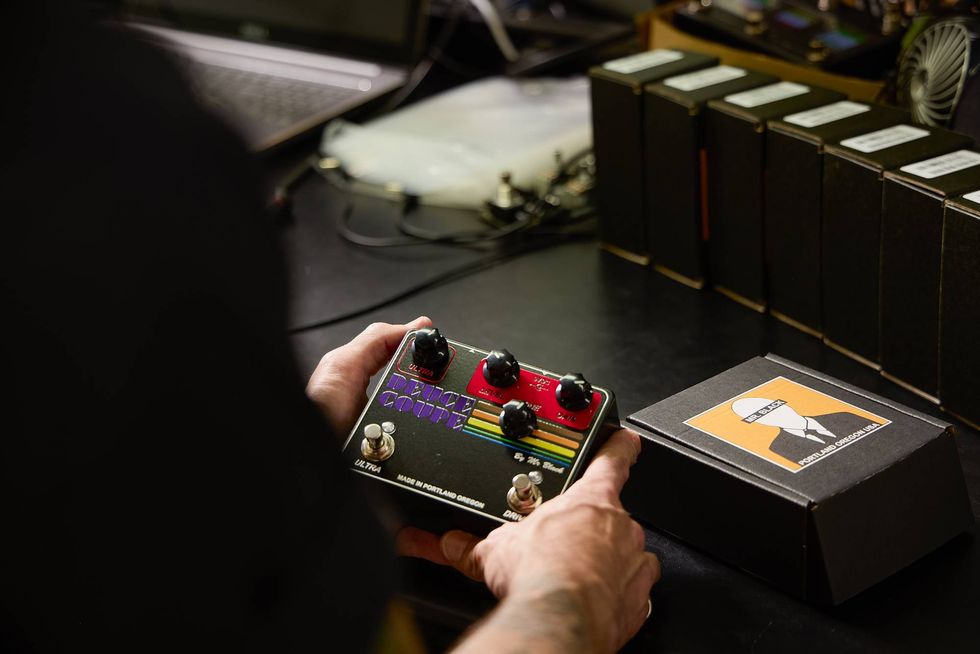
Final cosmetic inspection of a Deuce Coupe overdrive pedal.
Photo by George Barberis
Another easy thing to figure out: focusing on making pedals. In 2008, after those first sales of the Dark Echo, DeVille was working as an amp tech at Eastside Guitar Repair in southeast Portland. “I would also make pedals and sell them out of that place,” he recalls. “People in town knew, ‘If you need a pedal fixed, they’ve got a guy who can do it.’” And he realized he wanted to take his technical knowledge even further. “It only made sense to be like, ‘I know how to repair stuff. I’ll stop working on cars and transition to just doing repair work on amplifiers and guitar pedals and all that,’” he says. “That’s all well and good, but repairs, service work, is kinda shitty. What gets me about that trade and career is that you’re surrounded by broken stuff all the time. Nobody wants to take their car to the shop. Nobody wants to take their amp to the shop.”
That year, he formed Jack DeVille Ltd.—but that venture wound up hitting a dead end. Things changed in early 2012, when he created Mr. Black Pedals as an offshoot product line—and within a few months he had the inspiration for the SuperMoon, which is accurately described on the company’s website as “cavernous, vast, and orbital.” DeVille initially only planned to make 100 pedals, but those sold in five days and demand continued to snowball.
His girlfriend at that time, Victoria, knew he was at a crossroads: “She was like, ‘You’re out of debt. I can’t believe it!’” DeVille says. “She’d met me just before the Mr. Black brand had launched. At that time, I was deep in debt, and there was no one I could turn to. She still liked me. She said, ‘Are you gonna quit? Are you gonna go back to automotive? You hated automotive.’ She only knew me as an amp-repair/pedal person. She said, ‘Don’t do that. Worst-case scenario, if it doesn’t work out, you can always go back to automotive later. Why stop at 100?’ I made another batch of 100, and those sold real fast.”
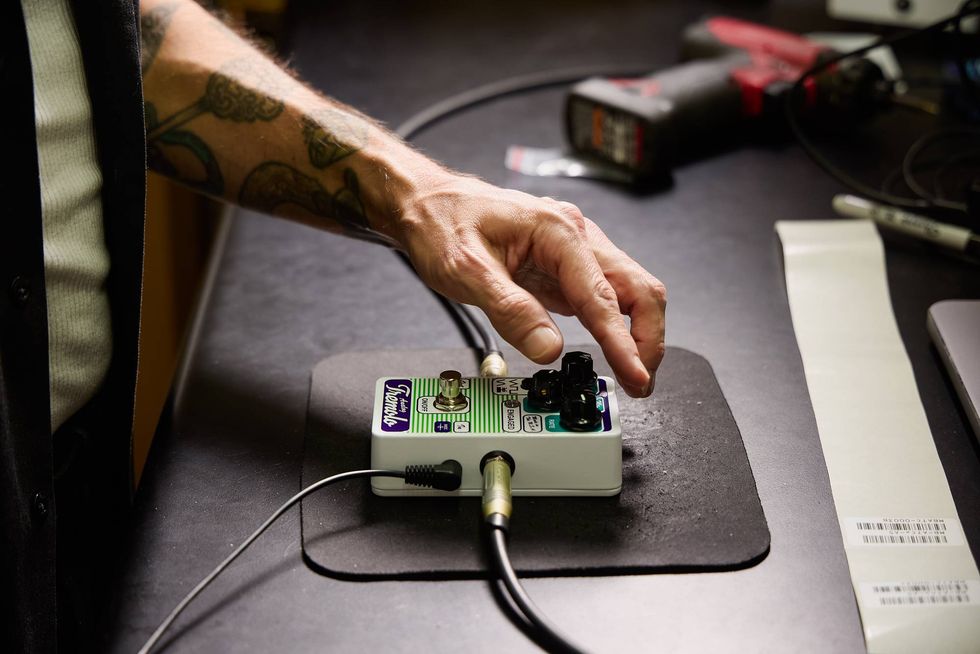
Final test/functionality/performance verification of an Analog Tremolo pedal prior to packaging.
Photo by George Barberis
With its massive, 30-second reverb tails and “dynamic, proprietary Sway modulation,” the SuperMoon became a sleeper favorite, with word spreading organically through forums like Harmony Central and The Gear Page. Even 14 years later, as DeVille’s product line has expanded to 30-plus pedals—from the transparent Deuce Coupe overdrive to the ADT/chorus-like DoubleTracker Stereo—he’s maintained that same workmanlike approach, choosing to let the quality of his builds do the talking for him.
“Little did I know I was starting a manufacturing company.”
“I’m not good at social stuff,” he admits. “I have friends who are like, ‘You should come meet so-and-so.’ That’s not my thing, man. Some people promote their products and brands through others, and I understand that’s a common and effective way people do things. It’s just not how I do it.”
DeVille thinks back to the wisdom of his former car-shop teacher, a Vietnam veteran and helicopter pilot named Paul: "When I knew him, he was in his mid-60s. He was my electrical and drivability instructor when I was in the apprenticeship program, and we became friends. One day around 2005, I stopped by Paul’s shop, and he said, ‘You gotta understand, man. I’m working on the grandchildren’s cars of my first customers.’ Paul’s shop had been there 30 years, in the same fucking building. He said, ‘Listen, Jack, all you’ve gotta do is offer a fair price for a good product, and you’ll never see the end of your business. You’ll never get rich like that, but you’ll always have work.’
“That’s always been my ethos,” DeVille continues. “I could have charged way more for the SuperMoon and all that. But who’s buying these? I don’t want to sell them to, like, blues dads. That’s fine. But I don’t want to limit a guy like myself. It’s nice to get a steak every once in a while, but it’s not steak every day. If I’ve got enough food on my plate, why do I need seconds?”
DeVille clearly isn’t chasing pedal-maker hype—he’s just happy to be creating some cool gear that galvanizes ordinary people to simply pick up the guitar and play. “As far as growth goes, I don’t know,” he says. “Money’s fine. I don’t want a big-ass corporation where I have to go to board meetings. I don’t like having employees. I don’t like having to kiss ass. I’m not good at it, and I have no interest in being good at it. I don’t want to have to go to some show for a band I don’t really like and say, ‘Oh, thanks for playing this product. Here’s a new product!’”
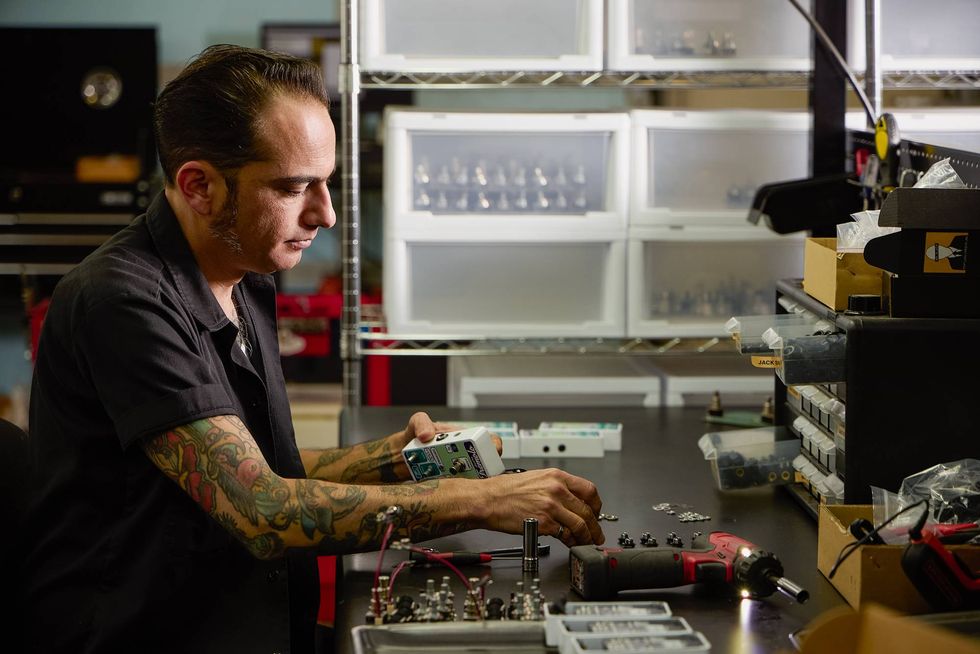
DeVille assembling Analog Tremolo pedals.
Photo by George Barberis
When asked about any famous artists who use Mr. Black pedals, DeVille is charmingly out of the loop. “There’s a country guy—maybe it’s Keith Urban—he has dark hair and stubble. A few years back, someone was like, 'Hey, they’re playing your pedal and gave you a shout-out in their magazine.' I said, ‘This is the first I’ve heard of this.’ I don’t know—I guess he bought it. I didn’t sell it to him, but he must have found it somewhere.” (Urban told Guitarist in 2026, “I use a [Mr. Black] SuperMoon for a couple of songs because it’s such a unique, cool-sounding ’verb.”)
Regardless of who’s playing his pedals, DeVille has some exciting things in the pipeline, including a “really fucking high-performance” product that he’s still tinkering with. “If I have a new thing I’m working on, it has to change the way you play and pull something out of you,” he says. “There are literal boxes full of perfectly good pedals that didn’t make the cut—they’re good, but they didn’t inspire."
The idea is simple: “Whoever inspires you, whatever it may be—maybe it’s Boss, maybe it’s MXR, maybe it’s Strymon, maybe it’s Joe Blow’s Fuzz Shack—buy the one that you like,” DeVille says. “And if at all possible, get the one that’s built by just a guy in his basement. That’s where the big dogs come from. They all start there, and you’re encouraging the next crop.”
He continues. “The expression I know is: ‘The grass is greener where you water it.’ If you want more of whatever it is—say there’s some fuzz pedal you really like, or there’s some boutique guy doing some weird, granular DSP bleep-bloop shit that I don’t understand—buy that one. Go for the one you’re uncertain about, that’s a little risky. Go for the underdog.”