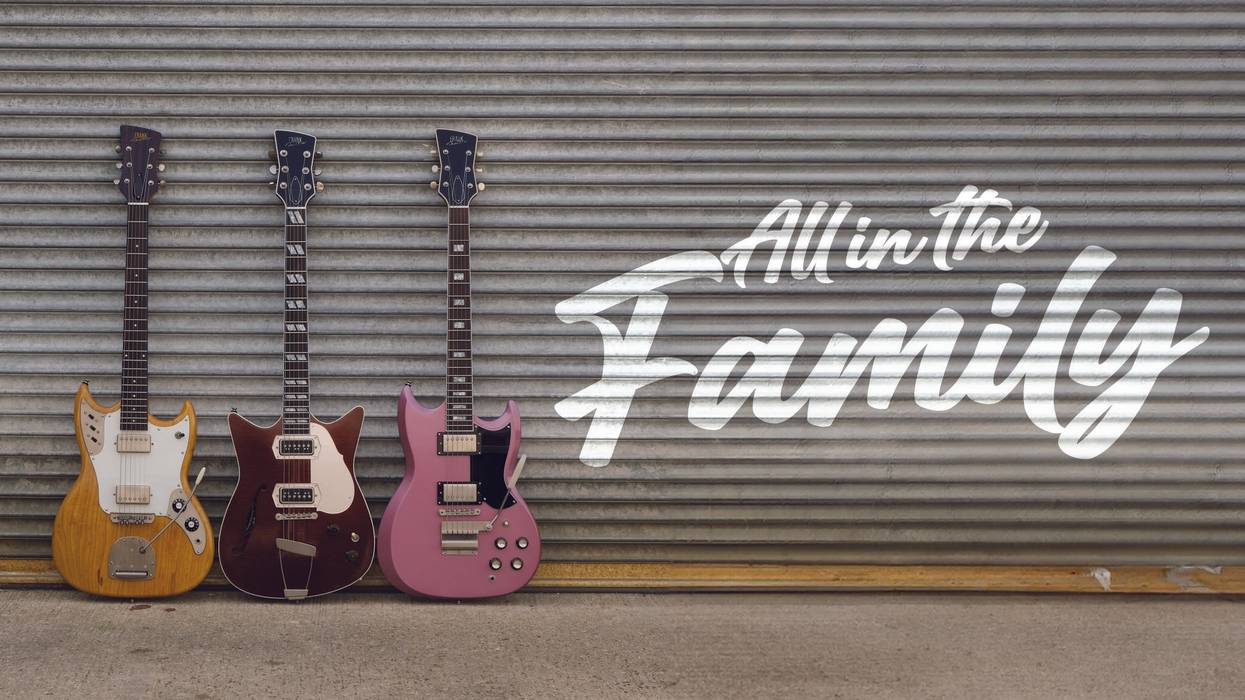

Jeff Tweedy, mastermind of legendary alt-rock act Wilco, is a total gear-head—always seeking out another guitar or amp or bass for his massive collection, seemingly hoping each strange and tantalizing toy sparks some form of inspiration. In January 2025, he opened up his treasure trove for an interview with Reverb, showcasing some of the boutique pieces that have captured his eye and ear. One obvious standout was a Grez Mendocino bass: a lightweight, semi-hollowbody that, with its sharp lipstick pickups, scans as a quirky tribute to the vintage Danelectro aesthetic. “I saw the instrument, [and] it looked austere and interesting,” he says in the video. “I listened to some clips of somebody playing one, and it sounded like something I didn’t have. It’s not like a Danelectro. It’s not like, really, anything.”
That’s basically the creative and business philosophy of Grez Guitars owner/luthier Barry Grzebik, who formed the small but surging company in 2009, operating out of a converted backyard horse barn in Petaluma, California. “I think most of these instruments are pretty versatile, but they’re not infinitely versatile,” he tells Premier Guitar, highlighting his compact line of 4-, 6-, and 12-strings. “I look at it less like ‘Who’s the right player for the instrument?’ A lot of people are. I look at it more like, ‘Who isn’t the right player?’ That’s a smaller group and more easily defined.” He points to the Tweedy-approved Mendocino: “If you’re playing slap-bass, super brash and bright with the treble cranked; if you’re looking for that crazy articulation and a super-fast vibe, these aren’t the instruments for you. Now, if you want something that blooms more interestingly and is a little fatter and richer-sounding, maybe if you’re deciding whether to put flats or rounds on it? [Give me] flat-wounds through a [Ampeg] B-15, and I’m just happy. Whatever that conjures in your mind tonally, that’s the vibe I want to embrace.”
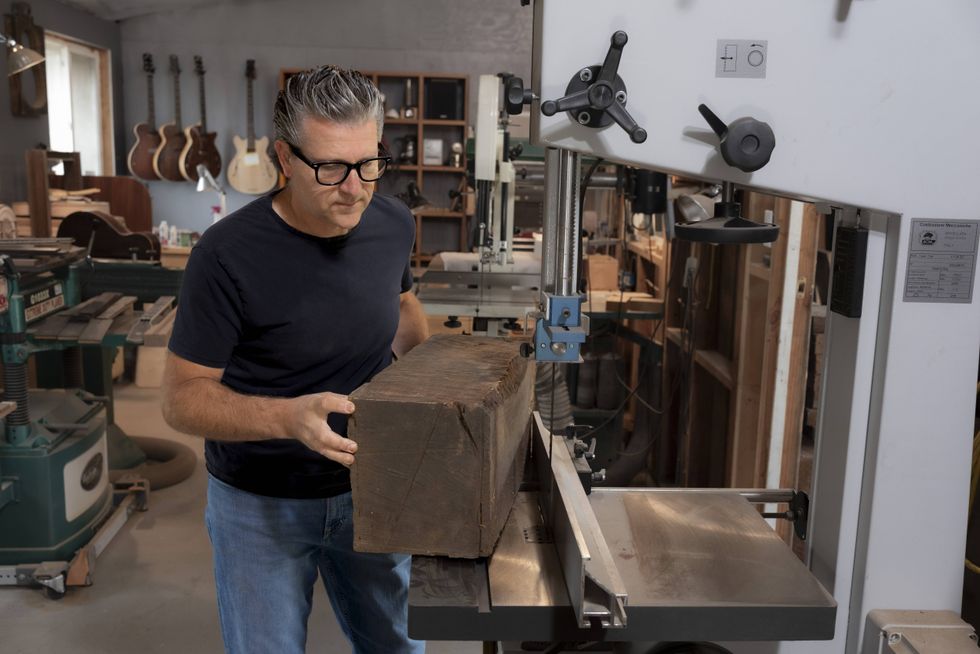
Grzebik with reclaimed old growth redwood ready to be resawn into tops for Mendocino and Grand Tour basses.
Grzebik never set out to build basses at Grez, having initially focused on guitars. Then again, he really couldn’t have pictured any of this organic rise—making his name as a luthier, spinning that name into a brand, getting online shout-outs from world-famous musicians—given that he spent most of his early career in the realm of electronics and pro audio. Early on, he dreamed of being a player—at least until he had a sobering epiphany of sorts.
“I can’t exactly put my finger on it, but I’ve always wanted to play guitar,” Grzebik says, looking back to his childhood. “The idea of being a musician was always fascinating to me, though I was never successful at doing it. But that doesn’t mean it’s not this thing you desire to do. I tried to play guitar as a young kid—maybe I was 8 or 9. My parents rented an acoustic guitar for me, and I went to a community center and took some group lessons. It didn’t stick, and I don’t even know why. And the guitar vanished because it was rented.”
He continues: “It cropped up again when I was 15 or 16—I got an electric guitar and started to learn to play. Then … while I was still in high school, I realized that I wasn’t really a guitar player. I love it, but it’s not for me. How should I put it? They say if you practice enough, you can become great at the guitar. And I know that when I practice, I become better. But I guess I’m also realistic about how much practice it takes me to get better versus someone else. As a kid, I’d run into other people who play guitar at parties and they’d just smoke me. I realized that, although I love it, it’s not what I’m meant to do—I should put my energy into places where I have more natural talent.”
“As a small custom builder, we’re kind of big, but we’re tiny in the grand scheme of things.”
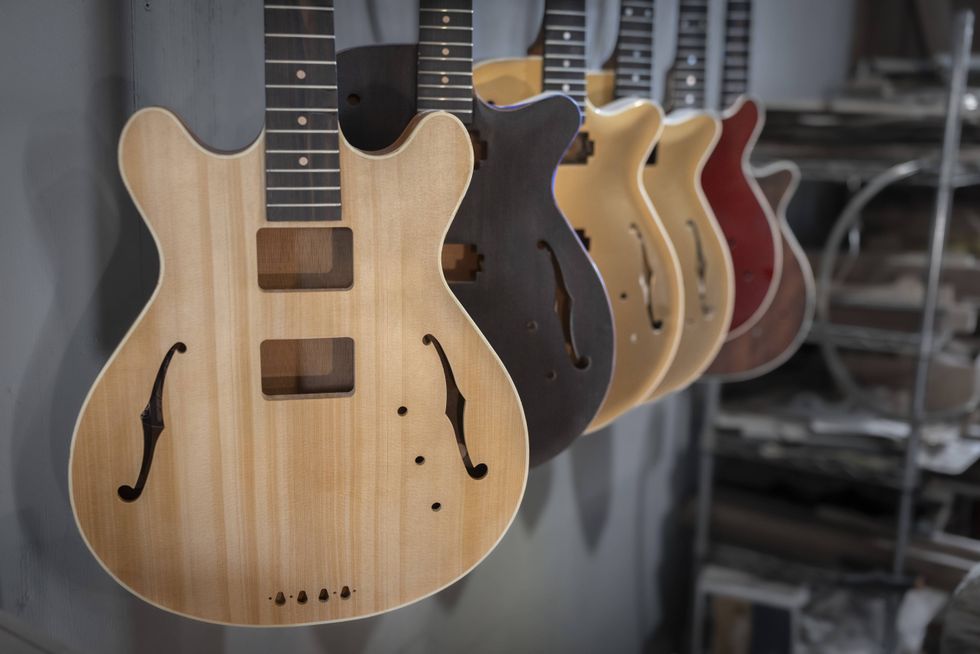
Grand Tour and Mendocino basses in various stages of finishing and buffing.
That area happened to be design. “I was always a mechanical kid,” Grzebik says, recalling how his dad bought him his own toolbox back in the ’70s. “I was fixing my bike, then my buddy’s bike, eventually motorcycles—taking things apart and understanding them.” Those skills dovetailed with music due to his “weird fascination” with hi-fi. “Having a boombox was a new thing, having a stereo,” he says. “When I realized I wasn’t going to make any money playing guitar, I took an electronics class at a local junior college, and the lights just went on: ‘This is amazing. It’s just these parts? There’s not even that many kinds of parts? You put them in a certain order and it does these things?’ All of the sudden, the mystery was gone. It’s like when you learn how a magician does their magic trick. I thought, ‘I can be around guitar and music, but in a different way.’ I feel lucky that I figured that out really early.”
Grzebik experimented a lot—making his own guitar amp, crafting “little battery-powered preamps that you could put in your bass.” By the early ’90s, that obsession led him to work with audio company Apogee, initially designing products like equalizers, amplifiers, and compressors. “That was completely fascinating to me. I was obsessed with that—so much so that I completely stopped playing guitar for a while,” he recalls. “Eventually I was designing loudspeakers. As a junior engineer, you’re not really designing the whole product—the look, the feel, the idea—you’re just given this little thing. ‘Lay out this circuit board.’ ‘Design a power supply.’ ‘We need a heat sink that works better or fits in this spot.’ But as you work your way up the chain, you’re in charge of the whole thing and you’re setting the tone of how a product is going to look and feel and work. So I started to realize that I was a designer. It slowly became more and more the thing I loved to do.”
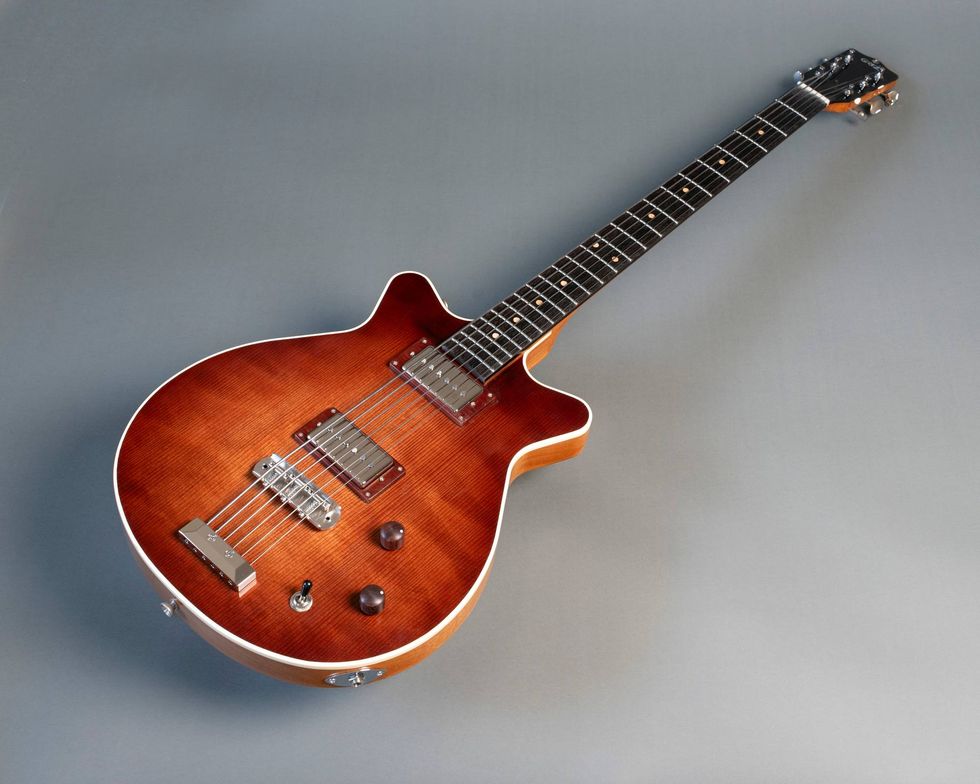
A Mendocino Bass VI with a reclaimed redwood top and Lindy Fralin noiseless alnico P-90s, in a burst finish.
Around this time, a theme had clearly emerged: Grzebik was an adaptable worker and a creative thinker, willing to go where the road happened to lead. Soon enough, Apogee noticed his customer service skills and started sending him into the field, where he traveled all over the world to oversee installations for major events like the Oscars and the Grammys. “If you spent $100,000 or $200,000 for a sound system for your venue or touring rig, you might expect someone from the company to show up and hand-hold you through the installation—show you what it does, how to tune it,” he says. “That took me away from guitar, but it was so fascinating and exciting.”
“I look at it less like ‘Who’s the right player for the instrument?’ and more like, ‘Who isn’t the right player?’”
After a while, Grzebik realized he could do this kind of thing on his own: “Having been director of engineering for Apogee Sound for a long time, I had a few contacts, and people would call and hire me. I would work as a consultant, and I still do a little bit—designing recording studios here and there. But I realized after a few years that I kind of missed designing products.”
In 2008, he devised an acoustic guitar amp for a small startup, but when the economy tanked, the whole thing unraveled. There was a silver living, though. “That product forced me to drag the guitars I hadn’t used in a decade out of the closet,” he says. “And once they were out of the closet, I didn’t put them back. Then the idea started to creep in: ‘I could probably design a guitar. I know about guitars and woodworking and cabinetry and electronics and sound.’ I would have never thought, when I was in my 20s trying to become a product engineer, that I would be a guitar builder for a living. It didn’t even cross my mind at the time, but it just sort of morphed into it.”
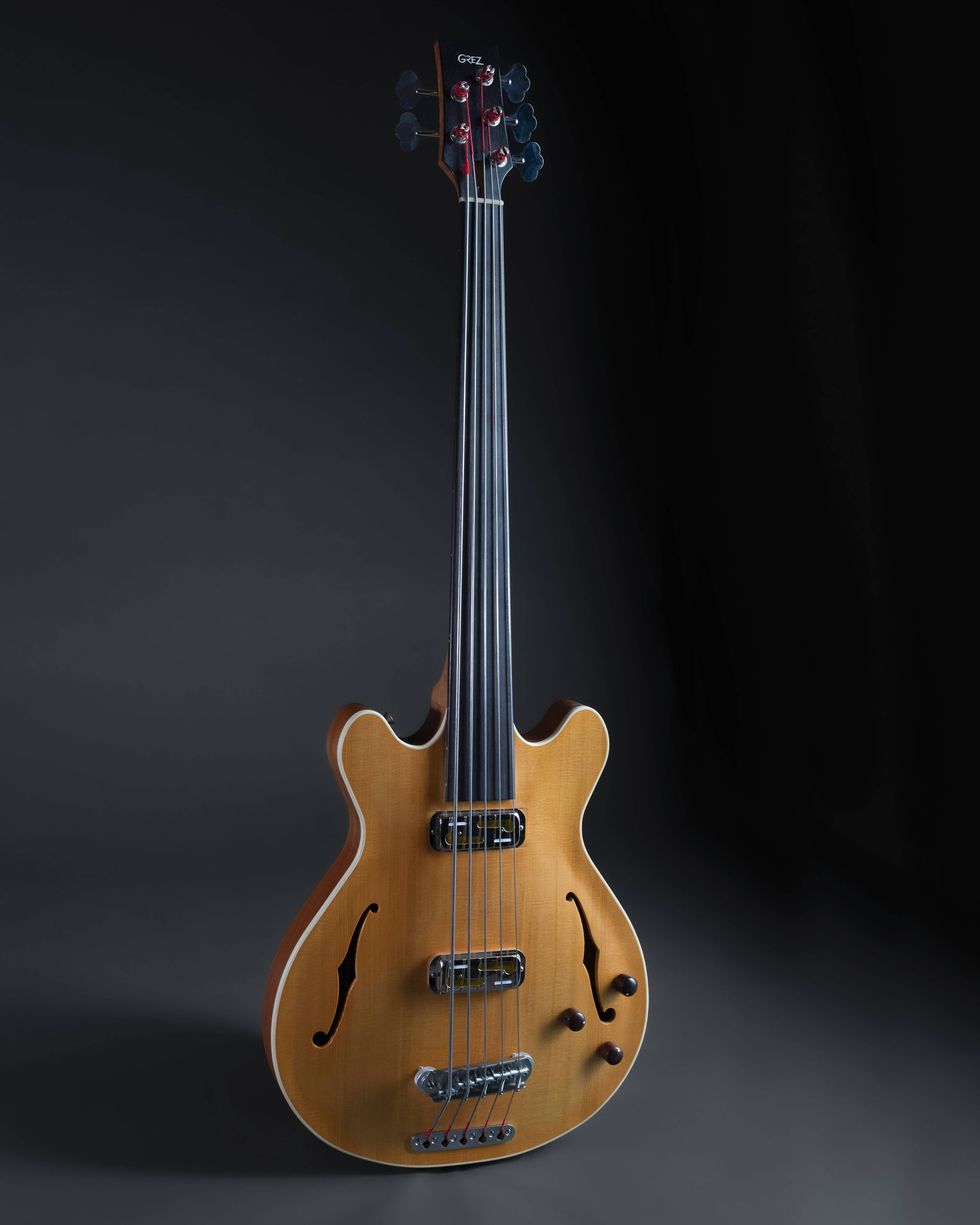
A Grand Tour 5-string fretless bass with a natural spruce top and Curtis Novak H22 pickups.
Flash forward to 2026, and Grez is one of the most reputable brands in the custom-guitar space, selling everything from Junior models to baritones, even a Mendocino Bass VI. The company produces somewhere around 100 instruments each year—about two per week—with 40 percent of sales going to dealers and 60 percent direct to customers, plus custom orders on request. “I have the ability to maybe do 150 in the facility I have, and then that’s it,” Grzebik notes. “And by ‘facility,’ what I really mean is ‘horse barn in the backyard.’ Once we get to about 150 a year, which is a place I slowly envision getting to, that’s it. We don’t make more than that. The goal isn’t necessarily to be giant. It’s just me and a few helpers, and we’re enjoying ourselves as best we can making a living. As a small custom builder, we’re kind of big, but we’re tiny in the grand scheme of things.”
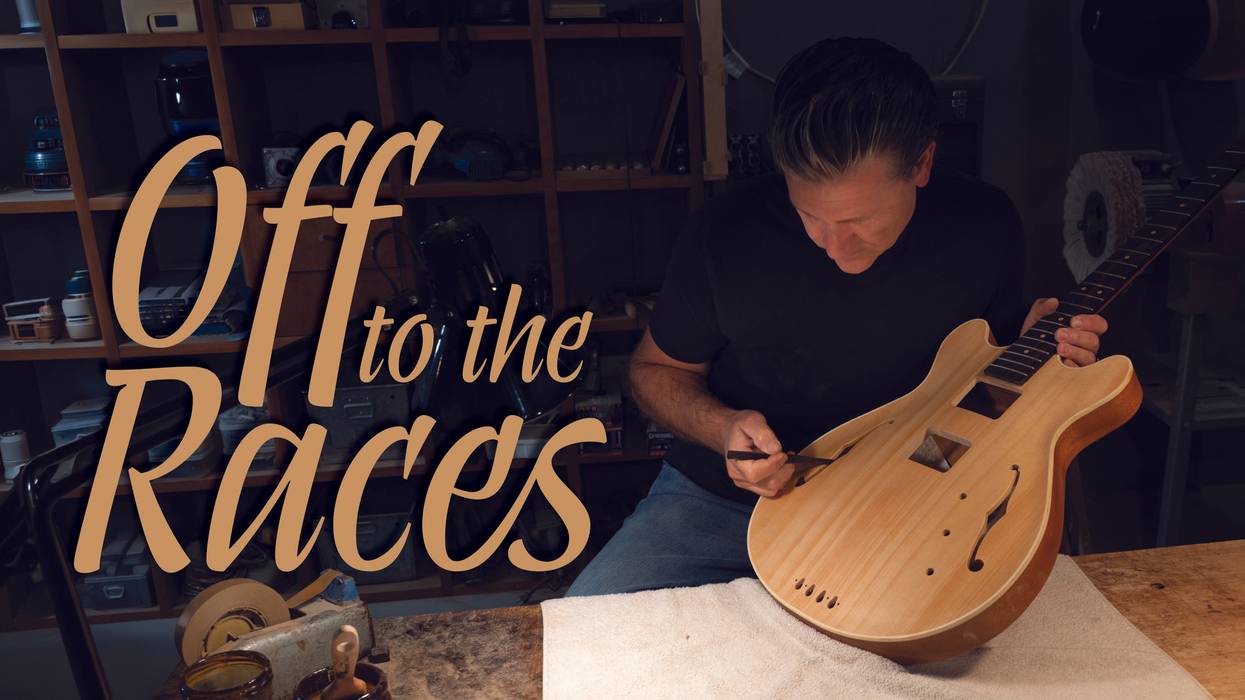
“I’m trying to make racehorses that you go out and race.”
For their bass models, the ratio is way different: almost 90 percent direct. But Grzebik isn’t too analytical about that divergence—it’s all been “morphing” slowly, as he moved from semi-hollows and archtop hollowbody guitars into the occasional 4-string. “It was this tiny little growth curve [for bass],” he says. “I made one, and then I made another, and then a few more. It was a slow-motion kind of growth.” Given how labor-intensive the instruments are, he eventually settled into the staple Mendocino model—first as a guitar, then a baritone, then the Bass VI, then the short-scale bass. “Some of it sold well because there’s not a lot of what I’m doing out there,” he continues. “Admittedly, I make weird stuff. I’m not making copies of Fenders. The Mendocino short-scale bass is conceptually based on the Danelectro short-horn bass—it’s a nod to that at its core. It’s a super niche instrument, and you’re only going to sell so many. But as a tiny company, I don’t need to sell that many. I can make these weird things, and if I sell a dozen of this weird model and a dozen of that weird model, all of the sudden I’m making a living.”
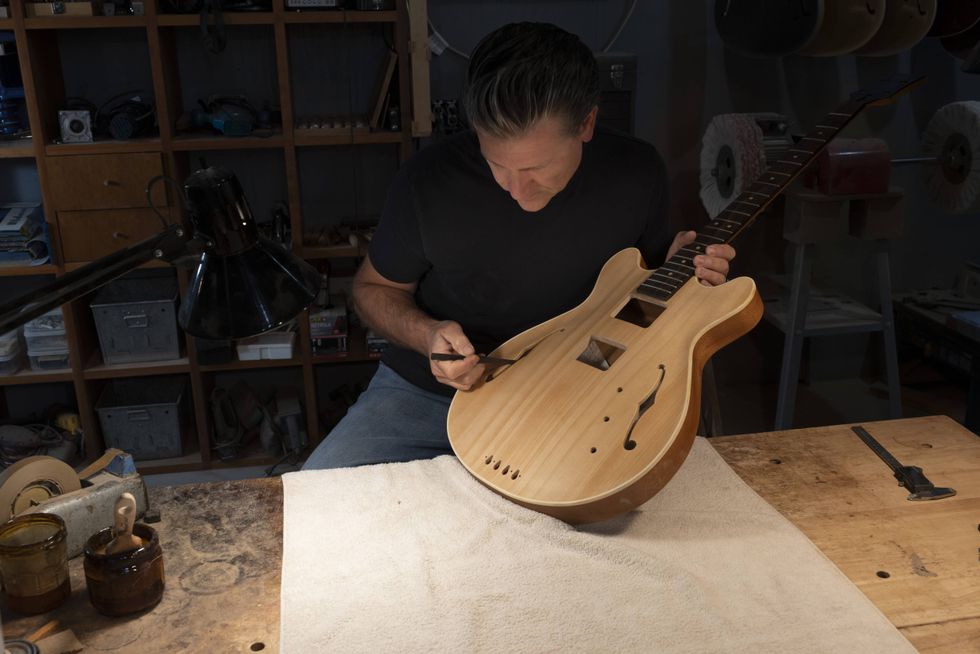
Grzebik sands inside the f-holes on a Grand Tour bass in preparation for paint.
Part of that sustainability boils down to resourcefulness. Using as much reclaimed wood as possible, Grzebik maximizes every piece he has: “Because of my manufacturing background, I’m fairly good at keeping common materials. If I have a chunk of Honduran mahogany as a body blank, one piece in stock, that can be used for almost any model I make.” But it also comes back around to the uniqueness of his instruments, which continue to intrigue players like Tweedy, Ian Martin Allison, and Allman Betts Band bassist Justin Corgan. (The latter, Grzebik notes, recently hit the road with a Grez Grand Tour: a 16", semi-hollow double-cutaway model.)
“The people who are into bass, when they look up onstage and don’t quite know what the guy is playing, that really piques their interest,” Grzebik says. “They get a lot of people coming up post-show asking about the instrument. The reality is that most people don’t know Grez. When they look up there and see this thing, they’re asking about it all the time. I think [bassists], most of the time, are getting more attention than they’re used to.”
It all ties back to the Grez ethos: crafting eye-catching objects that are built to be played, not simply admired. “I’m not trying to make show ponies,” Grzebik says with a smile. “I’m trying to make racehorses that you go out and race.”