
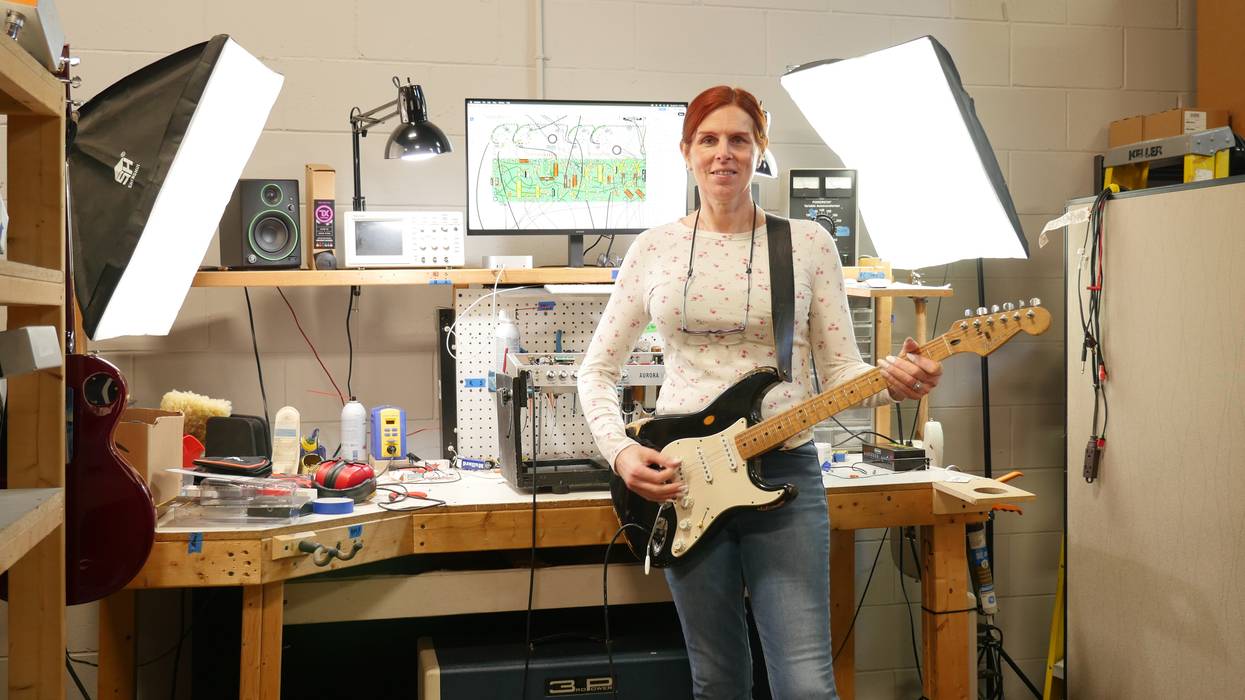
Dylana Nova Scott caught the music bug early—as in, toddler early—when her mother took her to the Seattle Pop Festival in 1969. “It was my mom’s birthday, and this was her present to herself,” Scott recalls. “I saw Led Zeppelin and the Doors. I got to see Bo Diddley way up close. He played on a flatbed truck, and I sat on it with my feet dangling to the music. He looked down and pointed at me as he played. I’ll never forget it.”
She laughs. “After that, I was pretty much done with nursery rhymes.”
It wasn’t long before Scott began strumming on acoustic guitars and ukuleles. If music wasn’t in her blood, she picked it up by osmosis. Her mother, a fashion designer, got her start making clothes for musicians in Seattle during the late ’60s and early ’70s. “She made leather pants for musicians,” Scott says. “I was around that and it all seemed quite natural. There was music and fashion, and the two things went together. I attribute everything I do to my upbringing. It’s just the way the molecules and emotions came together for me.”
She remembers trying to teach herself one of her favorite songs, Bob Dylan’s “If Not for You”—only she didn’t know it was a Dylan song. “I first heard George Harrison’s version, and then I heard Olivia Newton-John’s cover of the song,” Scott says. “I loved them both. I didn’t know what slide guitar was, but there was that sound on the records. I held an acoustic guitar on my lap and I would slide a nickel up and down on the frets. I figured out that I could move the coin around on the G and B strings to get that wailing sound. Nobody taught me how to do it. I just picked it up by ear.”
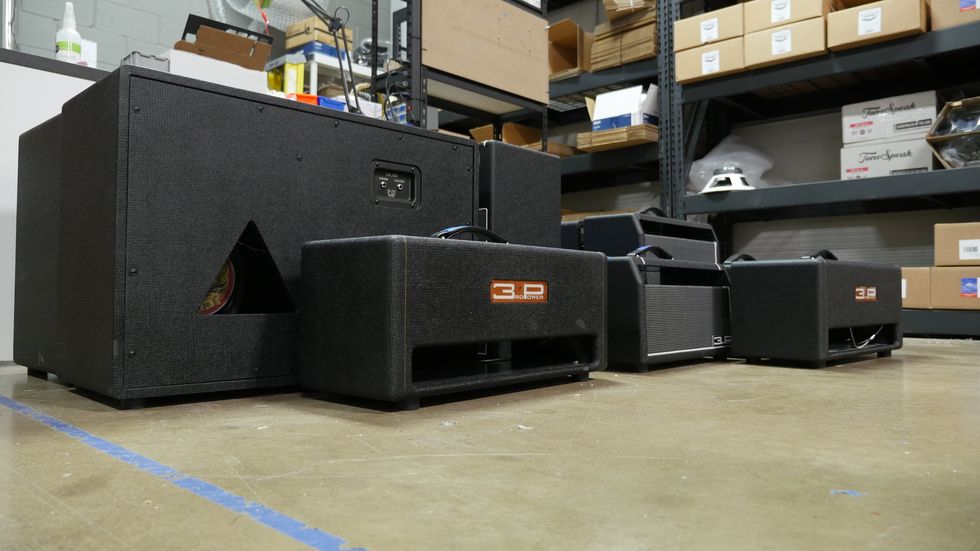
Empty head and cab enclosures that have been prepped before the actual amplifier gets installed.
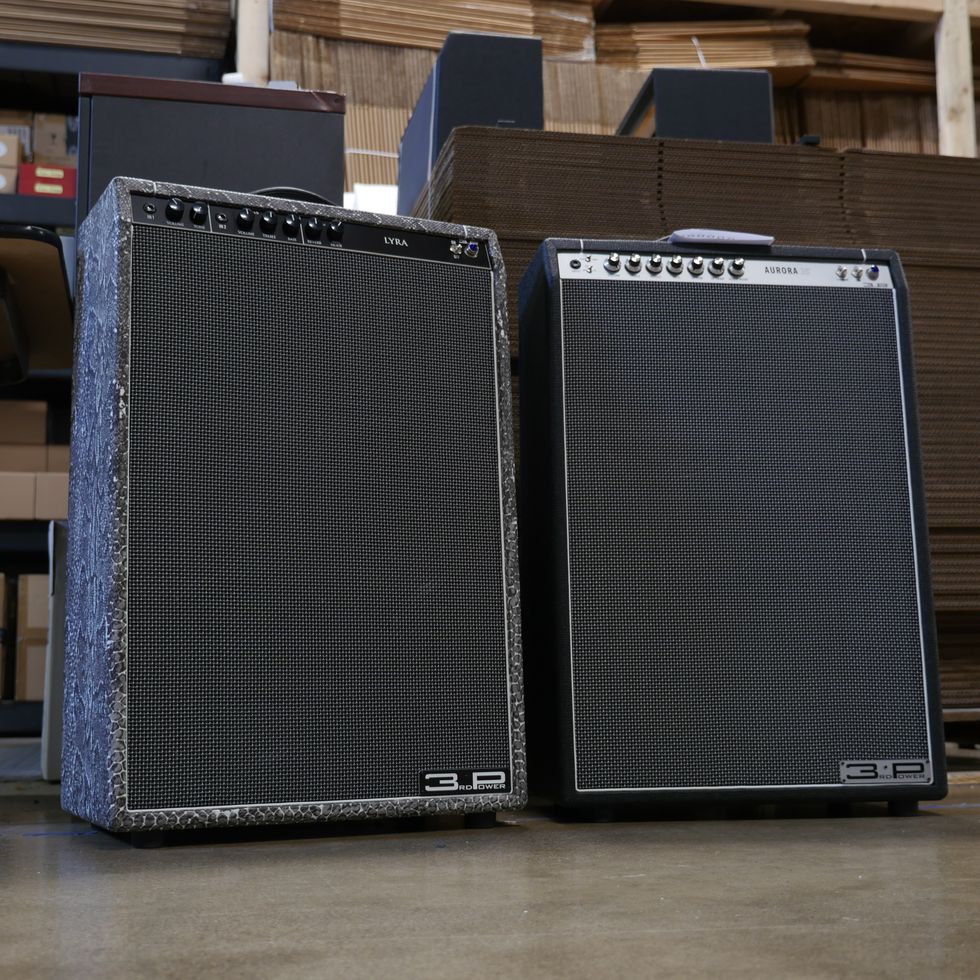
Two Highline series combos (l-r): A Lyra 3x10 with custom tolex, and an Aurora 35 2x12.
By the age of 12, Scott was playing a Les Paul copy and had gravitated to hard rock and metal—Kiss, Aerosmith, Blue Oyster Cult, Sabbath, Rush, Van Halen, Nazareth, and AC/DC were on repeat in her bedroom. “Playing guitar was all I wanted to do,” she says. “I’d look at my posters on the wall and think, ‘That’ll be me someday. I’ll be Ace Frehley.’” Problem was, her little Harmony combo amp wasn’t exactly the stuff of arena fantasies. As luck would have it, the solution was right next door. “Our neighbor had this giant cardboard box that hadn’t been crushed up yet,” she says. “So I took it and brought it into the house and cut out a space for a speaker. Then I tore apart my Harmony amp—removing the speaker and chassis—and mounted them both to the cardboard. I made myself a stack. It was great.”
Hearing Randy Rhoads was a revelation. “His sound, his technique, his look … It’s hard to describe, but he was this ray of hope for me,” she says. “I immersed myself in everything I could find, read, or listen to that had anything to do with Randy. He just changed everything for me.”
Another breakthrough came during the summer of 1980, when Scott spent upwards of eight hours a day practicing on her first “real” guitar, an O’Hagan Flying V. “It had a neck-thru body and a wood grain finish. I loved that guitar,” she says. “I showed up to ninth grade with my Flying V and never looked back. I was already on my way to a glorious career.”
“I’d look at my posters on the wall and think, ‘That’ll be me someday. I’ll be Ace Frehley.’”
It would still take some doing. Living with her mother and stepdad in Northern California, Scott got word that a local power metal band, Vicious Rumors, was looking for a guitar player. “I got the phone number of the bass player, and I kept calling him and calling him. This was back when you had to actually dial the phone,” she recalls. “They auditioned guitar players for a good six months and went through everybody. Finally, I wore them down.”
Scott’s first studio recording with Vicious Rumors, “One-Way Ticket,” was featured on Shrapnel Records’ compilation album, U.S. Metal Vol. IV—Unsung Guitar Heroes. But her tenure with the band was brief—next, she joined the Bay Area glam metal outfit Vain, led by lead singer Davy Vain. The group’s debut album, No Respect, was released in 1989 and received positive notices, but as they were readying a follow-up, they were dropped by their label, Island Records. “This was right when Nirvana came out, and the entire musical landscape was shifting away from hair metal and glam,” Scott says.
An attempt at putting together a band with Davy Vain and former Guns N’ Roses drummer Steven Adler failed to take hold, but Scott had powerful advocates in her corner. Longtime music executive Katrina Sirdofsky—whom Scott had known since she was 17—and her business partner Tim Collins, famed manager of Aerosmith, believed strongly in her talent and helped position her for an audition to replace Zakk Wylde in Ozzy Osbourne’s band. She recalls, “Katrina said, ‘You grew up loving Ozzy and worshipping Randy. Is this something for you?’ I said, ‘My chops are good to go. If you get me an audition, I’ll let it rip!’”
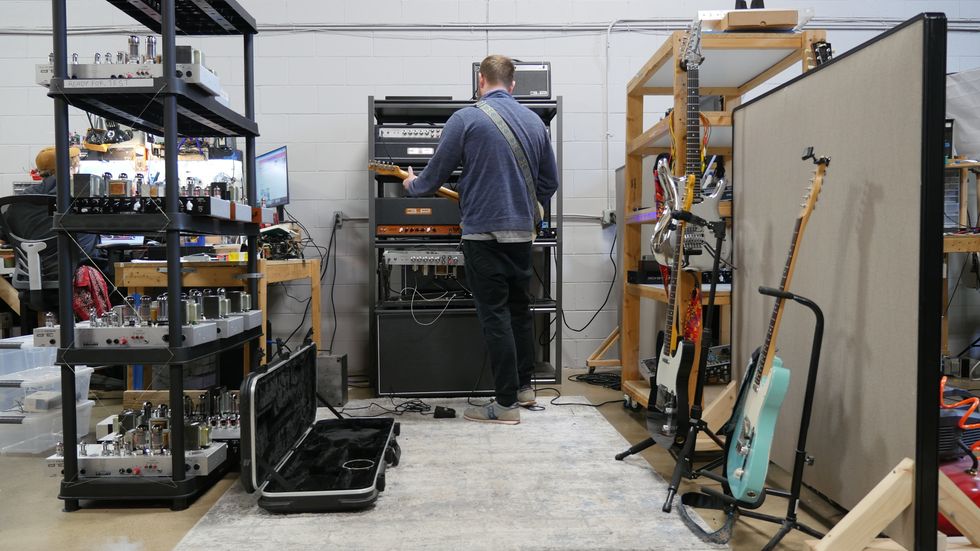
Production manager Paul doing the final play test on a new Aurora 45 model.
Scott’s shred-tastic demo was good enough to get her in a room with Ozzy’s band, and she showed up to the audition in a flashy guitar-god outfit that included gold leather bell bottoms. Which, in hindsight, might have been a mistake. “I was skinny as a rail, so I probably reminded them of Randy, and the bell bottoms were more like Zakk,” Scott says. “After two songs, Sharon called me over. We had a pleasant conversation, but it was like, ‘This isn’t going to work. Thank you for coming.’ Sharon recognized that I had talent and wished me luck. It was an amazing experience.”
While continuing to perform (she would rejoin Vain from 1993 to ’94, then again in 2000), Scott shifted her focus to sound design, working at Sennheiser, Neumann, X2 Digital Wireless, and Line 6. But something was eating away at her: “The sound of the guitar was getting tame,” she says. “People were telling guitarists, ‘Can you turn it down a bit? Your treble’s a bit harsh.’ Things weren’t sounding dangerous. The guitar was sounding convenient. There was no energy. The fire that Edward Van Halen brought to music was cooling down. I said to myself, ‘I’ve got to make it sound dangerous again.’”
“Things weren’t sounding dangerous. The guitar was sounding convenient.”
In 2009, she moved to Nashville and started her own amplification company, 3rd Power—so named for the “evil Ozzy-Black Sabbath tritone” that spans three whole tones, but also for what she calls the “three elements of a perfect performance: tone, attitude, and technique.” Her first amp, the HLH Series (that stands for “health, love, and happiness”), made good on Scott’s goal of delivering “studio-quality, aggressive hard rock tones; expressive and emotional, with all the shades of gain, from a great plexi sound to Eddie’s ‘brown’ sound.”
The amp was an immediate success, embraced by artists such as Richie Sambora, Neal Schon, and Steve Miller. “Steve Miller toured with an HLH 100 and three of my triangle cabinets in 2009,” Scott says. “I was incredibly proud of that.”
About those triangle cabinets: Scott introduced the HLH Series 312 180-watt speaker with the idea that its unconventional design would dramatically reduce standing waves and internal reflections. “This was a real departure from regular 412s,” she says. “Because there were no parallel walls, we could greatly reduce the enclosure’s internal reflections. I also put bass traps in the corners to minimize phase cancellation. The whole thing worked really well.”
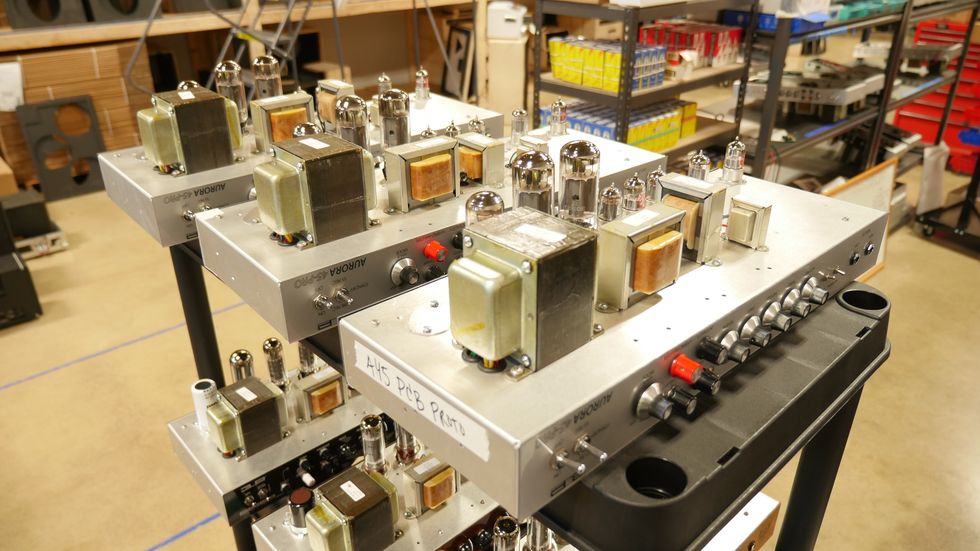
Amps waiting for their final play test
Funnily enough, the 312 speakers had their origin from when Scott would doodle on notebooks in high school. “I had one of those Pee-Chee folders that had an illustration of a baseball star and a tennis player on it,” she says. “I turned the tennis guy into Paul Stanley, and I made his tennis racket a Flying V. I drew a full pyramid stack of 312 amps. I knew that was going to be my backline someday.”
Following the success of the original 312 speakers, 3rd Power soon introduced the Switchback 312 cabinet, which used a similar triangular internal chamber within a rectangular housing.
Working in her garage with only one part-time assistant, Scott turned out more amps. The American Dream, a two-amps-in-one package, brought together the vintage 1960s sounds of a brown-panel and black-panel Deluxe. Likewise, the British Dream offered an AC on channel one and a plexi trip on channel two. The Kitchen Sink simulated iconic American chime (Fender-style) and British crunch (AC/plexi-style) in one unit, and it produced progeny: the Clean Sink and Dirty Sink grab-n-go models. The Dream Weaver paid homage to Fender and Marshall, while the Dual Citizen served as a tribute to Fender and Vox. Another “clean to mean” gem, the Citizen Gain, further refined Scott’s penchant for blending American clean tones and English grit. (A key feature of Scott’s amps, the patented HybridMASTER technology, maintains the guitar’s tone no matter what volume is chosen.)
“I’ve had so many opportunities that few people have been given. I’ve toured the world and have played with the biggest of the biggest. I’ve never given up the dream. I’m actually living it.”
Despite her company’s burgeoning success (amps were flying out the door as fast as they could be made, with guitarists like Joe Walsh, Vince Gill, and Tom Bukovac singing their praises), Scott was still confronting an internal struggle she had carried for much of her life. “I thought everybody felt that way,” she says. Over time, that weight became impossible to ignore, and Scott ultimately sought therapy, reflection, and deeper understanding. And so, as she turned 50, she transitioned from Jamie Scott to Dylana Nova Scott. Becoming who she is was a realization that had perhaps always been somewhere in her mind, even when she didn’t fully understand it.
“Certainly, as a kid, I didn’t know,” she says. “But music, and especially guitar, gave me a place where I could express parts of myself I didn’t yet understand. What stood out to me when I discovered Randy Rhoads was that here was somebody everybody admired who was powerful, expressive, and visually unique. He showed me that music could be a place for individuality, beauty, and freedom. I thought, ‘If I get good on the guitar, maybe I can truly be myself,’ whatever that meant at the time.”
Three years ago, Scott was still working in her Nashville garage when her phone rang. The ID on her cell phone read Joe Satriani, and she just assumed it was a prank. Only it wasn’t—the guitarist was about to begin the Best of Both Worlds tour with Sammy Hagar, Michael Anthony, and drummer Kenny Aronoff, and he was looking to replicate Eddie Van Halen’s 1986 Live Without a Net-era Van Halen sound. Satriani had asked friends if they knew who could tackle such an assignment, and Scott’s name was top of the list. Hours of conversations between Satch and Scott resulted in a collaboration, the Dragon DRGN 100—a roaring, vintage-sounding head equipped with modern, functional versatility.
“I told Joe, ‘Once I make the head, you can’t go plugging it into any old cabinet,’” Scott says. “Joe said, ‘Okay, make me something.’ I got him on tour with a quad-chambered 4x12, with bass traps and studio absorption treatment. What comes out of my cabinets is a cohesive wave—a true fader-up sound. I loaded his 412s with [Celestion] G12T-75s on top—he likes them because they never blow up—paired with [ToneSpeak] Manchester 1290s on the bottom.”
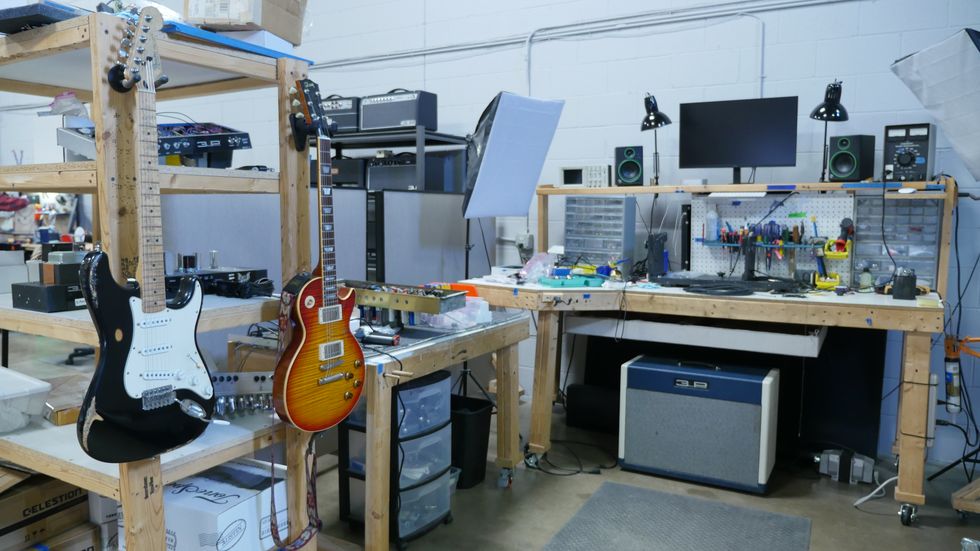
Scott’s workstation
The results were so impressive that Steve Vai, after hearing the cabinets night after night on tour, ordered a stereo pair for himself. Loaded with Celestion Vintage 30s, Vai has toured with them ever since.
Satriani has continued to tour with five 100-watt DRGN heads, and he’s been known to warm up backstage on a 25-watt model. “When he goes onstage, his fingers are already prepped for the way the Dragon responds,” Scott says.
After spending the last 17 years in Nashville, Scott recently packed up and moved to Minneapolis to better accommodate the growing requests for 3rd Power products. “Stevie Renner of Stevie’s Guitars.net called me and we met for dinner,” Scott says. “We talked and I met his crew, and I was amazed at their level of intelligence and integrity. I got to know everybody, and we decided to join forces.”
At the same time, Scott’s days of gigging are far from behind her. She points to a couple of guitars in a corner—a 1981 Charvel and a Gibson Custom 1967 Flying V reissue. “The Flying V keeps me grounded, but I don’t play it live,” she says. In another week, she’ll hook up with Vain to join Black Label Society, Night Ranger, the Darkness, Queensryche, Lita Ford, and a host of other performers on the Monsters of Rock Cruise.
The prospect of hitting the high seas and cranking up one of her DRGN 100s makes her eyes dance. “I’ve had so many opportunities that few people have been given,” she says. “I’ve toured the world and have played with the biggest of the biggest. I’ve never given up the dream. I’m actually living it.”