Guitar virtuoso/singer-songwriter Paul Gilbert’s latest release, WROC, a homophone of “rock,” is based on George Washington’s Rules of Civility and Decent Behaviour In Company and Conversation. Yes, the George Washington you learned about in middle school—Gilbert’s one of the few people on the planet that can make a history lesson fun!
While Gilbert’s peers in his early metal days were more inclined to doodle pentagrams and flip through the Satanic Bible, Gilbert had vastly different interests. “I read a bunch of Founding Father writings decades ago,” he explains to PG. “I was curious, so I bought the full, thick compendium of everything written by Ben Franklin, Thomas Jefferson, and George Washington. There are no stories there; instead it’s almost like finding somebody’s emails from hundreds of years ago. That was the first time I came across Washington’s Rules of Civility, and the idea of being more civil, of having better manners, somehow that was appealing to me.”
In February of last year, Gilbert had just wrapped up the final concert of Mr. Big’s “The Big Finale” tour at Tokyo’s storied Budokan, and on the flight home, both inspiration and Rules of Civility struck. “I was thinking, ‘Okay, it’s a new start for me,’ and I was excited about what to do next. I had an internet connection on the plane, and that excitement turned into this conversation with AI,” he recalls. “I couldn’t remember what they were called, I just sort of remembered there were these rules that Washington tried to follow when he was a kid. So I Googled around and asked AI, and refreshed my memory.”
Gilbert and his chatbot then worked in tandem to dissect lyrics out of Washington’s rules. “I said, ‘Take a random Washington rule and turn it into a blues lyric.’ And in three seconds, I got this Washington rule turned into a blues lyric,” he says. Gilbert then proceeded to ask AI to do additional things: Make the chorus repeat more. Find a different Washington rule for the bridge. “I was sort of telling AI what to do. That was my initial process,” he says. “As I went on, I realized it was better if I did it myself, because I know what I want. So then my conversation with AI changed. Instead of having AI do it, I said, ‘AI, give me the list of rules.’ There’s 110 of them, so I said, ‘Put them in order according to length—the short ones first and the longest last.’ That way, when I’m searching around, if I just need a short line, I don’t have to hunt through the whole book.”
Washington’s rules were the perfect springboard for Gilbert. “I love writing from a lyric—it’s so much easier than any other way of songwriting,” he says. “It was maybe the most fun I’ve ever had writing songs in my life. It’s almost escapism—I can get out of myself and enter some other world. I would take [Washington’s] lines and try to make it into a melody. Then once I had that, all the jobs that follow are my favorite jobs. I love finding chords for a melody, I love the balance of repetition—but not too much. You get to that point where it’s like, ‘Okay, that’s too many repeats, I’ve got to pull it back and find, like, a weird note that I haven’t used yet.’ And that will inspire a chord I didn’t think of. That whole craft is something I really have fun with.”
Gilbert wails on his Ibanez during a recent gig.
Simone Cecchetti
Paul Gilbert’s Gear
Guitars (live)
Ibanez FRM350 Paul Gilbert signature
Ibanez PGM50 Paul Gilbert Signature
1970s Ibanez IC200
Ibanez RS530
Ibanez Custom Shop PGM Paul Gilbert Signature (pink)
1970s Ibanez double neck (set neck version)
Guitars (studio)
Ibanez AS7312
1970s Ibanez 751 acoustic
Amps
1990s Fender Custom Vibrolux Reverb into a Randall isolation cabinet
1960s Fender Vibrolux Reverb as a wedge monitor
Victoria Club Deluxe (turned on for solos as a volume boost)
Effects
Distortion pedals for main amp:
Xotic AC Booster (always on)
JHS Overdrive Preamp
Mojo Hand Colossus
Distortion pedals for solo boost amp:
MXR Distortion+
Xotic AC Booster
Voodoo Labs Pedal Power 2 Plus
Boss LS-2 Line Selector (Gilbert has two: one to switch between distortion and clean, the other to switch on solo boost amp)
“Clean” pedals:
Boss CS-3 Compression Sustainer
Catalinbread Callisto
“Modulation” pedals:
JAM Pedals RetroVibe
MXR Stereo Chorus
Home Brew Electronics THC Three Hound Chorus
Sabbadius Tiny-Vibe
Strings, Picks, Slides & Cables
Ernie Ball Mighty Slinky (.0085–.040; Gilbert replaces the .040 with a .046)
Dunlop Tortex III .73 mm picks
Dunlop 318 Chromed Steel slide
Divine Noise coiled cable
DiMarzio straight cables, patch cables, and speaker cables
In a perfect world, Gilbert would have loved to use Washington’s rules exactly as they were written, but each song went a different way. To turn the rules into songs and make them singable, Gilbert had to resort to some basic rules of songwriting. “The first trick is just to repeat things. Or repeat an ending,” he explains. “Like, ‘If you soak bread in the sauce, let it be no more, let it be no more.’ You sing the last line twice, it becomes more like a song. So a lot of that is, you sing a line and then take the end of it and repeat it. And then once I had the verse, I might grab the book and flip through to find the bridge. Some of the songs are really simple in that I just sort of repeat the same part, but the second verse will have a harmony to it, so that’ll take it to a different direction.”
The chord progressions on some WROC songs like “Orderly and Distinctly” reveal a harmonic palette that stands out among today’s songwriters. When I covered Gilbert’s Great Guitar Escape camp in 2013, the nightly jams featured harmonically rich songs like the Bee Gees’ “How Deep is Your Love,” and ABBA’s “Dancing Queen.” These types of compositions inform Gilbert’s writing style, and their influences can be heard on many of the chord progressions on WROC.
“The idea of being more civil, of having better manners, somehow that was appealing to me.”
“That comes from growing up in the ’60s and ’70s and hearing a lot of piano-composed songs,” he says. “I was listening to Elton John, the Carpenters, Todd Rundgren, Queen, the Beatles, the Beach Boys. And you know, there’s some chords in there. That was the hard thing for me as a kid—and it was really helpful for me to go to school [in 1984 Gilbert enrolled at GIT, now called Musician’s Institute] to learn that stuff, because I was essentially an ear player. I’ve learned by ear mostly. I never had a deep knowledge of harmony until I went to school, and then I started filling in the missing puzzle pieces.”
Gilbert continues, “I remember learning ‘God Only Knows.’ I’m ruminating about the half-diminished chord in that song because it was so important to me. Or another one is, ‘When I Grow Up to Be a Man.’ The opening vocal harmony, I don’t even know what it’s called—I know what it looks like. It’s like a sharp 11 or something. It’s really a crazy chord and it starts the song off. And I don’t necessarily have to know what it’s called—whenever I hear one of those things I know it’s the ‘When I Grow up to Be a Man’ chord. My wife [Emi Gilbert] is amazing at jazz piano, but she began as a classical piano player. So some of the jazz chords are new to her and she’ll be like, ‘What is that?’ Well, there’s that Beach Boys chord. I can spot it. And I think the Beatles were like that. They weren’t trained in the vocabulary of the terminology. But they were really well trained with songs.”
Paul Gilbert’s latest, WROC, is a treatise on good manners. Sort of.
As the songs for WROC started coming together, Gilbert made an interesting, and unfortunate, discovery about AI, his writing partner. “I learned that AI doesn’t always tell you the exact truth. It’ll make stuff up,” he says. He found this out when he did a Google search for a rule he used for a song title—and nothing came up. Gilbert recalls, “I then asked AI, ‘Which Washington rule is this?’ And AI was like, ‘That’s not any Washington rule.’ I said, ‘Well, you gave it to me. You were the one that told me.’ And the response was, ‘Oh, I’m sorry, I must have hallucinated.’ So I was searching through this list, and now I know it was about 80 percent correct and 20 percent hallucinated. And that was a good learning experience.”
The lesson? “Always double check your AI, because it’ll just make stuff up,” he says. Nevertheless, one song on the album, “Conscience is the Most Certain Judge” features some of these AI hallucinations—Gilbert kept them because he felt they were still in the correct spirit. He also took poetic license and composed variations with his own words on “Show Yourself Not Glad at the Misfortune of Another.”
WROC, of course, is more than a mere (AI-assisted) history lesson. Since his Racer X days, Gilbert’s fanbase has been heavily populated by guitar geeks that salivate at every 16th-note run he unleashes. As is to be expected, WROC showcases Gilbert’s fiery six-string work. The opener, “Keep Your Feet Firm and Even,” kicks off with characteristic neoclassical licks and harmonized melodic lines. “Maintain a Sweet and Cheerful Countenance,” meanwhile, is built on an incendiary harmonized jazz/fusion and prog-influenced riff in the intro, which leads to a solo that sees Gilbert tearing it up on the slide—a texture he’s been exploring over the past decade.
“I learned that AI doesn’t always tell you the exact truth.”
Gilbert’s slightly unusual guitar setup accommodates both his newfound slide inclinations and his legacy speed-demon licks. While Gilbert’s strings are very light—he uses .0085 for his high-E string (at this year’s NAMM convention, while performing with Steve Morse at the Ernie Ball booth, he even admitted to using .007s on that day)—the guitar’s action is set fairly high. “It’s funny, I did a guitar clinic in Italy where I didn’t bring my own guitar,” he says. “All the students let me use their guitars, so there were, like, ten guitars on a stand. They said, ‘Use any guitar you want,’ and I picked this one up and I hurt myself. Everybody had .010s and low action and, man, I can’t play .010s with low action. I can’t get a grip on the string, and I bend all the time.”
Even though he’s been most often identified throughout his career as a guitar hero, Gilbert’s focus hasn’t been strictly on the guitar. Since King of Clubs, his 1997 debut solo album, his abilities as a lead vocalist have come to the forefront. Gilbert is a charismatic frontman who can belt out songs in a multitude of styles. He readily admits, however, that guitar is still more natural for him. “As a lead singer—which, really, if you want to be a pop musician, singing is very important—my voice always had limitations that my hands didn’t have,” he says. “If I sat down and practiced, you know, I could play this Van Halen thing. Whereas if I practice singing, I still couldn’t sing ‘Oh! Darling’ by the Beatles, no matter how much I practiced.”
Currently, Gilbert’s guitar practice goals are less about mechanics and more about melody. The days of endlessly repeating outside picking exercises with an ever-increasing-in-tempo metronome have taken a backseat to his new obsession with mastering the ability to instantaneously play the melodies he hears in his head on the guitar. Being able to produce a melody on the guitar with the proper inflections is an art that isn’t nearly as easy as it might sound (especially doing it on the spot in real time), even if you can shred scales and arpeggios at supersonic speeds. “It’s funny, right before this interview I was practicing improvising over Gary Moore’s ‘Still Got the Blues,’” he says. “Which has challenging changes, almost like ‘Autumn Leaves.’ To me, that’s a rough, rolling rapid of rocky river to navigate, but I’m getting better at it. Step one is I found all the shapes—the shape for the B half-diminished and for the E7. But then I’m using my eyes to navigate, like, ‘This shape goes into this shape.’ That’s useful to some extent, but it’s not coming from my singer’s voice. So now I sit down and go, ‘Don’t play it if you can’t sing it.’ And I force myself to sing and solo at the same time.
“I’m not great at it yet,” Gilbert continues, “so it’s risky to do it because it does slow everything down. But the more I do it, the better it gets, and there’s a real payoff at the end. But it feels like I’m telling the truth when I really play what was in there. Suddenly everything’s connected and it tells a story.”
Michael Hampton with the Kidd Funkadelic guitar, a tribute to The Fool, the SG once owned by Eric Clapton and Todd Rundgren.
Photo by Nick Millevoi
Michael Hampton’s whole career started with a single song.
As a teen growing up in Cleveland, Ohio, he taught himself to play along with records on just one string. The Temptations’ “Get Ready,” Led Zeppelin’s “Dazed and Confused”—those worked. Then he expanded, adding strings and songs like Kool & the Gang’s “Jungle Boogie” and Edgar Winter Group’s “Frankenstein” to his repertoire. Somewhere in there, he started jamming along with Funkadelic’s 1971 psychedelic guitar opus, “Maggot Brain.”
On the opening track to the band’s album of the same name, guitarist Eddie Hazel defined new boundaries of post-Hendrix fuzz-and-wah-soaked psychedelia. George Clinton’s Echoplex manipulations cranked the mind-melt factor further afield. It moved the young guitarist, and he kept coming back to that song.
By 1974, the band rolled through Cleveland and the 17-year-old had a chance to witness the live P-Funk extravaganza. Around that time, he had been playing music with his cousin, Lige Curry, and “a guy on the east side called Ed Sparks, he was an older guy playing bass,” according to Hampton. Together, they went to catch the show at Public Hall. Afterward, they all ended up with some of the band back at Sparks’ house.
“Ed’s like, ‘Go play “Maggot Brain,”’” Hampton recalls in his soft-spoken voice, “and I just played it til I couldn’t play it no more.”
About two weeks or so later, P-Funk drummer Tiki Fullwood called and invited the teenager to join the band. Driven to the airport by his cousin—who would also go on to join the band in 1978—he recalls, “I took my first plane ride to a sold-out show at the Capital Center in Landover, Maryland. I put my head down and played ‘Maggot Brain.’ Bernie [Worell, the band’s keyboardist] was accompanying me, which helped a lot. They wanted just Bernie and myself to do it. He was good at putting that backdrop behind me so I could solo freely.”
At first, Hampton’s only role in the Parliament-Funkadelic stage show was to play “Maggot Brain.” He eventually learned the whole set, somewhere along the way earning the nickname Kidd Funkadelic. (A recording of Hampton’s “Maggot Brain” from 1978 is included on the CD edition of Funkadelic’s One Nation Under a Groove, showing his soaring, liquid phrasing and searing tone.)
Hampton doesn’t keep track of which guitars he uses on which tracks, but this guitar, a gift from PhilipTheArtist, hit the road on a recent Hampton solo tour.
Photo by Nick Millevoi
Ever since that first night, Hampton has been a fixture in the P-Funk universe, and the band and its music have been the centerpiece of his musical life. Though he’s done some collaborating beyond P-Funk, his own solo work has maintained an orbit, as can be heard on his 1995 release, P-Funk Guitar Riffs for DJ’s, or on the more solo-minded but still related Heavy Metal Funkasonfrom 1998, which features Curry as co-producer and Clinton on guest vocals. More recently, with drummer Chuck Treece and guitarist PhilipTheArtist (Philip Smith), he’s released music as Punkadelic, which includes original material, but remains reverential in name.
Now, he seems ready to set himself apart. But that might not be a conscious effort. In fact, sitting and talking to Hampton on one of the couches at SoundPlex Studios in South Jersey, just outside of Philadelphia, I get the distinct sense that Hampton makes his way through life by going with the proverbial flow. He takes it as it comes, and for a guy who’s been playing a lot of the same music for decades, he seems surprisingly in the moment, not lingering on the past.
“Since Parliament-Funkadelic is one of the most sampled groups of all time, it’s probably safe to say you’re among the most sampled guitarists around,” I point out. “Do you ever reflect on that?”
“Nah,” he tosses off. “I don’t reflect on it. I’m honored.” He pauses, adding, “It’d be cool if I could get some more sessions or be a fly on the wall at some of these sessions that they do.”
What does get him excited is a lifetime of listening. Hampton cites his musical inspirations off the cuff: Pink Floyd, Herbie Hancock’s solo on “Chameleon,” Kiss—he stops to show me a recent gift from guitarist PhilipTheArtist, the owner of retro-minded Goldfinch Guitars, an LP-style guitar with an Ace Frehley tribute finish. “This was a gift after Ace passed,” he explains. “That’s what’s gonna get me inspired to do more—‘I wanna do something Kiss-like with that guitar’ or whatever.”
“Everything I hear, I want to play.”
He jumps to a host of more recent references—cosmic jazz saxophonist Kamasi Washington, bass futurist MonoNeon, blues phenom Christone “Kingfish” Ingram, and electric blues rocker Joe Bonamassa—then goes more big-picture. “The grooves to a lot of things—it could be commercials—whatever catches my ear, it could be electronica, it could be classical, everything I hear, I want to play.”
Hampton gets stoked thinking about all the music he loves. He mentions Les Paul, then catches himself—“Django … his ass! Man, come on!” It’s a wide musical world, full of inspiration.
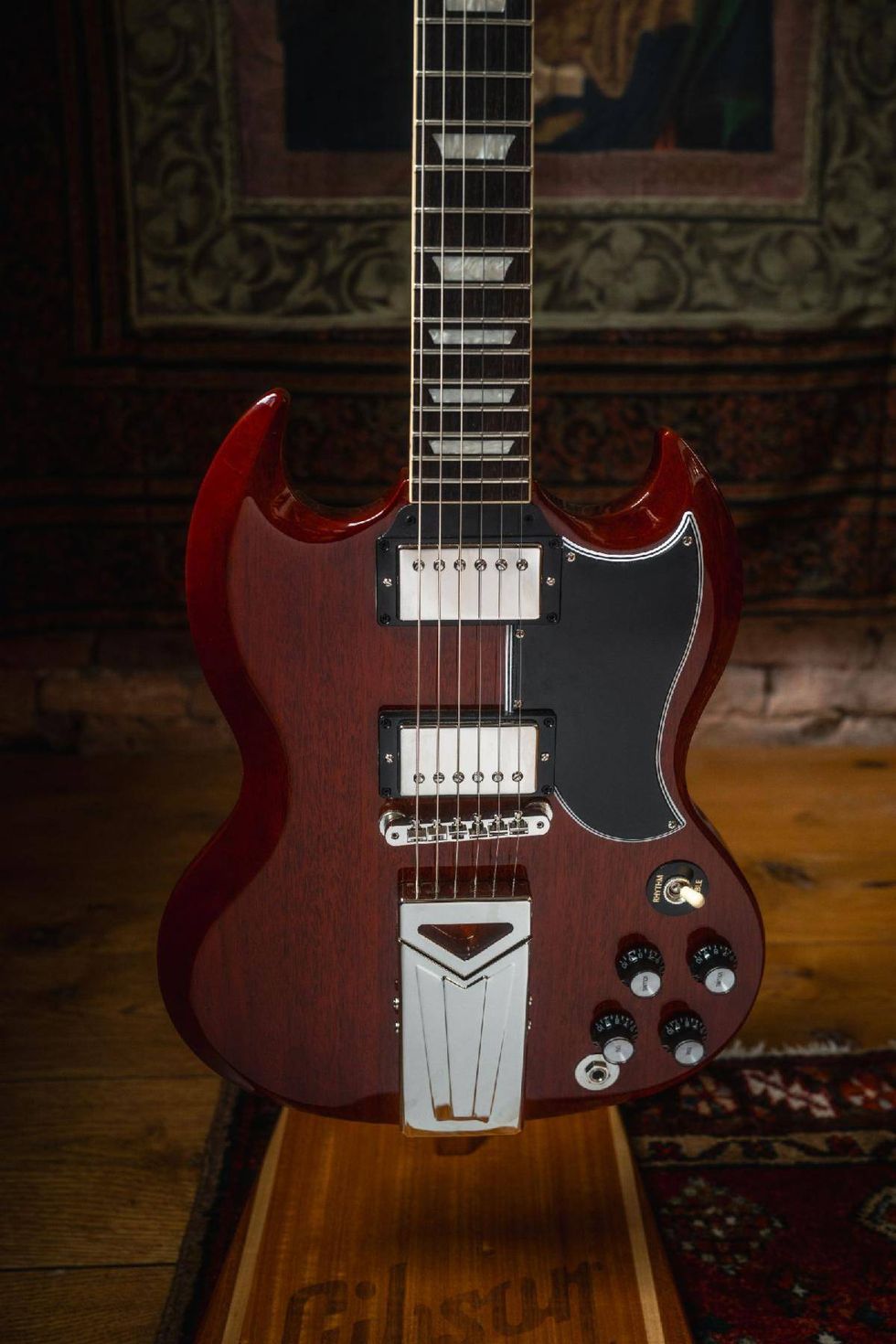
It’s not just music itself that gets him going, it’s the instruments as well. Hampton loves to collect guitars, and figures he currently owns around 50 or so. In addition to the Ace Frehley tribute, he’s also brought another recent gift, also from PhilipTheArtist, this one an SG-style guitar with a finish in the style of The Fool—the Gibson once owned by both Eric Clapton and Todd Rundgren. On this one, the iconic angel has been replaced by the Kidd Funkadelic logo from Funkadelic’s 1976 Tales of Kidd Funkadelic.
That guitar made it out with Hampton for some solo band dates to celebrate the release of Into the Public Domain, the first of two EPs plus an LP that he’s releasing. The name is literal: He’ll also be releasing the multitrack files, which can be used royalty free.
Hampton’s latest, Into the Public Domain, is the first of three records that he’ll be releasing, alongside King Kong and The Kidd.
It’s a large project with a lot of moving parts and a long cast of collaborators, but it came together at the behest of PhilipTheArtist, who co-produced the record along with Hampton, Joe “the Butcher” Nicolo, and John Schreffler. Recorded at Fort Wolf Studios in Canyon Country, California, and Los Angeles’ Sunset Sound, much of the music was initiated by PhilipTheArtist and Schreffler in order to create something, according to the former, “like if National Geographic or Nova wanted something in the background—not just rock ’n’ roll.”
A song like the off-kilter funky rocker “Steve’s Kadillac” strikes an experimental funny bone that could certainly work in that direction, with warped riffs floating in and out across the groove-centric soundscape. But there is plenty of rockin’ to be found, as on the opening “Fight or Flight” and the title track, where Hampton’s distortion-drenched leads crack the stratosphere wide open and launch into space.
PhilipTheArtist explains that “Technicolor Mobile Home” has roots that reach beyond the studio. “When me and Michael play ‘Hit It and Quit It’ [from Funkadelic’s Maggot Brain] live,” he explains, “there’s a certain way he plays the chorus that is different than the record. That way he plays it evolved into ‘Technicolor Mobile Home,’ then I recorded what I remembered he came up with.”
Hampton remembers the sessions as a laid back affair, where the vibe, from his perspective, was “just do what ya feel.” He recalls, “Phil would call me up from California and say, ‘You got time, Mike?’” If he was available, he’d fly out from his Philly area home. “If I didn’t jump on and do it then, I wasn’t gonna do it,” he says.
“Today, there are some serious issues and it’s like, what am I gonna write to that? Am I gonna write about it? Or not gonna write about it? Or just play?”
Nicolo, a nine-time Grammy winner and co-founder of legendary hip-hop label Ruffhouse Records, assembled the jammy tracks into songs. “I had so many colors of the rainbow to paint with,” he says.
Hampton will follow Into the Public Domainwith King Kong, a musical telling of the classic story, and The Kidd. With a preview of rough tracks from the latter, it seems as though the trilogy will showcase just how singular and varied Hampton’s guitar playing is. The early tracks indicate a world that’s all over the sonic map, his still-distinctive guitar fitting right into ’90s ZZ Top-style heavy blues, warped disco funk, soul jazz, and beyond.
Nicolo will release the albums through his SMN Records imprint—a part of his Sound Mind Network, a nonprofit whose “mission is to change the way the world looks at trauma suicide and drug abuse with the arts.” He says the records display Hampton’s “splintered genius” and calls him a “chameleon" who is “so unlike traditional guitar players.”
Joe “the Barber” Nicolo, of production team the Butcher Bros., whose credits span pop stardom, calls Hampton a “chameleon” and a “splintered genius.”
Photo by Philip Samuel Smith
Hampton is all about the vibe, and that seems to be what makes him such an adaptable player. He gets the vibe, and dives in. It’s an approach that any improvisor knows requires staying in the moment and keeping overthinking at bay, and that’s where Hampton is most natural.
“I like to remain ‘not-knowing,’” he muses. “I like to practice a lot, but at the same time, I want it to be new.” (It’s also the answer he gives when I ask if he likes messing around with pedals, which he doesn’t really get into extensively: “Every time I hook something up, I want it to be brand new.”)
“Staying inspired,” he continues, “it’s just life itself. Today, there are some serious issues and it’s like, what am I gonna write to that? Am I gonna write about it? Or not gonna write about it? Or just play?”
This recent burst of activity is intentional, though; Hampton tells me he’s trying to be more available to new musical things. In this case, it’s been working out. Jams that started some years ago in Philadelphia turned into sessions—he mentions some early jams related to the project at Bam Margera’s house—that led to more sessions and eventually to the L.A. recordings. Throughout, he’s just been trying to be open to saying yes. Where that will lead next is anybody’s guess.
“I like to remain ‘not-knowing.’ I like to practice a lot, but at the same time, I want it to be new.”
If all that sounds like he’s always on to the next thing, that’s only partially true. P-Funk continues to take it to the stage, and when we talk, Hampton is getting ready to head out for a few dates. The group’s large ever-changing lineup has sounded powerful on recent tours. And at the recent Hampton-band live shows in California, the pickup band assembled by PhilipTheArtist opted to stick to versions of P-Funk classics, namely “Butt-to-Butt Resuscitation,” “Red Hot Mama,” “Hit It and Quit it,” and, of course, “Maggot Brain.”
While the classics remain in all parts of his life, Hampton says he hopes to get a live band playing the new material. He adds that when the time comes to play those songs, “I don’t want to know them too well.”
The driving force in Hampton’s camp, it seems—the one making sure this all goes down—is PhilipTheArtist, and he’s passionate about the music. He wants people to hear the breadth of what’s possible. The world knows his work with P-Funk, but he wants Hampton to be heard as an individual. “It’s time for Michael to get out there,” he says. “Every legendary guitar player has a set of solo records and has a sound people can put their finger on. Michael was under-celebrated in that way. It was time.”
What is it about Hampton that has driven this project? “Michael has the ability to give you goosebumps with his playing,” PhilipTheArtist says. “He’s one of those guys who can make you cry or make you smile with his playing.” Or to put it simply, “He just knows how to make you feel something.”
At $749, the Walrus Mantle got our columnist some pushback on price.
At the beginning of my career, I made a lot of mistakes. The beginning is the time for it. If you’re lucky, and you are surrounded by enough good people (as I thankfully was), you begin to learn what’s important and replace the mental noise with hard work.
Buried in the center of all the mental stuff is, for a lot of bass players, the inevitable pursuit of sound through gear. Sometimes it’s totally justified; other times it’s what has become known as GAS: Gear Acquisition Syndrome.
In those early years, I knew nothing about gear. I had very little of it. Maybe three or four basses and a total of two pedals and a tuner. (The EBS Octabass and a Boss Chorus, for anyone wondering.)
If you know anything about me now, almost 30 years later, you literally can’t move in my studio for pedals. Sometimes I grab a gig bag out of the closet to go to a gig and find a bass inside that I forgot I owned. This isn’t a flex; this is just to highlight how things have changed, how absurd they have become, and to perhaps lend some validity to what I want to talk about today, considering the amount of experience (good and bad) I’ve had with gear.
My good friend Ian Martin Allison, who you may know from Scott’s Bass Lessons or from countless recordings and tours, recently collaborated with Walrus Audio on a preamp/DI, the Mantle. I was fortunate enough to receive an advance unit to check out and give feedback on. I posted an episode of my podcast featuring it, and the outrage at the price point of the Mantle is on a level I haven’t experienced before on my channel.
It’s fascinating to see how far the algorithm has come in terms of brainwashing us into thinking we either need, or deserve, every new thing that is announced, regardless of whether it makes any sense for what we do, and more importantly, regardless of what our personal means are. People look at the price, know they can’t afford it, and immediately accuse the company of greed, all the while having never used it, never been involved in R&D, and with no experience of the artist/brand relationship.
I was very careful on my podcast to highlight the fact that there are a multitude of entry points into the world of preamps, and at $749, this latest one might not be the thing for you, no matter how much FOMO you think you might have or how much you love the way it sounds.
I really like how the Bugatti Chiron looks, and boy would it be a special moment to be able to drive one and experience engineering that is incomprehensible to most of humankind. But the $4-million-plus price tag lets me know it’s not for me, that I should appreciate it from afar, and reminds me my Mazda (at 0.63 percent of the cost) still has four wheels, AC, Bluetooth, and gets me where I need to go in quite some comfort.
“Not only do you probably not need the latest, most expensive thing on the market, you really don’t need to be mad about its price.”
I think the internet has changed the way we bass players chase things like sound, and a healthy dose of awareness could not only save you a ton of money but get you to the thing that is actually right for you. Is it a unit that is $749 (Mantle), $1,400 (Noble Preamp DI), or $449 (JHS Colour Box)? It could well be. If that is the case, and you are a professional who requires high-quality gear that you will actually use, then fantastic. Question asked, question answered.
If your budget doesn’t allow for that right away, definitely try to have the patience to save until it does so that you buy once and cry once. Patience now for a short period of financial pain and a lifetime of happiness with your sound.
Is your budget sub-$300? This is also great information, and you have so many options for bass preamps. I used the EP Booster from Xotic for years. I think I paid $100 for it used and still have it to this day. Want more EQ options and a DI? MXR Bass Preamp at $189. Want an industry-standard DI that will never die? Radial Engineering JDI for $260.
This isn’t a commercial piece for any of the aforementioned companies or products. It’s just a heads up that not only do you probably not need the latest, most expensive thing on the market, you really don’t need to be mad about its price. If we can start asking bigger questions about our own needs and means, we’ll be able to shut out the mental load marketing algorithms place on our decision-making process and live a far more streamlined existence with the absolute best gear for us.
“Any time we make a record, it’s like we’re taking a snapshot of where we’re at that particular time,” says Lamb of God guitarist Mark Morton. “I think it’s inevitable that over the course of your career you start to understand what people respond to and what they don’t. But we’ve never chased the approval of anyone—not critics, not even our fans. We’ve always rallied very strongly around the idea that we’re making music for the five of us in this band. I mean, if we can’t get excited about what we’re doing, how can anybody else?”
For Morton, the process of gearing up for Lamb of God’s 10th studio album, Into Oblivion, involved a period of reflection. After the band (which also includes guitarist Willie Adler, bassist John Campbell, drummer Art Cruz, and singer Randy Blythe) finished their 2024 Ashes of the Wake 20th anniversary tour, he went through the group’s catalog and listened to a number of songs they had never performed live. “That kind of spun me off into thinking, ‘Who was I back then? Where was my head at when I was writing those songs?’” he says.
Morton decided to investigate further, and went down the rabbit hole of bands he listened to some 25 years ago, like Meshuggah, At the Gates, and the Haunted. But he didn’t stop at early 2000s Swedish death metal; he also reconnected with records by local bands from Lamb of God’s hometown of Richmond, Virginia. “I’m talking about Breadwinner and Sliang Laos and some other bands that never got the kind of notoriety they deserved,” he says. His listening binge then segued to old favorites like Fugazi and the Jesus Lizard. He notes, “We have a new song called ‘Sepsis’ that’s like the Jesus Lizard and Sliang Laos spun together in a modern metal song.”
Before hitting the studio with Lamb of God, Morton issued his second solo album, Without the Pain, an engaging and thoughtfully crafted Southern rock-tinged set that featured collaborations with Cody Jinks, Charlie Starr, and Jason Isbell, among others. Coming out the other side, the guitarist felt ready—refreshed and rejuvenated—to reconvene with Lamb of God. “I think longtime bands can only survive if there’s room for members to pursue other opportunities,” he says. “I can get other music out of my system and still allow Lamb of God to maintain its character and personality.”
He doesn’t beat around the bush as to the nature of the band’s identity. “We’re a heavy metal band,” he says. “We make heavy metal records. It’s what I want us to do, and it’s what we want to do. We’re really good at it, and we keep trying to get better. I respect what we’ve done in the past, and I feel obligated to honor our history and help us make something that’s worthy of that body of work.”
Which wasn’t always a walk in the park. The band went through an intense vetting process while writing material for the album, weeding out anything that sounded like reworked versions of songs from their past. “That was the challenge,” Morton says. “If you want to get to a new place, you’ve got to be willing to put the work in, and it can be hard. You listen a lot, rewrite a lot, try new ideas. If something sounded fresh or out of the ordinary, we ran with it. Even if it didn’t pan out, at least we were out of our comfort zone.”
Lamb of God guitarists Willie Adler (l) and Mark Morton
“Any delays, choruses, or phasers are done with outboard gear in the mix.”
Strings, Picks, and Cables
Stringjoy Mark Morton Artist Series
Dunlop Tortex 1.00 mm
Mogami cables
The guitarist recalls each band member using a certain word throughout the writing and recording period: stock. “We said that over and over,” he says. “It became our touchstone. We had to be brutal. If something felt stock—a riff, a song, a performance—we’d toss it. You keep listening, and you go, ‘It’s not bad. It’s not broken. There’s no mistakes. But it feels stock.’ Good enough wasn’t good enough. Regular-schmegular wasn’t gonna cut it. It had to be great. So you keep going till you get there.”
Morton embraced self-scrutiny when it came to his own guitar playing. If he found himself playing the same patterns as a result of muscle memory—it’s as typical among musicians as it is with athletes—he sought a new approach. He credits longtime band producer Josh Wilbur for his unsparing, pull-no-punches approach in the studio. “Josh has been with us for close to 20 years, so he knows the work in and out,” the guitarist says. “I’ll play something and he’ll go, ‘How many times have we said this already? This riff feels like it’s been on two other records. Can we say something else?’ A lot of other guitarists would have their pride hurt, but I don’t mind. You have to rally around the perspective that you’re trying to do something of value.”
Morton calls himself a “card-carrying tone chaser,” and to that end, he found what he was looking for years ago and stuck with it. Into Oblivion is brimming with his two-tone approach: For rhythm tracks, he ran his go-to guitars (either a signature Gibson Mark Morton Les Paul or a 1969 Les Paul Custom) through a Mesa/Boogie Rectifier Badlander with a vintage Ibanez Tube Screamer in front (“I put the gain all the way up and the overdrive all the way down”), and for solos he used a Mesa/Boogie Mark IV with a Klon Centaur boost pedal in front. “I didn’t feel the need to try to change my sound for the sake of changing it,” he says. “The self-editing I felt I needed had more to do with my actual playing.”
“If we can’t get excited about what we’re doing, how can anybody else?”
Any band that gets to their 10th album might sound as if they’re coasting, but Lamb of God are full of frenzy on Into Oblivion. As they have from the beginning, they serve up a vicious mix of sledgehammer heavy metal and metal-adjacent subgenres (metalcore, thrash, post-metal, death metal, doom metal), but the beauty of it all lies in their seemingly indefatigable ability to make each song’s wicked grooves and way-out licks sound like inspired bits of improvisation. What’s even more remarkable is that, unlike on their previous album, 2022’s Omens, which was recorded live in the studio, Into Oblivion was tracked in sections, with various band members operating in different locales (Morton cut his guitars at his home studio).
“I don’t think recording live off the floor is the standard anymore, for any band,” the guitarist says. “We enjoyed doing it on the last record, but this time we did things individually, and cool stuff came from it. It’s fun to open up the files and listen to tracks one of the other guys did. It’s like opening presents on Christmas. That’s not to say that everything is a total surprise—we’re all very involved with the writing and pre-production. These are just steps along the way when we’re working independently to bring material in.”
The album’s title track is fiery stuff, built around a pile-driving, high-velocity riff that Morton kicked around in pre-production. “It was one of the last songs we worked on,” he says. “Josh and I were sitting in my studio, and I had a riff that we started building into a song. We actually did speed that up about four bpm,” Morton remembers, “which isn’t huge, but we have to be careful about that kind of thing because tempos have a huge impact on the song.”
For Into Oblivion, Lamb of God stepped outside their comfort zone. “If something sounded fresh or out of the ordinary, we ran with it,” Morton says.
Photo credit: Joey Wharton
“Sepsis” comes on like a volcanic beast from hell. Blythe howls and hollers like he just laid his hand on a smoking cast-iron skillet, and a pummeling guitar-and-bass riff adds knockaround punishment. Mid-song, Morton goes weird and wonderful, ramming the message home with jarring dissonant chords that evoke the styles of the Jesus Lizard’s Duane Denison and indie producer Steve Albini. “I love both those guys,” Morton says. “The Melvins, too—they were huge for us. When we talk about Lamb of God, we have to talk about punk and alternative, but also Slayer and Pantera. All that stuff is vital for us.”
The award for Naming Songs For Exactly What They Sound Like goes to Lamb of God for “Blunt Force Blues,” an overwhelming nod to Vulgar Display of Power-era Pantera that asks the musical question: Why have just one corrosive metal riff when 20 will do? “We all have a hand in the songwriting, but that one is a clear example of Willie Adler’s train of thought,” Morton says. “He has this incredible stream of consciousness that sometimes we have to roll back and sometimes we don’t. It can be a wild ride interpreting what’s inside his head.”
When asked if the band has yet tackled the song live, Morton laughs and says, “No. I might need to bring some notes if we do get to that one.”
“Regular-schmegular wasn’t gonna cut it. It had to be great.”
The band hits the brakes on their high-speed tempos for the somber and atmospheric “El Vacio,” a mini-epic of sorts that’s distinguished by layers of gorgeous, echo-drenched, clean-toned guitar textures. “That one began as a bit of an assignment given to me,” Morton says. “Josh and Randy were out in L.A. doing some vocals and writing, and I got a text from Randy: ‘Hey man, send us something weird. We’ve got great songs, but we need to shake the snow globe. Even if we don’t use it, give me something super out of the box.’”
Morton accepted the assignment as a challenge and came up with “something that feels a little like the Cult from their Love period. It was really different for us, and the band loved it.”
Not every song on Into Oblivion features a guitar solo (Morton has never presented himself as a particularly self-indulgent player), but “Parasocial Christ” is a standout. Amid rugged rhythms, the guitarist shoots lead fireworks, abusing his instrument like it owes him money and even tossing in a heaping helping of old-fashioned dive bombs. “It’s nothing I’ve ever done in my professional career, but I did all that stuff when I was younger,” he says. “I did all the tapping and dive bombing that everybody else was doing. There’s actually a lot of whammy bar stuff on the record, which is entirely attributable to Josh Wilber. Every time we cut a solo, he’d say, ‘Why don’t you do a dive bomb?’ I was like, ‘Did you just discover whammy bars or something? I play Les Pauls, so what are we gonna do?’ He just went, ‘We’ll figure something out.’”
Ultimately, the producer got his wish, and to that end Morton utilized a Fender Custom Shop Stratocaster “super-Stratted” by master builder Mike Shannon. “Whenever you hear a dive bomb, that’s me playing the Strat,” Morton says.
“I didn’t feel the need to try to change my sound for the sake of changing it. The self-editing I felt I needed had more to do with my actual playing.”
Whether he’s detonating dive bombs or digging deep into earth-moving rhythms, Morton burns through it all with the zeal and youthful stamina of someone making his first album. For guitarists seeking pre-album training tips, Morton says simply, “By the time we start tracking a record, we’ve spent months doing pre-production, running through the songs and trying different ideas. At that point, I’m ready to go.”
Pressed further, he admits that there is a bit of a science to the art of capturing the perfect guitar performance. “It can come down to all sorts of things, or even just one thing,” he says. “Am I in a good mood? Am I excited about what I’m doing? Do I feel good physically? Am I undercaffeinated or overcaffeinated? It rarely takes me two days to track a song, but if we have to do something again to get it right, we will. The bottom line is, I try to stay in a good mental space.”
Asked if he has any special tricks for that one, Morton cracks a grin. “Yeah—I turn off social media.”
Fender Musical Instruments Corporation (FMIC) announces the John Osborne Telecaster® in collaboration with the Grammy®-winning guitarist John Osborne. A highly customized signature model inspired by his personal, road-tested 1968 Telecaster guitar, the John Osborne Telecaster is designed for expressive, dynamic playing; this instrument blends classic Fender craftsmanship with innovative performance features, including the signature B String Bender. Launching as part of Fender’s celebration of the Telecaster’s 75th anniversary, the John Osborne Telecaster honors both the enduring legacy of this iconic guitar and the distinctive artistry of one of the most influential players in modern country music.
“There are a lot of amazing guitars in this world, but none are as versatile as the Telecaster,” said John Osborne. “It just works with every song, works with every genre; I want someone to pick it up and take this instrument that I’ve played for so long, and blaze their own trail with it.”
John Osborne is a Grammy-winning guitarist and songwriter best known as one half of Brothers Osborne, the multi-platinum duo behind numerous Top 10 hits and fan-favorite anthems like ‘Stay a Little Longer ’ and 'It Ain’t My Fault.’ With multiple ACM and CMA Awards to their name, MCA’s Brothers Osborne have helped redefine modern country music with a sound that blends raw authenticity and rock energy. Widely regarded as a “player’s player,” Osborne has earned a reputation for his expressive bends, soaring solos and tone-driven approach that puts guitar craftsmanship at the forefront of today’s country landscape.
“Working with John Osborne was really about honoring the way he plays and finding a way to bring that into a guitar other players could connect with,” said Max Gutnik, Fender’s Chief Product Officer. “We began with his original ’68 Tele and collaborated closely with him to shape a signature model that feels true to who he is as a player. From the B-string bender to the road-worn feel, it’s unmistakably John’s guitar, but it’s built to inspire anyone who wants to explore that sound and make it their own.”
The John Osborne Telecaster centers on its Fender B String Bender, a signature mechanism that raises the B string a full step, unlocking the pedal steel-inspired bends and sweeping lead lines that define Osborne’s sound. As Fender's first-ever in-house designed B-bender, this feature is a standout for players seeking that signature pedal steel-style expression. Built on a balanced alder body with vintage-inspired aesthetics, the guitar delivers professional-grade tone and sustain. Custom-voiced pickups cover everything from shimmering cleans to growling overdrive, making the guitar as versatile in the studio as it is on stage.
Key Features:
Fender B String Bender mechanism – Allows players to achieve pedal steel-style bends and expressive lead lines, a signature element of John Osborne’s playing.
Road Worn® Olympic White finish – Captures the authentic wear and character of a gigging musician’s trusted instrument, combining vintage aesthetics with a broken-in feel.
Custom-voiced John Osborne Telecaster pickups – Designed to deliver shimmering clean tones, growling overdrive, and the tonal versatility John relies on for studio and stage.
’68-Style Maple Neck With Maple Cap Fingerboard – Smooth playability and classic Fender feel, providing comfort and precision for long sets or recording sessions.
3 Compensated Brass Barrel Saddles – Ensures perfect intonation across the strings while retaining signature snap and twang.
Custom Pickguard – Tailored specifically for John Osborne’s signature look and style, completing the aesthetic of a road-tested, performance-ready instrument.
Beyond Brothers Osborne, John Osborne has continued to expand his creative footprint in recent years, emerging as a sought-after producer known for his instinctive musicianship and artist-first approach in the studio. His production credits include acclaimed projects such as the Grammy-nominated album Ashley McBryde Presents: Lindeville, as well as recent work with rising talents including Grace Bowers and Caylee Hammack, further cementing his reputation as a trusted collaborator across generations of artists. John is currently in the studio with Brothers Osborne working on new music set for release later this year, continuing to evolve the duo’s signature sound while pushing his own musical boundaries even further.
John Osborne Telecaster® (MSRP: $2199.99 USD, £1,849 GBP, €2,199 EUR, $3699 AUD, ¥330,000 JPY) Grammy-winning guitarist and songwriter John Osborne has shaped modern country music with his expressive playing and distinctive tone, earning multiple top 10 hits and accolades from both the Academy of Country Music and Country Music Association. The John Osborne Telecaster® is closely modeled on his personal, road-tested instrument, translating the guitar he relies on night after night into a production-ready signature model. Its Fender B String Bender allows players to achieve the pedal steel-inspired bends and lead lines that define Osborne’s sound, while the Road Worn® Olympic White finish and custom pickguard capture the authentic look and feel of a gigging musician’s trusted instrument. Custom-voiced John Osborne Telecaster pickups, a ’68-style maple neck with maple cap fingerboard, and 3 compensated brass barrel saddles deliver the tone, precision, and playability that Osborne demands, from shimmering cleans to growling overdrive. Every element of the guitar reflects Fender’s commitment to artist-driven design and Osborne’s personal style, offering players a professional-grade instrument built to perform in the studio, on stage, or anywhere inspiration strikes.