

If I think about the effects that most often confound neophytes, the Uni-Vibe and its many clones have to be right near the top of the list. Maybe it’s the expectation of instant-Hendrix-at-your-fingertips that baffles (an expectation that has left more than a few eager germanium Fuzz Face newbies scratching their heads too.) In reality, an authentic Uni-Vibe or clone can be unforgiving—often sounding flat, small, trebly, and decidedly un-psychedelic at low volume or with little amps, or unexpectedly radical and inorganic at high volume—sending the puzzled player rushing back to their old Boss Chorus or Small Stone.
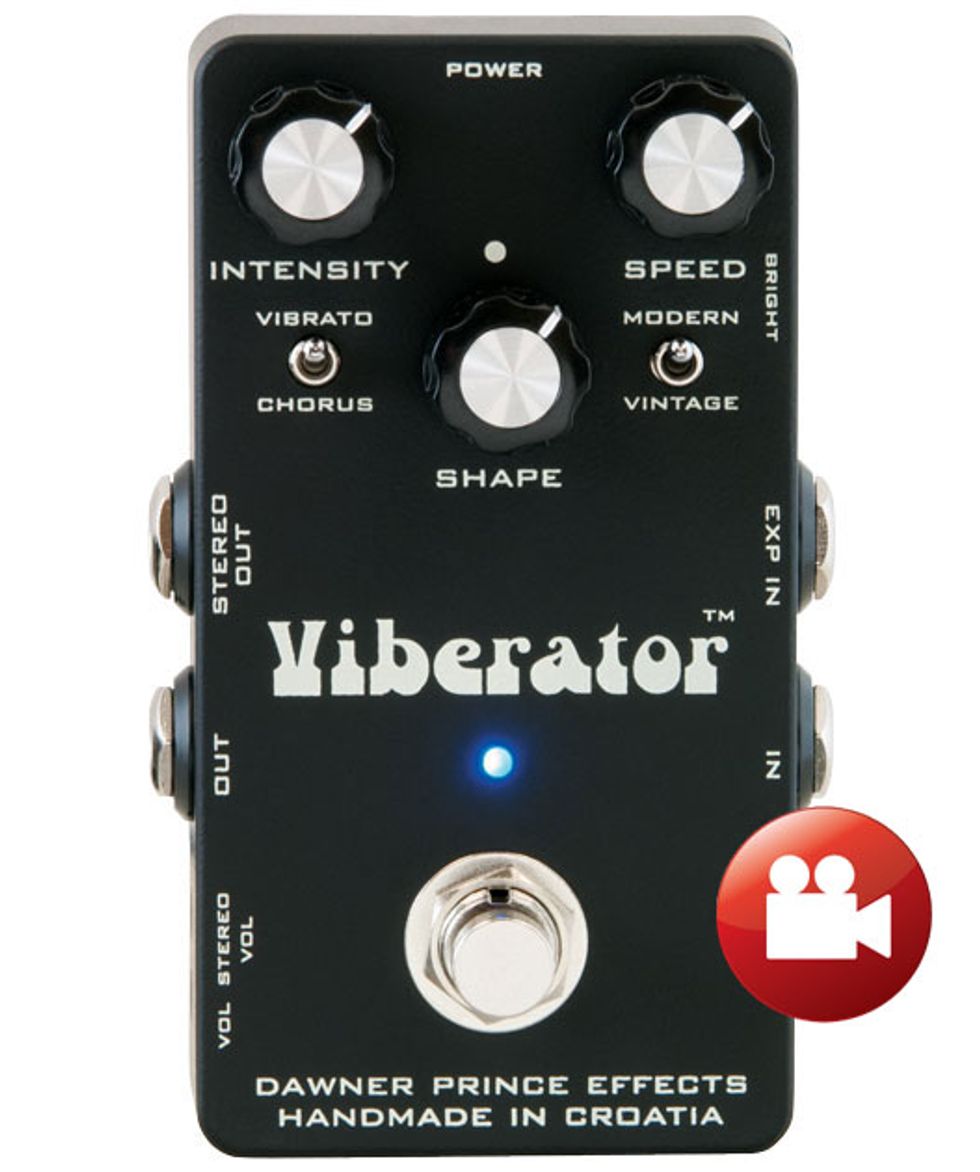
What’s laudable and remarkable about the photocell-driven Viberator from Dawner Prince Effects is that it sounds fantastically deep and makes the trickier, pricklier aspects of Uni-Vibe easier to manage—all in a compact and altogether utilitarian little package.
Croat-Stone Solid
Handmade in Croatia, the Viberator is a stout and lovingly built little dude. The guts of the unit don’t reveal much because the circuit is flipped. What you do see, however, reflects an exacting mindset on the part of its builders. The same goes for the unit’s exterior. The three small trimpots for output volume and brightness are aligned perfectly so you can make adjustments with a small Phillips or flathead screwdriver. The four 1/4" jacks for input, stereo output, and an expression pedal feel sturdy. Knobs and pots also feel secure and rotate with a satisfying, precise feel. Even the two mini-toggles for the modern/vintage voicing and chorus/vibrato switch have a mil-spec robustness.
Dawner Prince’s ability to cram so much onto and into such a small enclosure is impressive, though it means there’s no space for a battery and you’ll have to use a 9V adapter (up to 16V is fine, if you like a little extra headroom). The pedal doesn’t feel cramped or cluttered, and getting around is a breeze, once you get a feel for what’s what. The only design decision that may prompt debate is whether the Viberator would be better off with a bigger enclosure and the very useful output volume and brightness controls on the topside where they can be adjusted on the fly. That move would have been my preference, but Dawner Prince (wisely, I’m sure) deferred to the growing population of pedalboard clutter obsessives.
It’s worth noting that there’s also internal trimpots for gain and offset (which, together, effect the overall “throbbiness” of the unit). The stock trimpot settings worked just fine for the purposes of this evaluation, and while these pots probably don’t merit topside controls, they are certain to be useful to tweakers who want a more far-out pulsing effect or just want to better tailor the unit to their rigs.
One less common control that did make it to the unit’s faceplate is the “symmetry” control, which dials in a ramp on either side of the wave peak, depending on whether you turn it left or right of center (the noon setting dials in a symmetrical waveform).
Rock Around the Vortex
Like so many Uni-Vibe-inspired pedals, the Viberator sounds richest and most detailed when it’s out in front of a loud amp—especially one with 12" speakers (10" and 8" speakers made the Viberator sound perceptibly less dimensional). At low volumes and with small speakers in the mix, low-end output from the vintage voice sounds disproportionately throbby and swollen, while the top end sounds a bit thin and metallic. Switching to the modern voice, which introduces a high-impedance FET input buffer, reduces the low-end intensity relative to treble tones, but doesn’t add much in the way of overtones. That said, even in the small amp/low volume settings that put the Viberator at a disadvantage, it’s still easy to discern the extra bit of thrust and intensity the Viberator puts behind each wave sweep, and a wide-open Fender Champ or Blues Junior sounds thrillingly twitchy and, well, vibey.
Experiments with Marshall and Fender amplifiers in the 18- to 85-watt range made the Viberator feel much more at home. You don’t need to play deafeningly loud to hear the Viberator at it’s best, but there is a threshold where the Viberator moves from black and white to wide-screen Technicolor. And it’s in these settings you also discover how very flexible the device can be.
Ratings
Pros:
Super-malleable voice that can be mated to any guitar-and-amp combination. Powerful blend of versatility and size. High-quality build.
Cons:
Side-mounted output level and brightness controls hard to change on the fly.
Tones:

Ease of Use:

Build/Design:
Value:

Street:
$299
Dawner Prince Effects Viberator
dawnerprince.com
Just like an original Uni-Vibe, the Viberator has a vibrato and chorus switch. The chorus switch is the key to nailing the languid swirl of Hendrix ballads and Gilmour space jams. The Vibrato setting is the less celebrated side of any Uni-Vibe effect, but it’s superb on the Viberator. It’s colorful, deep, and can add a touch of tape wobble to a sterile delay tone or generate a wonderful fast rotary-speaker simulation—especially with a little overdrive on the back end.
You can really start to bend the Viberator to your own needs with the modern/vintage voice switch. The difference between the two voices is especially pronounced in chorus mode. In vintage modes, the Viberator really favors the deep, bottom-heavy intensity that some folks treasure in vintage Uni-Vibes. On the Viberator, this deep, bass-heavy throb and pulse is apparent even in the lowest reaches of the intensity setting. Switching to the modern voice, however, puts the buffer to work—attenuating the low end, emphasizing the high end, and adding a more spacious, clean quality to the modulation. For players who switch between single-coils and humbuckers, or use darker amps, this mode can really open up the Viberator’s possibilities. Better still, the modern voice can be fine-tuned using the bright trimpot.
Together, these voicing controls are very effective for mating the Viberator to a rotating cast of amps and guitars, making this pedal a formidable (and potentially invaluable) modulation device for fly-in specialists and studio chameleons. But here again, we found the side-mounted brightness trimpot powerful enough to merit inclusion among the main control set and worth the tradeoff of a bigger enclosure—fine-tuning a pedal with a screwdriver amid the time crunch of a soundcheck just isn’t that fun. The same goes for the very handy output level controls—these are powerful, useful tools that would be even more powerful if they could be adjusted on the fly.
The Verdict
The beauty of the Viberator is that it’s likely to reward dyed-in-the-wool Uni-Vibe fans and players with more subtle modulation needs. And while some players will no doubt wish that the brightness and output volume controls were more conveniently situated, Dawner Prince should be applauded for making a ’Vibe machine this flexible so small. The Viberator is definitely on the pricey side, but for touring pros or swirl aficionados who make the Uni-Vibe sound a cornerstone of their approach, this thoughtfully, ruggedly built modulation monster will be worth the investment.
Watch the Review Demo:

![Rig Rundown: The Black Crowes’ Rich Robinson [2026]](https://www.premierguitar.com/media-library/youtube.jpg?id=66952027&width=1245&height=700&quality=70&coordinates=0%2C0%2C0%2C0)