

| Download Example 1 Lead Channel Download Example 2 Rhythm Channel, Clean Funky Download Example 3 Rhythm Channel, Tremolo Effect Clips recorded with a 1978 Greco EG-700 Watch a video review of the amp on page 2. |
Mark Bartel of Tone King Amplification (a member of the Premier Builders Guild) knows well the payoff that comes from putting those elements together right. He designs his amps with a very simple philosophy—distill great guitar tones down to their basic elements, and then design an amplifier around them. His amps have already attracted the ears of Mark Knopfler, and his latest creation—the Tone King Galaxy—will likely impress the famous and anonymous alike with its capacity for big, clear 6L6 tones, low-end girth, and snarling sounds when it’s wide open.
To Boldly Go . . .
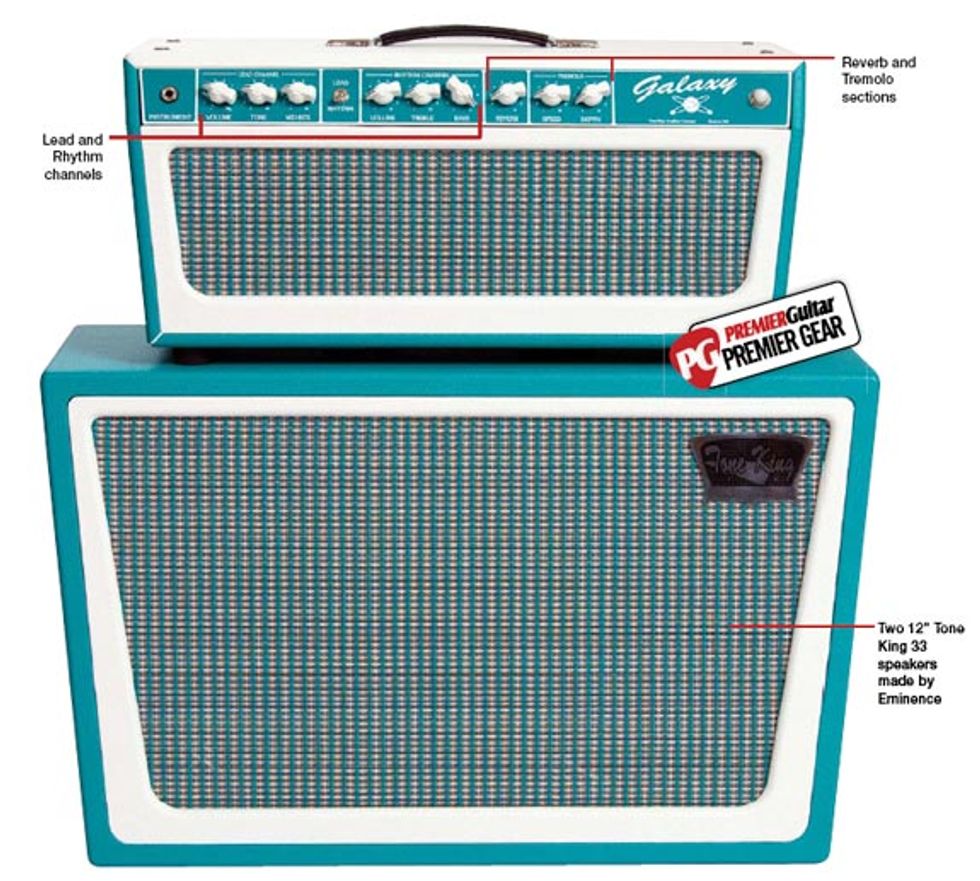
The turquoise-and-white Galaxy is a showstopper. Stacked on the matching 2x12 cabinet, its Jet Age style looks like a cross between a ’57 Chrysler and a mid-century television—it really looks like it should be making a martini while broadcasting John Glenn’s Mercury mission and kicking out Ventures tunes. The head is fairly light, weighing in at 36 pounds. Even when hauling the head and the 35-pound cabinet together, I was surprised at how light the whole set is—especially given that the cab houses two 12" Tone King 33 speakers (which are made by Eminence) and an optional Tone King Ironman attenuator. (The latter uses a transformer-coupling design rather than a resistor-based build to attenuate volume. According to Tone King’s Bartel, this facilitates the most transparent and clean attenuation possible. Either way, the attenuator enables you to enjoy the Galaxy at home just as easily as at the club or studio.)
Bartel says one of the most critical factors in capturing a great guitar tone is superior speaker cabinet design. He’s built hundreds of test cabinets—examining factors such as wood type and grain direction, as well as different coatings and fastening methods—to achieve the proper voicing for the Galaxy. The cabinet can be elevated with four removable wooden legs (not shown), and doing so only accentuates the amp’s likeness to old tube televisions. It took some elbow grease to loosen and remove the feet, but that’s probably a good sign that there’s no immediate danger of stripping the mount. But while it was a relatively straightforward procedure, a slide-out design would be quicker for gigs.
The build quality of the Galaxy was just as impressive as its knockout looks. I was unable to find any finish or construction flaws. The tips of the screws holding on the cabinet’s rear baffle were visible inside the cab, but I really had to feel around in there to find them. Every knob turned smoothly but also had a pleasing resistance that’s nice for setting precise levels—and keeping them there.
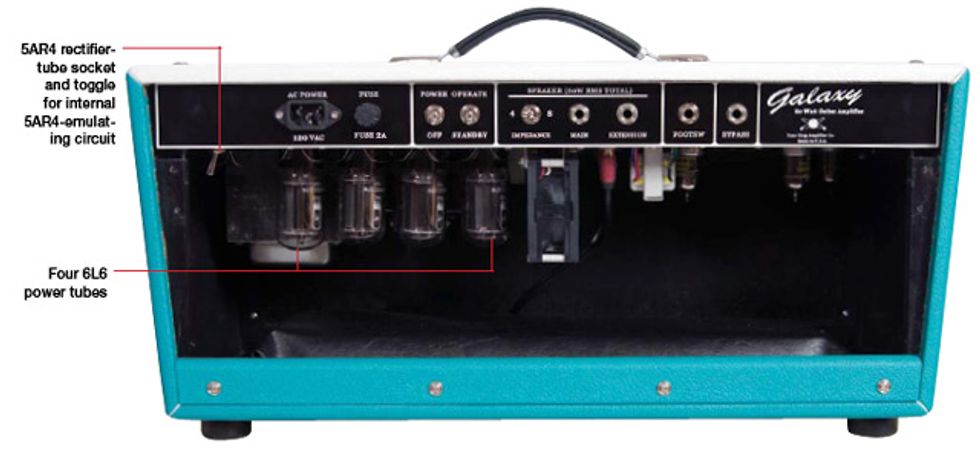
Though it’s a 2-channel amp, the Galaxy is simple as could be. The clean Rhythm channel has Volume, Treble, and Bass knobs, and things are just as easy on the Lead channel, which makes do with Volume, Tone, and Mid-Bite knobs. The latter fine-tunes the midrange growl. A traditional long-spring reverb unit and tremolo lend space and texture to the Galaxy’s tone. And this thing has tons of tone on tap. With 60 watts of power from a quartet of cathode-biased 6L6 power tubes, the Galaxy obviously takes a page out of the vintage Fender book. Keen-eyed amp aficionados will notice an empty tube socket next to the leftmost 6L6. That socket is coupled with a large switch that lets you toggle between an optional 5AR4 tube rectifier (for a looser feel) or an internal circuit that emulates a 5AR4—in case you’re willing to sacrifice some tube authenticity for convenience.
Out-of-This-World Tone
It’s tempting to look at the Galaxy’s retro looks and assume the tones are purely a retro exercise, too. But while it’s rich with tones that typify the late ’50s and early ’60s—from surf-able cleans to biting blues—it’s capable of much, much more. I plugged in a Strat, flipped to the Rhythm channel, and set the attenuator to wide open. With a single Am7 chord, I was treated to some of the cleanest, punchiest, most harmonically rich tone I’ve ever encountered. Memories of a long-lost vintage Bandmaster filled my head as I laid into the strings with varying degrees of pick attack to explore the Galaxy’s impeccable touch sensitivity and satisfying tonal body.
It’s really remarkable just how loud and bass-heavy the Galaxy can get, too. It’s got a lot of low end, even when using the cabinet with the optional legs—which were added to counteract transference of bass frequencies to the floor (a situation that can often spell trouble in a recording session). Even so, I preferred leaving the Bass knob set between 8 and 10 o’clock—I simply couldn’t believe how much low-end power I got without things sounding boomy!
Using a 1978 Greco EG-700 Les Paulstyle 6-string, I was able to make the Galaxy’s Lead channel come alive with a brazen, unbridled tone that was simply flooring. The highs were just as sparkly and harmonically juiced as they were in the Rhythm channel, but with a midrange that snarled like a Rottweiler. There’s a real unique character in the Lead channel’s mid frequencies, and it’s most obvious in the rather bright upper end of its spectrum. It was almost as if there were two midrange frequencies at work—one that had a squishy, chewy character, and another on top that was clear and sharp. And it’s just as apparent in wide-open, AC/DC-esque chords as in lead lines—and with both clean and dirty tones.
Even with the cab’s open back design, palm muting yielded tight, percussive tones, and there was enough gain on tap to enter early-’90s hard-rock territory. To produce that much overdrive, I turned up the Lead channel’s Volume to around 1 o’clock— which was blisteringly loud. That’s where the Ironman attenuator became a big help: It enabled me to lower the volume while also allowing the speakers to breathe and the tone to remain tight and full.
What about reverb and tremolo? The range of the reverb effect is extensive—this thing can get wet—but I preferred keeping the knob just under the 9 o’clock position to retain the note definition I prefer. The tremolo circuit was equally impressive, but I hoped for a slightly slower minimum speed at times.
The Verdict
Tone King’s Galaxy is a tone monster, with deceptively versatile tone lurking within its sparse features and simple control layout. Its touch sensitivity, ample volume, clean Rhythm-channel headroom, and smooth Lead-channel overdrive were a joy to experience. While it’s capable of loud cleans and great tones at lower volumes, the Galaxy loves to be cranked and get dirty. It’s a great choice for blues, rock, and country, but it really hits it out of the park with alt-country tones. In this reviewer’s eyes and ears, it really doesn’t get much better than the Galaxy for vintage Fender and Vox flavors, which really makes the Galaxy ready for just about anything—on this world or any other.
Buy if...
you need killer clean tones reminiscent of blackface Fenders and a lead channel that crunches with the best of ’em.
Skip if...
you prefer more modern tones.
Rating...


Street $2595 (head), $995 (cab), $1745 (cab w/ attenuator) - Tone King Amplifiers - toneking.com