Rebecca Dirks graduated from the University of Iowa with degrees in journalism and art, and joined Premier Guitar as an intern in 2007. She lives in the Iowa City area with her husband, two giant dogs, and more cats than are appropriate to mention. When not petsitting, she enjoys challenging herself in the kitchen, watching the Packers dominate, and discovering new music or rediscovering old favorites.
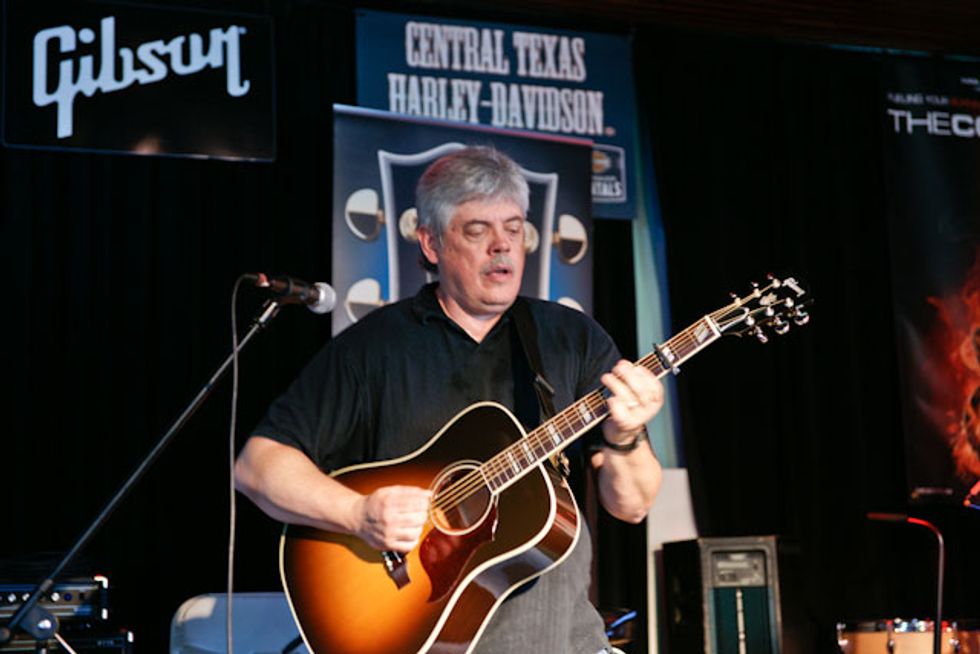
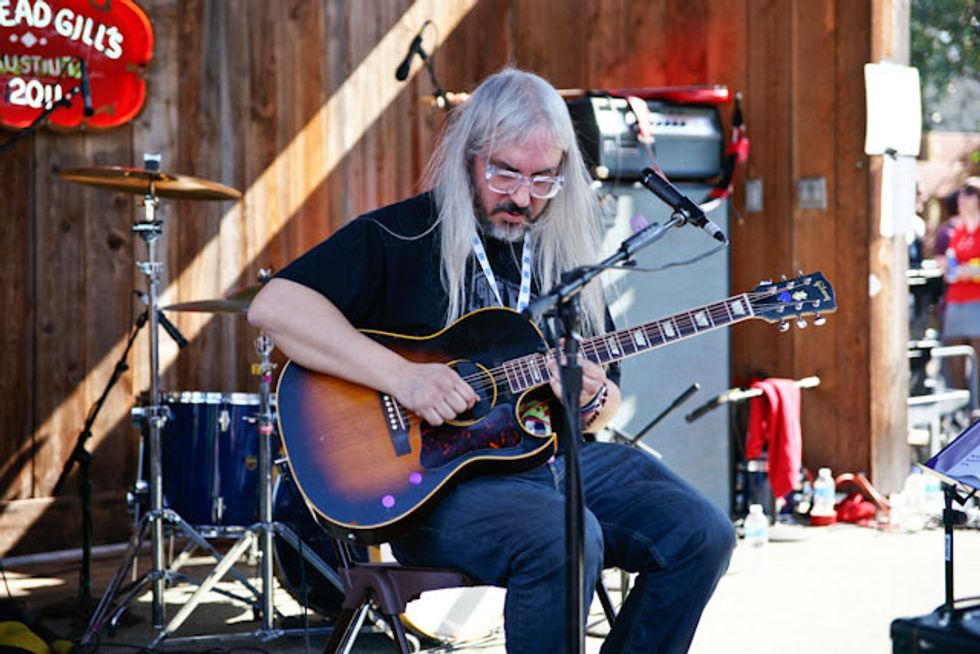
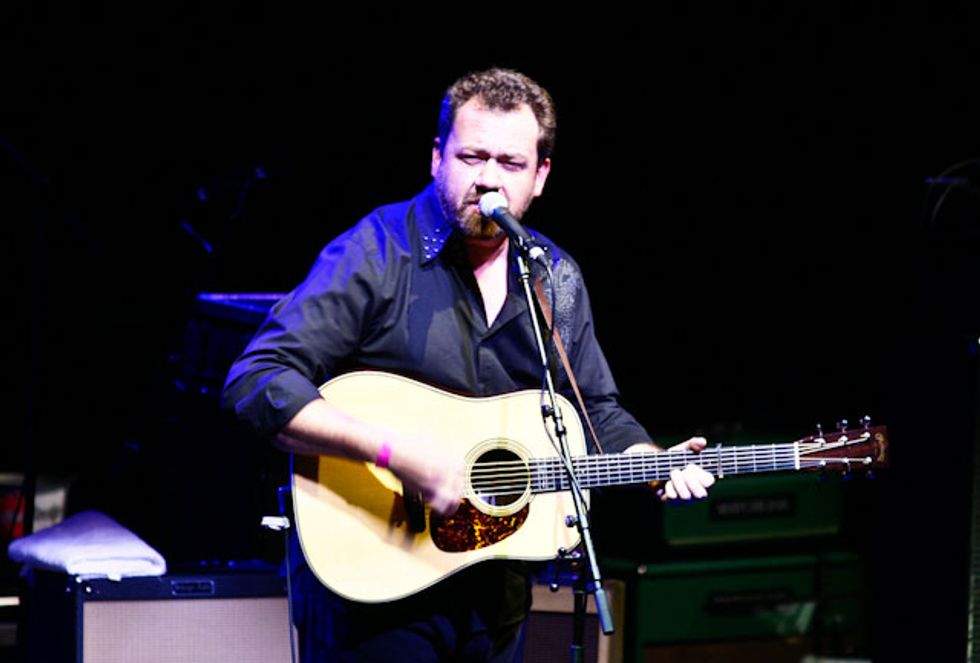
"Maines, a Grammy Award-winning country producer and multi-instrumentalist, opts for a classic Gibson J-45 acoustic capoуd at the third fret for his set at Maggie Maeуs Gibson Room."
Silvertone has reintroduced the iconic 1446 semi-hollow electric – one of the most recognizable guitar models in rock history.
Played by artists Chris Isaak, Elvis Costello, Hubert Sumlin and more, the Silvertone 1446 is now available for the first time in decades, and that sound - and that guitar - can be yours.
Originally sold through the Sears catalog from 1961 to 1967, the Silvertone 1446 holds a special place in electric-guitar history. Over the last 60 years it has become one of the most sought-after models among recording artists and collectors.
Now Silvertone has reintroduced the 1446—meticulously recreated with modern performance features while honoring every detail that made the original a legend.
A Classic Reborn for the Modern Player
The new Silvertone 1446 delivers enhanced playability and tonal versatility while maintaining its iconic silhouette. The original “2×4 lumber” neck profile has been re-engineered into a comfortable modern-taper soft-C shape. A chambered center-block maple body improves sustain, reduces feedback, and opens up the guitar’s dynamic range—perfect for the demands of today’s stages and studios.
Two versions of the 1446 are available. The 1446V, available in Black finish, features a genuine Bigsby® B70 vibrato tailpiece that works seamlessly with a Tune-o-matic style bridge featuring roller saddles for exceptional tuning stability. The 1446T, available in Black or Tobacco Sunburst finish, features a ‘Trapeze’ tailpiece. The guitar’s 24 ¾” scale mahogany neck and rosewood fingerboard feature state-of-the-art “Semi-Hemispherical” frets for an ultra-smooth playing feel.
Vintage Mojo, Recreated with Precision
One of the most revered elements of the original 1446 was its pickups—mini humbuckers designed by Seth Lover and manufactured exclusively for Silvertone. Known as the P19, these rare pickups had a unique 3+3 pole-piece design and a distinct, lower-wind voice.
To recreate this sonic magic, Silvertone collaborated with renowned designer Trev Wilkinson. His new Wilkinson “R Series” mini-humbuckers are exacting, era-specific recreations featuring custom tooling, period-correct Alnico V magnets, and carefully matched winding. The result: the unmistakable clarity and warmth that made the 1446 famous.
“When you pick up this guitar, you immediately understand why the original became such a cult classic” says Silvertone Product Manager, Rick Taylor. “We set out to deliver the soul of the ‘60s 1446, but with the playability and reliability modern musicians expect. The new 1446 gives you inspiration from the moment you plug in.”
The Silvertone 1446VBK with the Bigsby vibrato tailpiece carries a street price of $999. The two 1446T models with the Trapeze tailpiece are priced at $799.
BOSS announces the GX-1 and GX-1B, two entry-level additions to the popular GX multi-effects series. The GX-1 is designed for guitarists, while the GX-1B is tailored for bassists. BOSS also expands its accessories lineup with the FSC-10 Footswitch Cap, a high-quality solution that makes standard metal footswitches easier to press while performing.
GX-1 and GX-1B
The GX-1 and GX-1B deliver pro-grade sound in ultra-portable platforms for practice, recording, and performance. Authentic GX series amp and effect algorithms supply endless creative fuel, while high-res color displays, intuitive effect buttons, and Gear Suite tools make sound creation a snap. Beyond the internal sounds and chassis colors, each product offers identical features.
The GX-1 and GX-1B make premium sound accessible to every player, from beginners and home enthusiasts to touring pros seeking an all-in-one travel solution. With a vast selection of amps and effects, adjustable effect order, and eight simultaneous blocks plus a volume pedal and noise suppressor, users can easily craft custom setups for playing different music styles and performing specific songs on stage.
Whether editing presets or building sounds from scratch, the GX-1 and GX-1B are designed for frustration-free creation. Hexagon-shaped panel buttons provide a visual representation of the effect categories, and it’s possible to turn effects on/off with a tap or access detailed parameters with a long press. There are 99 memories loaded with ready-to-play presets, plus 99 user memories for storing custom sound creations.
The GX-1 and GX-1B introduce Gear Suite, a powerful new feature that enables quick setup of amps and effects. Each type includes professionally tuned Gear Suite settings, and players can save favorites in user locations for instant access to personalized parameters.
The GX-1 and GX-1B each offer freely assignable footswitches and an expression pedal that support control of everything from basic effects on/off to multiple parameter targets. Going further, wired and wireless options are available for external control. Each unit offers three versatile power options (batteries, AC adaptor, or USB), allowing users to practice and perform anywhere.
In addition to their sounds and performance features, the GX-1 and GX-1B include Bluetooth® and USB connectivity to elevate practice and recording sessions. The BOSS Tone Studio app further enhances the user experience with YouTube integration, built-in rhythms, editing features, and pro sounds on BOSS Tone Exchange.
FSC-10 Footswitch Cap
Footswitch caps are an affordable way to enhance the functionality of traditional pedal switches, making them more visible on stage and easier to press. Molded from rugged, transparent polycarbonate that allows LEDs to shine through, the FSC-10 is a high-quality solution that works with a growing range of BOSS gear.
The FSC-10 is fully compatible with BOSS products that have metal footswitches, including multi-effects such as the GX-1 and GX-1B, select pedal effects, and Loop Stations. Each FSC-10 package includes 10 units.
Availability & Pricing
The GX-1 and GX-1B are available now for $229.99. The FSC-10 is also available now for $14.99.
To learn more about the GX-1, GX-1B, and FSC-10, visit www.boss.info.
New for 2026, Ibanez has announced the debut of the Alpha series electric guitars, a line engineered from the ground up to meet the demands of the modern, performance-focused musician.
The Alpha models blend cutting-edge features with thoughtful ergonomics, leaning heavily into concepts that optimize tone and playability. Key specifications include multi-scale construction for enhanced clarity and intonation across extended ranges, and Fishman Fluence Modern humbuckers, providing versatile, noise-free, and aggressive tonal options.
The highly sculpted, ergonomic body design is central to the Alpha series, engineered for extreme comfort whether standing or seated. The lightweight body features a deep, comfortable forearm cut and an innovative lower body carve that facilitates both conventional and classical-style seated playing positions.
Some of the unique design innovations include a rear-mounted input jack for a cleaner stage profile, and an innovative three-bolt neck joint design. This system utilizes two screws mounted within an oval-shaped stainless-steel plate, complemented by a third screw driven directly from the body into the neck. This distinctive construction not only ensures robust joint strength but also significantly improves access to the high frets and enhances overall playability.
The Alpha series is offered in both 7- and 8-string configurations. Each model features one of three contemporary metallic finishes: Iron Pewter, Nebula Shift, and Coral Mirage.
Features
A527
Parallel Wizard AS 5pc Maple/Walnut neck
691mm/27.2” scale at 7th string, 648mm/25.5” scale at 1st string
American Basswood body
Ebony fretboard w/Mother of Pearl Step off-set dot inlay
Jumbo Stainless Steel frets
Fishman® Fluence™ Modern Humbucker Alnico 8 (H) neck pickup
Fishman® Fluence™ Modern Humbucker Ceramic 8 (H) bridge pickup
Fishman® Fluence™ Voicing switch
Mono-rail G2 bridge
Black hardware
Gotoh® MG-T locking machine heads
Luminescent side dot inlays
Gig bag included
Finishes: Iron Pewter, Nebula Shift
LIST PRICE: $2,533.32
ESTIMATED STREET PRICE: $1.899.99
A528
Parallel Wizard AS 5pc Maple/Walnut neck
698mm/27.5” scale at 8th string, 648mm/25.5” scale at 1st string
American Basswood body
Ebony fretboard w/Mother of Pearl Step off-set dot inlay
Jumbo Stainless Steel frets
Fishman® Fluence™ Modern Humbucker Alnico 9 (H) neck pickup
Fishman® Fluence™ Modern Humbucker Ceramic 9 (H) bridge pickup
PG contributor Tom Butwin sits down with Dylana Nova Scott, president and amp designer at Third Power Amplification, to explore the all-new Highline series -- a flexible set of vertical combo configurations for 3rd Power's wide-ranging amplifier offerings. Dylana breaks down the design philosophy of the Highline Series, plus the innovative features and tonal possibilities of her hand-wired amps built for players who demand both classic voice and modern flexibility.
3rd Power Amplification
Highline Series
When the amp stands taller, the sound meets you halfway. The HIGHLINE Series is a reimagining of how a guitar amplifier occupies space - visually, physically, and sonically. Inspired by the tall "player-facing" combos of the early 1970s, this vertically oriented enclosure lifts the sound field off the floor and places it where it belongs: directly in front of the player, with the controls at natural standing height. The result is a commanding, immersive wall of sound that feels bigger, clearer, and more immediate - and much easier to use. With flexible speaker configurations including dual 12", triple 10, or a 15"/10" pairing, the HIGHLINESERIES delivers classic authority with modern versatility, wrapped in timeless design. This is not a new amplifier - it's a new way to experience one.
In my experience, constructing lines has always been about texture and structure. Developing ideas for soloing and writing melodies takes a keen sense of harmonic and rhythmic context. It’s about seducing the listener and delivering a ride that’s hard to forget—a ride that caters to the listener. Of course, it’s important to write for yourself and from the heart, but also remember that if your heart’s intent is to inspire others, then you’re on the right track for the long haul. And this is where melody comes in.
Melody deserves a certain level of priority in relation to harmony and rhythm. In this lesson, I’m going to show you a quick way to start improving your lines. The good news is music knows no bounds and music doesn’t care what level you’re at. Harmony and rhythm need to help each other tell your story.
In Ex. 1 we’ll be playing the Em7 arpeggio (E–G–B–D) in two positions. Don’t worry, we won’t get into too much theory, just remember these shapes can be transposed into any key. The top one starts in 10th position and shifts up the neck, while the bottom one starts in 5th position. Getting these under your fingers will help map out quite a bit of the fretboard. I try to only visualize one octave at a time, and then take that shape and move it wherever I need to chase the melodic and rhythmic ideas that inspire me.
Ex. 2 follows the same idea, but this time using a Gmaj7 arpeggio (G–B–D–F#). I’ve chosen E minor and G major because they are closely related key centers. When learning these arpeggios, focus on the string pairs that occur in each octave. In the extended arpeggio that ascends from the 2nd fret, notice how the patterns recur in each octave. That’s not always the case, as you’ll see in the second arpeggio that ascends from the 9th fret.
Next, we’re going to use the first Gmaj7 arpeggio—the one with the recurring pattern—to practice running through a sequence. Think of Ex. 3 in groups of five. When practicing such lines, I like to use drum grooves instead of a metronome. Now here’s the twist: To progressively challenge my technique, I keep changing the subdivision of the meter I’m using. For example, we’re in 4/4 time here. As I develop the sequence, I’ll increase the subdivision from quarter-notes, to quarter-note triplets, to eighth-notes, to eighth-note triplets, then 16th-notes, and finally 16th-note triplets. That not only increases my speed but it also forces me to be rhythmically aware, thus giving me both speed and accuracy. It gives me full control. Take your time with this example because we’ll apply the same shifting-subdivision concept to the next one.
We revisit the Em7 arpeggio pattern at the 12th fret for Ex. 4. Let’s take a moment to talk about picking. Please use whatever technique you feel most comfortable with, but if you must know, in the corresponding audio clip I’m using as much legato technique as I can. For those not familiar with this term, it means I’m using hammer-ons and pull-offs to sound many of the notes, as indicated in the notation and tab. But there’s no need to get hung up in the picking technique. If you want to pick every note using alternate or economy picking, then do so with style. If you want to hybrid pick, go for it. The point is to increase your rhythmic knowledge and execute some creative ideas.
Now it’s time to step up the subdivisions. In Ex. 5 and Ex. 6, we’re using the same arpeggios we mapped out earlier, only this time we’re playing 16th-notes. If this is something you haven’t done before, don’t be alarmed. Just think of it as a slight increase in speed. Learning to shift subdivisions with seamless control is a great way to expand your ability to develop lines.
Enough with the exercises—let’s make some music. Ex. 7 starts out by traversing the Em7 arpeggio with 16th-notes, then transitions into the next octave using 16th-note triplets. Then for variety, we mix in some pentatonic lyricism. That brings me to a side note: Always step away for a moment from using only arpeggios by mixing in some pentatonic or scalar lyricism to your lines. A line composed of only arpeggios can sound stiff and redundant. One way to avoid this is to sprinkle some scale tones into the phrase.
In Ex. 8, we’re using Em7 arpeggios again, but the position conveniently gives us a full three octaves to work with. Instead of sticking exclusively to the basic shape, I also included some pentatonic moves. Notice how mixing 16th-notes and 16th-note triplets add color to the line. The key to sounding like a professional player is to make sure your playing offers the listener variety in rhythm and note choice.
We head back to the Gmaj7 shape for Ex. 9. It starts out in the lowest octave, which is at the 2nd fret, and once again mixes in that good ol’ E minor pentatonic (E–G–A–B–D) tonality. We repeat the same thing an octave higher, but because we run out of real estate, we need to slide up before finishing off the line in a G major tonality.
In our final example (Ex. 10), we return to the Gmaj7 arpeggio in its higher position, though we’re treating it a bit more lyrically this time around. No sequences, just playing bits and pieces of the arpeggio.