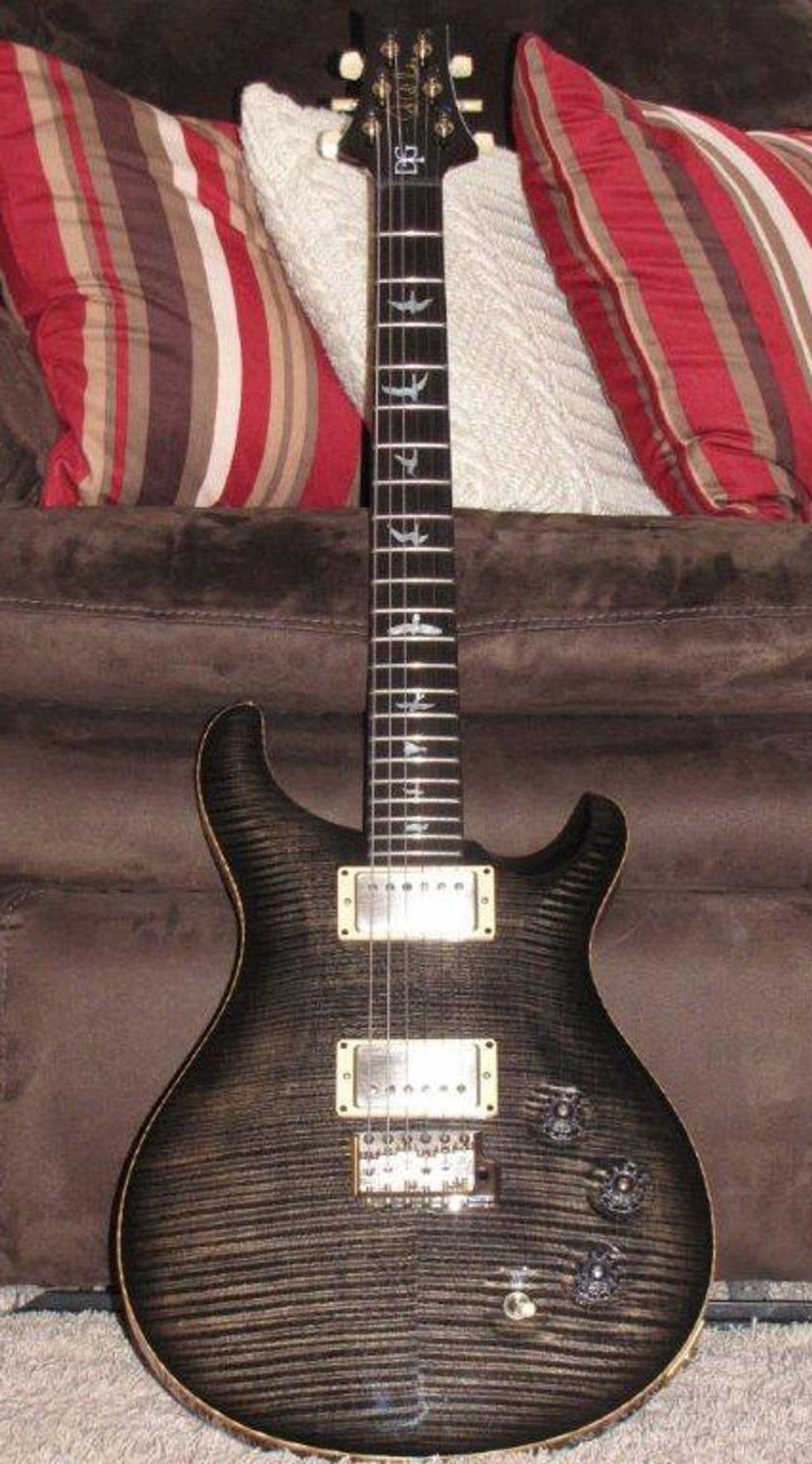
"The guitar covers all ground, and I haven't found a situation where it doesn't ""fit"". It's the most versatile guitar I've ever played and it sounds amazing in any setting. - Andy Baerg"
When Japanese engineer Susumu Tamura designed the Maxon OD808 overdrive, he could hardly have known that it and its export twin, the Ibanez TS808 Tube Screamer, would become perhaps the most influential and, probably, imitated pedals in stomp box history. In fact, upon its introduction in 1979, the Tube Screamer, whose smooth sound is characterized by a bass roll off, midrange bump, and slight high-end attenuation, was not an instant success. But as the pedal was adopted by players as disparate as Stevie Ray Vaughan and Kirk Hammett, it gradually became a ubiquitous presence on pedalboards of all persuasions.
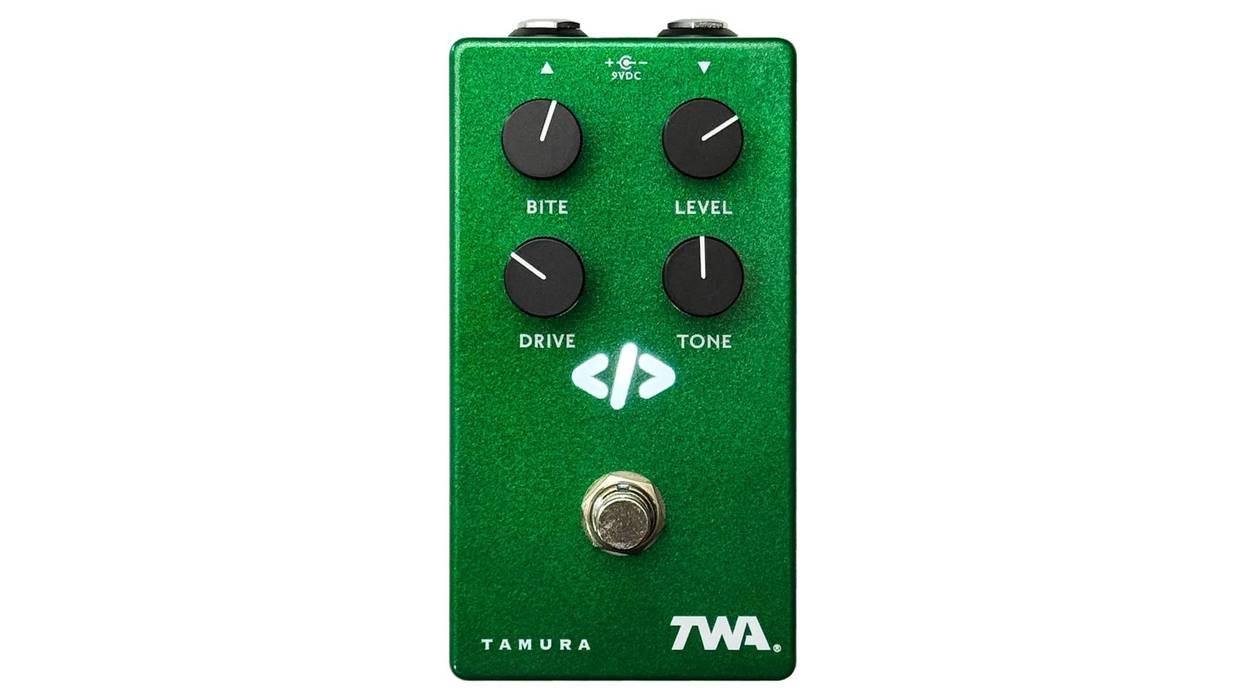
Tumura, a guitarist himself, spent several of the intervening decades working on wireless designs. In recent years, however, he began modifying Tube Screamers for Japanese guitar stores. But now in his seventies, he found the pace—almost 1,000 pedals annually—exhausting. Why not, he thought, just make a pedal that incorporated all his refinements? Enter the TWA SC-01 Source Code, which is exactly that. Handmade in the U.S., the SC-01 features improvements on the TS design, including 18V operation via an internal regulator, a +6 dB boost, anop amp that claims toinject “complex harmonics and an amp-like feel,” and, most importantly, a “Bite” control that can mix in asymmetrical, tube-like clipping to the symmetrical clipping-based sound of the original.
Source in Session
Using a Stratocaster and Fender Princeton Reverb as my test platform—a made-for-Tube Screamer rig if there ever was one—I first determined whether the Source Code could speak traditional Tube Screamer by A/B-ing it with a recent Ibanez TS-9 reissue. It does, producing tones indistinguishable from the traditional circuit when the bite control is at zero. That said, if your take on Tube Screamers has always been, “if it could only just…,” you’ll find that the bite knob opens up a whole new world. Goosing it adds the extra measure of sizzle, zing, and teeth that more common iterations of the design always lacked. And adjusting the balance of the drive and bite controls dials in an enhanced and expanded range of overdrive tones that truly transcend the original TS.
The Verdict
Whether you deploy Susumu Tamura’s latest refinement of the TS circuit to hit the input of an amp that’s already breaking up or as your primary source of overdrive, you won’t be disappointed. It offers all the essence of the original, but it’s the extra oomph and range that impresses.
Most people think of samplers as drum machines with delusions of grandeur—four-bar loops, predictable patterns, and neatly sliced bits living forever in the prison of the grid. But for me, samplers and loopers are something completely different. They’re instruments of disruption. They’re creative accelerants. They’re circuit breakers designed to shock me out of my comfort zone and force my compositions, productions, and performances into strange, exhilarating new shapes.
One of my favorite studio practices—and something I encourage my Recording Dojo readers to experiment with—is to sample your performances. Not a preset library, not a pack from somebody else, but use your own melodic lines, motifs, rhythms, textures, and half-formed ideas. There’s something magical about hearing your own musical DNA come back to you in an unfamiliar, mutated form. It’s like collaborating with a version of yourself from an alternate timeline.
The real thrill isn’t about capturing pristine performances. In fact, it’s often the opposite: I’ll grab a phrase that’s imperfect, or mid-gesture, or harmonically unresolved, and drop it into a sampler purely to see what it becomes. When you do this, your musical habits—your well-worn licks, default rhythms, and predictable choices—don’t stand a chance. The sampler shreds them, recontextualizes them, and hands them back as raw material for re-writing, re-arranging, or composing something that never would have emerged in a linear workflow.
Sometimes the transformation is subtle—a lick becomes a rhythmic ostinato, a sustain becomes a pad, a passing tone becomes a focal point. Other times the sampler just mangles it, spits it out sideways, and you think, ‘Oh… now that’s interesting.’ Either way, it becomes a tool for breaking patterns, both musically and psychologically.
My Process: Mutations, Not Replications
My approach to sampling isn’t any more complicated than anyone else’s. I’m not using some secret, elite technique. I’m simply collecting fragments—little melodic cells, rhythmic quirks, harmonic gestures—and giving them permission to misbehave.
I’ll chop up key licks into uneven slices, or isolate just the back half of a phrase, or extract a rhythmic hiccup that wouldn’t survive in a normal editing session. Then I reassemble these bits with the expectation that they won’t behave. I want mutations. I want the musical equivalent of genetic drift. I’m not trying to color within the lines; I’m trying to see what happens when I throw the coloring book across the room.
Once the sampler gives me something intriguing, I run these new creatures through chains of further processing: glitch delays that stutter and fold the sound into origami-like shapes, micro-loopers feeding into overdrives or fuzz pedals, shimmering reverbs that stretch a 200-millisecond blip into a widescreen texture. The result can be anything from a ghostly sustained pad to a snarling, percussive accent, to a completely alien harmonic bed.
You can use these elements as alternate melodic lines, counterpoint, ambient beds, transitions, ear candy, or even structural material for entire songs. And because the source is you, the end result stays connected to your musical identity—just bent, twisted, and refracted into something fresh.
Outcome Independence: The Spirit Behind the Process
If there’s one thing that makes this approach powerful, it’s letting go of the expectation that what you sample must “work.” This is pure experimentation, not product-driven crafting.
I’m outcome-independent when I do this. I’m not looking for a result so much as engaging in the joy of the unknown. Some days nothing meaningful emerges. Other days I strike gold. But either way, the process sharpens my creative instincts. It keeps me curious.
“There's something magical about hearing your own musical DNA come back to you in an unfamiliar, mutated form.”
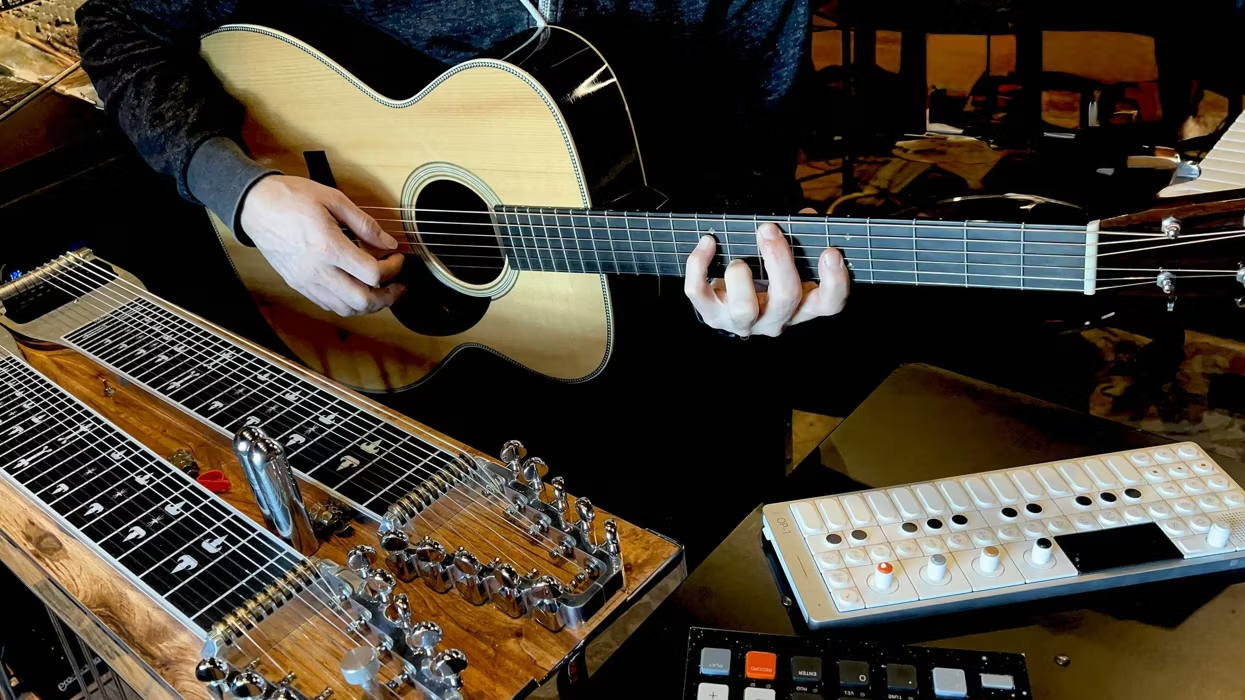
I use this same strategy when producing artists or working on film and soundtrack material. Recently, I applied it to pedal steel—an instrument known for its lyrical beauty—and the resulting textures were … well, not beautiful in the traditional sense. They were fractured, shadowy, almost Jekyll-and-Hyde. Perfect for a track built around the duality of personality. The clients absolutely loved the unpredictable, emotive soundscape those mutated pedal steel lines created.
Some Favorite Tools for Sonic Mutation
You don’t need a million pieces of gear to do this. A single sampler and a single effects chain can take you far. But here are a few of my favorite “chaos engines,” all of which I own and use regularly:
• Teenage Engineering OP-1 Field – A sampler, synth, tape machine, and chaos generator disguised as a minimalist art object. Its sampling engine and tape modes are perfect for tonal mutations.
• Teenage Engineering EP-133 K.O. II – A quick, dirty, wonderfully immediate sampler for slicing, punching, and recombining your ideas without overthinking.
• Omnisphere 3 – The granular engine alone is a goldmine for turning simple samples into cinematic, evolving textures.
• NI Maschine – Still one of the fastest environments for grabbing a sound, flipping it, and building an idea around the unexpected.
• …and whatever else you have lying around. The point is exploration, not allegiance to any one workflow.
Final Thoughts
Sampling your own voice as an instrumentalist—and then breaking it—reminds you that creativity doesn’t live in the safe, predictable spaces. It lives in the moments where you lose control just enough to discover something new. Give your sampler permission to surprise you, confuse you, and sometimes even challenge your sense of what you sound like. That’s where the good stuff begins.
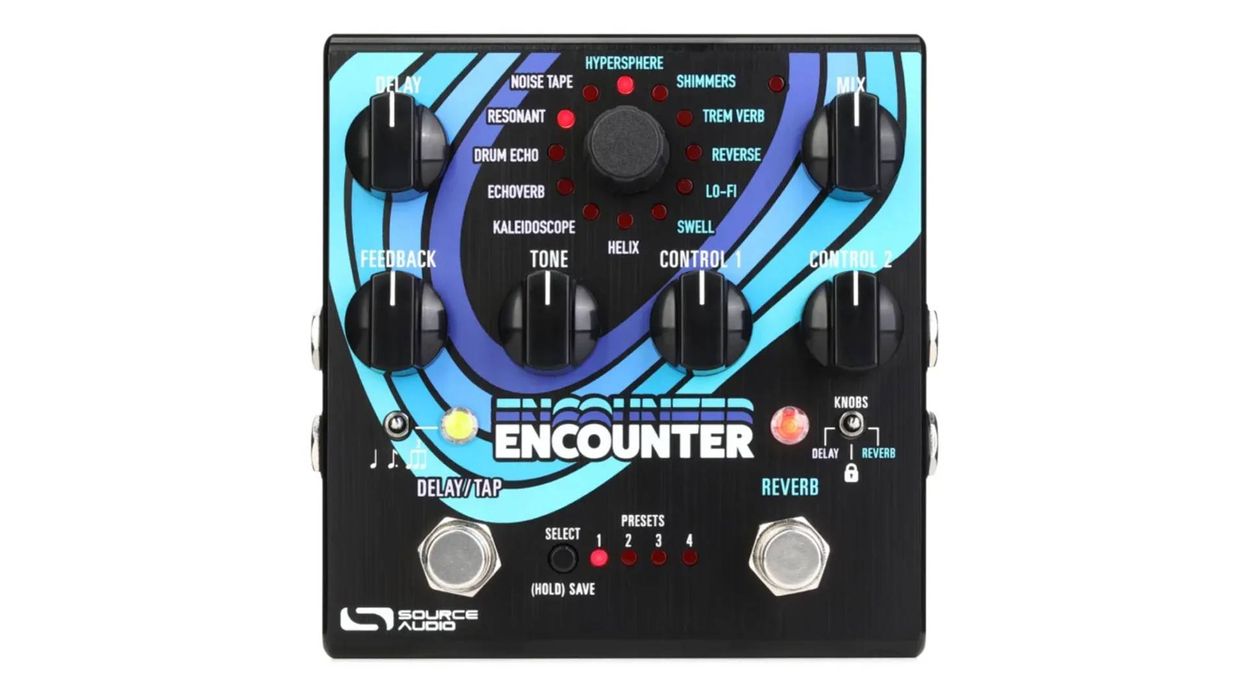
Reverb and delay. What two effects are better suited to live side-by-side in one pedal? Source Audio’s new Encounter reverb and delay is a mirror image of the company’s Collider, which explores the reverb/delay combo via a vintage lens. The mirror by which Encounter reflects the Collider, however, is more like the funhouse variety. There are many psychedelic, cosmic, and wildly refracted echoes to utilize in the Encounter. There are lots of practical ones that can be tuned to subtle ends, too. But Encounter’s realm-of-the-extra-real extras make it a companion for players that ply dreamy musical seas. It’s incredibly fun, a great spark for creativity, and, most certainly, a place to lose oneself.
Exponentially Unfolding
Of Encounter’s six reverb modes and six delay modes, four of them—the hypersphere, shimmers, and trem verb reverbs, and the kaleidoscope delay—are entirely new. Hypersphere, fundamentally, makes reverberations more particulate. Source Audio says it’s a reverb without direct reflections. In their most naked state, these reverberations can still sound a touch angular and perhaps not quite as ghostly and fluid as “no direct reflections” suggests. But they are still complex, appealing, immersive sounds. Odd reverberation clusters can conjure a confused sense of space and highlight different overtones and frequency peaks in random ways. At settings where you can hear this level of detail, hypersphere shines, particularly in spacious solo phrases. Hypersphere also features phase rate and pitch modulation depth functions via the control 1 and control 2 knobs, and they can further accent and enhance those frequency peaks, creating intoxicating, deep fractal reflection systems.
“Blends of the delay and reverb are the kind of places where you can lose track of a rainy day.”
The new trem verb mode can be practical or insane. The two effects together are a pillar of vintage electric guitar atmospherics. But the Encounter’s trem verb explodes those templates. As with the hypersphere mode, trem verb can zest simple chord melodies by using extreme effect settings at low mixes, where chaotic, half-hidden patterns dip in and out of the shadows, sometimes creating eerie counterpoint. But I loved trem verb most at extremes—mostly high mix, feedback, and decay settings with really slow modulation. Sounds here can be intense and vague—like strobe flashes piercing drifting fog. It might not be an ideal place to indulge fast, technical fretwork, but it’s a wonderland for exploring overtones, drone, and melodic possibilities.
Incidentally, the trem verb is a great match for the six delays, and the new kaleidoscope delay in particular, which fractures and scatters repeats in a million possible directions and spaces. Blends of the delay and reverb are the kind of places where you can lose track of a rainy day. The sound permutations often seem endless, and finding magic can take some attention and patience. But you can strike gold fast, too. You have to take care to save settings you really love (you can store as many as eight presets on board, and 128 total via midi) because it’s hard to resist the urge to meander through— and meditate on—hours of sound without stopping. Not all of the Encounter’s sounds are perfectly pleasing. Some combinations reveal peaky little chirps that betray digital origins—the merits of which are subjective and contextual. For the most part, though, the combined sounds are liquid and vividly complex, and can be especially enveloping at high mix and feedback.
Extended Reach
If the onboard controls don’t get you in enough trouble, downloading the Neuro 3 app, which unlocks deep control and functionality, is a minor wormhole. Take the case of trem verb—you can use Neuro 3 to change the wave shape or set up the reverb to affect the wet signal only, just the dry signal, or both of them. All of these changes open up a new system of tone caves as the sound evolves. If you’re deep in the nuance of a mix or arrangement, this functionality can be invaluable. And it’s a boon if you have nothing but time on your hands. In a state of engaged, intuitive workflow, I like to avoid these kinds of app dives. But having that much extended power on your phone or computer is impressive.
Neuro 3 extends the capability of the Encounter in other ways, too. The SoundCheck tool within Encounter is home to prerecorded loops of various instruments that you can then route through a virtual Encounter pedal. That means you can explore Encounter’s potential while stuck in a train station. It’s a real asset if you want to understand the pedal as completely as possible, and certainly a way to extract the most value from the unit’s considerable $399 price.
The Verdict
About that price. It looks steep. For most of us, it’s a significant investment. But when I consider how many sounds I found in the Encounter, how compact it is, and the possibilities that it opens up in performance and portable production (especially when you factor in the stereo ins and outs), that investment seems pretty sound. I must qualify all this by saying I was happiest with the Encounter when exploring its spaciest places—the kind of atmospheric layer where Spacemen 3, ambient producers, 1969 Pink Floyd, and slow-soul balladeers all hang. But there is room to roam for precision pickers that background radical effects, too.
Still looking to justify the cash outlay? Consider the Encounter as a portable outboard post-production and mixing asset. If you’re creating music built on big, shape-shifting ambience, it’s a cool thing to have in your bag of tricks. Different artists will mine more from the Encounter than others, so you should consider our ratings scores on a sliding scale. But as you contemplate the Encounter, be sure to factor in mystery paths that will beckon when you dive in. There’s lots of fuel for creation along most of them.
Most amp kits are Fender flavored, typically recreating historic 5F1 Champ, 5F2-A Princeton, or 5E3 Deluxe tweed-style circuits. And since an actual late-’50s Princeton, for example, costs about $3,000, at well less than a third of that price a DIY kit is an affordable alternative for any guitarist with soldering skills and the patience to follow instructions. But what if Fender isn’t exclusively the taste you’re looking for? What if Valco, Ampeg, Marshall, or modern takes on classic tones also float your rubber raft?
Enter StewMac’s mighty little Valve Factory 18 head kit, a 12-pound beast that punches above its weight class, offers a variety of classic-inspired sounds, and hints at modern boutique amp voices.
Flexible Fryer
Part of the Valve Factory 18’s versatility is due to the two preamp tube options provided in the kit: a 12AX7 or a 12AY7. But it’s mostly the result of a concise-but-flexible set of controls. On the front panel, there are volume, gain, and tone dials, but the way they shape sound depends on whether your guitar is plugged into the low- or high-input jack. The low input is the clearer of the two and hews close to Fender tweed world. But the high input offers gentle breakup that, to my ears, gets into gnarlier old amp voices. Both channels offer plenty of headroom and work well with pedals, but if your primary sources of tone color are stompboxes, the low input may be best for you. Both also benefit from a clean boost footswitch that pumps up the volume without altering the tones in play too much.
On the back, there’s an impedance switch with 4-, 8-, and 16-ohm settings, so the Valve Factory 18 can be used with most cabinets. There’s a single speaker-out jack, and on/off and standby toggles. And as its name implies, the amp delivers 18 watts, and it’s a loud 18 watts at that—fitting for today’s small-amp sweepstakes.
Brick By Brick
Confession: StewMac sent me an immaculate, pre-assembled review model rather than a kit. But I still settled into a meticulous reading of the highly detailed and lavishly illustrated instruction book. It begins with a menu of the included parts, which are metal film and metal oxide resistors, plus a single wire-wound resistor, two 1N5408 diodes, nine various capacitors, a pair of custom-built Pacific Trans transformers (power and output, naturally), wire, heat-shrink tubing, sockets and tubes (more on the tubes later), the fuse and fuse holder, the pilot lamp, screws and locknuts, input jacks, control pots, front and rear faceplates, the fully assembled footswitch for the boost, and a very solid anodized metal chassis.
Point-to-point assembly begins with the filter cap and works through the sockets on up to populating the circuit board, and so on. It’s advisable to have a digital multimeter handy to check each resistor before installation. Our test Valve Factory 18 arrived ready to go save for installing the tubes, which was easy, since this amp does not have a cabinet, so, it's merely a matter of plugging the tubes into the slots on the top of the chassis. Two JJ 6V6s live atop the amp’s crown next to the filter cap, which is also adjacent to the 18-watt power amp. I inserted the provided 12AT7 phase inverter tube and then decided whether to plug the 12AX7 or 12AY7 into the preamp slot.
Totally Tubular
Those aren't the only tubes that can be swapped in the preamp slot. The amp will function happily with 7025, 5751, 12AT7, and 12AU7 valves. But I stuck to the provided 12AX7 and 12AY7. Both performed true to their tendencies. I used the Valve Factory 18 to power a Sam Hill Custom 1x12 cab with a 50-watt Eminence Private Jack and plugged in a two-humbucker Les Paul, a PRS SE Silver Sky, a Dean electric resonator with a lipstick pickup and a piezo, and a Steinberger Spirit. In all these combinations the 12AY7 yielded a little more headroom than the 12AX7, little breakup when pushed, and a cleaner sound profile overall. That is not to say the 12AX7, my favorite of the two, lacks headroom—especially when I plugged into the low-input jack. But playing through the high-input side, the 12AX7 gave me exactly what I want from an amp: enough clean tone to stay articulate along with a gritty patina that speaks the language of rock and blues.
For me, that sound sings best with the tone between 10 and 2 o’clock and the gain between 10 and 12 o’clock which generates genuine old-school breakup. The tone control has great range. Turned hard to the left, it creates a booming, bass dominated voice; hard right, it’s bright and cutting, but never piercing. I did not find an unsatisfying sound within its scope. Dialing the gain to the top and the tone to about 8 o’clock, visions of doom rock danced in my head. With the tone at noon and higher, and the gain all the way up, I could hear the hard rock and metal applications, though the Valve Factory 18 isn’t a 5150 by any means. The volume dial simply makes things louder without significantly impacting the tone, which is ideal.
The Verdict
Short story: I dig this amp in all its sonic variations. Although the Valve Factory 18 is simple to use—and seems relatively easy to build—it is cleverly designed too. Playing it is a joy. So much so that I am disappointed that it’s not gig-ready. Without a cabinet or some cover to protect the tubes, transformers, and filter cap, it’s easily damaged. That said, the power, versatility, tonal range, and sense of accomplishment in building a point-to-point packed with character seems well worth $599.
After a devastating theft in 2021, the metal band’s guitarist rebuilt his tone empire around some life-changing loans.
Chicago post-metal band Russian Circles had to battle their way back to gear heaven. In 2021, the bulk of the band’s gear was stolen while on tour, leading to a years-long rebuild. As a result, many of the items you might’ve seen in guitarist Mike Sullivan’s Rig Rundown back in 2017 are long gone.
PG’s Chris Kies recently met up with Sullivan at the band’s Chicago practice space, where they’ve resided for nearly 20 years. Check out some highlights from Sullivan’s new, resurrected rig below.
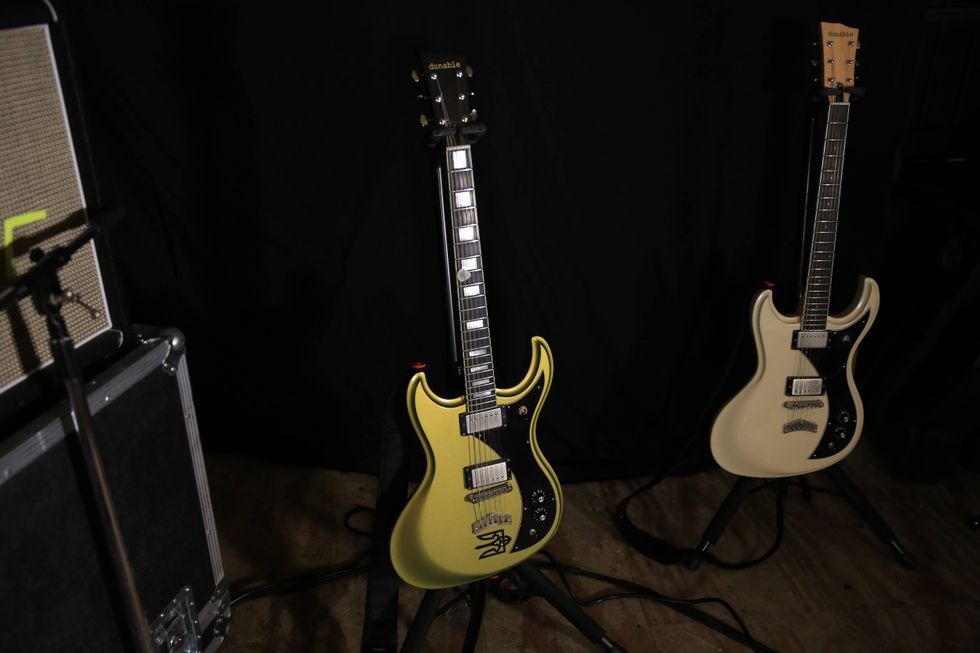
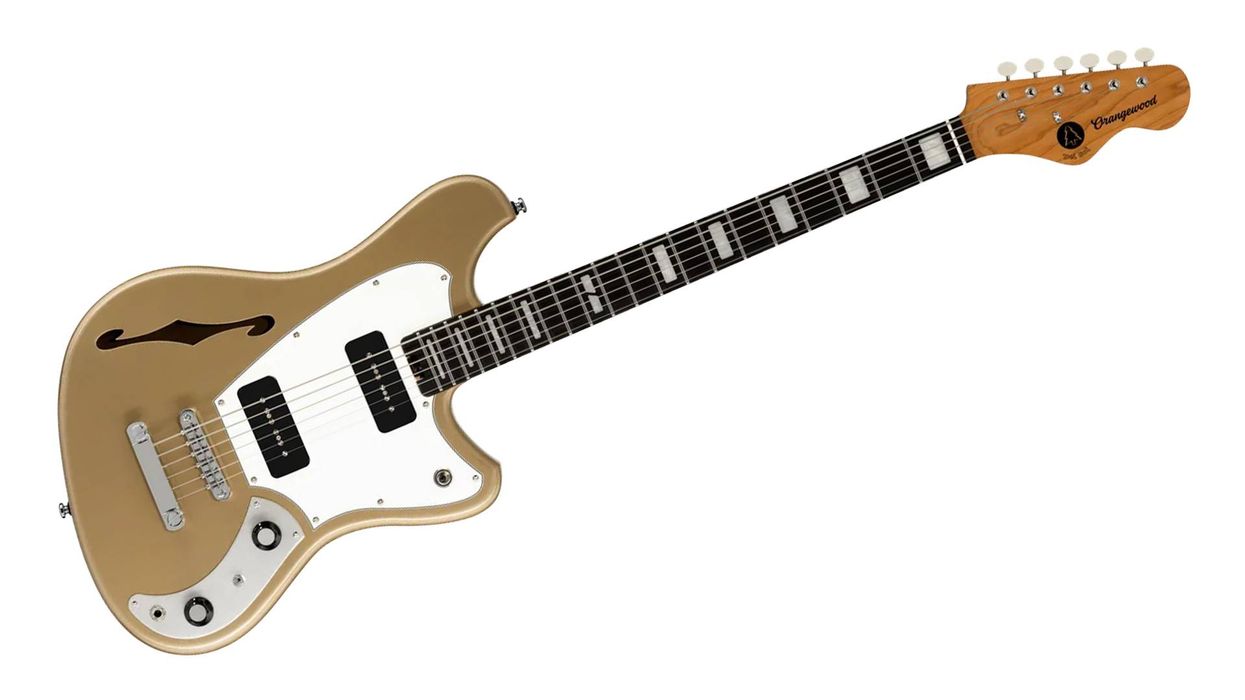
Sullivan has been favoring Dunable guitars of late, borrowing one from tourmate Chelsea Wolfe after his other guitar was nabbed. The green one is based on the Dunable Narwhal, with a more Gibson-like scale—comparable to Sullivan’s old Les Paul. This Narwhal has a mahogany body and neck, maple top, and a coil-tap function for the two humbuckers: a DiMarzio PAF 26th Anniversary and a DiMarzio Joe Duplantier Fortitude signature. Vibrating atop those pickups are D’Addario strings—a set of .011–.056, with the low E swapped for a .058. Sullivan uses a number of different down tunings, all with D-A-D-G-A-D as a starting point.
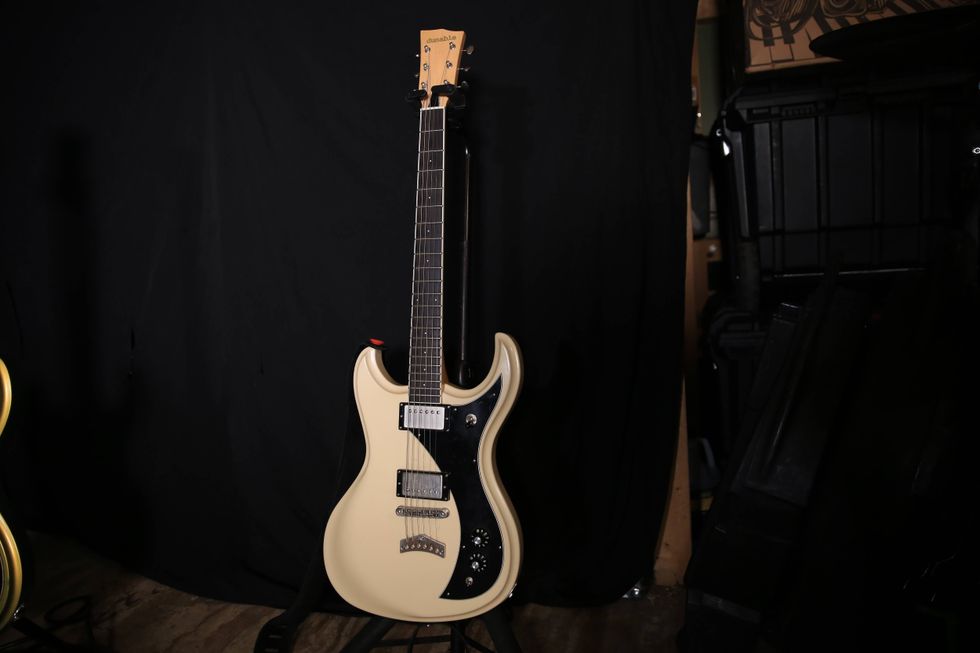
The white Dunable has a maple neck, a 25.5” scale, and is tuned lower, with a .062 for the low E string. It’s used for drop-A tunings, and has the same DiMarzio pickups.
Gettin’ Hi
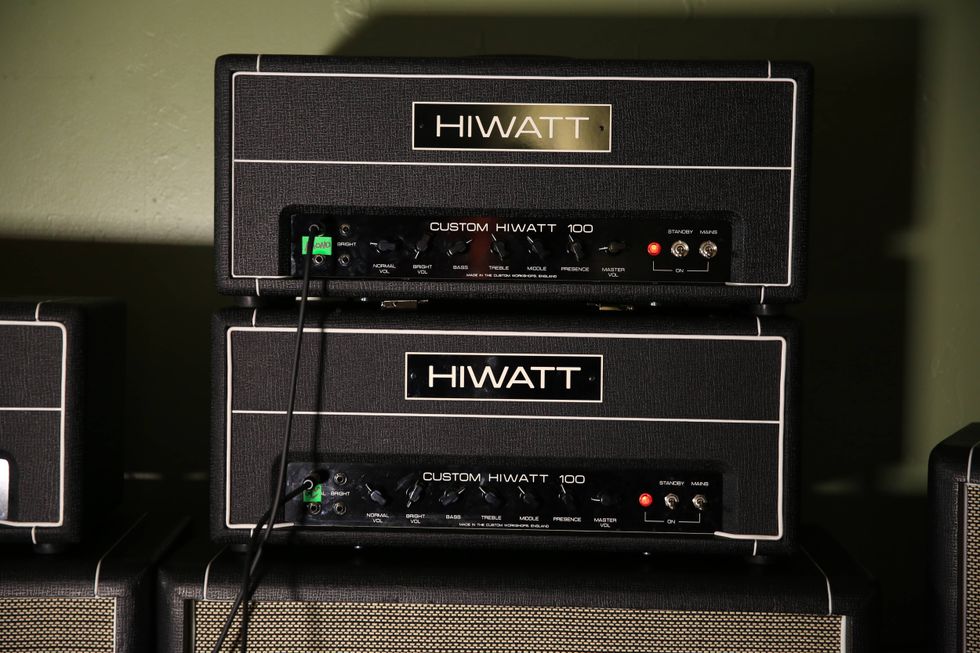
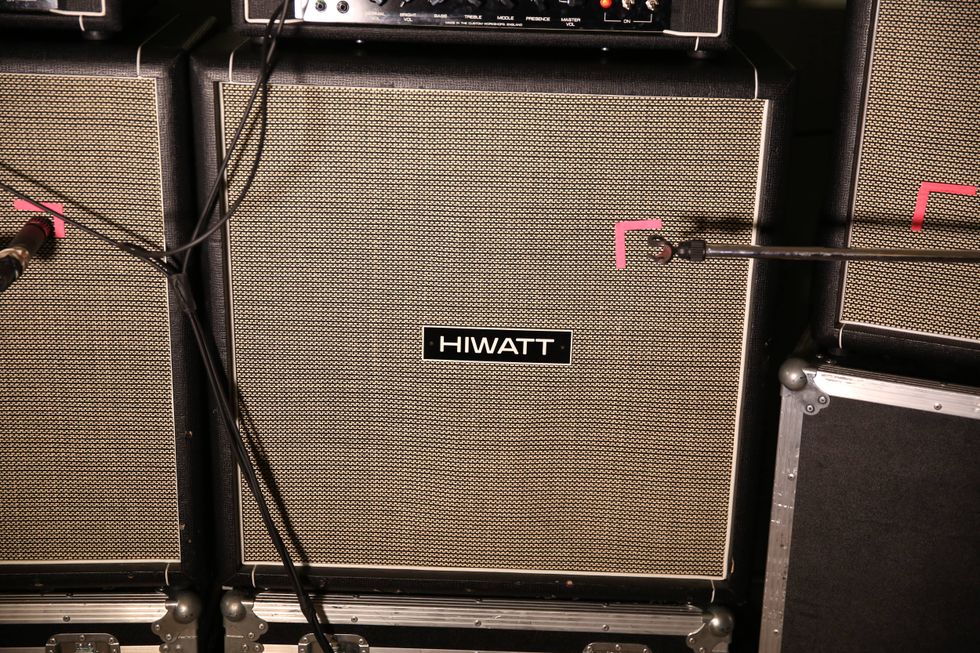
Sullivan was turned onto Hiwatts after acquiring some on loan in the wake of the gear theft, and he hasn’t turned back since. The cabinets are loaded with Hiwatt Octapulse speakers.
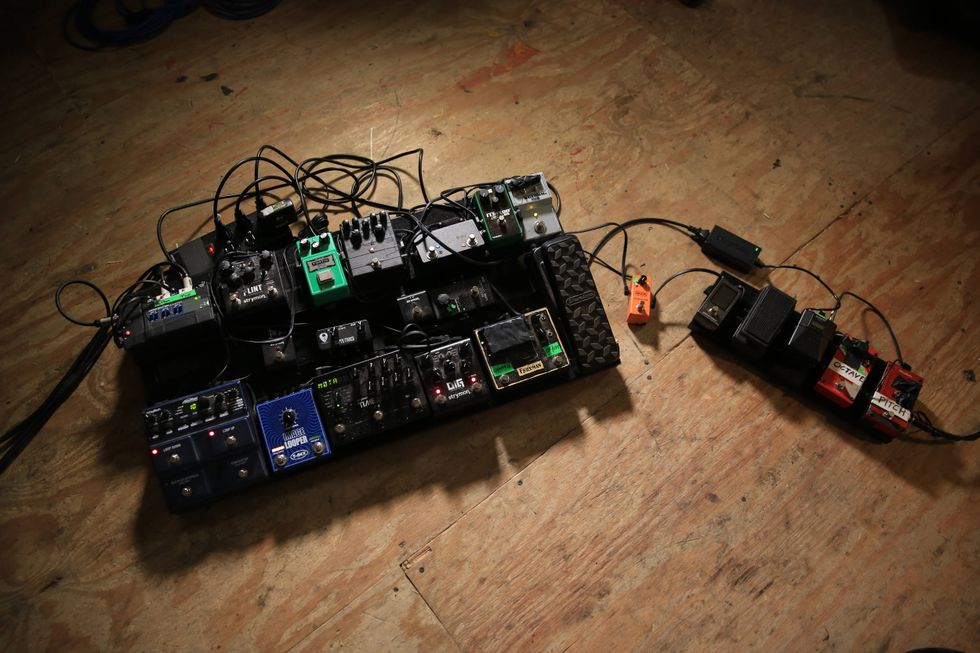
Mike Sullivan’s Pedalboard
Sullivan runs two pedalboards. The first includes a Peterson tuner, Shure P9HW, Dunlop CBM95 Cry Baby Mini, DigiTech Drop and Whammy Ricochet, and MXR Phase 95.
The motherboard carries a Dunlop DVP3 volume pedal, a Friedman BE-OD Deluxe, Strymon Dig, TimeLine, and Flint, a T-Rex Image Looper, DigiTech JamMan Stereo, MXR CAE Boost/Line Driver, Foxrox Octron3, Electric Eye Cannibal Unicorn, Maxon Apex808, Fortin-Modded Ibanez Tube Screamer, and a Radial Shotgun Guitar Splitter and Buffer.
















![Rig Rundown: Russian Circles’ Mike Sullivan [2025]](https://www.premierguitar.com/media-library/youtube.jpg?id=62303631&width=1245&height=700&quality=70&coordinates=0%2C0%2C0%2C0)