

For an effect that has so unmistakably impacted the work of giants, phasers don’t get a fraction of the props accorded to, say, overdrive, fuzz, or delay pedals. Folks seem to either love that swirly texture or loathe it. But the venerable MXR Phase 90’s lack of subtlety didn’t dissuade some of rock’s most important guitarists from using it liberally: David Gilmour used it all over Wish You Were Here. Jimmy Page put his to work on “Achilles Last Stand” and used one regularly onstage. And the Sunset Strip strut of Van Halen’s 1978 debut would’ve been way less feral without the nitrous rush of Eddie’s Phase 90.
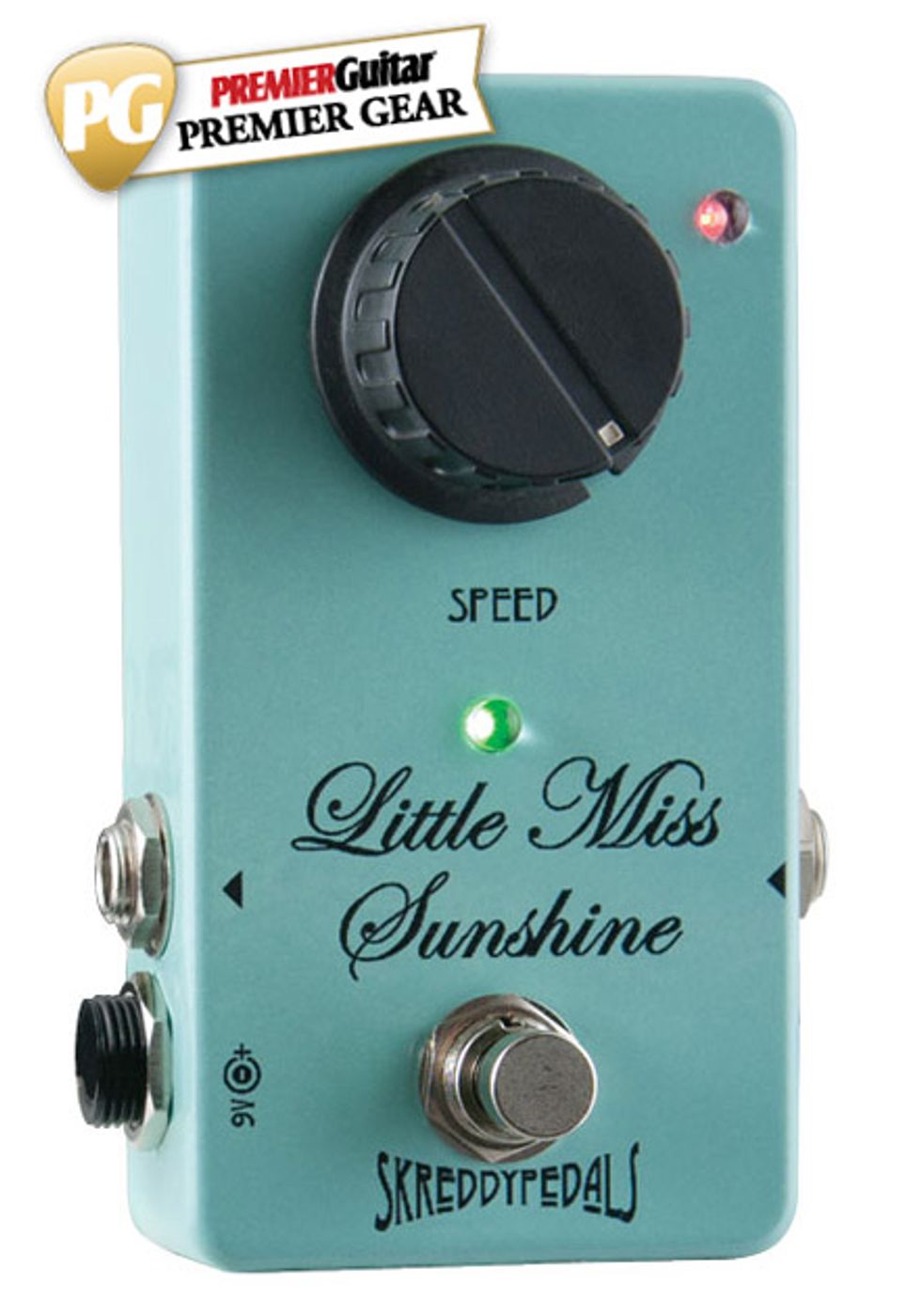
It’s these bold, creamy, hallucinogenically time-warping sonic characteristics of the original “script-logo” Phase 90 that Skreddy Pedals’ Marc Ahlfs had in mind when designing the Little Miss Sunshine. The impressively authentic, deep-swooshing textures of the Sunshine might have limited appeal for players seeking subtle modulation, but they will be ambrosia for players frustrated by anemic phasers. When we say this thing swirls, we mean it swirls—and with a luxurious musicality that we don’t often hear in any modulation unit.
Swirls from the Hills
Skreddy is a low-key, small-batch operation from California’s mellow, sun-baked Sierra Foothills. The company is probably most famous for the Lunar Module, Lunar Module Deluxe (a Fuzz Face-style silicon fuzz/treble booster that bowled over Dark Side of the Moon tone obsessives), and the superbly versatile Screwdriver overdrive. While the latter two incorporated a whopping five knobs, Little Miss Sunshine is much simpler: There’s a footswitch and a single phase-rate control
A peek inside the Little Miss Sunshine reveals profound differences between it and a Phase 90. Most fundamentally, the Skreddy uses an optical circuit with LED lamps that vary in intensity and rate to control the speed of the phase. Watching the lamps work amid the clean and orderly circuitry is a slice of sci-fi nerd heaven—it’s like seeing a B-movie computer calculate asteroid-dodging trajectories. (WARNING: The Little Miss Sunshine only runs on an external power supply, so don't attempt to watch the optical circuit in action unless you know electrical circuits well enough to avoid electrical shock.) But it’s the rich, psychedelic, funky sounds that emerge via the lightshow that are the real pleasure.
Churning Cosmic Butter
One-knob phaser haters are typically put off by the one-dimensionality often inherent in that design approach. But as the Skreddy demonstrates so well, a great one-knob phaser offers a wealth of tones to those who are resourceful with their guitar’s pickup, tone, and volume control settings, as well as how they use other effects to augment the phasing. In that regard, the Little Miss Sunshine is richly responsive—super-high-cholesterol rich. Much of this high-calorie goodness is derived from the lovely, very organic wave tapers created by the optical circuit. Each swell invites nuanced picking, rewards languid phrasing, and transforms simple chord patterns into hooks. Like any great pedal, it’s bound to inspire new songs.
Little Miss Sunshine is quiet and free from real or perceived volume loss when engaged. That means better balance between your guitar’s natural tone and the harmonically squeezed phase signal—which translates to lots of control via guitar volume and tone controls. You can’t entirely escape the Skreddy’s intrinsic intensity and depth, but manipulating a Telecaster’s tone and volume controls, varying pick attack, and switching through the three pickup positions colors chord arpeggios in shades from Revolver-era Beatles and psychedelic Bakersfield twang to archtop-like mellow tones and Curtis Mayfield lullaby zones.
Ratings
Pros:
Boldly diverse phase tones with a rich vintage vibe. Extremely responsive to playing and guitar-setting dynamics.
Cons:
Somewhat pricey.
Tones:

Playability/Ease of Use:
Build/Design:

Value:


Street:
$229
Skreddy Little Miss Sunshine
skreddypedals.com
That capacity for color and range also makes the Skreddy a killer companion for fuzz and overdrive. It has a mellowing affect on both, but remains very alive and reactive. Ernie Isley licks sound delicious and nasty when the Skreddy is paired with a Big Muff. Fuzzy neck-pickup tones and faster phase rates summon sassy, soulful Jimi-with-UniVibe voices. And the Skreddy is equally impressive when mated with harder-to-tame units. A Superfuzz, for instance—explosive and brimming with odd octave overtones—can turn a phaser into a jagged tangle of harmonic spikes. But the Skreddy massaged those harsher tones instead—retaining soft, vocal contours while adding a mind-warping wash to the fuzz. The Sunshine is a great phaser for loopers, too. The range of speeds and tone colors create striking differences between rhythm and lead tracks. And the smooth, clockwork-precise timing of the phase adds impact to phase-timed riffs and vamps.
The Skreddy is excellent for leads and rhythms. Single notes stay defined—especially with a little overdrive out front. Snapping, percussive funk chords lose none of their propulsive force. And few pedals make a chord arpeggio sound as driftingly dreamy as Little Miss Sunshine in a slow phase. Put a long reverb between the Skreddy and the amp, and you can disappear in simple chord arpeggios for weekends at a time.
In general, single-coils sound most defined for both rhythm and lead applications, though the pleasures of a mellow-toned, humbucker-equipped semi-hollow paired with the Skreddy are not to be missed. With a fast, Leslie-like setting, you might even be tempted to fire your Hammond B-3 player.
The VerdictThe elegant Little Miss Sunshine is a joy to behold—doubly so because the simplicity belies a deep sonic character within. It moves from deep, slow space-/time-bending modes to funky Leslie vibes. But its clarity, purity of voice, and dynamic responsiveness exponentially expand those voices. The Skreddy’s only limitation is its inability to radically lower the intensity or depth of the phase. In this way, Little Miss Sunshine is not for the timid. Bold users, however, will find a bottomless well of phase flavor—all on top of a rich basic voice that many conventional phaser fans will also find addictive.


![Rig Rundown: The Black Crowes’ Rich Robinson [2026]](https://www.premierguitar.com/media-library/youtube.jpg?id=66952027&width=1245&height=700&quality=70&coordinates=0%2C0%2C0%2C0)